 By Ayesha Khan
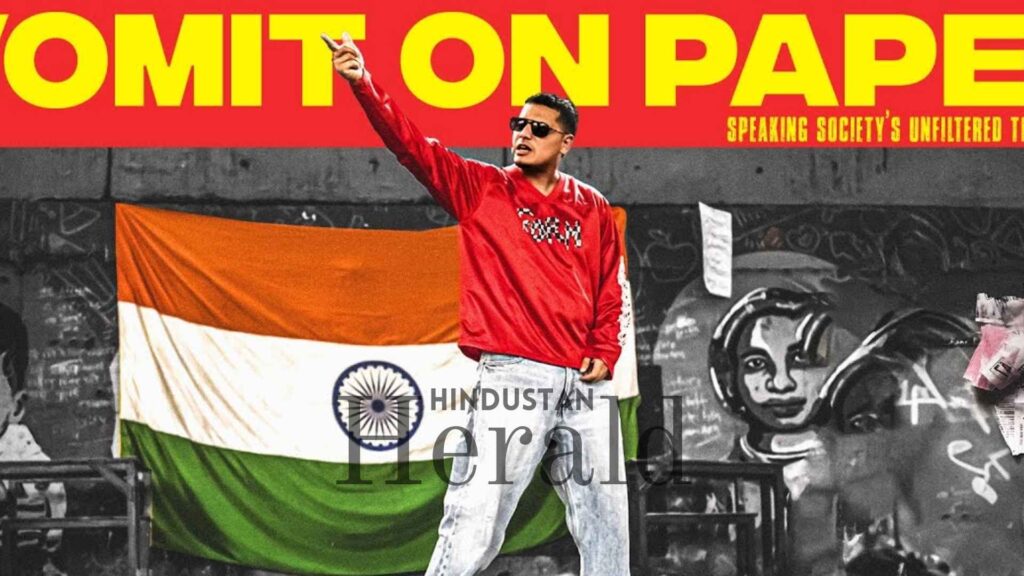
New Delhi, December 10: Dhanda Nyoliwala has never been the kind of artist who trims his edges, and his track “Vomit On Paper” from the album KOHRAM wears that defiance openly. The official video sits on YouTube, drawing steady traffic, while fan uploads and chopped versions keep surfacing in every corner of the platform. Nothing unusual for a Haryanvi rapper whose following thrives on rawness.
But over the past couple of days, something shifted. Listeners began posting frantic clips on Instagram and Threads, insisting the video had “disappeared” from search results unless they disabled YouTube’s Restricted Mode. Some went further, claiming platforms had quietly removed the song for “promoting violence”. Others swore the track had been scrubbed from streaming altogether. None of these claims came from the artist or his label; they came from the churn of social media, loud, emotional, and often contradictory.
What People Think Is Happening
Scroll through the reels long enough, and you’ll see a pattern. Viewers show their own YouTube screens where the search bar returns nothing. Someone records a screen capture, instructing, almost conspiratorially, “turn off Restricted Mode”. A few claim the video was taken down and reuploaded. And then come the fan pages reposting the track in different formats, almost as if guarding it from disappearance.
In community forums dedicated to Indian hip hop, the reaction has been a mix of praise, confusion, and curiosity. Some call the track one of the best of the year. Others dig into the artist’s past, asking for clarity on the allegations mentioned in scattered comments. It all adds up to a familiar digital mood: excitement layered with paranoia, amplified by a song already built on confrontation.
What Actually Shows Up On Platforms
When you check the platforms themselves, the picture grows muddier rather than clearer. The official YouTube upload is still visible. Multiple fan reposts are also up, untouched. Dhanda Nyoliwala’s artist pages on major streaming services continue to list songs without any public notice of restrictions or removals.
This kind of uneven availability is usually a sign that no major takedown has happened. If a platform removes a track for policy violations, the action is typically consistent across copies and formats. Here, nothing suggests such a coordinated move. Instead you find a scattered landscape: one upload playing normally, another buried by algorithms, a third behaving differently depending on the viewer’s account settings.
That said, these platforms are not transparent machines. They filter content in ways users do not always see. A video can be flagged, age-gated, or placed under limited visibility without the kind of formal announcement people now expect. And if a viewer has account-level restrictions enabled, the experience becomes even more unpredictable.
Untangling The “Restricted Mode” Theory
Most of the online panic seems to stem from a misunderstanding of how YouTube’s controls work.
Restricted Mode is something users enable, often by accident, or because a school network or shared device has locked it on. When active, it hides videos flagged as potentially sensitive. A viewer may think a video is missing when, in reality, it is their settings doing the blocking.
Some of the loudest posts complaining of a “ban” show exactly this scenario: search results thinning out, recommended videos going blank, and the track reappearing only after toggling the setting off.

There is also a second possibility: a restriction applied at the upload level by YouTube. That could reduce a video’s visibility without fully removing it. However, the artist has not mentioned receiving such a notice, and no publicly visible age gate appears on the main upload page.
And the most dramatic theory an official takedown or legal order has no evidence behind it. No newsroom has reported one. No regulator has issued a statement. No legal document is circulating.
Why The Issue Has Exploded Anyway
Part of the reason this rumor caught fire is that “Vomit On Paper” already feels like a provocation. It rails against hypocrisy, corrupt systems, and self-styled gurus. It carries a tone that fans describe as an anthem, and critics call aggressive. When a song like that suddenly becomes harder to find for a subset of viewers, the story writes itself.
Another part is simply today’s digital reality. Algorithms bury certain uploads for reasons as small as a thumbnail, a lyric keyword, or a misread content flag. Fans interpret these fluctuations as censorship. The reaction snowballs, and the narrative tightens.

And in the music world, whispers of a ban often do more for a track’s visibility than any official marketing budget. The rumor becomes the hook. Screenshots become evidence. A setting toggle becomes a conspiracy.
What To Watch In The Coming Days
For now, this episode sits at the crossroads of speculation and search-engine behavior. The real clarity will come from three places:
• The artist or label, if they acknowledge receiving any notice.
• YouTube or major streaming services should confirm whether any moderation action was taken.
• Independent reporting, if the matter escalates enough to reach regulators or courts.
Until then, the noise around “Vomit On Paper” tells us more about how music circulates in 2025 than about any secret clampdown. A track can be everywhere and elusive at the same time. A setting buried in a menu can spark a censorship panic. And a song built on rebellion can find itself at the center of a story it never intended to headline.
Stay ahead with Hindustan Herald — bringing you trusted news, sharp analysis, and stories that matter across Politics, Business, Technology, Sports, Entertainment, Lifestyle, and more.
Connect with us on Facebook, Instagram, X (Twitter), LinkedIn, YouTube, and join our Telegram community @hindustanherald for real-time updates.

Covers films, television, streaming, and celebrity culture with a focus on storytelling trends.
- Ayesha Khan

- Ayesha Khan
- Ayesha Khan
- Ayesha Khan