
 By Sandeep Verma
New Delhi, December 7: People in Arpora, especially those who work around the late-night circuit, keep saying the same thing today. It was supposed to be an ordinary Saturday, nothing close to the Goa nightclub fire that would soon shake the village. The kind of night that nudges tourists toward clubs like Birch by Romeo Lane, where the lights run warm and the music settles across the room before midnight really takes hold. But sometime after twelve, something blew in the kitchen. A sharp blast, according to early accounts, and then a dull thud of panic rising across two floors.
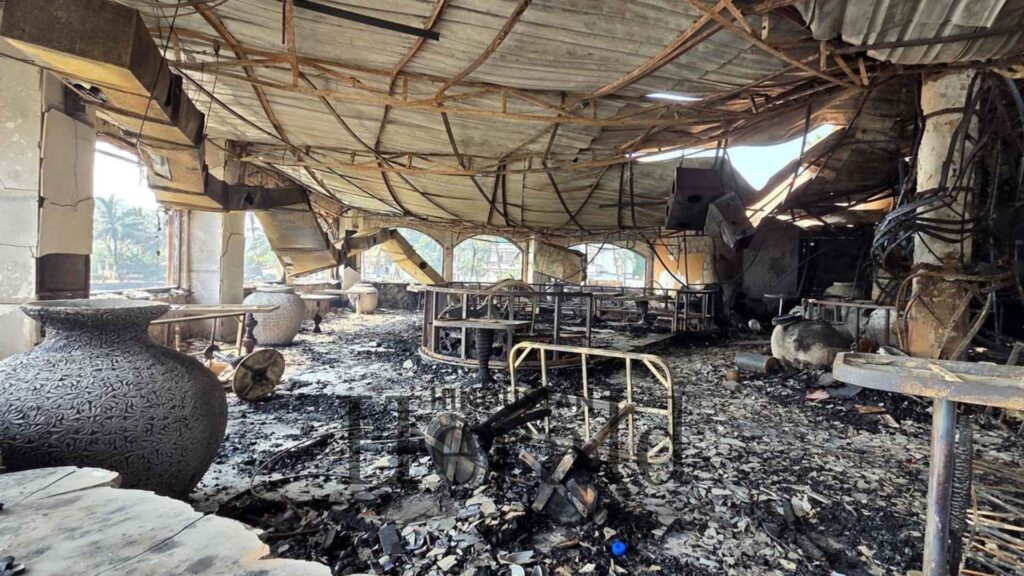
Fire swallowed the place quickly. It moved too fast for a club that should have had more room to breathe. By the time firefighters broke in, 25 people were gone. Most died because they simply could not find a way out.

Reporters on the ground, from NDTV and AP News among others, heard the same story repeated in different words. There were around 100 people inside, many squeezed near the dance floor. When the smoke began rising, plenty ran toward the stairs because the exits were narrow and scattered, or so survivors say. Some ended up in the basement, where the air turned unlivable within minutes.
That part has haunted families. Several of those who died were staff members, young workers trying to hold on to seasonal jobs. Four tourists are among the dead as well. The identities of seven others remain unsettled.
The Fire Took What The Building Offered It
If you look at the photographs and video stills circulating among reporters, one thing jumps out. The decor. The palm leaf structures pasted along the walls and ceiling were beautiful while they lasted. But these were dry, flammable, almost too willing to burn. The Federal has already pointed to this as a major reason the fire spread the way it did.
The exits, as it turns out, were a problem even before the fire. They were narrow, in some places angled awkwardly, and the ventilation was poor. People who rushed down the stairs said they ran into smoke as soon as they turned the corner. That describes a building designed for ambience, not for evacuation.
Then comes the paperwork. Or the lack of it. Several reports, including those compiled on Wikipedia, indicate that the club did not have a valid construction licence. It had even faced demolition notices earlier. Yet it stayed open through the busiest month of the year. Nobody has given a convincing answer to how that happened.
The Administration Moves, But Not Fast Enough For Families
By morning, the Goa government announced a magisterial inquiry. Police arrested the club’s general manager. The owner was nowhere to be found and remains wanted. The Centre has offered two lakh rupees to the families of the dead and fifty thousand rupees to those injured, Mint reported.

Still, people gathered outside hospitals kept asking the same question. Why were there no safety checks strong enough to shut the place down earlier? Some waited all night for updates on relatives who worked as servers or kitchen staff. For many, the official statements sounded distant from the grief that had just arrived without warning.
Opposition parties have now demanded that Chief Minister Pramod Sawant step aside, calling the tragedy symptomatic of deeper administrative failures. The government says the responsibility lies with the management of the club. But the debate is widening because everybody knows this is not the first time a venue in Goa has sidestepped safety norms.
A State Built On Tourism Finds Its Tension Laid Bare
Goa lives on nightlife, hotels, music festivals, and the promise that for a few days, you can forget the rest of the world. That economy allows thousands to earn a living. But it has also stretched villages like Arpora, where narrow internal roads were never designed for booming club traffic and late-night crowds.
As India Today noted, the tragedy has pushed long-ignored issues back into the front seat. Fire safety clearances, proper building permits, crowd limits, and electrical load assessments. These are old conversations in Goa. The problem is that they fade once the season picks up and the tourist numbers climb.
People in nearby homes say they had raised concerns about noise and construction patterns before. They rarely got more than a polite acknowledgement. The fire has turned those quiet complaints into a statewide discussion about how much growth Goa can handle without reinforcing the systems that keep people safe.
Inside Hospitals And Corridors, The Wait For Clarity Feels Endless
By late afternoon, families were still moving between wards, police desks, and waiting rooms, trying to understand what exactly happened inside those last few minutes. Some had spoken to survivors who described crawling under smoke. Others just wanted to know why the workers inside did not have clearer instructions, or whether anyone tried to guide people out.

The inquiry will try to answer that, though these investigations rarely work as quickly as people hope. The arrests may give the appearance of movement, but hardly anyone believes the story is simple. Too many permissions, too many blind spots in the system, too few checks at the right time.
What the fire has already achieved is this. It has cut through Goa’s polished party image and exposed something raw underneath. A reminder that safety is not a decoration to be installed later but something that must exist before the first light flickers on.
For now, the village carries both grief and anger. And the state, which thrives on its open doors and warm nights, is forced to reckon with a tough truth. When rules weaken, tragedies do not wait.
Stay ahead with Hindustan Herald — bringing you trusted news, sharp analysis, and stories that matter across Politics, Business, Technology, Sports, Entertainment, Lifestyle, and more.
Connect with us on Facebook, Instagram, X (Twitter), LinkedIn, YouTube, and join our Telegram community @hindustanherald for real-time updates.

Regional journalist bringing grassroots perspectives and stories from towns and cities across India.
- Sandeep Verma

- Sandeep Verma
- Sandeep Verma
- Sandeep Verma




 Kavita Iyer and Sandeep Verma