 By Ananya Sharma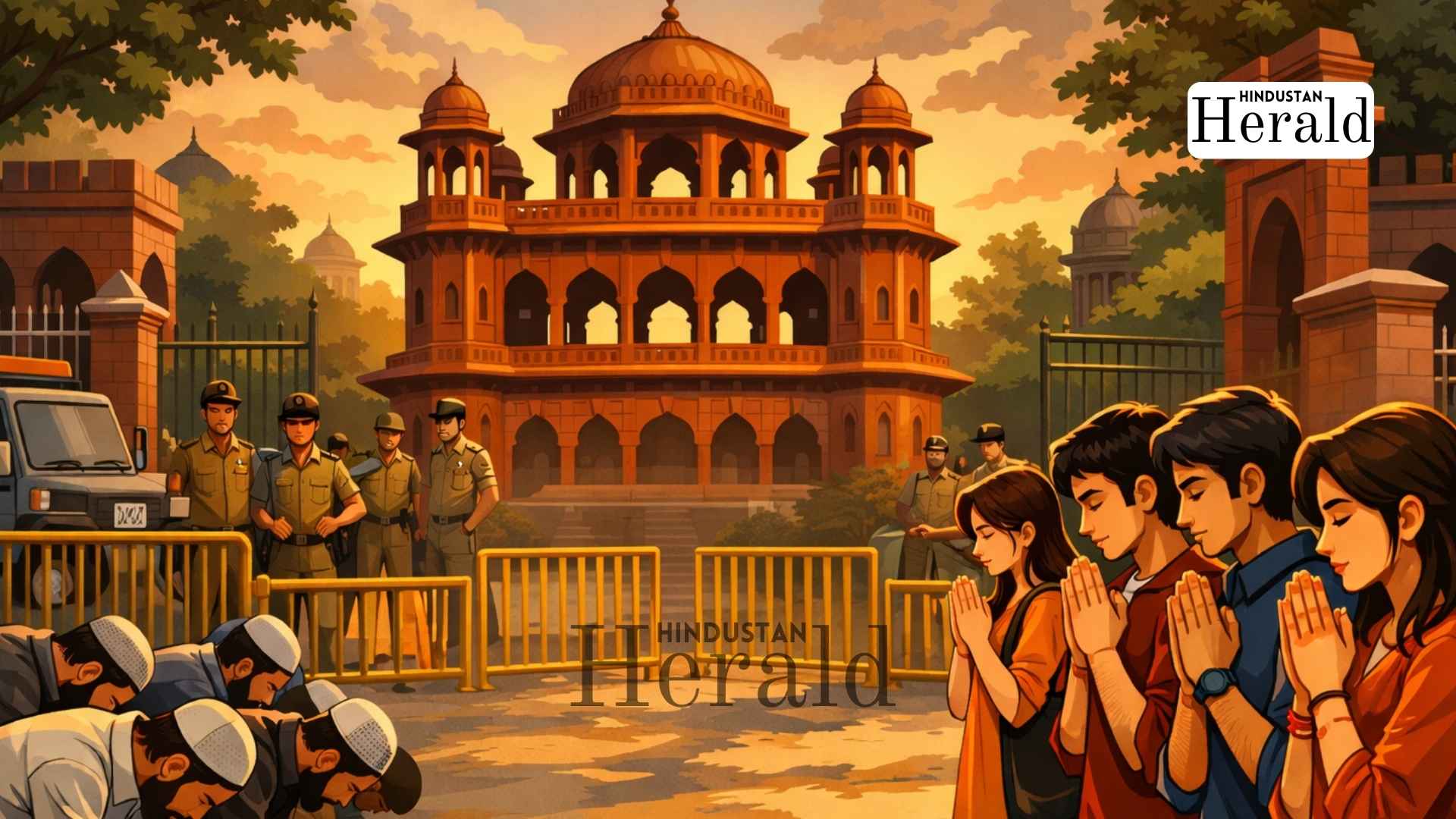
Lucknow, February 24: The first thing you notice at Lucknow University today is not the police. It is the silence. Not complete silence. Classes are running. Autos are dropping students off at the main road. Tea sellers are doing business. But there is a hush around Gate No. 3, the kind that settles in when everyone knows something is off, especially near the locked red façade of the Lal Baradari just beyond the barricades.
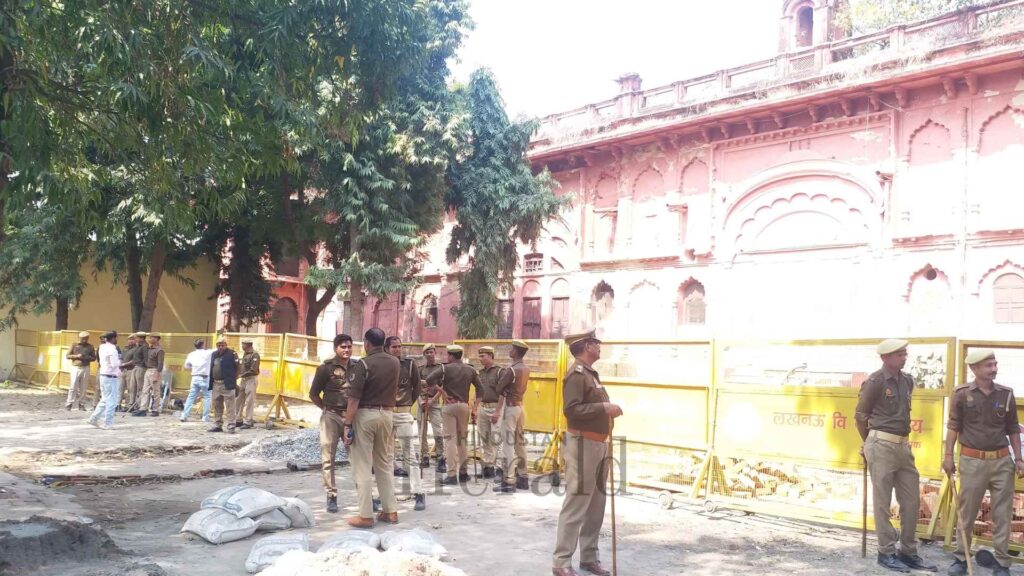
A line of barricades cuts across the entrance. Personnel from the Provincial Armed Constabulary stand in small clusters, some alert, some visibly tired. A police vehicle is parked near the arts block. Students slow down as they pass the sealed stretch that leads to the Lal Baradari.
The old red building has seen two centuries of Lucknow’s history. It has seen royal processions, colonial bureaucracy, campus debates, and, more recently, a bank and a canteen operating within its fading walls. Today, it is locked. And that lock has become the centre of a storm.
How A Lock Sparked A Campus Crisis
University officials say the issue is simple. The building is fragile. A portion of it reportedly weakened recently. Engineers flagged concerns. The administration sealed the gates. Restoration talks are underway with the Archaeological Survey of India.
If the story had ended there, it would have been a footnote in campus maintenance records.
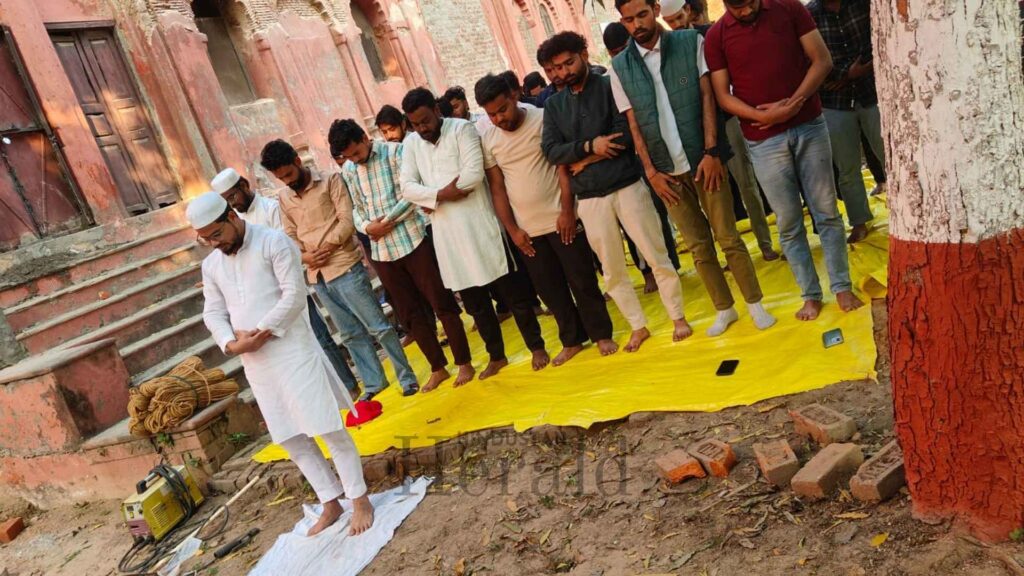
But the sealing happened during Ramadan. For many Muslim students, that timing hit differently. They say that within the Lal Baradari complex, there has long been a mosque space where prayers were offered quietly for years. No loudspeakers. No banners. Just routine.
When access was denied earlier this week, a small group offered Namaz outside the locked gate instead.
That moment changed the tone.
The Pushback And The Police
Soon after, members associated with the Akhil Bharatiya Vidyarthi Parishad, the Vishwa Hindu Parishad, and the Bajrang Dal announced they would recite the Hanuman Chalisa at the same spot.
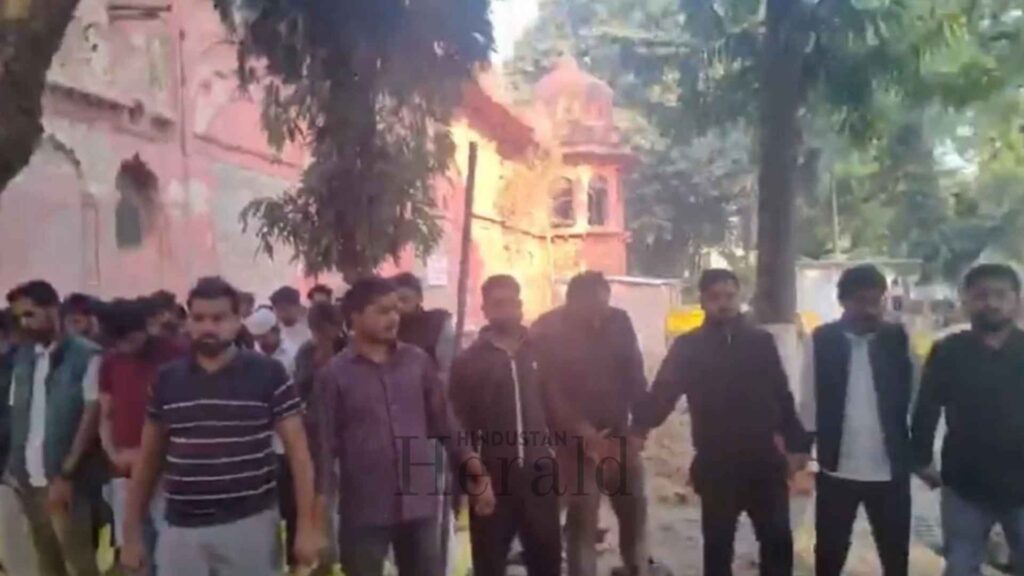
On Tuesday, they attempted to enter. Police stopped them before they could reach the inner grounds. Some were detained briefly. Officers described it as a preventive step to avoid confrontation.
Students describe it differently.
“It feels like everything is being watched,” said a second-year undergraduate standing near the barricade. “We came here to study. Now every day feels political.”
The argument from right-wing groups is direct. A university, they say, is not a religious space. If one group prays, others will demand the same right. Better to allow none.
Muslim student groups say they were not asking for something new. They were continuing what they call a long-standing practice. For them, the issue is not about expanding religious presence. It is about being stopped suddenly, and during a holy month.
The two positions are not meeting halfway.
The Video That Touched A Nerve
On Sunday night, a short video spread across social media platforms. It showed Hindu students forming a human chain while Muslim classmates offered prayers outside the sealed gate.
No slogans. No pushing. Just students standing shoulder to shoulder.
The clip was widely shared as a symbol of Ganga-Jamuni tehzeeb, the shared cultural identity that Lucknow often takes pride in. Alumni praised the students. Some called it a reminder that harmony is still possible.
Inside the campus, reactions were mixed.
The administration called the gathering unauthorised. Rival groups questioned why rules were being bent. The same video that many saw as hopeful became, for others, proof that discipline had slipped.
Symbolism travels fast. Context moves more slowly.
Legal Notices Add Pressure
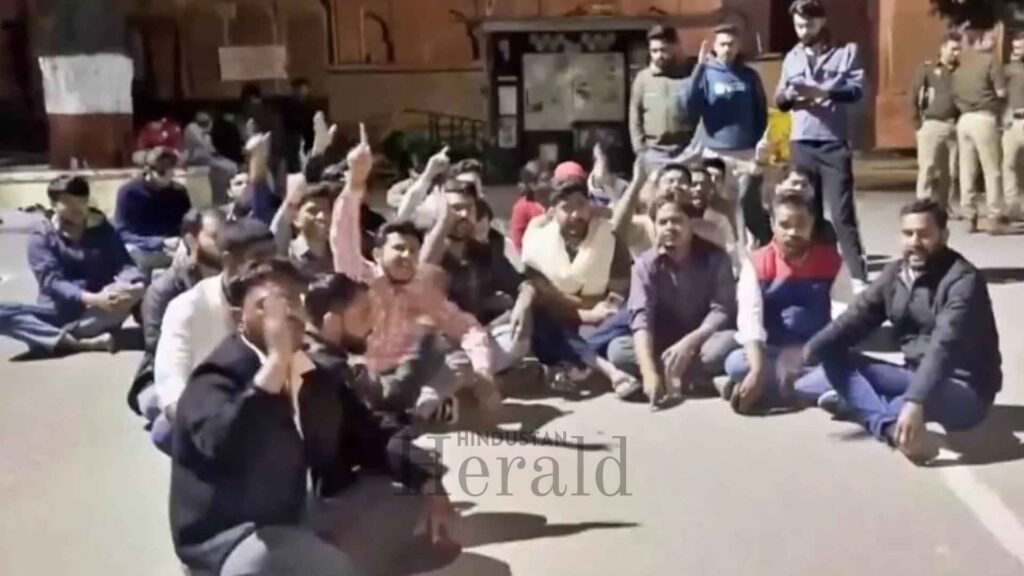
As tensions rose, the Executive Magistrate issued notices to 13 students linked to organisations such as NSUI, Students’ Collective for Socialism, and AISA. They have been ordered to submit personal bonds of ₹50,000 each, along with two sureties of the same amount, committing to maintain peace for a year.
For families already managing tuition and hostel fees, that figure is not small.
Those named insist they were part of a peaceful activity. University officials maintain the move is preventive, meant to stop escalation before it begins.
Either way, the notices have added anxiety to an already strained atmosphere.
More Than Just A Building
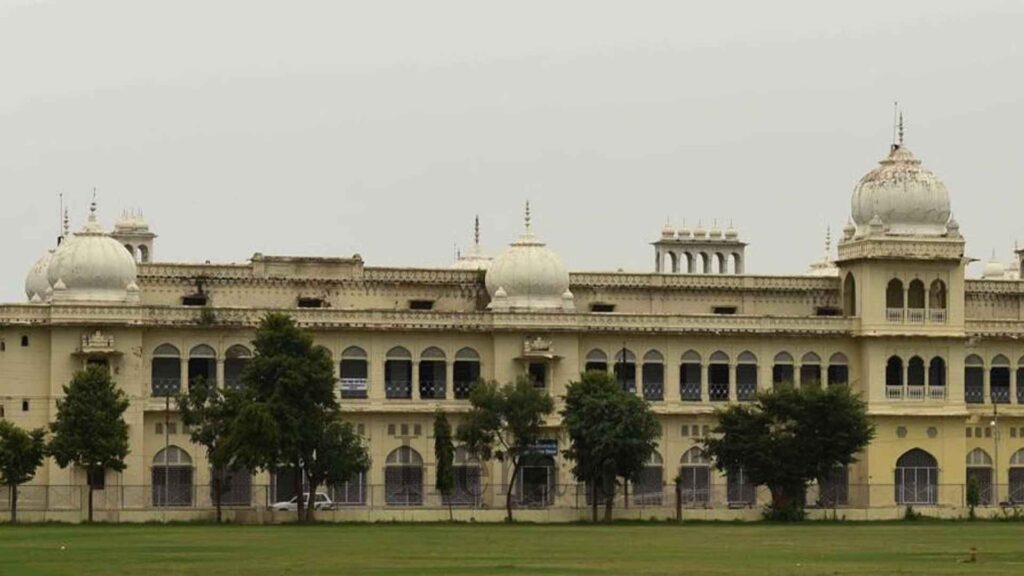
The Lal Baradari itself stands weathered but dignified. Built between 1814 and 1820 under the Nawabs of Awadh, it is part of the city’s architectural memory. Its red walls are cracked in places. Paint has peeled. The corridors echo when you walk through them.
Years ago, a bank branch functioned inside. A canteen operated nearby. Both were relocated when structural concerns emerged.
The administration says the building is a heritage structure, not a designated religious site. That legal detail matters to them.
Students challenging the closure argue that history is not always defined by paperwork. If prayers happened there for decades without objection, they ask, does that history count for nothing?
This is where the conversation becomes complicated. Safety versus sentiment. Law versus lived experience.
A City Watching Closely
Lucknow has long been described as a city of layered identities. The phrase Ganga-Jamuni tehzeeb is often invoked with pride. Shared festivals, shared food, shared language.
That is why the human chain video resonated so strongly. It fit the story people like to tell about this city.
But Lucknow is also the capital of Uttar Pradesh. Politics is never far away. What happens inside Lucknow University can quickly become a talking point outside it.
For now, a heavy police presence remains. There have been no reports of serious violence. Classes continue, though attendance near the arts block appears thinner.
Students gather in small circles, talking in low voices. Some worry about exams being disrupted. Others worry about their names appearing in news reports.
What Happens Next
University authorities say restoration discussions will continue. Student groups are demanding dialogue. Police are maintaining watch.
Nobody is claiming victory. Nobody seems satisfied.
What began as a locked gate has opened up larger questions. How should public universities handle spaces that carry religious memory? Is neutrality possible when history itself is layered? Can administrative decisions be separated from perception?
For now, the red doors of the Lal Baradari remain shut. Barricades stand firm. Police remain on duty.
And inside the campus, amid lectures and lab sessions, a sense lingers that something fragile is being tested. Not just an old building. But trust.
Stay ahead with Hindustan Herald — bringing you trusted news, sharp analysis, and stories that matter across Politics, Business, Technology, Sports, Entertainment, Lifestyle, and more.
Connect with us on Facebook, Instagram, X (Twitter), LinkedIn, YouTube, and join our Telegram community @hindustanherald for real-time updates.

Covers Indian politics, governance, and policy developments with over a decade of experience in political reporting.
- Ananya Sharma

- Ananya Sharma
- Ananya Sharma
- Ananya Sharma