
 By Ananya Sharma
New Delhi, February 25: For years, red mud sat in the margins of environmental reporting. A technical term buried in regulatory filings. A problem that surfaced briefly after a spill, then retreated behind factory walls and bureaucratic paperwork. This week, it exploded into the mainstream.

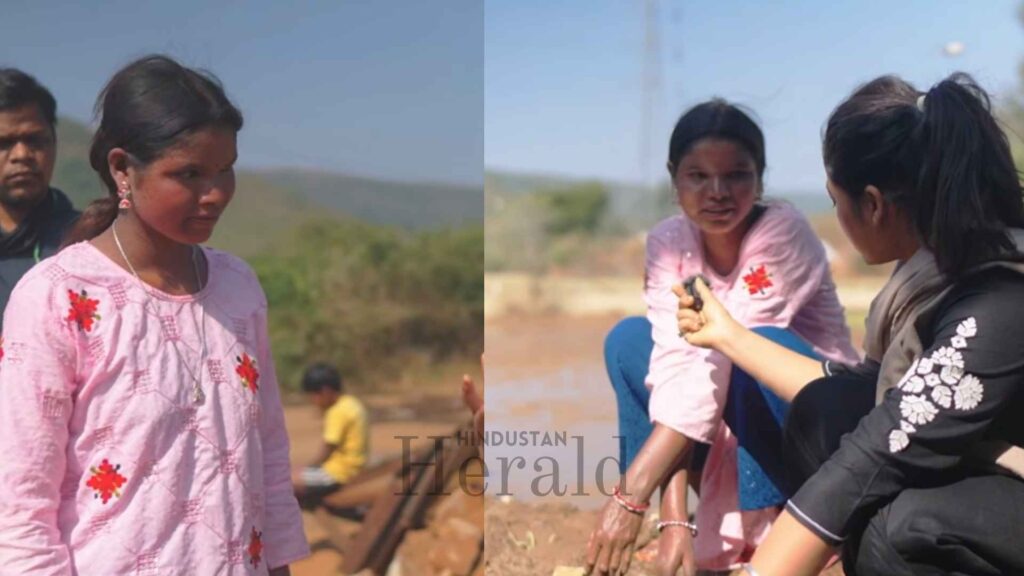
The documentary Red Mud Pond is now everywhere. Clips are ricocheting across Instagram, Telegram channels, and student WhatsApp groups. Drone shots of vast crimson reservoirs. Villagers standing ankle-deep in rust-colored sludge. A woman holding up a jar of cloudy water and asking a question no one seems ready to answer.
At the center of it all is filmmaker and activist Archana Tiwari, whose name has been trending alongside the hashtag #RedMudCrisis. Her style is direct, occasionally confrontational. She films inside villages, near plant boundaries, sometimes arguing with officials on camera. Supporters call it fearless reporting. Critics call it theatre.
Somewhere between those two claims lies the truth.
What The Film Shows
The documentary focuses on the waste left behind after refining bauxite ore into alumina. The residue, known as bauxite residue or red mud, is highly alkaline. Experts have long documented that its pH can exceed 11. Touch it without protection, and you risk chemical burns. Let it seep into the groundwater, and the damage compounds quietly.

India, one of the world’s major aluminum producers, generates millions of tonnes of this waste annually. Most of it is stored in large containment areas often referred to as red mud ponds. These are not small pits. They are industrial-scale reservoirs, sometimes stretching across hundreds of acres, held back by engineered embankments.
In the film, Tiwari’s camera lingers on those embankments. Cracks in dry soil. Rainwater pools after a storm. Farmers describing crop loss. A fisherman speaking about declining catch. The documentary does not always separate allegation from verified contamination data with clinical precision. But it captures something else: anxiety.
And anxiety spreads faster than footnotes.
The Legal Pushback And The Backfire
Unconfirmed reports circulating on Tuesday suggested that a legal notice seeking to halt the distribution of the film had been issued in certain regions. No official confirmation had emerged by the time of publication. Still, the mere suggestion of a cease and desist order was enough.
Downloads spiked. Mirror links multiplied. Encrypted channels began circulating full copies. Media scholars call it the Streisand Effect. Try to suppress something and you guarantee it travels further.
If that was the intention, it misfired.
Industry representatives, speaking in statements shared online, argue that the film paints with too broad a brush. They point out that many facilities have shifted toward improved storage systems, including dry stacking methods designed to reduce the risk of leakage. They say regulatory compliance is monitored by state pollution control boards and the Ministry of Environment, Forest, and Climate Change.
Those claims are not new. Neither are the counterarguments.
A Problem With History
Red mud disasters are not hypothetical. The 2010 spill in Hungary, which released a massive wave of toxic sludge into nearby villages and rivers, remains one of Europe’s worst industrial accidents. Images from that catastrophe still circulate in environmental circles.

India has not experienced a disaster on that scale. But smaller incidents and allegations have surfaced over the years in mineral-rich belts. Reports in regional publications have periodically raised questions about water contamination and embankment safety. Investigations have followed. So have denials.
What makes this moment different is visibility.
Until recently, red mud ponds were physically and psychologically distant from urban India. Out of sight, out of mind. Now, high-resolution drone footage has collapsed that distance. A college student in Delhi can see what a containment dam looks like after heavy rain in a coastal district hundreds of kilometers away.

That visual immediacy changes the conversation.
The Economics No One Can Ignore
Here is the complication. Aluminum is not a villainous product. It sits inside India’s renewable energy push, its electric vehicle ambitions, and its infrastructure expansion. Solar frames, transmission lines, and lightweight auto parts. The metal is central to the country’s development story.
Scaling down production is not a simple option. But neither is ignoring waste.
The refining process relies on the Bayer method, which inevitably produces red mud. Globally, researchers have experimented with ways to reuse the residue in cement, bricks, and even rare earth recovery. Some Indian producers have announced pilot projects. Utilization rates, however, remain uneven.
The Gen Z campaign, now gathering steam under the slogan Zero-Waste Aluminum, demands far more aggressive adoption of such technologies. On campuses, screenings of the film have turned into town hall discussions. Engineering students are debating circular economy models. Law students are reading environmental compliance clauses.
It is messy. It is loud. It is not going away this week.
Archana Tiwari’s Uncomfortable Spotlight

For Tiwari, the sudden attention is double-edged. Environmental groups have framed her as a whistleblower figure. Industry voices question her methods and accuse the documentary of lacking balance. Online commentary, as always, swings between adulation and hostility.
What the film undeniably does is humanize an industrial byproduct. Red mud stops being a statistic and becomes a backdrop to someone’s home.
Still, documentaries are not court judgments. They are narrative constructions. The responsibility now shifts partly to regulators and independent scientists. If contamination claims are exaggerated, transparency can defuse panic. If risks are understated, stronger oversight becomes urgent.
Silence, in this climate, convinces no one.
Climate, Rainfall, And Risk
There is another layer to the timing. Extreme rainfall events have grown more frequent in several parts of India. Older containment systems designed decades ago may not have accounted for shifting climate patterns. Engineers will argue that safety margins exist. Activists will argue that those margins are too thin.
Both perspectives deserve scrutiny.
Tailings dam failures worldwide have often been traced not to one catastrophic oversight but to gradual neglect. Monitoring lapses. Deferred maintenance. Assumptions that tomorrow’s rain will resemble yesterday’s.
In that sense, the debate triggered by Red Mud Pond is less about one facility and more about systemic resilience.
What Happens Next
Policymakers are now under visible pressure to respond. That could mean public safety audits. It could mean mandated disclosure of red mud utilization rates. It could mean nothing more than a statement reiterating existing safeguards.
Public attention is fickle. But industrial waste has a way of lingering long after hashtags fade.
The real test will be whether this moment produces structural reform or simply another cycle of outrage.
For now, one thing is certain. A waste product most Indians had never heard of a month ago is now part of dinner table conversation. That shift alone tells you something about the power of images and the fragility of public trust.
Red mud was always there. This week, people are finally looking at it.
Stay ahead with Hindustan Herald — bringing you trusted news, sharp analysis, and stories that matter across Politics, Business, Technology, Sports, Entertainment, Lifestyle, and more.
Connect with us on Facebook, Instagram, X (Twitter), LinkedIn, YouTube, and join our Telegram community @hindustanherald for real-time updates.

Covers Indian politics, governance, and policy developments with over a decade of experience in political reporting.
- Ananya Sharma

- Ananya Sharma
- Ananya Sharma
- Ananya Sharma




 Herald Desk
  Sandeep Verma