
 By Kavita Iyer and Ananya Sharma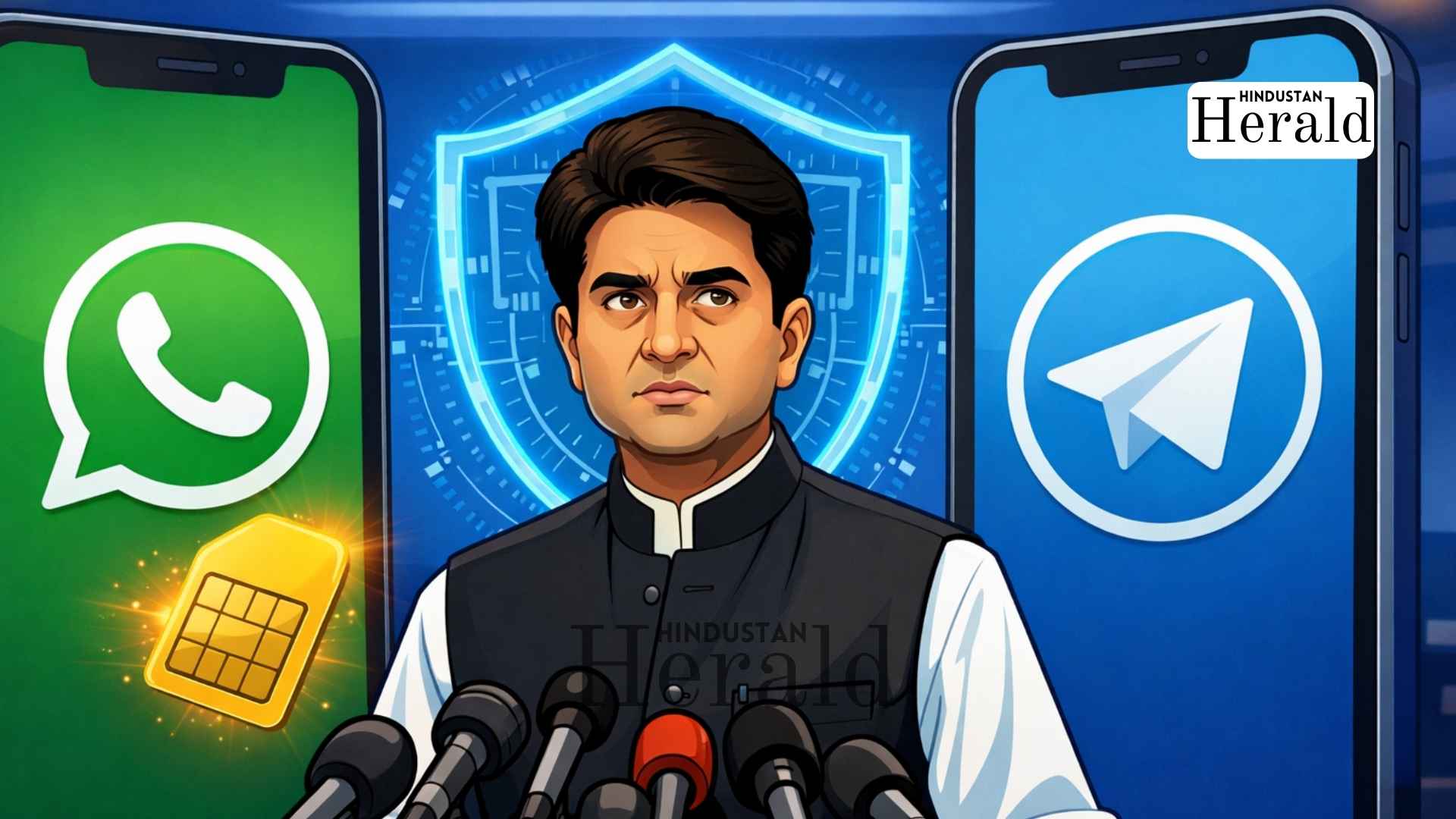
New Delhi, February 25: The message from Union Communications Minister Jyotiraditya Scindia on Tuesday afternoon was not dressed up in diplomatic language. It was direct, almost blunt. The government, he said, will not extend the deadline for enforcing the new SIM binding rules for messaging platforms. Not by a week. Not by a day.

In an interaction reported by Hindustan Times, Scindia made it clear that arguments about compliance costs or advertising revenue were secondary. National security, he insisted, is not a negotiable variable.
The deadline clock, first set ticking in late 2025, will run its course.
A Security Push That Is Not Slowing Down
The rules, notified by the Department of Telecommunications, require over-the-top messaging platforms such as WhatsApp, Telegram, and Signal to ensure their services function only when the registered SIM card is physically present and active in the user’s phone. If the SIM is removed, deactivated, or swapped out, the app must stop working.
The second pillar of the policy has attracted almost as much attention. Any web or desktop session linked to these apps must automatically log out every six hours. Users will have to scan a QR code again to regain access.
Scindia reportedly told reporters there is “no thought of relaxing” this requirement.
The government’s reasoning is straightforward, at least on paper. According to reporting by The Economic Times, investigators have struggled with cases where fraudsters remove SIM cards after verification but continue to operate messaging accounts through linked devices. The digital trail goes cold. Accounts remain active. Law enforcement is left chasing shadows.
Binding the app to the SIM, the government argues, binds the identity to the platform.
That said, the simplicity of the explanation does not fully capture the scale of what is being attempted.
The Backdrop Of “Digital Arrests” and Cross-Border Fraud
Over the past two years, India has witnessed a surge in what officials have described as “digital arrest” scams. Victims receive calls from individuals posing as police officers or investigative agencies. They are told they are under investigation and must transfer money immediately to avoid legal consequences. The intimidation is real enough. The money vanishes quickly.

Many of these operations, according to multiple investigative reports, originate outside India’s borders. Messaging apps become conduits for intimidation, coordination, and fund transfers.
Scindia’s argument, as quoted in media coverage, is that such crimes thrive precisely because there is no tight technological tether between a telecom identity and an app identity. Remove the SIM, keep the account running, and the accountability dissolves.
The new rules are meant to close that loophole.
Still, critics argue that fraudsters are often several steps ahead of regulators. A six-hour logout may slow them down, but will it stop organized networks? That question remains open.
Industry Anxiety Is Real
Behind the scenes, industry bodies have been lobbying for more time. According to LiveMint, technology companies have raised concerns about the feasibility of continuous SIM verification, especially on devices where operating system restrictions limit how apps can monitor SIM presence.

There are practical issues. Dual SIM phones are common in India. eSIM adoption is rising. Users frequently travel abroad and swap local SIMs temporarily. What happens then? Will messaging apps go dark until the original SIM is reinserted?
Companies have reportedly warned that such friction could frustrate users and disrupt business communications. For small enterprises that rely heavily on WhatsApp Web for customer engagement, six hour logouts could translate into operational inefficiencies.
Scindia’s position, however, appears unmoved. Security, he has maintained, outweighs inconvenience.
In regulatory language, that may sound straightforward. In lived reality, it may be messier.
What Changes For Ordinary Users
For millions of Indians, the impact will not be abstract.
If you remove the SIM registered with your messaging account, the app will stop functioning. Not partially. Not with limited features. Completely.
If you use WhatsApp or Telegram on a desktop at work, expect to scan that QR code several times a day. The automatic logout every six hours is mandatory.
There is also a parallel rollout of Calling Name Presentation, or CNAP, which will display the KYC verified name associated with a SIM when you receive a call. The government believes this will reduce spoofing and impersonation.
On paper, these steps create a tighter, more accountable digital environment.
In practice, they also shift how seamlessly Indians have grown accustomed to using communication apps.
India is the world’s largest market for WhatsApp. For many, it is not just a messaging app but a business platform, a payment interface, a family bulletin board, and a crisis hotline rolled into one. Any structural change to its functioning carries social and economic weight.
The Legal And Regulatory Question
There is also a quieter debate unfolding about jurisdiction.
Messaging platforms have historically argued that they are not telecom operators. They operate over the internet, not licensed spectrum. Bringing them under telecom-style cybersecurity mandates marks a subtle but significant shift.
As reported by The Economic Times, some legal experts have questioned whether the Department of Telecommunications’ framework stretches beyond its traditional remit. Others counter that the evolving nature of digital communication requires regulatory evolution.
The government’s posture suggests it is prepared for that debate.
Officials have pointed to compliance norms already standard in banking and financial technology sectors. SIM binding is routine for mobile banking apps. Why should messaging platforms be different, they ask, when they are increasingly used for financial coordination and sensitive exchanges?
The comparison is not perfect. Banks deal directly with money. Messaging platforms deal with conversations. Yet the lines between the two are increasingly blurred.
Privacy Concerns Linger
Civil liberties advocates have expressed caution. Continuous SIM verification implies deeper integration between telecom data and application-level activity. While the government frames it as a technical safeguard, privacy groups worry about potential overreach or unintended vulnerabilities.
What data will be stored? How frequently will verification occur? Will there be audit transparency?
So far, public communication has focused more on fraud prevention than on data governance specifics.
That absence of granular detail fuels skepticism in some quarters.
The Broader Digital Policy Trajectory
This move does not exist in isolation. It sits within a broader arc of India’s digital policy evolution. From stricter intermediary guidelines to data protection legislation, the state has steadily expanded oversight over digital platforms.
Supporters argue that India, with its scale and diversity, cannot afford a laissez-faire approach to digital risk. Critics worry about the creeping centralization of control.
Scindia’s statement on February 25 signals that the current government is firmly in the first camp.
For now, compliance is the only path forward for platforms operating in India. The 90-day window is closing. The message from the top is that there will be no last-minute reprieve.
A Transition Moment
There is often a gap between policy announcement and ground reality. Technical updates must be coded, tested, and deployed across millions of devices. Customer support systems will need to handle confusion and complaints. Businesses will adjust workflows.
Some friction is inevitable.
Yet the political calculus appears clear. After a wave of high-profile fraud cases, the government likely sees visible action as both necessary and urgent.
Whether the SIM binding regime meaningfully dents organized cybercrime will only become clear over time.
For now, India’s digital ecosystem stands on the cusp of a structural shift. Messaging apps that once operated with relative independence from telecom infrastructure are being pulled closer to it.
And as Scindia underscored, the priority, at least from the government’s perspective, is unambiguous. Security first. Revenue later.
Stay ahead with Hindustan Herald — bringing you trusted news, sharp analysis, and stories that matter across Politics, Business, Technology, Sports, Entertainment, Lifestyle, and more.
Connect with us on Facebook, Instagram, X (Twitter), LinkedIn, YouTube, and join our Telegram community @hindustanherald for real-time updates.

Former financial consultant turned journalist, reporting on markets, industry trends, and economic policy.
- Kavita Iyerhttps://hindustanherald.in/authors/kavita/

- Kavita Iyerhttps://hindustanherald.in/authors/kavita/
- Kavita Iyerhttps://hindustanherald.in/authors/kavita/
- Kavita Iyerhttps://hindustanherald.in/authors/kavita/





Covers Indian politics, governance, and policy developments with over a decade of experience in political reporting.
- Ananya Sharmahttps://hindustanherald.in/authors/ananya/
- Ananya Sharmahttps://hindustanherald.in/authors/ananya/
- Ananya Sharmahttps://hindustanherald.in/authors/ananya/
- Ananya Sharmahttps://hindustanherald.in/authors/ananya/




 Ananya Sharma