
 By Prakash Nair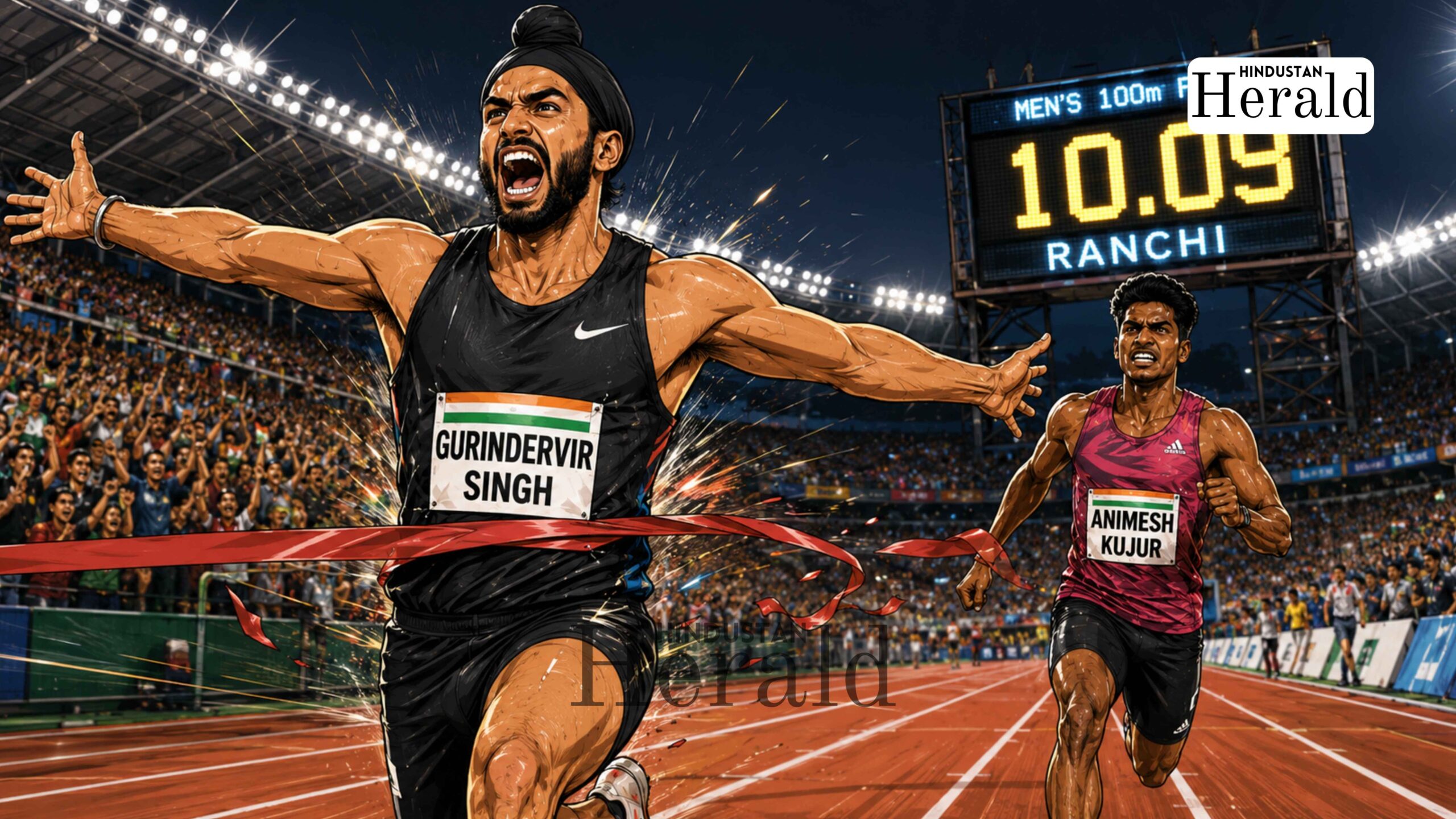
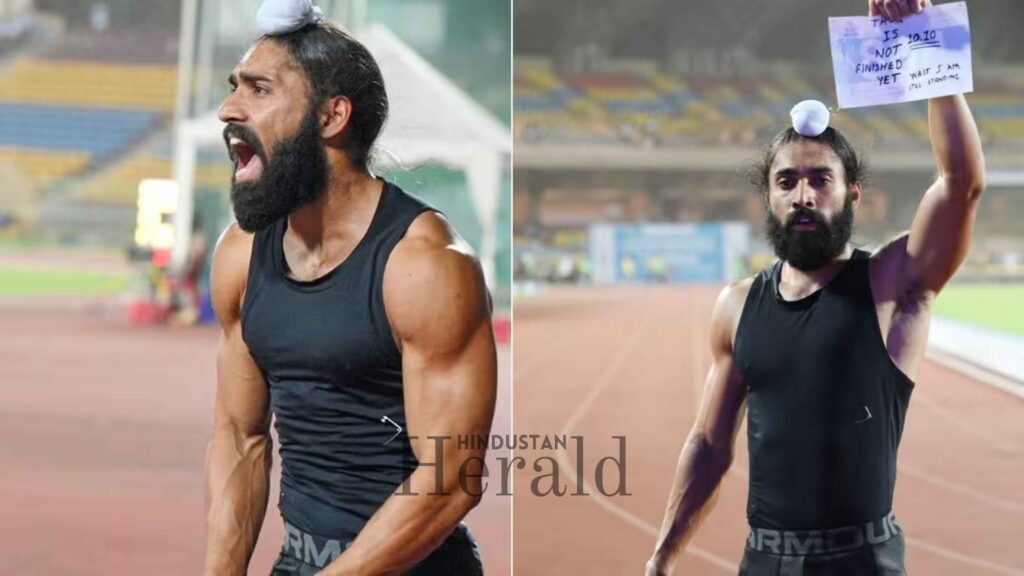
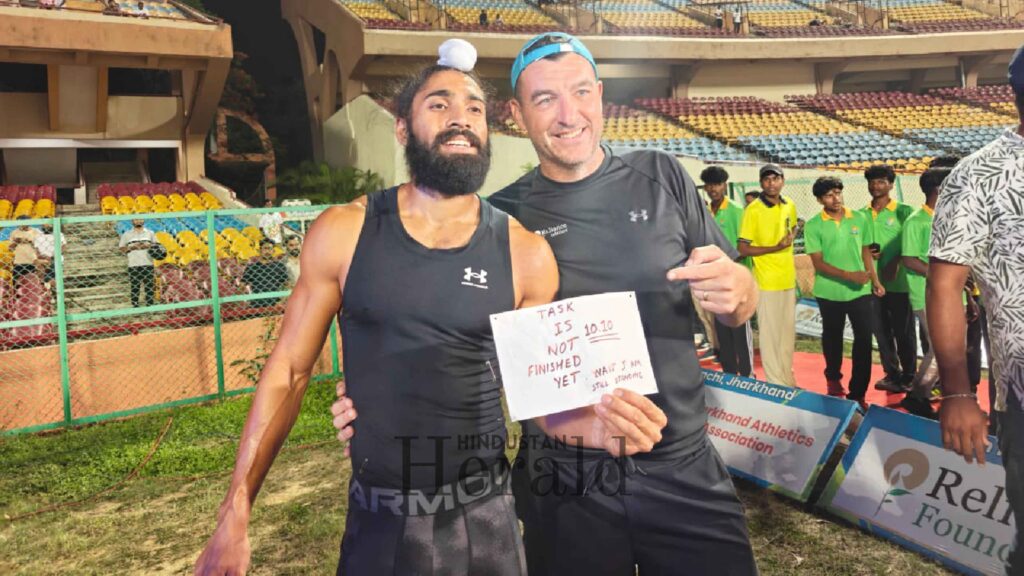
Ranchi, May 24: Gurindervir Singh stood at the finish line for a moment longer than he needed to. Maybe he was catching his breath. Maybe he was just letting it sink in. Either way, the scoreboard at Birsa Munda Stadium was not lying. 10.09 seconds. A number nobody from this country had ever produced before.
The 29th National Senior Athletics Federation Competition had just handed Indian sprinting its greatest individual moment. And it had done it in the most dramatic way possible.
It Started the Night Before
You cannot tell Saturday’s story without Friday.
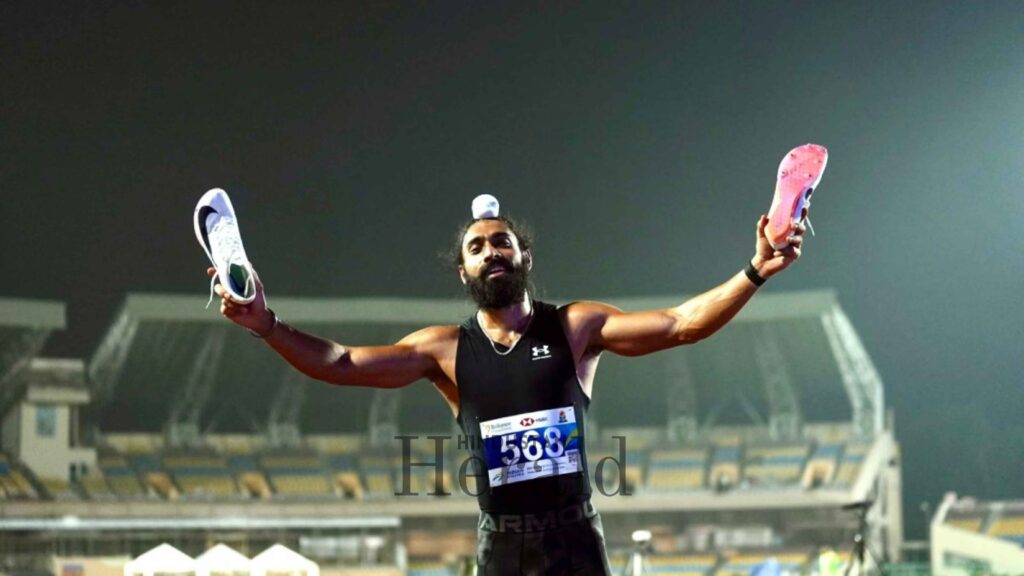
Gurindervir came into this meet without the national record. He had held it before, but Animesh Kujur, a 22-year-old from Odisha, had taken it from him in 2025 with a run of 10.18 seconds. Animesh was the man everyone was watching heading into Ranchi. Younger, fresher, with the record already in his pocket. By most readings, the favourite.
Friday’s semifinals did not go the way anyone expected. They went better.
Gurindervir lined up in the first heat and ran 10.17 seconds. The national record was gone. His, again, after months of watching someone else carry it. For a few minutes, he was back where he felt he belonged.
Then came the second semifinal heat, and Animesh Kujur walked to the blocks.
He ran 10.15 seconds. Record back. Just like that. And in doing so, Animesh also dipped under the 10.16-second mark the Athletics Federation of India had set as the Commonwealth Games qualification threshold for Glasgow. As reported by olympics.com, two national records had been broken in the same session, minutes apart, by two men who were now set to face each other the following evening. The final had not even happened yet and this was already one of the better stories the domestic athletics circuit had produced in years.
The Final Itself
Gurindervir did not leave it close.
10.09 seconds. Animesh finished second in 10.20. Pranav Gurav was third in 10.29 seconds. The margin between first and second was 0.11 seconds. In 100m terms, that is not a photo finish. That is a statement.
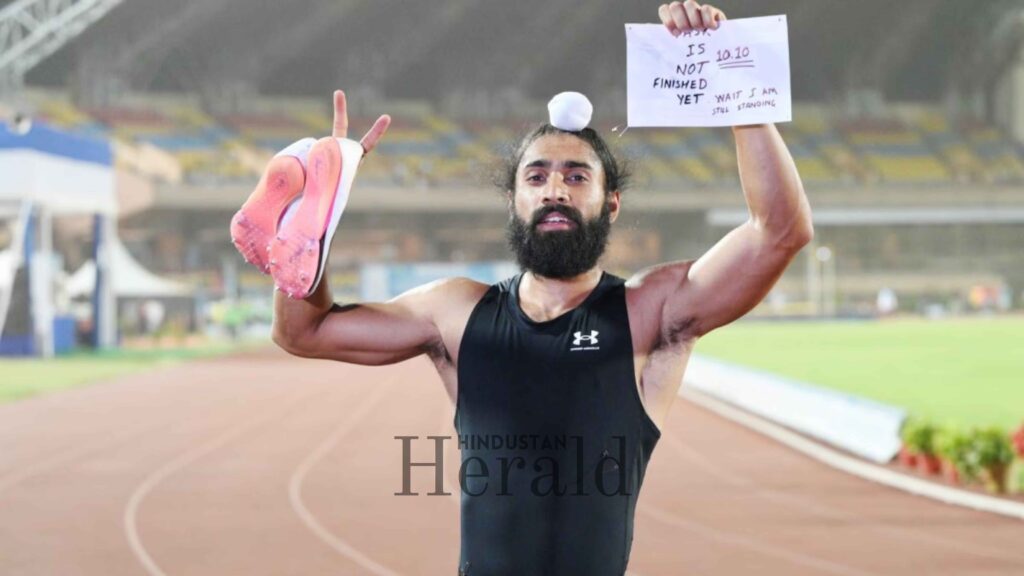
The 10.10 barrier does not appear on any official qualification sheet. No federation has it written down as a standard you must hit. But within sprinting, particularly in Asia, it carries a weight that numbers on paper cannot fully capture. Very few athletes from this continent have ever gone faster. Gurindervir is the first Indian to do it. The first. Ever. In the entire history of the sport in this country.
According to Outlook India, his 10.09 seconds is the second fastest time recorded by any Asian sprinter this season. The only man ahead of him is Fukuto Komuro, a 19-year-old Japanese sprinter who ran 10.08 in May. That is the tier Gurindervir Singh now occupies. Sitting alongside the fastest Asian on the planet right now. That sentence has never been written about an Indian sprinter in quite this way before, and it deserves to be read slowly.
He also cleared the AFI’s Commonwealth Games qualification standard of 10.16 seconds with ease, which settles that particular question for the selection committee. Glasgow is very much on the table for him.
A Word on Animesh
It would be easy, given the scale of Gurindervir’s achievement, to reduce Animesh Kujur to a footnote. That would be wrong.
What Animesh did across the two days in Ranchi was genuinely impressive. He came in as the national record holder, watched that record get taken in the first semifinal heat, and responded in the very next heat by not just reclaiming it but running faster than he ever had. That kind of immediate, high-stakes response is rare. Most athletes, when a rival breaks their record in real time, need a night to process it. Animesh needed about twenty minutes.
He lost the final. He lost it to a better run on the day. But he ran 10.20 seconds in a race that someone else ran 10.09. That is not underperformance. That is just Gurindervir Singh being extraordinary on a particular Saturday in Ranchi.
The rivalry between these two has moved past the point of being a subplot. They are both serious athletes at the peak of their domestic form, they have now raced each other across three national records in 24 hours, and if both make the Commonwealth Games squad, a rematch in Glasgow becomes one of the more compelling things Indian athletics could offer at those Games. Whether the selectors put both of them on the plane is a decision worth watching closely over the coming weeks.
The Afternoon Did Not Stop There
Elsewhere at Birsa Munda on Saturday, Vishal Thennarasu Kayalvizhi ran the 400 metres in 44.98 seconds and became the first Indian man to break the 45-second barrier. His previous national record was 45.12 seconds, set at the Inter-State Championships last year. Paris 2024 Olympian Rajesh Ramesh finished second in 45.31 seconds, Jay Kumar third in 45.47 seconds.
The caveat is painful. The AFI had set the men’s 400m Commonwealth Games qualifying mark at 44.96 seconds. Vishal ran 44.98. He missed it by two hundredths. He ran faster than any Indian in the history of the event, produced a number that would not have been believed a year ago, and still fell marginally short of the standard that determines whether he goes to Glasgow or not. What the federation decides to do with that result will be a question worth following.
Tejaswin Shankar had his own landmark moment, finishing the decathlon with 8057 points to become the first Indian to breach the 8000-point mark. He had set the previous national record himself at 7826 points. As reported by olympics.com, the AFI’s Commonwealth Games qualification standard in decathlon was 7787 points. Tejaswin crossed that by 270 points. His spot in Glasgow looks settled.
Vithya Ramraj won the women’s 400m in 52.22 seconds. Ancy Sojan leapt a personal best of 6.75 metres to win the women’s long jump ahead of Shaili Singh. On any other weekend, those would have been the conversations people walked away with. This weekend, they were buried under an avalanche of records.
The Bigger Picture From Ranchi
The Federation Cup is not a glamorous event. It never has been. No foreign fields, no prize money worth talking about, no global broadcast. What it has this year is context and consequence. It is the only selection trial for the Commonwealth Games athletics squad, with the AFI having set strict performance standards across events and India limited to 32 track and field athletes for Glasgow.
Put athletes under that kind of pressure and you find out who is actually ready. Ranchi found out.
Three national records in three events in 24 hours. The 100m mark broken three times across two days, ending at a number Indian sprinting had never seen. A 400m barrier that had never been crossed, crossed. A decathlon ceiling that had never been touched, cleared by a distance.
This is not a fluke weekend. These are not accidents of timing or favorable wind readings. This is a group of athletes who have arrived at a significant moment in genuinely significant form. Whether they carry it to Glasgow is the next test and a fair one. The Commonwealth Games will be harder than a domestic trial, the fields deeper, the pressure different.
But right now, in this moment, the scorecard from Ranchi is extraordinary. And at the centre of it is a 25-year-old from Punjab who ran 10.09 seconds when it mattered most and became, in doing so, the fastest Indian man who has ever lived.
That is not a small thing. It should not be treated as one.
Stay ahead with Hindustan Herald — bringing you trusted news, sharp analysis, and stories that matter across Politics, Business, Technology, Sports, Entertainment, Lifestyle, and more.
Connect with us on Facebook, Instagram, X (Twitter), LinkedIn, YouTube, and join our Telegram community @hindustanherald for real-time updates.

Sports reporter covering cricket, football, and Olympic disciplines, with on-ground event experience.
- Prakash Nair

- Prakash Nair
- Prakash Nair
- Prakash Nair