
 By Sandeep Verma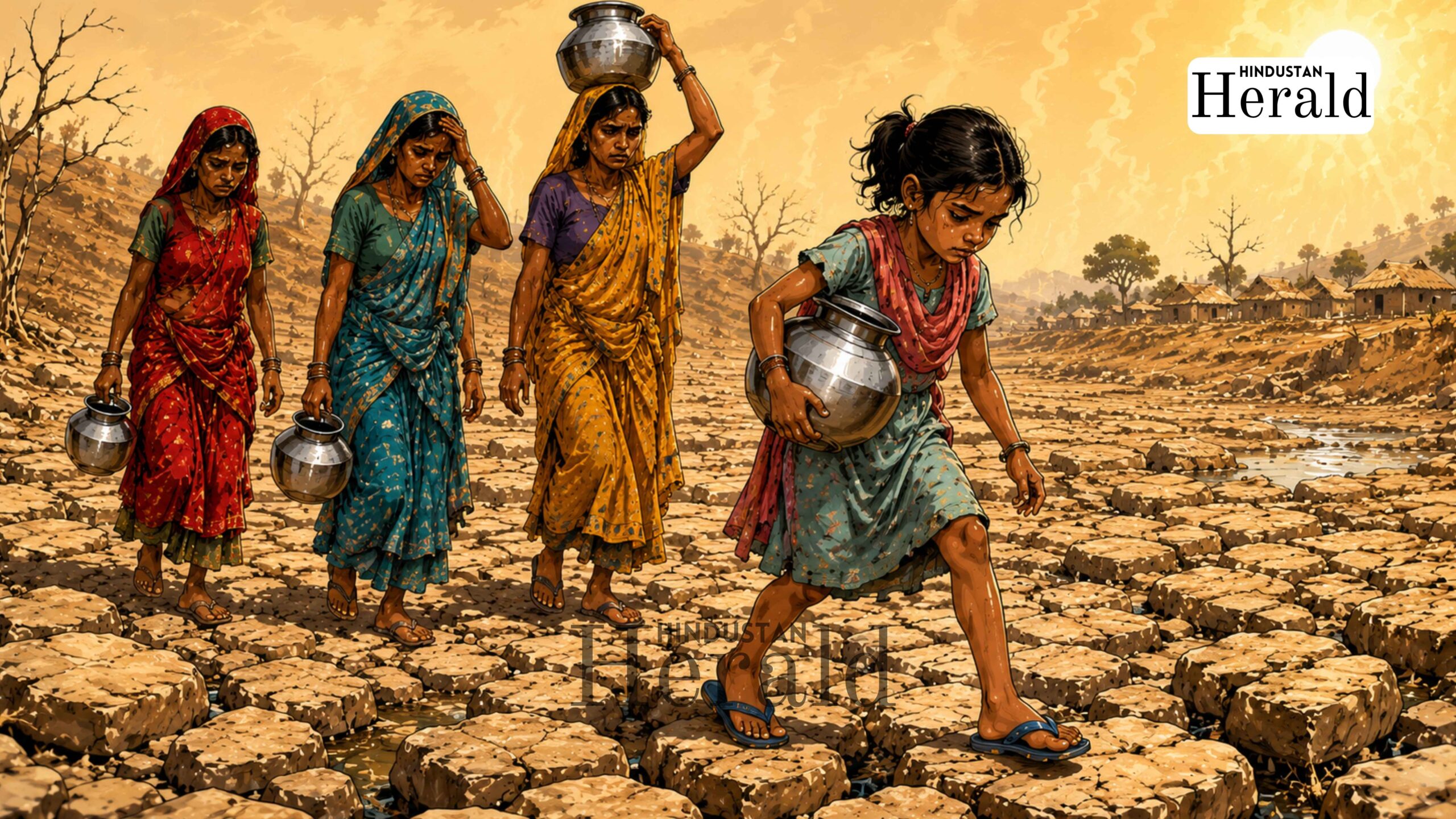
Khargone, May 24: The youngest of the three looks about twelve. Maybe younger. She is picking her way across split rock in rubber chappals, a vessel balanced in the crook of her arm, squinting into a sky that offers no shadow and no mercy. The other two women move just ahead of her, also carrying containers, also watching their footing on ground that has cracked open like old plaster in the heat.
This is Rekhaliya Jhirra Faliya, a small hamlet in Khargone district in Madhya Pradesh’s Nimar belt. The riverbed they are crossing is dry. Has been for weeks. Temperatures in Khargone have been sitting close to 45 degrees Celsius through much of May, and the water that used to be reachable without this kind of journey stopped being reachable some time ago.
A video of this scene has been circulating on social media since last week. It has done what such videos do: provoked outrage in cities, been shared with pained captions, prompted a few official responses that said nothing and promised even less. Then the news cycle moved, as it always does.
The women in the video are still making that walk.
The Landscape That Summer Exposes
Khargone is not a district that appears often in national news. It sits in the southwest corner of Madhya Pradesh, where the Vindhya and Satpura ranges converge and the terrain is mostly basalt rock over thin soil. During the monsoon it looks manageable. In April and May it reveals what it actually is, which is a landscape that does not retain water.
The groundwater stress in this region is not new and not accidental. Decades of shallow bore wells, minimal recharge infrastructure, and a near-total absence of community water harvesting have left the district chronically exposed every summer. The springs go first. Then the hand pumps run dry. Then the taps, where they exist, lose pressure and give up.
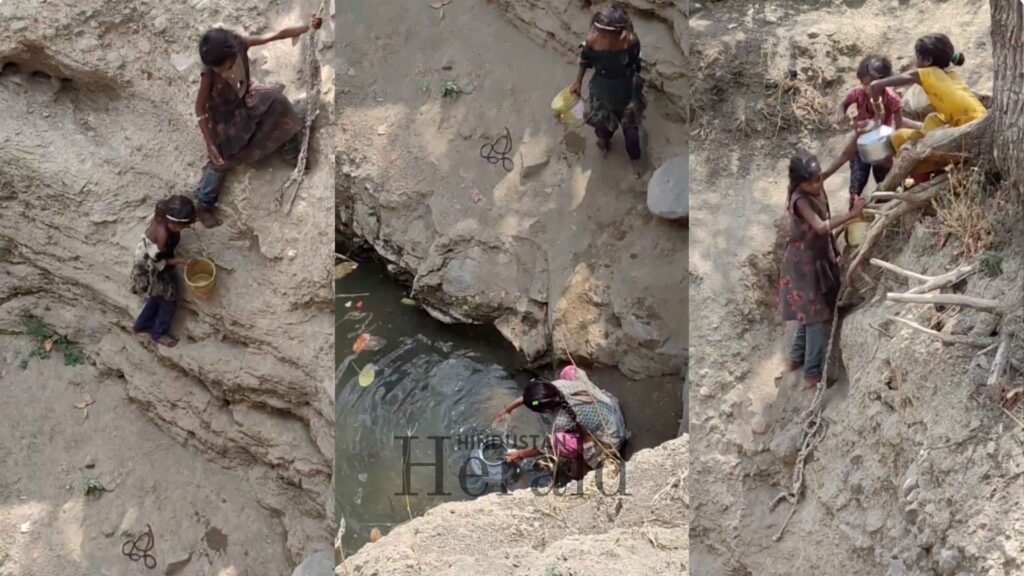
This year has been worse than most. Khargone recorded 44.6 degrees Celsius in the second week of May, placing it among the hottest districts in a state that itself ranked among the most severely heatwave-affected in India. Rajgarh hit 45 degrees on May 18. Districts across the Nimar and Malwa belts have been under continuous heatwave alerts since mid-April with barely a break. The IMD has warned that relief is not coming soon.
When the heat holds like this for weeks on end, the depletion of water sources is not gradual. It is sudden, and then it is total.
What the Mission Was Supposed to Deliver
Seven years ago, the government announced the Jal Jeevan Mission. The pitch was simple and the deadline was firm: a functional tap water connection in every rural home in India by 2024. No more walking. No more dry riverbeds. No more twelve-year-old girls navigating boulders in rubber chappals in 45-degree heat.
The numbers the government quotes are large enough to sound like success. Nationally, tap water connections went from three crore rural households in 2019 to fifteen crore by mid-2024, one of the faster expansions of basic infrastructure in the country’s post-Independence history. Eight states and three Union Territories have been certified fully covered.
Madhya Pradesh has not been certified. As of March 2025, roughly 68 per cent of rural households in the state had a tap connection on record. That leaves nearly a third of rural Madhya Pradesh still without one, a figure that has been sitting in government reports for over a year.
That said, the 68 per cent itself overstates what is actually happening on the ground. A government-commissioned functionality survey in 2024 found that even among households nationally with recorded tap connections, only about three-fourths were receiving water that was regular, adequate, and safe. The tap exists on paper. The tap works is a different question.
In tribal hamlets like Rekhaliya Jhirra Faliya, that gap tends to be widest. Pump motors burn out and stay broken. Power supply is intermittent. Groundwater laced with iron or fluoride makes the water that does flow undrinkable. And the maintenance personnel who are supposed to keep the system running are, in most such settlements, nowhere to be found.
The Last Hamlet on Every List
There is something specific about the word Faliya that matters here. In Madhya Pradesh, a Faliya is a small hamlet, typically tribal in composition, that sits on the edge of a larger revenue village. These settlements exist in a kind of administrative limbo. They are counted in census data but routinely left out of infrastructure rollouts. When a gram panchayat files a report claiming water coverage, it usually counts the main habitation. The Faliyas on the periphery, sometimes a kilometre or two away, get counted too, even if the pipe never reached them.
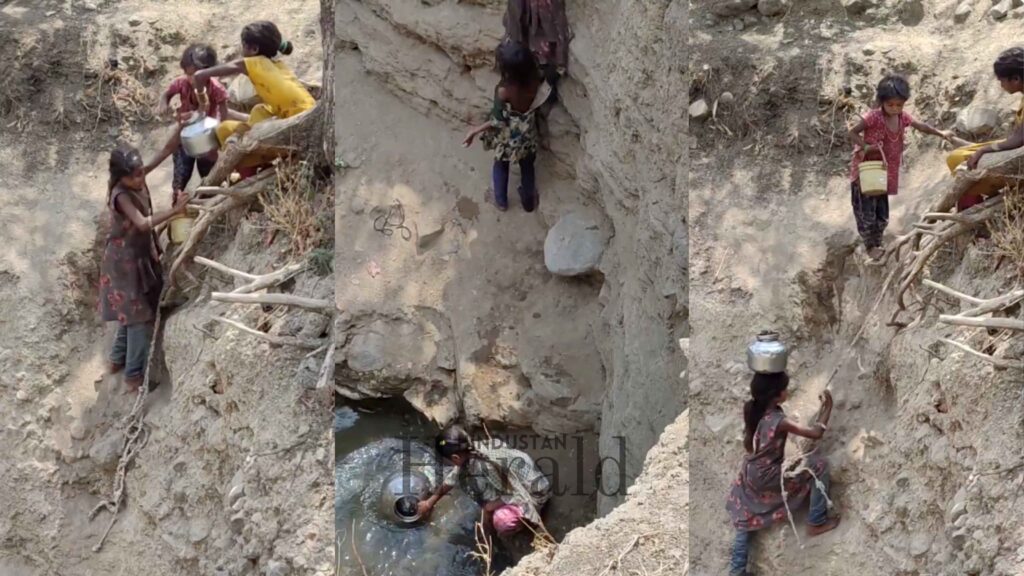
This is not a new observation. A parliamentary standing committee review of the Jal Jeevan Mission specifically named Madhya Pradesh among the states significantly lagging in functional coverage, alongside Rajasthan, West Bengal, and Jharkhand. The committee found that practical implementation gaps, not just funding shortfalls, were the core problem and called for them to be resolved.
The JJM guidelines themselves acknowledge the priority. Tribal areas, water-stressed districts, and villages with groundwater contamination are supposed to be at the front of the queue, not the back. Khargone, as a tribal-dominated district with documented groundwater stress, ticks all those boxes. Whether that priority is reflected in what has actually been built is a different matter.
The mission deadline of 2024 was missed. It was extended to 2025, then extended again to 2028 in the Union Budget. A JJM 2.0 has been announced, with new reform-linked agreements with states and a digital mapping platform called Sujalam Bharat launched in December 2025 to track the water supply chain from source to tap. These are administrative responses. They are real. They are also not the same thing as a functioning pump in Rekhaliya Jhirra Faliya this week.
The Work That Never Gets Counted
Something worth saying plainly: in rural India, when the water system fails, the people who absorb the failure are almost always women and girls. This is not incidental. It is a social structure that has outlasted every government programme aimed at dismantling it.
In tribal and agrarian communities across central and western India, water collection is understood as a female responsibility in the same way that cooking is, without question and without compensation. Men use water for the fields. Women fetch it for everything else, for drinking, cooking, washing, bathing children, all of it. When the water source is far, it is the women and girls who walk far. When it is dangerous, they take the risk.
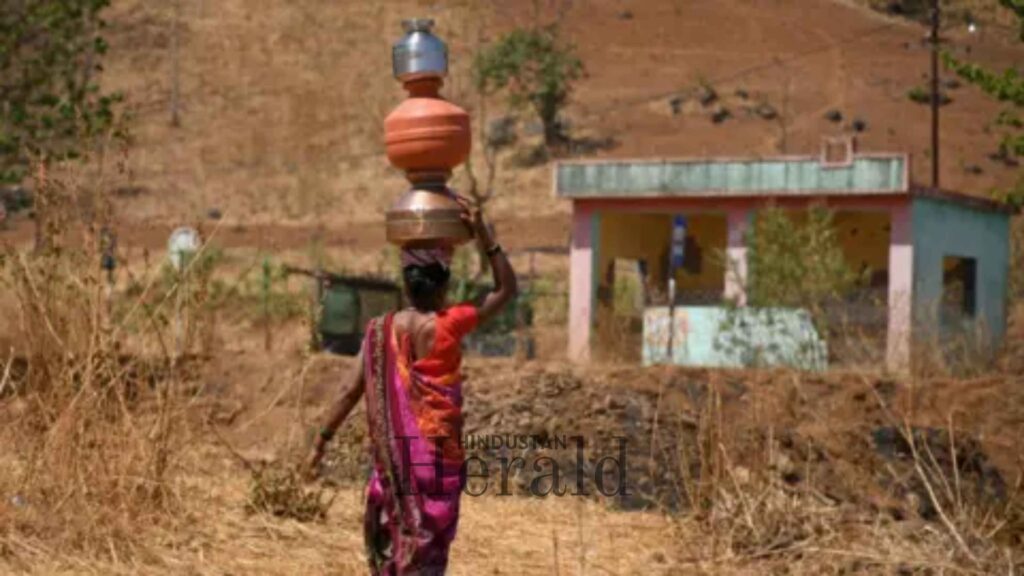
Women in rural India can make up to six trips a day for water. The distances involved, across difficult terrain, often total ten miles or more by the end of a summer day, with fifteen litres or more balanced on the head or carried in both arms. The back problems, the joint deterioration, the heat exhaustion, the injuries on rocky paths, none of this registers as a labour statistic anywhere.
Girls drop out of school over this. Not dramatically, not all at once, but steadily. A girl starts helping her mother because the walk takes too long to do alone. She misses a few days of class. Then a few more. Eventually the gap is too wide to close and school becomes a thing that used to happen. This pattern is so common in these communities that it barely registers as a crisis. It is just life.
The proponents of the Jal Jeevan Mission are right that a functional tap connection at home is one of the most direct ways to break this cycle. A tap changes a girl’s morning. It changes her year. It changes what becomes possible for her. That is not government pamphleteering; it is documented and true. The problem is that a tap that is not connected, or connected but dry, or connected and running contaminated water, does none of those things.
A Pattern That Repeats Across States
Khargone is not an isolated case. Gujarat, Uttar Pradesh, Rajasthan, and Chhattisgarh have all seen similar images surface this summer, women and children navigating dangerous terrain or waiting hours at the one hand pump in a three-kilometre radius that still has water. The specific geography changes. The dynamics do not.
India’s heatwaves have already been deadly this year, with casualties reported since late March. Climate scientists have been consistent in their projections that the subcontinent will face more intense, longer, and more frequent heatwave events in the decades ahead. What that means in practice, for communities without reliable water access, is that the Rekhaliya Jhirra Faliya situation is not an aberration to be corrected. It is a preview of what becomes routine unless the infrastructure deficit is addressed at the settlement level, not the district level or the state level, but the settlement.
The difference between states that have achieved real water coverage and states where women are still rationing trips to dry riverbeds comes down, largely, to this: did the administration count habitations or just panchayats? Did maintenance get funded or just installation? Did someone come back six months later to check whether the pump was still working?
The Same Questions, Waiting
Local administration in Khargone has acknowledged the problem after the video circulated, as per sources familiar with the district’s response. Survey work is reportedly underway in affected Faliya settlements. What that means in terms of timeline, funding, and actual delivery is not yet clear.
It rarely is, at first.
The pattern in these situations tends to follow a familiar arc. Video surfaces. Officials respond. Survey is announced. Monsoon arrives in June and takes the immediate crisis off the front page. By October, when the dry season is six months away and the urgency has faded, the survey findings sit in a file somewhere and the next round of budget allocation happens without them.
That may not be what happens this time. It may be that the pressure from this particular video produces a different result. There is no reason to assume it will not. There is also, looking at the record, no strong reason to assume it will.
For now, Rekhaliya Jhirra Faliya is waiting. The rocks are still there. The sun is still there. The Jal Jeevan Mission dashboard has numbers on it. The girl in rubber chappals had water to carry home yesterday, because she went and got it herself. Whether she has to do the same tomorrow depends on decisions being made in offices she has never seen, by people who have not seen her either, but who have presumably seen the video by now.
Stay ahead with Hindustan Herald — bringing you trusted news, sharp analysis, and stories that matter across Politics, Business, Technology, Sports, Entertainment, Lifestyle, and more.
Connect with us on Facebook, Instagram, X (Twitter), LinkedIn, YouTube, and join our Telegram community @hindustanherald for real-time updates.
Regional journalist bringing grassroots perspectives and stories from towns and cities across India.
- Sandeep Verma

- Sandeep Verma
- Sandeep Verma
- Sandeep Verma




 Arun Upadhayay
  Rajiv Menon and Ananya Sharma
  Ayesha Khan