
 By Shelesh Joshi and Rajiv Menon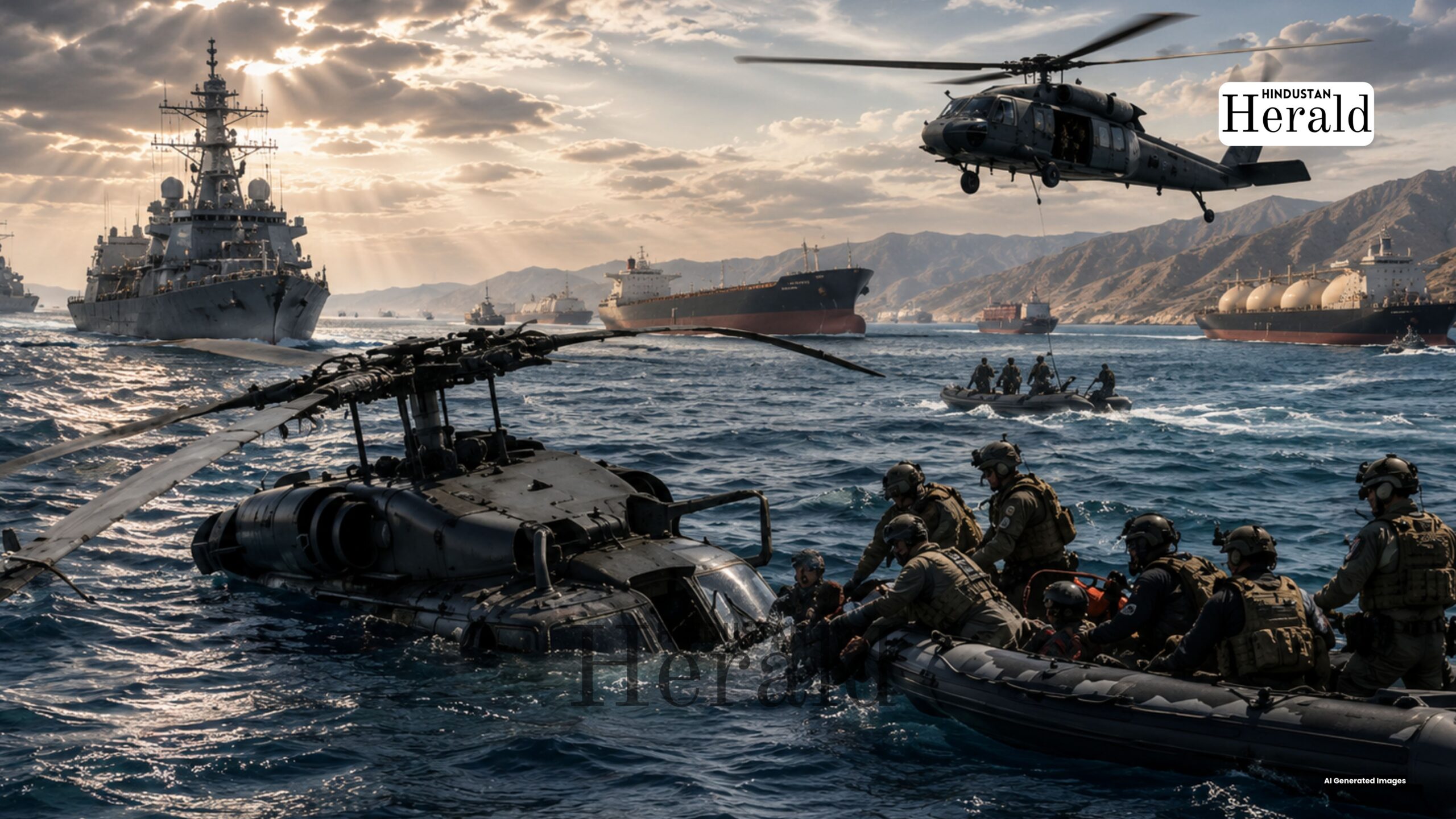
New Delhi, June 9: A US helicopter crash near the Strait of Hormuz on June 8 has no official explanation. What it does have is a four day old CENTCOM record of seven Iranian missiles fired through the same corridor, and a country of 1.4 billion people whose cooking gas travels through it.
That much is confirmed. The New York Times broke the story, and the Times of Israel picked it up in its live Tuesday coverage. Beyond those basic facts, the official record goes quiet. No cause. No statement from the Pentagon. No press release from US Central Command (CENTCOM). Just a downed aircraft, two rescued crew members, and a corridor that has been in varying states of armed tension since late February, occasionally paused, never actually settled. The cause of the crash has not been established. The timing, though, says a great deal on its own.
Four days before this helicopter went down, CENTCOM confirmed on its official website that Iranian forces had fired seven ballistic missiles at Kuwait and Bahrain, and had launched four one way attack drones directly at the Strait. All of it intercepted, according to CENTCOM. All of it logged in an official June 5 press release on centcom.mil, an official US Department of Defense domain. In the same operation, US forces struck Iranian coastal surveillance radar sites in Goruk and on Qeshm Island. That was not weeks ago. That was June 5. A helicopter went down on June 8.
No American spokesperson has drawn a connection between those two events. That silence is itself a kind of answer. The absence of any statement leaves the question sitting in the open: what exactly was this helicopter doing, in that airspace, on that day?
Quick Summary
- A US military helicopter gunship went down near the Strait of Hormuz on June 8, 2026, with both crew members rescued safely, as first reported by The New York Times
- The Strait of Hormuz carries an average of 20 million barrels per day of crude oil and oil products, representing approximately 25 percent of the world’s seaborne oil trade, according to the International Energy Agency (IEA)
- On June 5, 2026, just four days before the crash, CENTCOM officially confirmed Iran fired 7 ballistic missiles toward Kuwait and Bahrain and launched 4 attack drones toward the Strait, all intercepted by US forces
- Before the 2026 crisis, approximately 45 percent of India’s crude oil imports transited the Hormuz route, as confirmed by Union Minister Hardeep Singh Puri in his parliamentary statement published by the Press Information Bureau (PIB) on March 12, 2026
- India imports approximately 60 percent of its LPG consumption, with 90 percent of those imports previously transiting the Strait, as confirmed in the PIB inter ministerial briefing of March 11, 2026
- On June 1, 2026, Iran’s state affiliated outlet Tasnim reported that Iranian negotiators would halt talks with the US and vowed to “completely block” the Strait of Hormuz, causing oil prices to spike more than 7 percent, as reported by CNBC
What The Ceasefire Actually Looks Like On The Ground
There is a ceasefire in place. Technically. Pakistan brokered it on April 8, 2026. According to Doordarshan Newsonair’s official coverage, President Donald Trump agreed to a two week pause on US strikes, subject to Iran agreeing to the complete and immediate opening of the Strait of Hormuz. Iranian Foreign Minister Abbas Araghchi confirmed safe passage through the Strait would be possible through coordination with Iranian armed forces. Brent crude dropped roughly 16 percent the same day, as reported by Doordarshan Newsonair. Markets exhaled. For about three weeks, it looked like the worst might be behind us. It wasn’t.
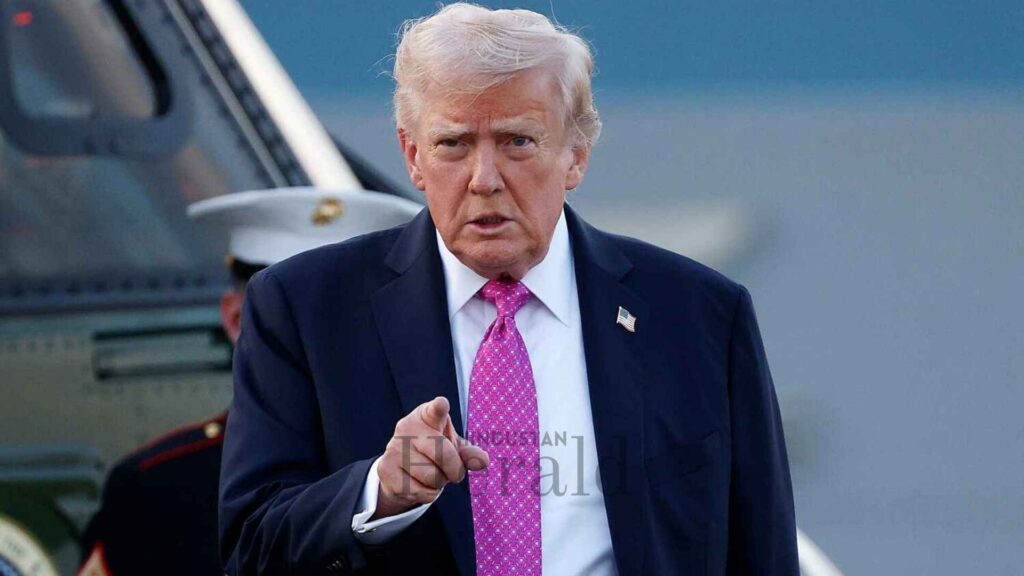
By June 1, Iran’s state affiliated Tasnim news outlet was reporting that Iranian negotiators had decided to stop exchanging messages with the US through intermediaries, and that Tehran was moving to fully close the Strait of Hormuz once more. As reported by CNBC, oil prices jumped more than 7 percent on that news alone. When CNBC reached President Trump for comment, he said: “I don’t care if they’re over, honestly. I really don’t care. I couldn’t care less.” The remark was casual in the way that only very large bets can afford to be. What it did not do was lower the temperature.
By June 7 and 8, CNN’s live coverage was reporting that Iran’s top negotiator Mohammad Bagher Ghalibaf had publicly stated Iran would defeat the US naval blockade of its ports. Iranian official Ebrahim Azizi told CNN a deal was possible but only if the US changed its behaviour what CNN described as “a climate of deep mistrust.”
The helicopter went down the next day. This is the ceasefire. Not a settlement, not even a genuine pause a contested interval between escalations, while both sides continue to test the other’s limits in one of the most consequential stretches of water in the world.
The Corridor Itself: What It Carries And Why That Matters
The International Energy Agency maintains an official factsheet on the Strait of Hormuz on its website at iea.org. It is worth sitting with the numbers for a moment, because they are the reason every development in this corridor carries consequences far beyond the two countries nominally at the centre of the conflict.
In 2025, an average of 20 million barrels per day of crude oil and oil products moved through the Strait. That is approximately 25 percent of all the world’s seaborne oil trade, passing through a waterway that is 29 nautical miles wide at its narrowest point, with navigable shipping channels just 2 miles wide in each direction. Nearly 15 million barrels per day of that was crude oil alone, accounting for 34 percent of global crude trade, according to the IEA. The bulk of it flows to Asia. China and India together took 44 percent of those crude exports in 2025.
For natural gas, the situation is structurally tighter. The IEA confirms that approximately 93 percent of Qatar’s LNG exports and 96 percent of the UAE’s LNG exports pass through the Strait. Together, that is close to 20 percent of global LNG trade. And unlike crude oil, for which Saudi Arabia and the UAE have some limited pipeline alternatives, there is no bypass route for LNG. None exists. The IEA states this plainly: a disruption to LNG flows through the Strait simply cannot be compensated through rerouting. There is no pipeline that goes around Iran. There is no alternative terminal. The volumes either move through the Strait or they do not move.
There is also a compounding factor the IEA identifies that rarely gets adequate attention in mainstream coverage. Most of the world’s spare crude production capacity sits in Gulf countries the same countries whose export routes depend on the Strait. So if the Strait closes, not only do shipments stop, but the world’s ability to pump more crude from elsewhere to fill the gap is also constrained at exactly the same moment. The two crises arrive together, reinforcing each other. Prices spike not just because supply has been cut, but because the market can see there is no obvious mechanism for restoring it quickly.
That dynamic explains why a single Tasnim report on June 1 moved oil prices by 7 percent. The market is not reacting to the news of the day. It is reacting to a structural reality that the news of the day keeps confirming.
India Stood In Parliament And Said It Out Loud
On March 12, 2026, thirteen days into the closure, Union Minister for Petroleum and Natural Gas Shri Hardeep Singh Puri rose in the Lok Sabha and delivered a statement that the Press Information Bureau published in full under Release ID 2239021. He did not soften it.

“The world has not faced a moment like this in modern energy history,” the minister told Parliament, as recorded in the PIB release. “Today is the 13th day since the passage through the Strait of Hormuz, through which 20% of world’s crude, 20% of world’s natural gas and 20% of the world’s LPG flows, was disrupted following the military operation between Iran, Israel and the US. For the first time in recorded history, the Strait of Hormuz has been effectively closed to commercial shipping.”
That statement, made on the floor of the highest legislative body in the country and published by PIB, is the Indian government’s own formal reckoning with the scale of what happened.
The minister confirmed that before the crisis, approximately 45 percent of India’s crude imports had been transiting the Hormuz route. He confirmed that non Hormuz sourcing had been pushed up to approximately 70 percent of crude imports, from 55 percent before the conflict. He confirmed India was sourcing crude from 40 countries, compared with only 27 in 2006-07. That diversification did not happen by accident. It happened over years of quiet policy work, and it is the reason India’s position in March 2026 looked different from that of many of its neighbours.
He also did something unusual for an official parliamentary statement. He told the House what was happening in those neighbouring countries and he was specific about it.
One country nearby, as recorded in the PIB release, shut all schools for two weeks, moved government offices to a four day work week, ordered half of all public employees to work from home, cut fuel allowances for official vehicles, and took 60 percent of government vehicles off the road entirely. That country saw its largest ever single fuel price increase, with petrol rising roughly 20 percent in a single week. These were not emergency preparations. These were emergency responses to a crisis that had already arrived.
Another neighbour closed its universities early and brought forward a national holiday to conserve fuel. Countries in Southeast Asia had to implement rationing. India’s schools stayed open. India’s petrol stayed on the forecourt.
That comparison was not rhetorical. It was the government making its case to Parliament, on the record, that the policy response had worked under conditions that had destabilised governments with far less cushion. Those words are there in the PIB release for anyone who wants to verify them.
The Emergency Measures: What The Government Actually Did
The day before the parliamentary statement, on March 11, 2026, four ministries briefed the media at the National Media Centre in New Delhi. The PIB published the full record of that briefing under Release ID 2238525.
On crude oil: India’s daily consumption runs at approximately 55 lakh barrels. The government confirmed that diversified procurement had secured volumes exceeding what would normally have arrived through the Strait during that period. Refineries, the briefing confirmed, were running at very high utilisation in some cases above 100 percent of rated capacity to make the most of available feedstock.
On natural gas: India produces approximately 97.5 MMSCMD domestically out of a total national consumption of 189 MMSCMD. About 47.4 MMSCMD of imported supply had been knocked out by force majeure conditions following the crisis. The government issued a Natural Gas Control Order on March 9, 2026, under the Essential Commodities Act, allocating supply on strict priority. Homes and CNG vehicles got 100 percent. Industrial users got 80 percent of their previous average. Fertiliser plants received 70 percent, protecting agricultural supply chains ahead of the sowing season. Refineries and petrochemical units absorbed a 35 percent cut, with gas redirected upward in the priority chain.
On LPG: India imports approximately 60 percent of its LPG consumption. Of those imports, 90 percent had been transiting the Strait. On March 8, 2026, the government ordered all refineries to divert propane, butane, propylene, and butenes streams entirely into the LPG pool. Domestic LPG production rose approximately 25 percent as a result, as confirmed in the PIB briefing. All of that domestic output was directed to household consumers.
A three member committee of Executive Directors from IOCL, HPCL, and BPCL was constituted to manage commercial allocations for restaurants, hotels, and other commercial users. The government approved Rs 30,000 crore in compensation to oil marketing companies for LPG under recoveries, as confirmed by PIB.
The Delivery Authentication Code system was expanded from 50 percent to 90 percent of consumers, so that a cylinder cannot be logged as delivered without a one time confirmation code from the consumer’s registered mobile number. The minimum booking gap was raised from 21 days to 25 days in urban areas and 45 days in rural areas.
On pricing: despite the Saudi Contract Price rising approximately 41 percent between July 2023 and March 2026, the PMUY beneficiary price had actually fallen 32 percent in the same period. A domestic LPG cylinder for PMUY households stood at Rs 613 in Delhi. Comparable prices in the neighbourhood, per the minister’s parliamentary statement, were Rs 1,046 in Pakistan, Rs 1,242 in Sri Lanka, and Rs 1,208 in Nepal. The divergence is not accidental it is the accumulated result of procurement diversification, subsidy policy, and domestic production adjustments made over years, not weeks.
On maritime safety, the PIB briefing confirmed 28 Indian flagged vessels in the Persian Gulf, with a 24-hour control room operational since February 28, 2026. Two Indian nationals had lost their lives in attacks on merchant ships. Approximately 9,000 Indians were in Iran, with the Indian mission maintaining close contact. Indian students and pilgrims had been relocated from Tehran to safer cities. The Prime Minister had spoken directly to leaders of the UAE, Qatar, Saudi Arabia, Oman, Bahrain, Kuwait, Jordan, and Israel.
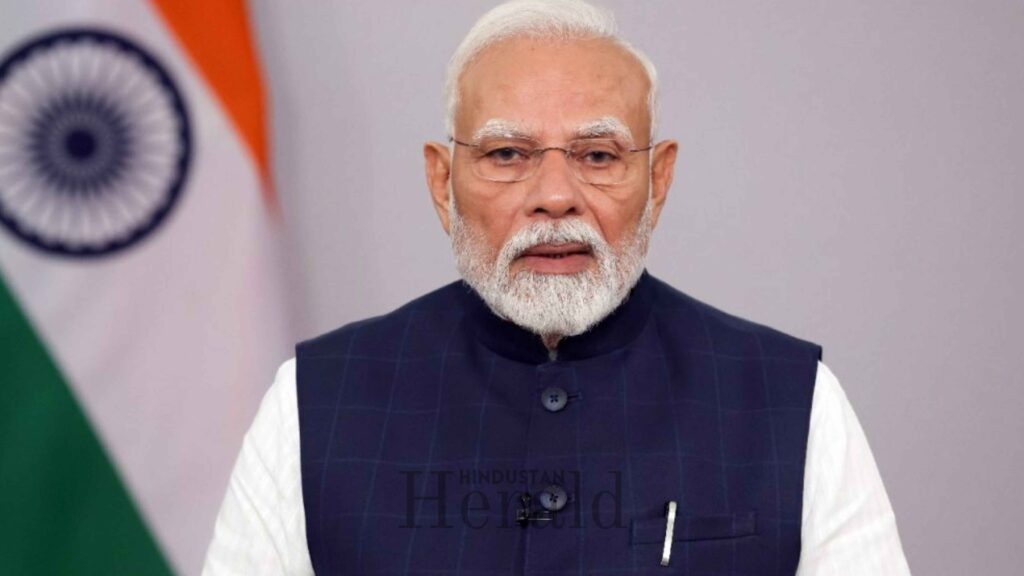
That last detail matters more than it is usually given credit for. Direct head of government conversations are not routine diplomatic maintenance. They happen when a country is trying to secure commitments under pressure.
Why the US Helicopter Crash of June 8 Is Bigger Than It Looks
The crash itself, two rescued crew members, cause unconfirmed, is not a strategic event in isolation. But read the timeline carefully and it becomes difficult to treat it as a routine incident in a stable environment.
A two week ceasefire was brokered in April. Within weeks, Iran was threatening to shut the Strait again. A deal was reported as largely negotiated by CNBC on May 23. By June 1, Iran announced it was halting talks and moving to fully close the Strait. By June 5, CENTCOM was publishing confirmed intercepts of seven Iranian ballistic missiles and four attack drones in the Strait. By June 7 and 8, CNN was reporting Iranian officials publicly declaring their intent to maintain control over the waterway regardless of any agreement.
On June 8, the US helicopter crash happened. No official has connected those events. That silence does not resolve the question. It leaves it open. Iran-US war latest news: US crew rescued after helicopter goes down near Strait Of Hormuz. The ceasefire has not resolved the underlying contest. It has paused it, imperfectly, at intervals, while both sides continue testing each other in the same corridor. The pauses are real. Prices do drop when they are announced. But they have not been durable, and the pattern of breakdown and partial restoration, repeated now several times in less than ninety days, is itself the signal that the US helicopter crash arrived inside.
For India, this is simultaneously geopolitical and completely practical. Not abstractly practical. Concretely practical, in the sense that the cooking gas arriving at a household in Lucknow or Patna or Bhubaneswar travels a route that passes through a 29-nautical-mile channel where, four days before the US helicopter crash, ballistic missiles were being intercepted.
Union Minister Puri told Parliament in March, as recorded by PIB, that India was navigating the most severe global energy disruption in recorded history. That disruption did not end with the April ceasefire. It became a low grade, ongoing condition of uncertainty in a waterway that carries a fifth of the world’s crude, a fifth of its natural gas, and virtually all the LNG that lights and heats and cooks for hundreds of millions of people across South Asia.
India managed the crisis phase well, by the government’s own documented account and by the results on the ground. The comparison to what happened in neighbouring countries is not a minor point. It is the central point. But the management was reactive, expensive, and entirely dependent on a ceasefire that has broken down and been partially restored multiple times. Managing a crisis well is not the same as having avoided one. India absorbed the hit better than most. That is genuinely significant. It is also not something any government would want to be in a position to repeat indefinitely.
The deeper issue is structural and has not changed since the US helicopter crash brought it back into focus. The IEA factsheet makes clear there is no alternative route for Qatari LNG. Pipeline bypass capacity for crude is limited. The world’s spare production sits in the same Gulf region that is being contested. India has 40 supplier nations now, a 24×7 control room, refinery diversification protocols, and LPG diversion orders that can be reissued within days. The institutional muscle memory from early 2026 is real and it counts.
But it is still a country of 1.4 billion people whose energy security runs through a waterway where the current state of affairs is this: ceasefire in name, active military testing in practice, and a US helicopter crash with no explanation sitting in the public record.
Every policymaker in South Block, every refinery manager in Jamnagar, every official in the Ministry of Petroleum who watched the Saudi Contract Price spike 41 percent in three years and then watched it move again on a single Tasnim report, none of them is reading the June 8 US helicopter crash as background noise.
The management of early 2026 showed what India could assemble under genuine pressure. That is not a comfortable thing to have had to demonstrate. It would be considerably more comfortable if the circumstances that required it had actually been resolved, rather than paused, renegotiated, threatened with collapse, partially restored, and now punctuated by a downed aircraft whose cause nobody in an official position has yet explained. They haven’t. Whether this needs to be done again, and how many more times, depends on what happens next in that narrow channel between Iran and Oman. For now, both crew members are safe.
Stay ahead with Hindustan Herald — bringing you trusted news, sharp analysis, and stories that matter across Politics, Business, Technology, Sports, Entertainment, Lifestyle, and more.
Connect with us on Facebook, Instagram, X (Twitter), LinkedIn, YouTube, and join our Telegram community @hindustanherald for real-time updates.

Tracking world politics, global markets, trade movements, policy decisions, and the changing balance of economic power.
- Shelesh Joshi

- Shelesh Joshi
- Shelesh Joshi
- Shelesh Joshi





Specializes in South Asian geopolitics and global diplomacy, bringing in-depth analysis on international relations.
- Rajiv Menon
- Rajiv Menon
- Rajiv Menon
- Rajiv Menon