
 By Ananya Sharma and Neeraj Kapoor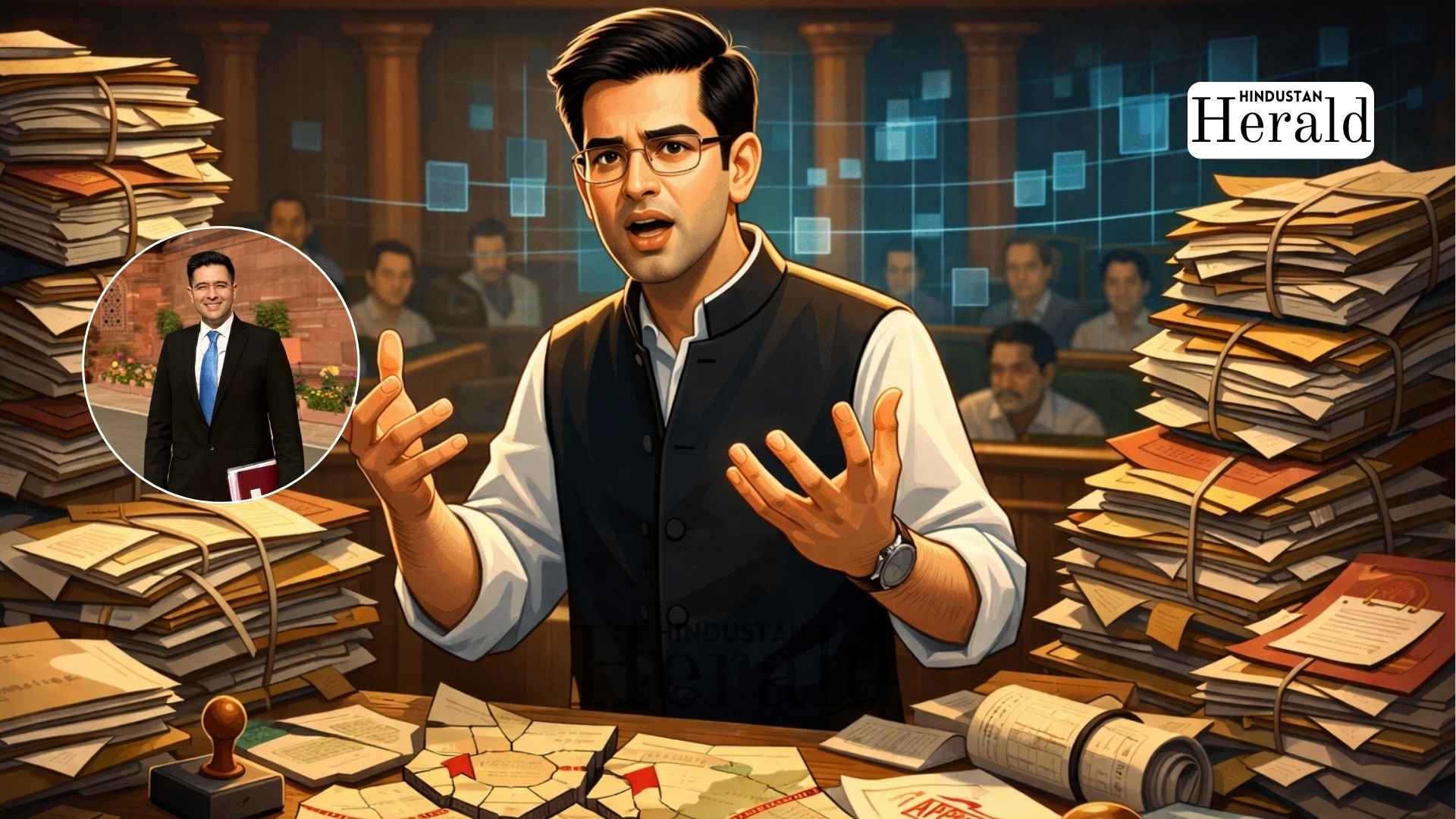
New Delhi, February 10: When Raghav Chadha rose in the Rajya Sabha to speak about land records, the House was not discussing a niche tech idea or a distant reform dream. He was talking about something most Indians have either endured themselves or watched a family member struggle through quietly for years: property disputes that refuse to end.
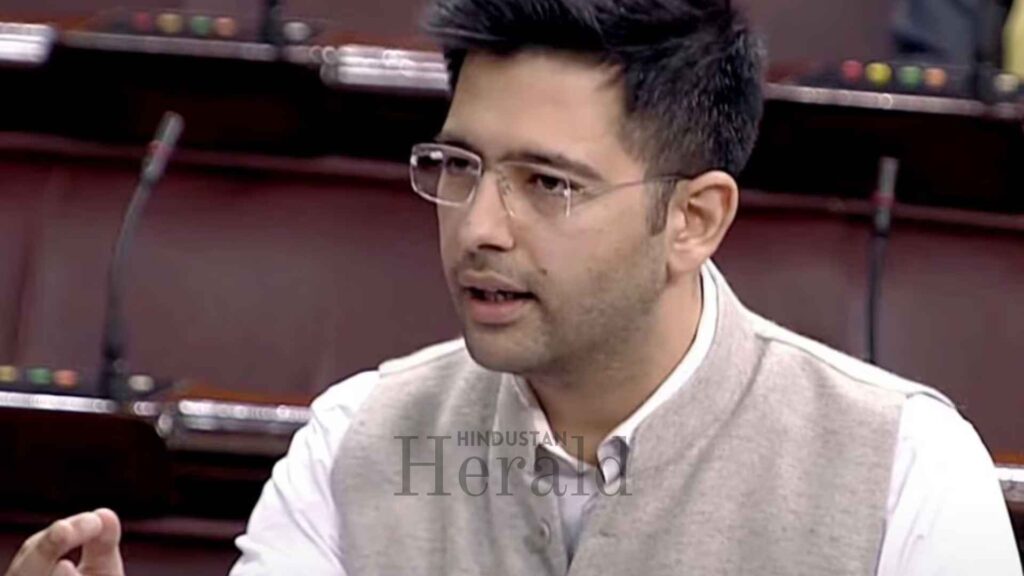
Chadha’s pitch for a blockchain-based national property register cut through the usual parliamentary noise precisely because it was anchored in lived reality. Titles that do not match the land on the ground. Documents that contradict each other. Years lost to courts, offices, and middlemen. His remarks travelled fast beyond Parliament, clipped and shared across social media through February 9 and 10, finding traction among urban homeowners, farmers, lawyers, and real estate professionals alike.
Yet, by the end of Tuesday, the attention had not translated into action. There was no response from the Union government, no assurance of a review, no indication of a pilot project, and no parliamentary follow-up.
A Crisis Hidden In Plain Sight
Chadha did not rely on abstract arguments. He leaned heavily on numbers that, taken together, paint an uncomfortable picture of how land is governed in India.

He told the House that two-thirds of civil cases in Indian courts are linked to land or property disputes. Nearly half of all properties lack a clear title, and almost the same proportion are caught in some form of dispute. Registration, meant to be a routine administrative step, often takes months, while disputes can sit in courts for seven years or more.
Perhaps most telling was his reference to the paperwork mountain. Over 6.2 crore land-related documents, he said, remain pending across registration and revenue offices nationwide.
No minister stood up to dispute these figures. No one endorsed them either. They were left hanging in the air, heavy and unanswered.
What Chadha Is Actually Proposing
Strip away the buzzwords and Chadha’s idea is relatively straightforward. He wants every land transaction in the country recorded on a single, tamper-proof digital ledger, using blockchain technology.
Sales, inheritance, transfers, mutations, mortgages. All of it logged in real time. Once entered, the record cannot be altered quietly. No backdated changes. No parallel paperwork quietly surfacing years later. A property’s full history would be visible, traceable, and verifiable.
Chadha was careful to note that land would remain a state subject, as the Constitution mandates. States would still administer land. The blockchain register would sit above that system, acting as a shared national record that prevents manipulation and duplication.
What he did not present was just as notable. There was no draft legislation, no estimate of costs, and no roadmap for migrating decades of inconsistent records into a clean digital system. Those gaps remain the biggest unanswered questions.
International Examples, Indian Complications
To make his case, Chadha pointed to Sweden, Georgia, and the United Arab Emirates, countries that have experimented with blockchain-backed land registries.
The examples are familiar in policy circles. Sweden’s pilots reduced paperwork and delays. Georgia’s reforms helped rebuild trust in property rights after years of uncertainty. Dubai has folded blockchain into its broader push for digital governance.
But India is not Sweden or Georgia or Dubai. Its land records stretch back decades, sometimes centuries, written in different languages, maintained by different departments, and often riddled with contradictions. Even supporters of blockchain reforms quietly admit that technology alone cannot fix inaccurate or disputed records.
Still, Chadha’s argument was not that blockchain is a magic cure. It was that without a secure, unified system, every other reform hits a wall.
A Supreme Court Nudge That Still Hasn’t Landed
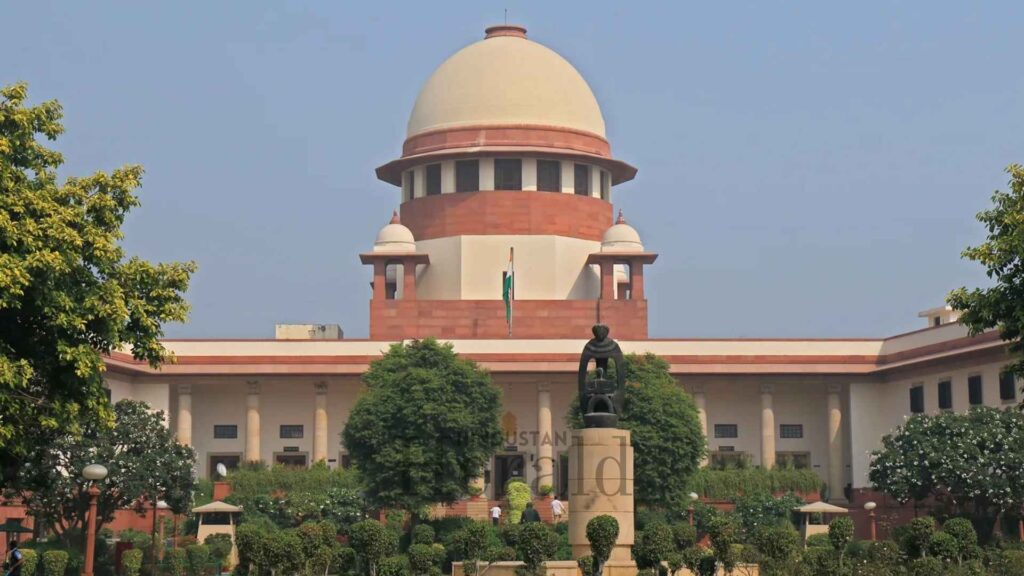
The timing of Chadha’s speech was not accidental. In November 2025, the Supreme Court of India described India’s land records process as “traumatic” for ordinary citizens. The court urged the Centre to explore blockchain-based systems and asked the Law Commission of India to examine the issue.
That intervention raised expectations. Courts rarely comment so directly on administrative reform unless the problem has become impossible to ignore.
And yet, months later, there has been no publicly released study, no pilot expansion, no white paper, and no indication that the Law Commission’s work has moved into the policy pipeline.
Silence From The Government
What followed Chadha’s remarks was striking less for what happened than for what did not.
No minister responded in the House. No department issued a statement. There was no attempt to claim the idea as already under consideration, a common parliamentary reflex when opposition members strike a nerve.
Procedurally, the silence is defensible. Chadha did not move a bill or submit a starred question. But politically, the absence of engagement has only amplified the sense that land reform remains everyone’s problem and no one’s priority.
Why This Refuses To Go Away
Land sits at the heart of India’s economy and its social fabric. It is collateral for loans, the backbone of infrastructure projects, and often the only asset a family owns outright.
Unclear titles stall highways and housing projects. They spook investors. They trap families in legal battles that outlast generations. Every promised reform eventually runs into the same obstacle: records that cannot be trusted.
Blockchain, for all the skepticism around it, has become a symbol of something deeper. A demand for certainty in a system built on ambiguity.
Recognition Without Resolution

As of February 10, nothing has moved beyond the debate itself. Raghav Chadha’s speech has been replayed, quoted, and argued over. The statistics he cited have reignited conversations long pushed aside. The Supreme Court’s earlier remarks hang in the background, unresolved.
For now, that is where things stand. A problem everyone agrees exists. A solution many find intriguing. And a government that has yet to say, publicly, what it intends to do next.
Stay ahead with Hindustan Herald — bringing you trusted news, sharp analysis, and stories that matter across Politics, Business, Technology, Sports, Entertainment, Lifestyle, and more.
Connect with us on Facebook, Instagram, X (Twitter), LinkedIn, YouTube, and join our Telegram community @hindustanherald for real-time updates.

Covers Indian politics, governance, and policy developments with over a decade of experience in political reporting.
- Ananya Sharma

- Ananya Sharma
- Ananya Sharma
- Ananya Sharma





Tech writer passionate about AI, startups, and the digital economy, blending industry insights with storytelling.
- Neeraj Kapoor
- Neeraj Kapoor
- Neeraj Kapoor
- Neeraj Kapoor