
 By Ananya Sharma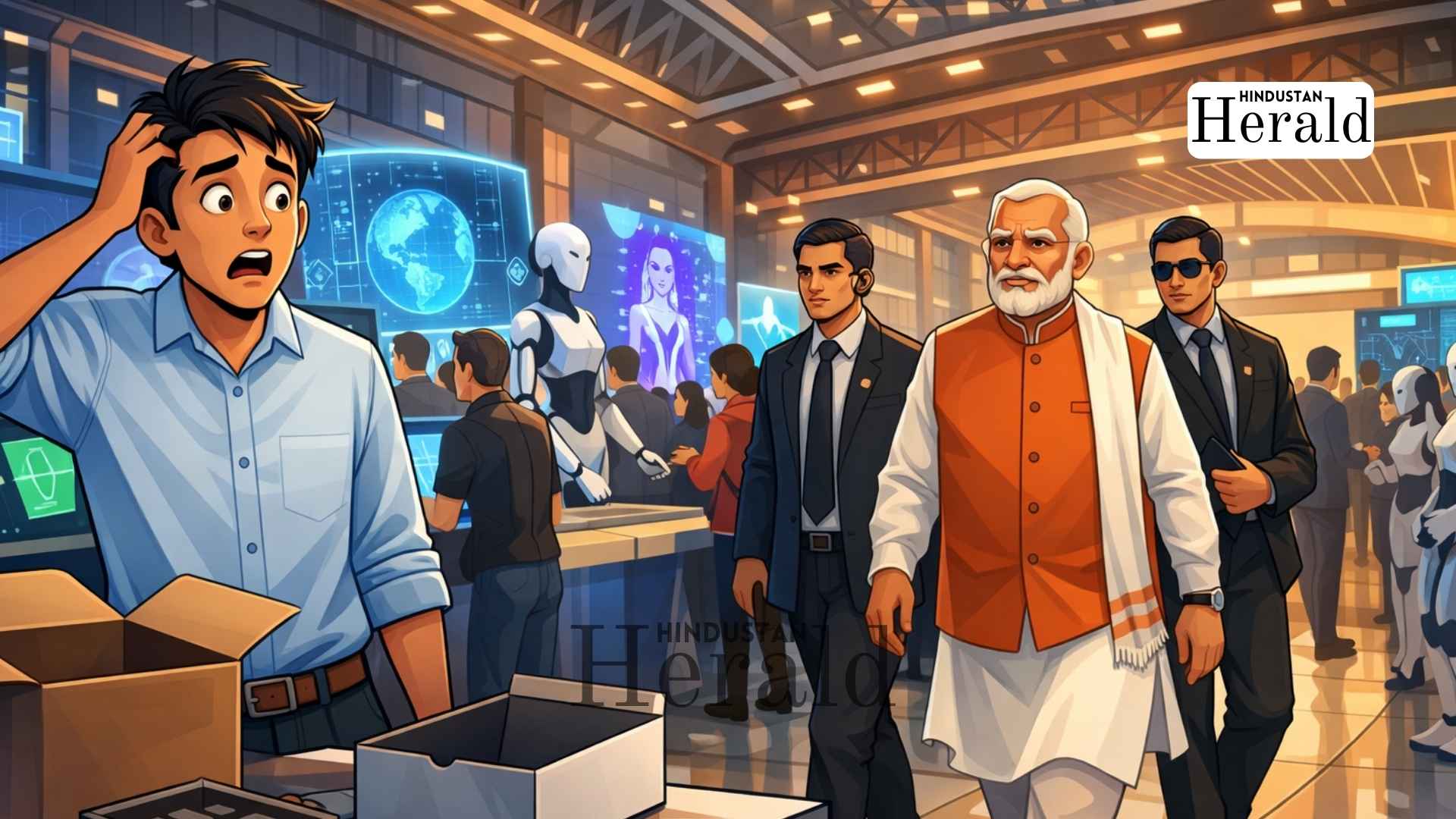
New Delhi, February 17: By mid-morning on Tuesday, the corridors of Bharat Mandapam were already humming again. Students with QR badges around their necks queued beside venture capitalists in linen jackets. Engineers huddled over demo screens. Volunteers tried to restore order where Day 1 had clearly frayed it.
The India AI Impact Summit, billed as the largest gathering of artificial intelligence stakeholders in the Global South, was meant to be a showcase of India’s technological coming of age. Instead, it has opened under a mix of ambition and embarrassment. Grand speeches on inclusive AI were followed by long queues for drinking water. Tight security for the Prime Minister preceded a theft complaint that now threatens to overshadow the event’s promise.
There is no denying the scale. There is also no ignoring the cracks.
A Grand Opening With Lofty Promises
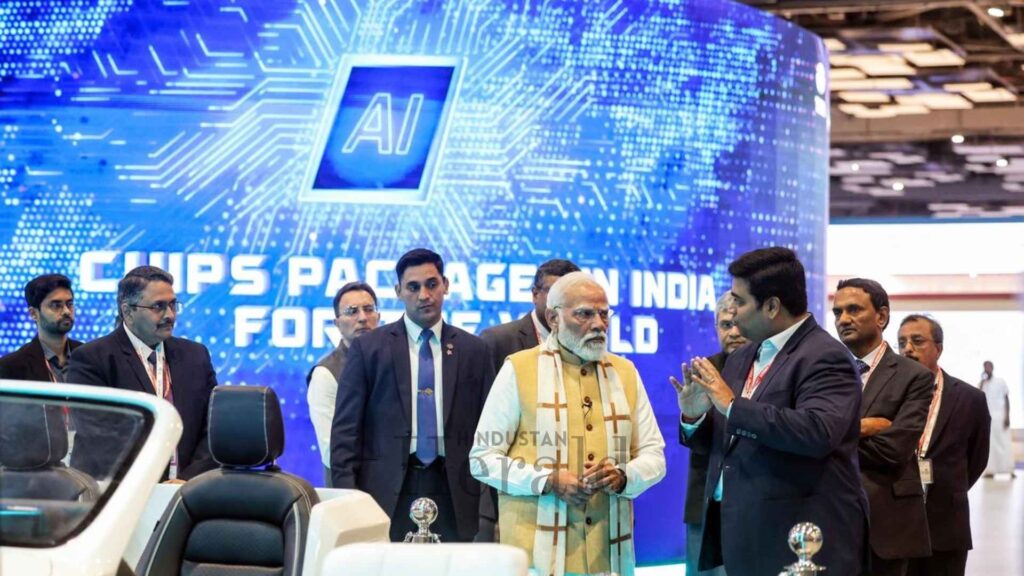
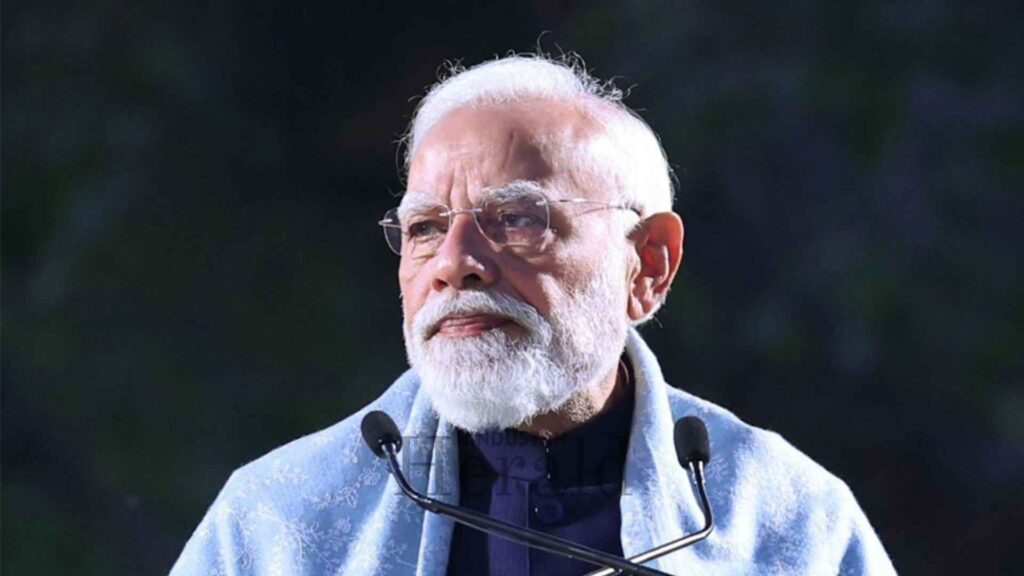
On Monday evening, Prime Minister Narendra Modi inaugurated the five-day summit, invoking the Sanskrit phrase “Sarvajana Hitaya, Sarvajana Sukhaya”, calling for AI that serves public welfare. The message was clear: India wants to lead not only in building artificial intelligence, but in shaping how it is governed.
Before stepping onto the main stage, the Prime Minister toured the exhibition floor. Organizers say more than 600 startups and 13 country pavilions are participating. At one stall, he examined rural AI tools for soil diagnostics. At another, he paused at a healthcare analytics display. The optics were carefully constructed. India as an innovator. India as a regulator. India as voice of the developing world.
During the inauguration, officials unveiled 12 indigenous foundation models, trained on Indian datasets. The emphasis was on local languages, agricultural data, and public service delivery. The subtext was strategic autonomy in AI development, reducing dependence on Western or Chinese models.
That vision, ambitious and carefully scripted, set the tone for what should have been a seamless opening. It did not remain seamless for long.
Crowds, Confusion, And An Uncomfortable Irony
By late afternoon on Monday, frustration was already bubbling online. Attendees described registration portals crashing. Several said their QR codes failed at entry points. Long lines snaked across the complex as security personnel carried out sweeps ahead of the Prime Minister’s visit.

Multiple delegates posted about a shortage of drinking water inside certain halls. Others pointed to an unexpected “cash-only” policy at food stalls. For a summit dedicated to artificial intelligence and digital transformation, the irony was not lost on anyone.
Some of this was perhaps predictable. The event is open to the public on certain days, and Day 2 has seen heavy footfall at the AI Impact Expo. Still, scale does not excuse poor planning. When delegates travel from across the country, sometimes across continents, they expect competence.
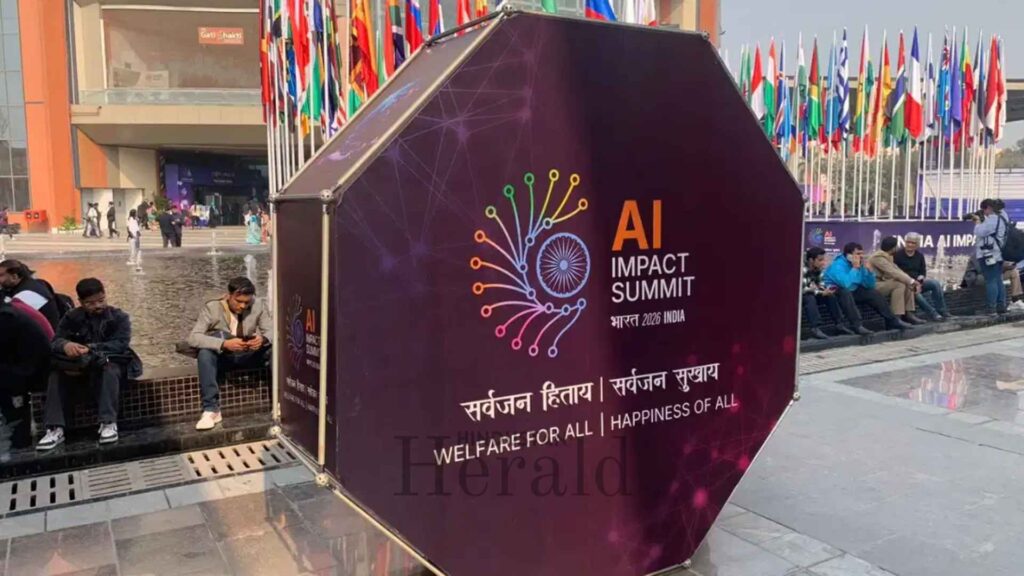
Traffic outside Bharat Mandapam was dense throughout the morning on Tuesday. Police personnel attempted to regulate entry while shuttle buses struggled to keep pace. Inside, panels on AI in healthcare and agriculture proceeded as scheduled, though many conversations in the corridors revolved less around algorithms and more around organization.
The Theft That Changed The Conversation
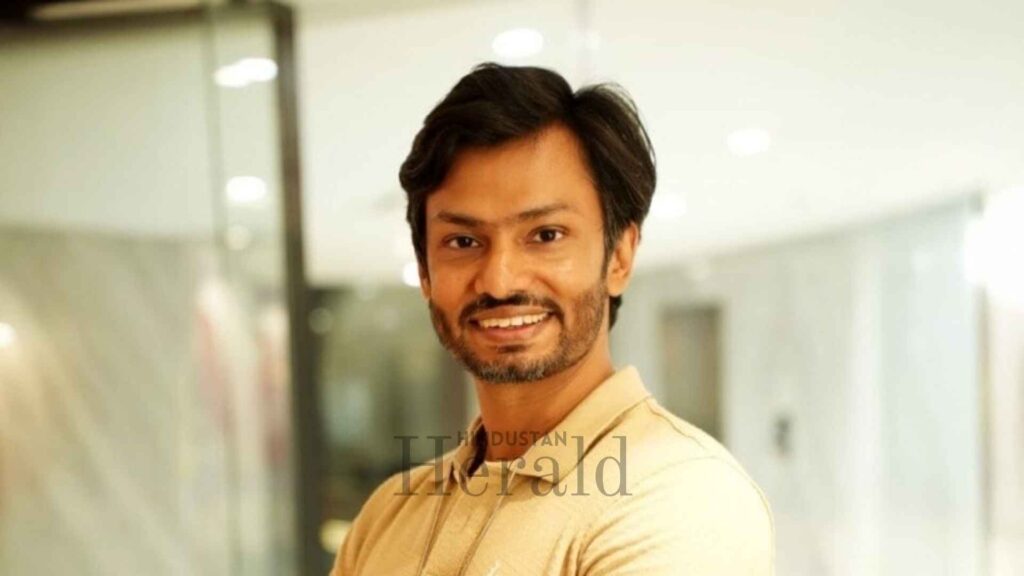
If overcrowding dented the summit’s image, the allegations made by Dhananjay Yadav, Co-Founder and CEO of NeoSapien, have shaken it more deeply.
According to posts shared by Yadav on X, during a security sanitization sweep ahead of the Prime Minister’s arrival on February 16, exhibitors were instructed to vacate their booths temporarily. Yadav has said security personnel assured founders that their equipment would remain safe, noting that some had even left laptops behind.
Yadav claims he was barred from returning to his stall for nearly six hours. When he finally did, he says he found that NeoSapien’s patented AI wearable prototypes were gone. He shared photographs of what appeared to be empty product boxes, neatly arranged but stripped of their contents.
The missing items were not ordinary demo units, according to his account. They were high-value prototypes capable of emotion tracking through biometric analysis. For a startup, such devices are not just hardware. They represent months of research, investor trust, and intellectual property.
The immediate question many have raised is simple: how could such a theft occur inside a secured zone, during a high-level security lockdown?
As of Tuesday afternoon, there has been no public confirmation from Delhi Police of a registered FIR related to the incident. Summit organizers have not issued a detailed statement addressing the allegations. That silence has fueled speculation online.

Founders attending the event privately admit that the episode has unsettled them. Several said off the record that they removed or secured their own equipment more carefully on Day 2.
Trust, once shaken, does not recover instantly.
A Journey That Added Fuel To The Fire
Yadav’s ordeal did not begin at the exhibition floor, at least according to his posts. He also described what he called a “hostage-like” experience during his journey to the summit. In his account, a driver affiliated with Namma Yatri allegedly refused to turn on the air conditioning and demanded additional fare. He claimed he was not allowed to exit the vehicle until payment was made.
Following public backlash, Namma Yatri reportedly issued a refund and apology. While the incident is separate from the summit itself, it has become part of the broader narrative surrounding Yadav’s experience.
It is the kind of story that travels fast. A startup founder arrives at a national AI showcase, faces a dispute en route, and later alleges that his prototypes were stolen under tight security. On social media, nuance rarely survives.
Between Vision And Vulnerability
There is something revealing about how quickly the summit’s tone shifted. On stage, speakers are discussing responsible AI frameworks, data governance, and India’s role in shaping global standards. Off stage, founders are worrying about physical security and basic logistics.
This contrast matters.
India has made no secret of its ambition to be a global AI hub. The unveiling of indigenous foundation models signals an effort to build domestic capacity. Policymakers have repeatedly emphasized “Responsible and Inclusive AI” as a guiding principle.
But responsibility is not only about algorithms. It is about infrastructure. It is about ensuring that when innovators show up, their work is protected. It is about ensuring that a summit promising digital excellence does not falter on basic execution.
None of this negates the genuine enthusiasm on display. Day 2 sessions have drawn packed audiences. Students crowd around startup booths, asking detailed questions about machine learning pipelines and edge computing. Agricultural AI demonstrations have attracted state officials keen on pilot projects.
There is energy here. There is also scrutiny.
What Happens Next
For now, much depends on how authorities respond to the theft allegation. If an FIR is filed and an investigation proceeds transparently, the incident may be contained as an unfortunate lapse. If silence persists, the damage could linger.
The summit runs through February 20. Organizers still have time to steady the narrative. Clear communication, visible security reinforcement, and logistical improvements would go a long way.
Beyond this week, the episode raises a larger question about India’s AI push. Can the country match its policy ambition with operational discipline? Can it create spaces where innovation is celebrated without being compromised?
Those answers will not come from keynote speeches alone.

As Tuesday progresses, the crowds at Bharat Mandapam remain thick. Panels continue. Investors exchange cards. Volunteers hand out brochures with renewed urgency. The mood is not sour, but it is watchful.
In the end, the India AI Impact Summit may still be remembered for its scale and for the policy commitments announced from its stage. But for many who were present on Day 1, it will also be remembered for a few uncomfortable lessons. Technology can be cutting-edge. Organization still has to be basic and human.
For now, the spotlight remains firmly fixed on how swiftly and transparently the concerns are addressed.
Stay ahead with Hindustan Herald — bringing you trusted news, sharp analysis, and stories that matter across Politics, Business, Technology, Sports, Entertainment, Lifestyle, and more.
Connect with us on Facebook, Instagram, X (Twitter), LinkedIn, YouTube, and join our Telegram community @hindustanherald for real-time updates.

Covers Indian politics, governance, and policy developments with over a decade of experience in political reporting.
- Ananya Sharma

- Ananya Sharma
- Ananya Sharma
- Ananya Sharma




 Sandeep Verma