
 By Ananya Sharma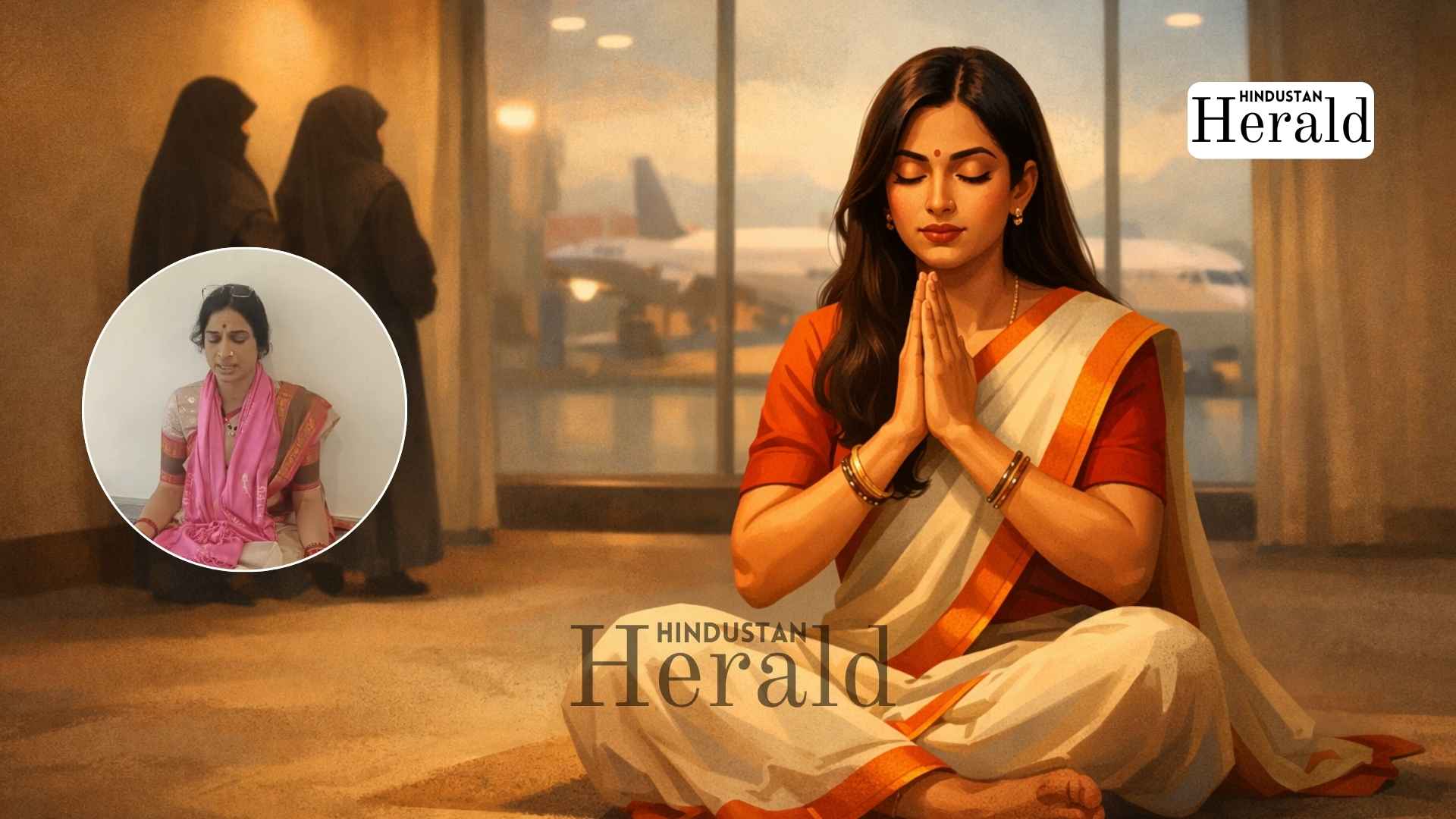
New Delhi, March 25: Let us be honest about something first. If you or I walked into an airport prayer room and quietly said a prayer, nobody would know. Nobody would care. We would catch our flight and life would move on.
Kompella Madhavi Latha is not you or me.
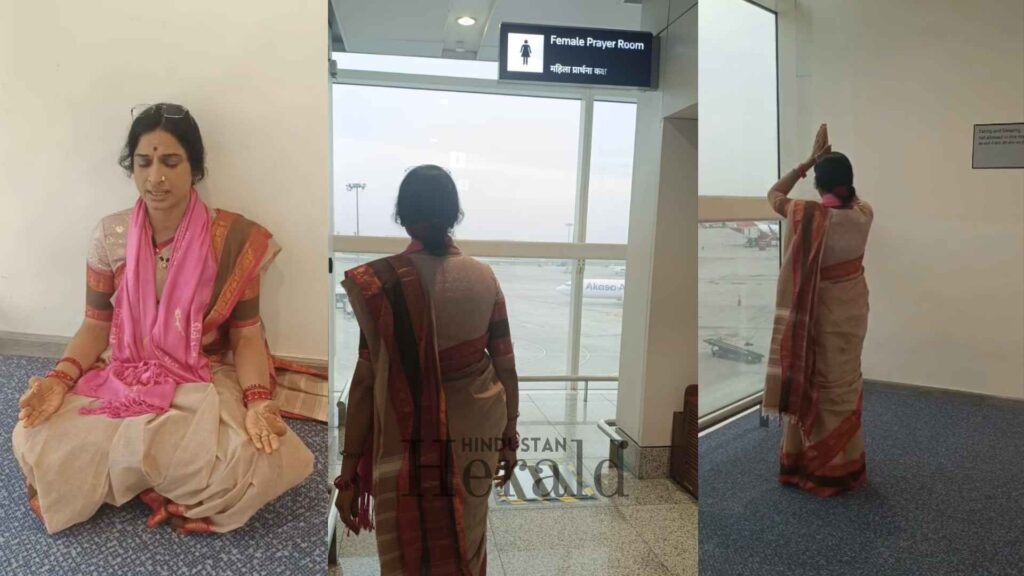
She is a BJP leader from Hyderabad. She walked into the women’s prayer room at Delhi’s IGI Airport on Monday, March 23. She sat down. She prayed the Durgā Sūktam, a Sanskrit hymn sung during Navratri by Hindus across the country. A few Muslim women were in the same room, offering Namaz. The room stayed quiet. Nobody fought. Nobody even exchanged a look, as far as the footage shows.
Then she posted the video online. With a caption. With hashtags. With the word Shuddhi.
And India lost its mind.
What Even Happened Though
Okay so here is the scene, played back simply.
Navratri is on. Nine nights of fasting, prayer, and devotion to goddess Durga. Latha is at the airport, presumably waiting for a flight. She finds the women’s prayer room. She goes in, sits cross-legged, and starts reciting the Durgā Sūktam out loud.
Some Muslim women were offering Namaz nearby. Nobody spoke to each other. Nobody interrupted anyone. Things stayed peaceful from start to finish.
She gets up. She leaves.
Clean, right? Two communities. One room. Zero conflict. Actually, if you think about it, that is kind of beautiful. That is India working the way India is supposed to work.
Except she had been recording the whole time.
She posted the video with a caption calling it a moment of stillness, writing that she had drawn strength from the Mother of the Universe, and urged people to treat such prayer rooms as sacred ground and to ensure their Shuddhi, meaning purity.
And that one word, Shuddhi, opened a can of worms that is still being argued about today.
Why That One Word Matters More Than People Realize
Most people reading this probably think of Shuddhi as just the Hindi word for cleanliness or purity. Fair enough.
But in the history of Indian communal politics, the word carries heavier baggage. It was the name used for organized movements in the early twentieth century that attempted to bring people from other faiths back into Hinduism, framing the whole thing as a process of purification. The word, in that context, was not just about spiritual cleanliness. It was about reclaiming spaces and people that were considered to have been lost or contaminated.
Now, did Latha mean all of that when she typed the word? Maybe. Maybe not. She has not explicitly said so.
But words carry their histories whether the person using them intends it or not. And when a political figure uses a historically loaded word while filming Muslim women in the same room without their knowledge, people are going to notice.
Nobody Is Completely Wrong Here, That Is What Makes It Messy
Here is where this story gets genuinely complicated, and any reporter worth their salt has to say this out loud.
Latha’s supporters have a point.
Airport prayer rooms are for everyone. They are not labeled for one religion. They do not have a majority community. They belong equally to the Hindu aunty catching a morning flight to Tirupati and the Muslim businessman heading to Dubai. If a Hindu traveler feels like these rooms are in practice dominated by Namaz while their own prayer feels unwelcome, that is a real feeling. Whether or not the data supports it, the feeling exists and it deserves to be addressed rather than dismissed.
Latha herself said she believes multi-faith prayer rooms should be respected as sacred spaces for people of all religions and that they reflect India’s diversity, accessible to everyone without discrimination.
Hard to argue with that on its face.
But here is the other side of it, and this part also matters.
Critics argued that these rooms are meant for quiet, private reflection, and that chanting out loud while a camera is rolling is not quite the same thing as personal prayer.
And the women in burqas in that video never agreed to be filmed. They walked into a private space to pray. They did not walk into a political video shoot. This is exactly what the Majlis Bachao Tehreek raised in their complaint at Dabeerpura Police Station in Hyderabad, flagging privacy violations alongside concerns about communal harmony.
Both of these things can be true at the same time. That is what makes this story hard to close neatly.
Okay But Who Is This Woman and Why Does She Always End Up in These Situations
Good question.
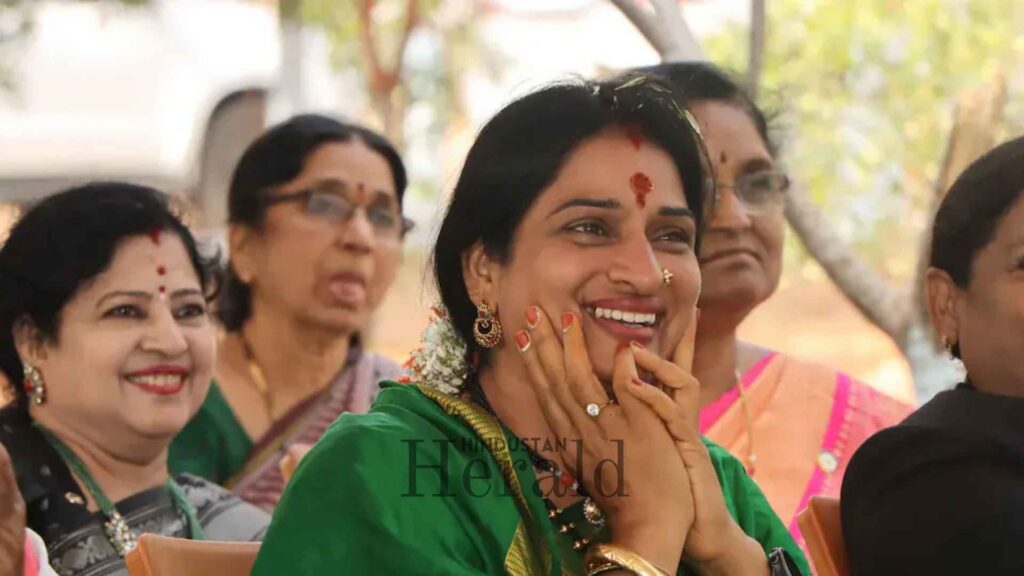
Madhavi Latha is a classical dancer turned social worker turned politician. In 2024, she became the first woman the BJP ever fielded in Telangana, specifically chosen to take on Asaduddin Owaisi, the AIMIM chief who has held Hyderabad like a fortress for decades. She lost. Badly. By over three and a half lakh votes.
But losing did not make her go quiet.
Before the votes were even counted, she had already made national news multiple times. During the campaign she drew controversy for directing an imaginary arrow toward a mosque. On election day she walked into a polling booth and personally checked the voter ID cards of Muslim women who were wearing burqas.
Both incidents got her condemned by opposition parties. Both incidents also got her massive attention, new followers, and viral coverage that money cannot buy.
Then came Aap Ki Adalat on India TV, the long-running interview show where host Rajat Sharma puts public figures in the hot seat. Latha sat across from him and spoke about Hyderabad, about Owaisi, about Triple Talaq, about the Hindu community in the Old City and what she called years of political neglect. She embraced her reputation for being aggressive. She did not apologize for anything.
Her first appearance on that show back in April 2024 was so well received that Prime Minister Narendra Modi personally called it exceptional, saying she had made solid points with both logic and passion and encouraging people to watch the repeat telecast.
She is not a nobody making noise from the margins. She has the Prime Minister’s public stamp of approval. That tells you something about how her party views her role in Hyderabad.
The Real Reason This Went National
People keep asking: why did a prayer in a prayer room become this big a deal?
Here is the plain answer.
Because India in 2026 is a country where any act involving both Hindu and Muslim identity in the same frame instantly becomes a national story. It does not matter how small the act is. It does not matter if no one was hurt. The moment those two communities appear together on camera in a context that can be read as friction, however minor, the political machine on both sides kicks into gear.
Latha knew this. She is not naive. She has been in politics long enough to know exactly what posting that video would do. The hashtags were not chosen randomly. The caption was not written in five seconds. That was a considered communication decision.
If a Muslim woman politician had walked into the same room, filmed herself offering Namaz while a Hindu woman was reading the Bhagavad Gita nearby, and posted it with a caption about reclaiming shared spaces for all of India’s children, the people currently defending Latha would be leading the charge against her. And the people currently attacking Latha would probably be celebrating the clip.
That is not a guess. That is just how Indian political social media works and everyone knows it.
Pointing this out is not about defending or attacking anyone. It is about being straight with the reader. The outrage in this country is rarely about principle. It is usually about which team is doing the thing.
Where Things Stand Right Now
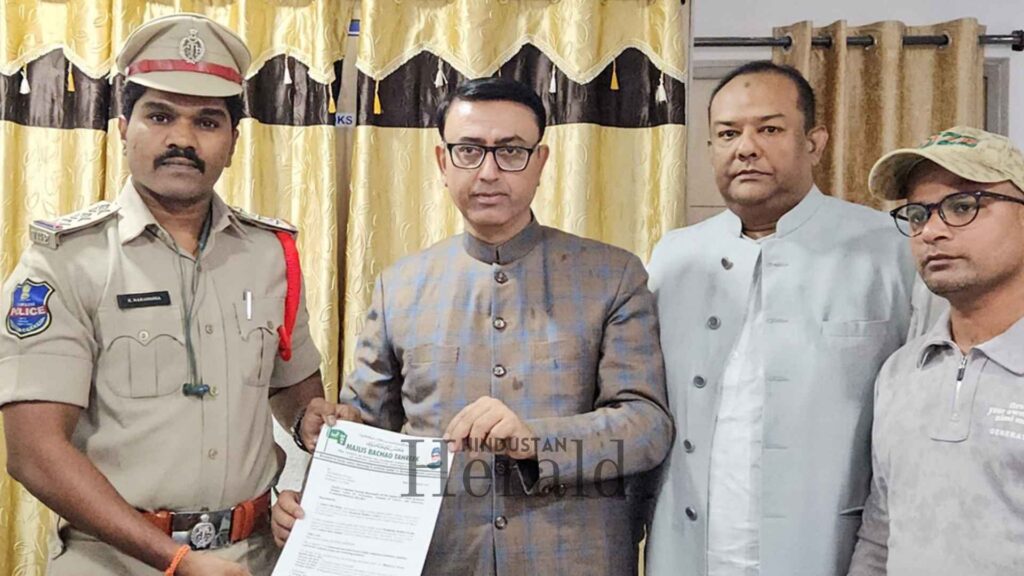
As of today, March 25, no action has been taken against Latha. The MBT complaint in Hyderabad is sitting with the police. The video is still up. The arguments are still going on television panels where six people shout over each other and nobody changes their mind.
Latha has not walked anything back. She does not tend to.
The Muslim women in that video have not spoken publicly. They probably just wanted to catch their flights.
And the prayer room at IGI Airport is still there, still open, still waiting for the next tired traveler who needs a few minutes of quiet before stepping back into the chaos of the terminal.
That room was built on a decent idea. The idea that in a country as big and complicated and religiously layered as India, you should be able to find five minutes of peace regardless of what you believe.
It is a shame the idea has to keep defending itself.
Stay ahead with Hindustan Herald — bringing you trusted news, sharp analysis, and stories that matter across Politics, Business, Technology, Sports, Entertainment, Lifestyle, and more.
Connect with us on Facebook, Instagram, X (Twitter), LinkedIn, YouTube, and join our Telegram community @hindustanherald for real-time updates.

Covers Indian politics, governance, and policy developments with over a decade of experience in political reporting.
- Ananya Sharma

- Ananya Sharma
- Ananya Sharma
- Ananya Sharma




 Arun Upadhayay and Ananya Sharma
  Neeraj Kapoor and Ananya Sharma