
 By Ananya Sharma and Arun Upadhayay
Nashik, April 13: There is a particular sound that a hundred-year-old banyan tree makes when it falls. People who were on Gangapur Road in the early hours of April 5 will probably not forget it. By the time the sun came up, the chainsaws were already running, JCB excavators had their arms raised, and a stretch of road that had been shaded by ancient trees for as long as most Nashik residents can remember was suddenly, violently, open to the sky.
What followed was not just a protest. It was grief.
Women wrapped themselves around trunks. Young men sat down in front of the machinery. Videos flooded every WhatsApp group in the city, one after another, trees toppling, branches crashing, decades of growth gone in minutes. By nightfall, what had been a slow civic dispute about Simhastha Kumbh Mela infrastructure had become something much more raw and harder to contain.
The Idea That Started It All
Go back a few months, and the issue looks almost manageable on paper. The Nashik Municipal Corporation needed space. Lots of it. The Simhastha Kumbh Mela is not a small gathering. The 2027 edition, which officially kicks off on October 31, 2026, and runs until July 24, 2028, is expected to draw a staggering number of pilgrims to the banks of the Godavari. To house the saints and religious orders who anchor the mela, the NMC was planning a Sadhu Gram in Tapovan, the kind of temporary township that becomes a city within a city during these events.

The scale of ambition was significant. The Sadhugram area, which covered around 350 acres during the 2015 Kumbh, was being expanded to nearly 1,200 acres this time. The number of sadhus expected had jumped from 2.5 lakh to an estimated 10 lakh. Maharashtra, watching what Prayagraj pulled off at the last Maha Kumbh, was not going to be outdone.
But the land chosen for this expansion was not empty. It was covered by trees. Hundreds of them. Some of them very, very old.
In November 2025, the NMC invited public objections to a proposal to remove over 1,700 trees from the Tapovan site. More than 600 people responded formally. Environmental groups filed 400 written objections. Around 1,670 trees had already been marked with yellow paint, roughly 40 percent of them earmarked for felling. That figure alone was enough to set off the first round of protests, the Chipko-style demonstrations where residents hugged trees in full public view and demanded the corporation look elsewhere.

The corporation did not look elsewhere.
What Nobody Mentions About September
Before the Tapovan row even became public, something else had already happened. Quietly, with barely a line of coverage, the NMC had cut down 1,273 trees in September and October 2025 to make way for new solid waste management systems. No dramatic announcements. No public consultation that activists were aware of. Just trees gone, and a city that did not quite notice until months later.
When this came to light, it changed the texture of the debate entirely. It was no longer about one site or one proposal. It was about a pattern, a civic body that treated tree-felling as an administrative detail rather than an ecological decision. That is the context in which Gangapur Road happened. That is why people were so angry so fast.
The Night the Stay Order Did Not Arrive in Time
A petition challenging the NMC’s tree-felling was pending before the Pune bench of the National Green Tribunal. A hearing was scheduled for Monday, April 7. It was adjourned to Tuesday.
The NMC, apparently aware of the adjourned hearing, used the gap. Through the night of April 7, tree-cutting on Gangapur Road accelerated. Activists who reached the site demanded it stop. Officials told them, ” Show us a written order. By 1:00 AM, 22 more trees had been cut. The stay came the next morning.
That sequence needs to sit for a moment. A government body with full knowledge of pending legal proceedings pushed ahead through the night to fell as many trees as it could before a tribunal could stop it. Advocate Shriram Pingale, who had filed one of the petitions, immediately warned the NMC of contempt of court proceedings.
The NGT’s Pune bench, acting on the petition filed by environmentalist Manish Baviskar, issued an interim stay on all tree-felling within Nashik’s municipal limits until April 28. The NMC has been directed to submit a counter-affidavit and appear before the tribunal on that date.
For the trees still standing on Gangapur Road, that order was the difference. For the 22 that fell overnight, it came too late.
The Law Already Had an Answer
Here is something the NMC’s public statements have not addressed directly. Under the Maharashtra Tree Protection Act, 1964, as amended in 2019, felling any tree older than 90 years is strictly prohibited. Not subject to a permit process. Not eligible for compensatory plantation. Prohibited.
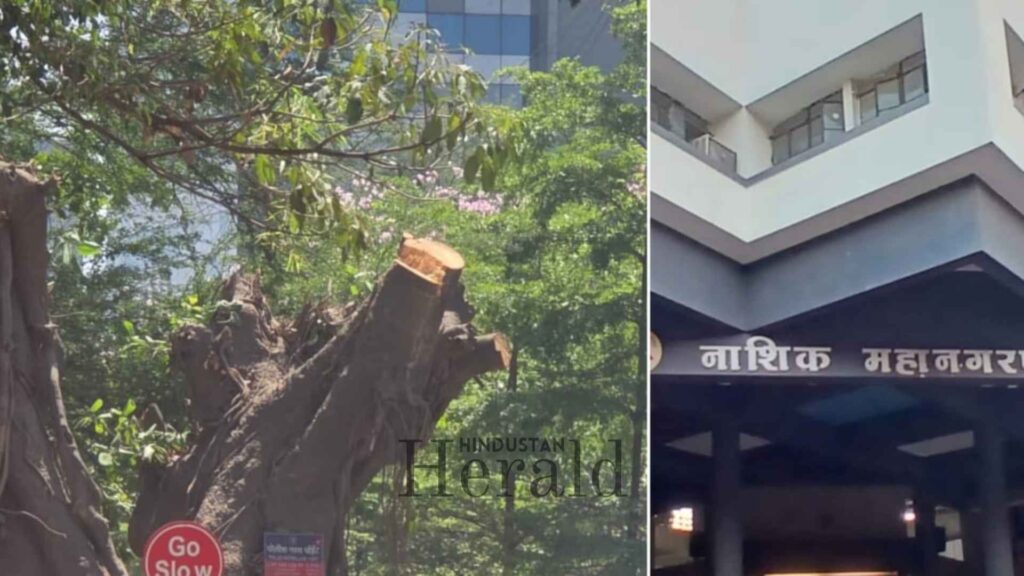
Nashik’s banyan trees, several of which were over a century old, were felled anyway. Environmentalist Sheetal Adke Gole put it plainly: “There is a complete disregard for the scientific protocols required for tree relocation. This is causing immense damage to the biodiversity that depends on these trees.”
The corporation’s defence leaned heavily on its 10-for-1 replanting promise, the assurance that for every tree removed, ten saplings would go in the ground. On the surface, it sounds reasonable. In practice, it is the kind of arithmetic that sounds better in a press release than it does in an ecology textbook. A sapling planted today will not provide canopy cover, groundwater recharge, or habitat value for decades. A 100-year-old banyan cannot be substituted. The math simply does not hold.
The NMC also promoted a slogan: “The same tree, but a new location.” Activists were scathing about this. The transplantation being carried out, they said, was not following the prescribed scientific protocols. Trees were being pruned incorrectly, in ways that effectively guaranteed they would not survive relocation. So the slogan was not just optimistic, it was, in their assessment, demonstrably false.
The Mayor’s Case
Nashik Mayor Himgauri Aher-Adke has been consistent in her defence of the NMC’s actions and it is worth understanding her argument fully before dismissing it.

Road widening on Gangapur Road, she said, was not a Kumbh Mela panic measure. The city’s accident record on that stretch was serious. Police data showed 46 fatalities over recent years, with 31 deaths and 23 injuries in the period between 2015 and 2019 alone. The Kumbh Mela would bring millions more onto these roads. Without expansion, she argued, the situation would become genuinely dangerous.
The Mayor told reporters that environment-friendly measures in compliance with Supreme Court directives were being implemented throughout the process and that tree conservation was being prioritized wherever possible.
That said, her argument does not fully explain the overnight acceleration when the NGT hearing was postponed, and it does not explain why trees explicitly protected under state law were felled. Safety arguments are real, but they are not above scrutiny, and the manner in which these operations were conducted left little room for the civic trust that such arguments require.
When the Sadhus Said They Did Not Need This
The politically awkward reality for the Maharashtra government is that the strongest opposition to cutting trees for the Sadhu Gram has come from within the religious community itself.
Mahant Ganeshanand Saraswati of Anand Akhada in Trimbakeshwar said naga sadhus live under extreme conditions by choice. They do not need comfort infrastructure built on the ruins of a forest. Before him, Jagadguru Shankaracharya Avimukteshwaranand Saraswati of Jyotish Peeth and Dwarka Peeth had said something even more pointed: that cutting trees to perform Kumbh snan is not a symbol of religion.
You cannot get a more direct rebuttal than that. The religious justification for this level of tree destruction has been rejected by senior figures in the very tradition it was meant to serve.
And then there is the question of what else is planned for Tapovan. The Sadhu Gram is one component. A convention centre is another. Activists have raised this repeatedly, the suspicion that the religious occasion is providing political cover for something that, stripped of the Kumbh framing, would face far more scrutiny as a real estate and infrastructure project.
An Alternative That Was Offered and Ignored
Manikrao Kokate, a minister from the Ajit Pawar-led NCP, offered a different solution entirely. Move the Sadhugram to Sinnar, about 30 kilometres from Nashik. Provide transport for sadhus to reach the Godavari. He said he had land available in Sinnar from his constituency and was willing to facilitate access.
The NMC and the Kumbh Mela authority have not responded to this proposal. The silence is telling. If the only goal were accommodation for pilgrims, Sinnar is a workable answer. The reluctance to engage with it suggests that proximity to the Tapovan site carries value beyond religious logistics.
5,000 Trees and a City’s Future Summers
Environmentalists are looking past the current legal battle at a number that should trouble anyone who lives in Nashik. They estimate that between 5,000 and 6,000 trees across the city could ultimately be at risk from the full scope of Kumbh Mela-linked construction and road work.
Gangapur Road on a summer afternoon used to be one of those roads you could walk. The canopy kept it tolerable even in May. It will not feel the same for a long time. Residents on social media were blunt about it: with summer temperatures already touching 45 degrees Celsius, the loss of this green cover is not an abstract environmental concern. It is a material change to daily life.
The ecology argument extends further. The Godavari itself depends on forest cover for its flow. The tree roots that line the banks are not decorative. They hold soil, regulate water, and support an entire biological web that makes the river’s banks habitable. Cutting them to prepare for a festival centred on that river carries an irony too heavy to ignore.
April 28 and What It Actually Decides
The NGT hearing on April 28 will be important. The NMC must defend its decisions formally, on record, before a tribunal that has already found reason to intervene twice. Whether the stay holds, gets extended, or is lifted with conditions will shape whether the rest of Nashik’s tree cover survives the Kumbh preparations.
But it will not undo what is already gone. The ancient banyans on Gangapur Road are not coming back. The 1,273 trees from last autumn are not coming back. Whatever the tribunal decides, Nashik has already paid a price that no sapling can repay on any realistic timeline.
What is actually being decided on April 28 is how much more the city loses.
There is a version of Kumbh Mela preparation that takes the environment seriously, plans years, uses alternative sites, and leaves the host city’s ecology intact. Every religious authority worth listening to on this matter has pointed toward that version. The question is whether the Maharashtra government, the NMC, and the administration of the Nashik-Trimbakeshwar Kumbh Mela Authority are still capable of finding their way there before the chainsaws start again.
For now, Nashik’s trees have until April 28. After that, nobody knows.
Stay ahead with Hindustan Herald — bringing you trusted news, sharp analysis, and stories that matter across Politics, Business, Technology, Sports, Entertainment, Lifestyle, and more.
Connect with us on Facebook, Instagram, X (Twitter), LinkedIn, YouTube, and join our Telegram community @hindustanherald for real-time updates.

Covers Indian politics, governance, and policy developments with over a decade of experience in political reporting.
- Ananya Sharma

- Ananya Sharma
- Ananya Sharma
- Ananya Sharma





- Arun Upadhayay
- Arun Upadhayay
- Arun Upadhayay
- Arun Upadhayay