
 By Rajiv Menon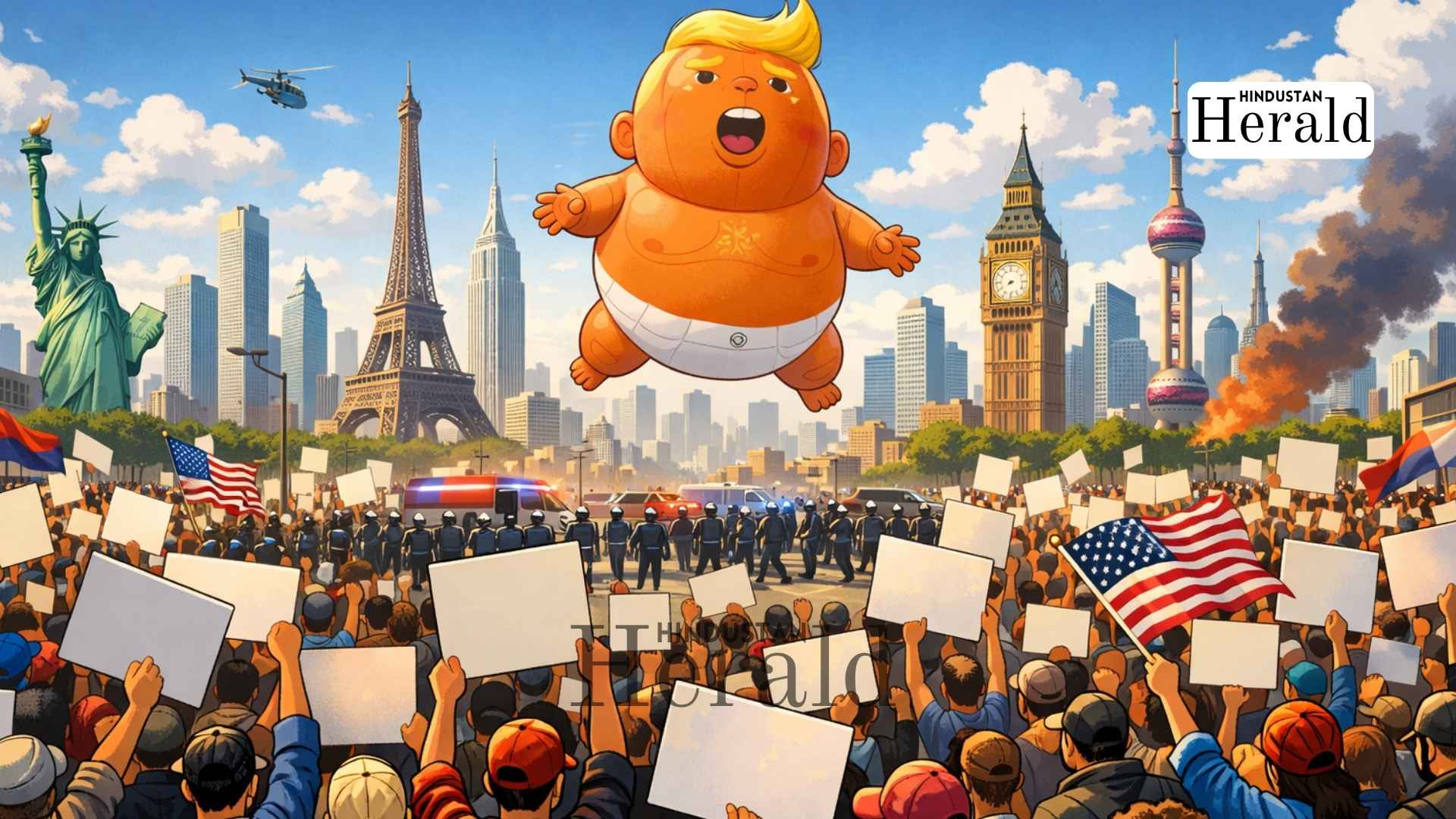
New Delhi, March 30: America’s streets turned into the world’s largest democratic spectacle on Saturday, March 28, 2026. More than eight million people marched, chanted, danced, held signs, and made noise across over 3,300 cities, towns, and villages in all 50 states of the United States, making the No Kings protest, by most measures, the single largest day of mass mobilization in American history.
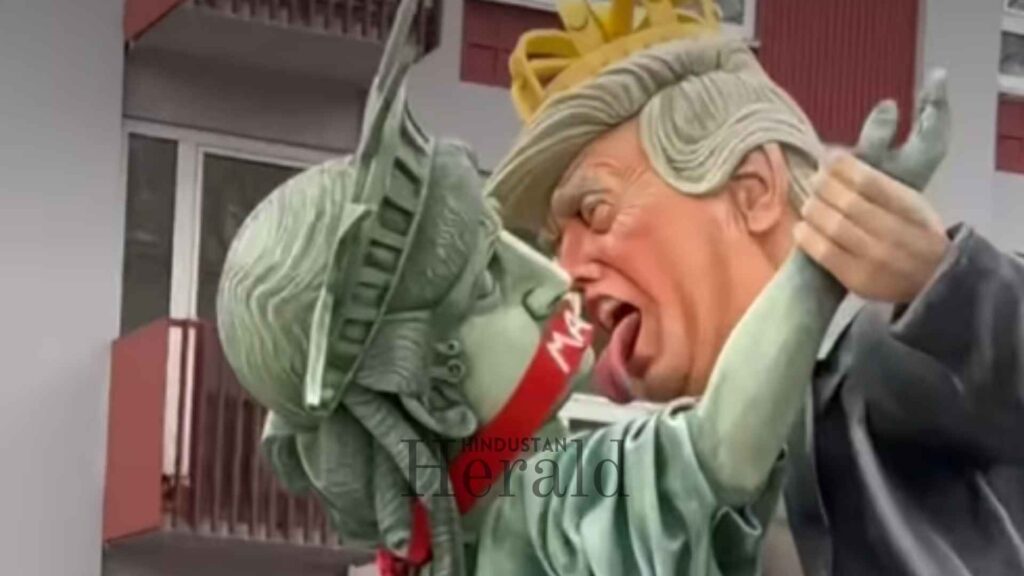
For the rest of the world and particularly for India, which sends more skilled professionals to the United States than any other nation, what happened on that Saturday is not just an American story. It is a World News event with direct, measurable consequences that stretch from Washington DC to New Delhi, from Silicon Valley to the Strait of Hormuz.
What The No Kings Movement Is And Where It Came From
The No Kings movement was not born on March 28. It has been building for nearly a year.
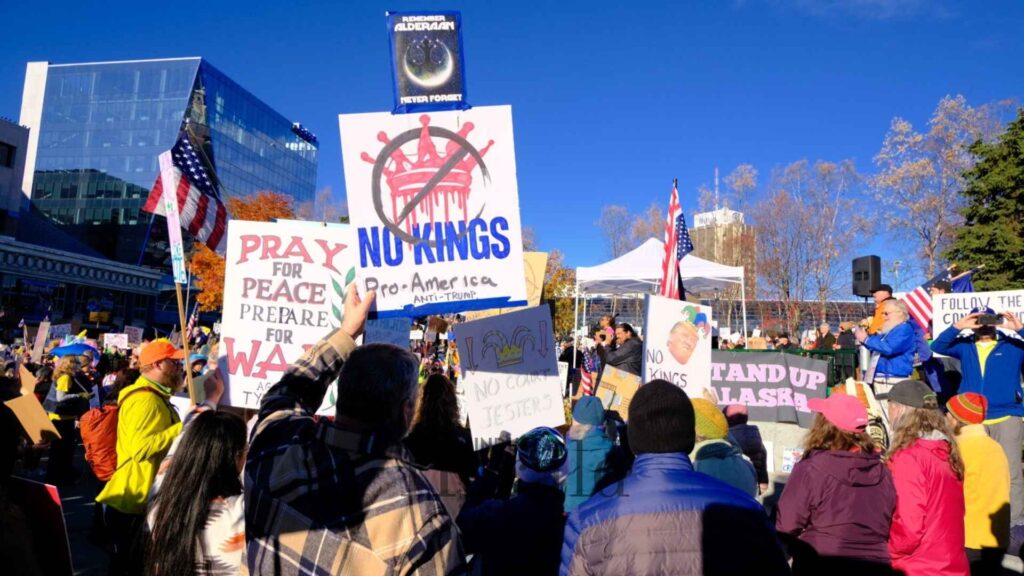
The protests were part of a series of demonstrations against the actions and policies of the second Trump administration, including the 2026 Iran war, democratic backsliding, suppression of the Epstein files, and ICE operations that led to shootings by immigration agents, most notably the killings of Renee Good, Keith Porter, and Alex Pretti.
The first No Kings protest took place on Trump’s 79th birthday last June and coincided with a military parade he organized in Washington. The second mobilization, in October 2025, drew an estimated seven million participants in more than 2,700 cities. March 28 was the third round and the biggest by far.
The movement is coordinated primarily by two organizations: Indivisible and 50501, with support from the American Federation of Labour and Congress of Industrial Organizations (AFL-CIO), the Third Act Movement, the ACLU, and dozens of other civil society groups. As ACLU chief political officer Deirdre Schifeling said in a statement ahead of the march, “Peaceful, people-led movements have always led the way for real change. We are at a dangerous moment for our democracy it’s time to come together again and fight to stay free.”
The Scale: Numbers That Matter
The raw numbers behind March 28 demand attention.
Organizers said at least eight million people took part in more than 3,300 events held in major cities, suburbs, and rural areas. Protests were mostly peaceful, but some arrests were reported in Los Angeles and Denver, according to local police.
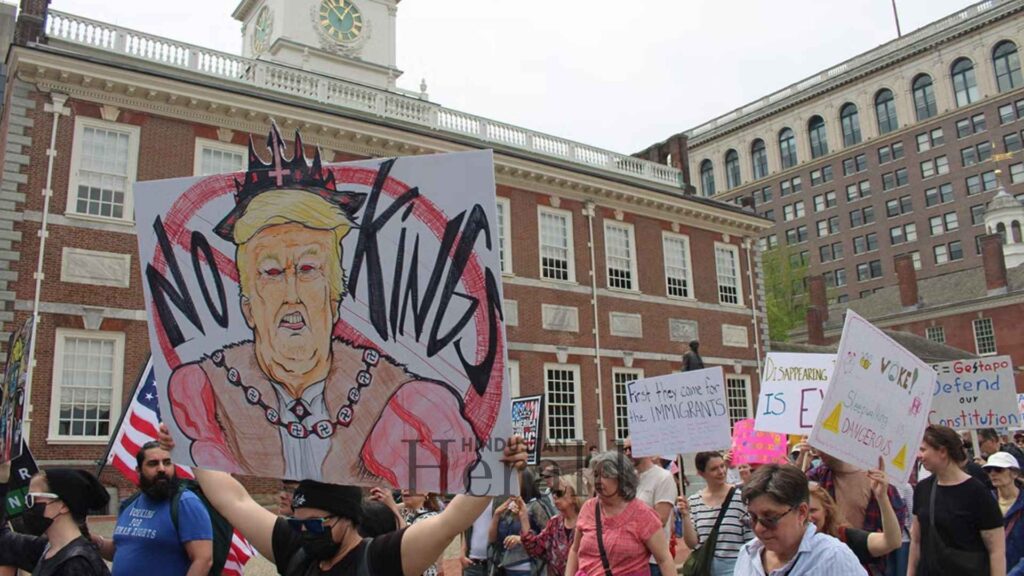
The No Kings movement launched last year on Trump’s birthday drew an estimated four to six million people across roughly 2,100 sites. The second mobilization in October involved an estimated seven million participants in more than 2,700 cities, according to a crowdsourcing analysis published by prominent data journalist G. Elliott Morris.
Harvard researchers have found that the No Kings protests are spreading deeper into Trump country over time. Almost half of the protests took place in GOP strongholds. Texas, Florida, and Ohio each had over 100 events. States like Idaho, Wyoming, and Utah had events in the double digits. Some of the most symbolically powerful protests took place not in New York or Los Angeles, but in deeply conservative communities that had never seen public dissent on this scale before.
What Drove Eight Million People Onto The Streets
To understand the No Kings movement, you need to understand what its participants say they are reacting to.
Demonstrators turned out to protest what No Kings organizers call President Donald Trump’s “authoritarian power grabs” policies covering everything from the Iran war, immigration, and federal law-enforcement crackdowns in cities, to the recent deployment of ICE officers to airports.
The Iran war was a dominant grievance. Saturday’s events came amid what organizers said was a call to action against the bombardment of Iran by the US and Israel, a conflict now four weeks old. Protesters in Durham, North Carolina and Washington DC specifically demanded an end to military action in Iran, with Vietnam War veterans leading chants of “No more war!” at multiple venues.
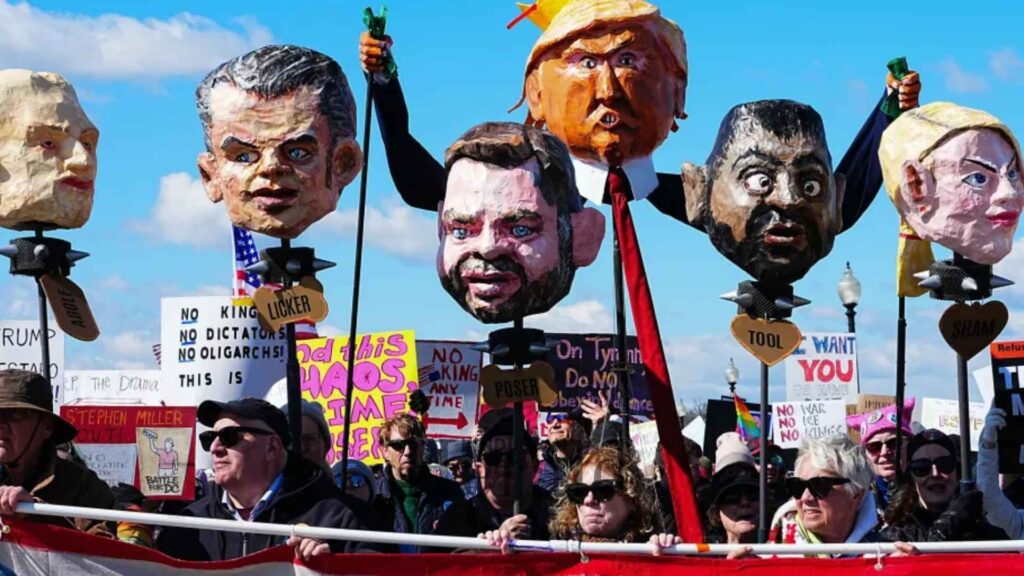
The immigration crackdown was the second major issue. Many in the crowd at the Minnesota flagship event held aloft posters bearing photos of Renee Good and Alex Pretti, whom federal immigration officers fatally shot in Minneapolis this year. The October 2025 mobilization was largely fuelled by a backlash against a government shutdown, an aggressive crackdown by federal immigration authorities, and the deployment of National Guard troops to major cities.
On the economic front, Trump’s polling was already described as “in the toilet” by analysts, with nearly 60 per cent of respondents in a Fox News poll disapproving of the job he is doing as president. Every day, Americans are feeling more and more squeezed by rising prices.
The Protest That Made The World Stop And Stare
What set this day apart from conventional political protest was its tone. It was loud, colourful, funny, and in many moments, deeply moving.
The image that circulated most widely across global social media was the giant blimp depicting Trump as a diaper-clad baby, floating above Los Angeles City Hall. Scores of protesters filed into San Francisco’s Embarcadero Plaza wielding American flags and No Kings signs alongside it.
In Portland, Oregon, three protesters dressed as inflatable sharks carried a sign reading “Abolish ICE,” marching to music played by the Unpresidented Brass Band a name that became one of the day’s most-shared jokes online. A sign in Portland read “So bad, even introverts are here,” which reportedly stopped passersby in their tracks.
At Boston Common, a man dressed as George Washington arrived carrying a sign reading “George Washington told Congress #NoKings.” In Washington DC, a demonstrator near the Washington Monument carried a sign reading “Trump for Prison 2026.” Outside the Minnesota State Capitol, one protester held a sign that read “They want 1939 Germany, they’ll get 1789 France.”
An elderly woman in Massachusetts went viral with a sign reading “NO YOU’VE PISSED OFF GRANDMA.” In Durham, as reported by NC Newsline, protesters wore brightly coloured costumes and played music despite the gravity of the moment. Jenny Hubert, who bought a drum from a thrift shop ahead of the march, said it was her first time playing one in public. “It regulates the nervous system,” she said.
The celebrity presence added further weight. Minnesota held the flagship No Kings rally at the State Capitol in St. Paul, where Bruce Springsteen performed his recent single “Streets of Minneapolis,” about the killings of Renee Good and Alex Pretti by federal officers, to a massive audience. The line-up also included Joan Baez and Governor Tim Walz. In New York City, tens of thousands rallied, including actor Robert De Niro, who called the US President an existential threat to American freedoms and security.
The Political Arithmetic: Trump’s Approval Crisis
The No Kings protest did not emerge in a vacuum. It came at a moment of acute political vulnerability for the Trump administration.
A March 23 poll by Reuters-Ipsos showed that 36 per cent of respondents approved of the president’s job performance, reflecting concerns about rising fuel prices at home and the war in Iran. The latest Quinnipiac poll found similar results, with disapproval ratings of 56 per cent overall, 58 per cent for his handling of the economy, 59 per cent for his handling of foreign policy, and 59 per cent for his handling of the Iran war.
Trump’s approval rating has fallen to 36 per cent, its lowest point since his return to the White House, according to a Reuters/Ipsos poll. A spokesperson for the National Republican Congressional Committee criticised Democratic politicians for supporting the rallies, calling them “Hate America Rallies where the far-left’s most violent, deranged fantasies get a microphone.”
Heading toward November’s midterm elections, which will determine the makeup of the US Congress, rally organizers say they have seen a surge in the number of people organizing anti-Trump events and registering to participate in deeply Republican states like Idaho, Wyoming, Montana, and Utah. Aldon Morris, an emeritus professor of sociology and African American Studies at Northwestern University, says he sees strong parallels between the civil rights movement of the 1950s and 1960s and the current wave of activism.
The Global Dimension: Protests Beyond American Borders
The No Kings movement crossed borders on March 28.
Rallies also took place in Europe, with around 20,000 people marching under a heavy police presence in cities including Amsterdam, Madrid, and Rome. In Paris, several hundred people, mostly Americans living in France, along with French labour unions and human rights organizations, gathered at the Bastille. “I protest all of Trump’s illegal, immoral, reckless and feckless endless wars,” said the Paris No Kings organizer Ada Shen.
Some events were planned in Australia, Costa Rica, Europe, Canada, and Japan by a number of American expatriate organizations such as Democrats Abroad. In France, various grassroots movements joined the protests in most of France’s major cities.
That international dimension matters for a specific reason. The Trump administration’s foreign policy decisions, including the war in Iran, tightening immigration controls, and steep tariffs on trade partners, are not America’s problems alone. They carry consequences for energy markets, diplomatic alignments, and migration corridors that touch virtually every major economy, India included.
What This Means For India: A Direct Line Of Impact
For Indian readers, the No Kings protest is not just international background noise. The political forces it is reacting to are the same forces that have reshaped the conditions for millions of Indians living, working, and studying in the United States.
On visas and skilled migration: During Trump’s first term, H-1B visa denial rates rose sharply from about 6 per cent in 2016 to 24 per cent in 2018, reaching nearly 30 per cent by 2020. Despite this, Indian professionals continued to dominate H-1B visa approvals, securing around 73.9 per cent of all visas issued annually. More than one million Indians became stuck in employment-based green card backlogs, with waiting periods extending into decades.
In the second term, conditions have tightened further. A US judge upheld the administration’s $100,000 application fee on H-1B visas, sealing what Bloomberg described as a year of immigration chaos hurting Indian businesses and families. According to the Reserve Bank of India, remittances sent back from the Indian diaspora worldwide stood at around $135 billion in 2024. Nasscom said in a statement that the new fee could have “ripple effects” on US innovation and the wider job economy.
On sentiment within the diaspora: A 2026 survey by the Carnegie Endowment for International Peace found that Indian Americans are confronting a convergence of cross-pressures that has recast their position in America’s social and political landscape. The survey found that 18 per cent of Indian Americans report avoiding political rallies or protests, and another 21 per cent report avoiding leaving and re-entering the United States. Immigration policy stands out as a focal point of opposition to the Trump administration’s second term.
On the trade and tariff front: New Delhi is currently facing a steep 50 per cent tariff on its exports to the US half of that for buying Russian crude, which the US says is funding the Kremlin’s war on Ukraine.
On alternative destinations opening up: As highly skilled immigrants face fewer options in the United States, other countries have opened their doors. Last year, Germany increased the number of visas granted to skilled Indian workers from twenty thousand to ninety thousand. China launched its new K visa, which offers STEM graduates work authorisation without a job offer. Canada, South Korea, and the United Kingdom are also exploring options to attract the highly skilled labour market that Trump’s proposed policy could create.
The No Kings protest is, at one level, an internal American political battle. But the policies that protest immigration restrictions, military adventurism, and economic nationalism have already altered the calculus for Indian professionals, Indian students, and the Indian government’s own foreign policy positioning.
What Comes Next
No Kings organizers will hold a community call on March 31 to address what comes next. They plan to roll out training sessions for protest participants to know their rights and how to de-escalate tensions with law enforcement or counter-protesters at future rallies.
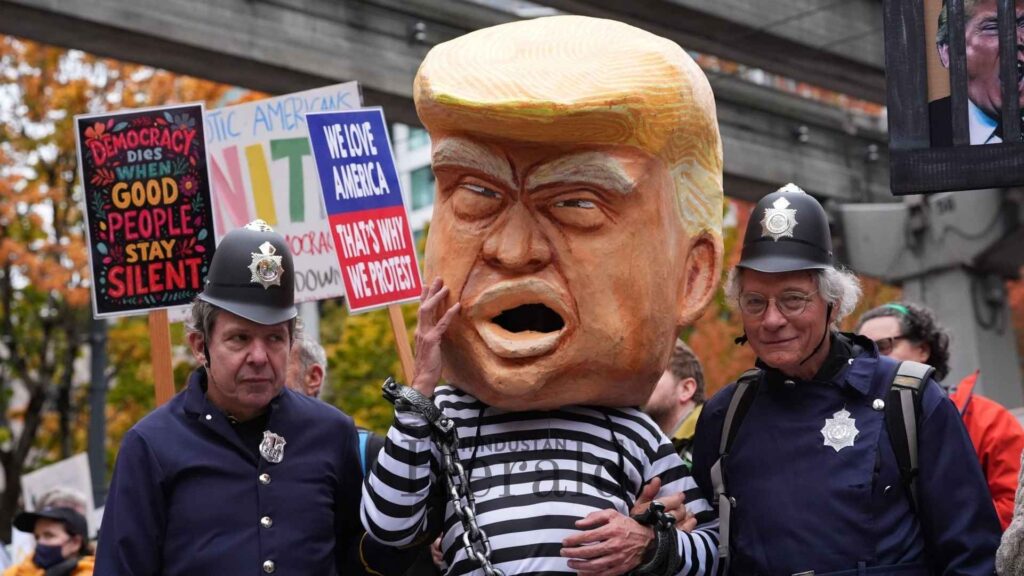
The No Kings movement has emerged as the most visible and outspoken opposition to Trump since he began his second term in January 2025. As the November midterm elections loom and the president’s approval rating sinks below 40 per cent, Republicans are in danger of losing control of both chambers of Congress.
At multiple venues, including Durham, organizers have called for a May 1 general strike, an escalation that, if it gains traction, would represent a significant shift from symbolic street protest to economic disruption. Whether that call converts into action will be one of the defining political tests of the coming weeks.
For now, the world has witnessed something historically significant. Eight million people. One day. Over 3,300 locations. A grassroots movement that has grown with every mobilization, reached deep into conservative heartlands, and crossed international borders. Whether it changes American politics and by extension, American foreign and immigration policy is a question that will be answered in November 2026.
India, with its four million-strong diaspora in the United States and its deep economic and diplomatic ties to Washington, has good reason to watch closely.
Stay ahead with Hindustan Herald — bringing you trusted news, sharp analysis, and stories that matter across Politics, Business, Technology, Sports, Entertainment, Lifestyle, and more.
Connect with us on Facebook, Instagram, X (Twitter), LinkedIn, YouTube, and join our Telegram community @hindustanherald for real-time updates.

Specializes in South Asian geopolitics and global diplomacy, bringing in-depth analysis on international relations.
- Rajiv Menon

- Rajiv Menon
- Rajiv Menon
- Rajiv Menon




 Ananya Sharma