
 By Ananya Sharma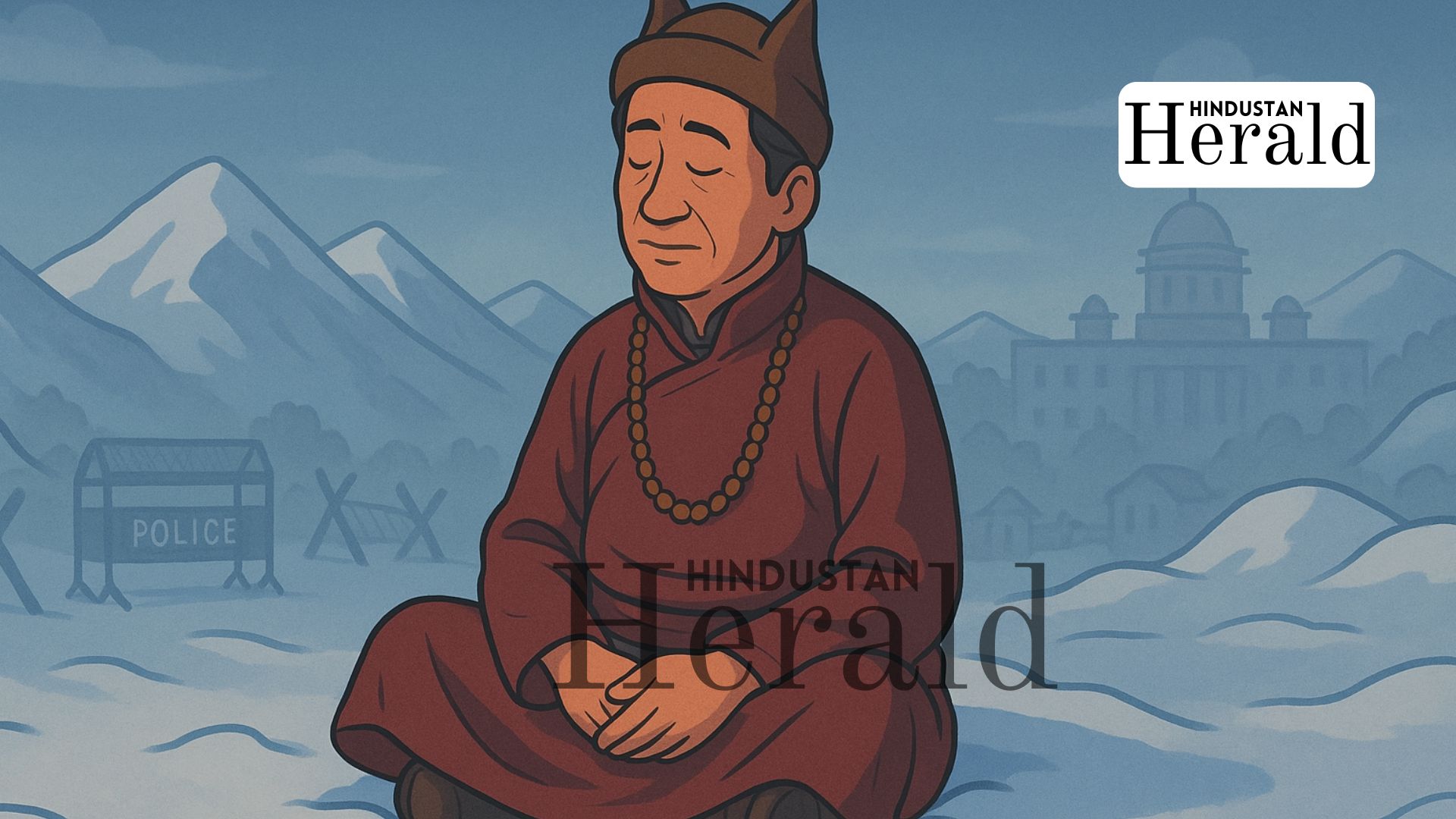
New Delhi, October 5: In Ladakh, the wind cuts cold and clear across the mountains. But what’s unfolding there right now feels anything but clear. A region once known for quiet resilience is suddenly at the centre of a storm that reaches far beyond its borders into questions of power, democracy, and who really gets to speak in today’s India.
At the heart of it is Sonam Wangchuk, the engineer-turned-educator who’s spent years trying to build a sustainable future for Ladakh’s fragile ecosystem. Now he’s sitting in Jodhpur Central Jail, detained under the National Security Act (NSA), a law meant for terrorists and spies, not climate activists. His wife, Dr. Geetanjali Angmo, has no idea where he really is or what condition he’s in. She’s moved the Supreme Court, pleading for his release and for something simpler: information.
“I just want to know if my husband is safe,” she said in a statement to the press. “He was taken away. No word, no medical update, nothing.”
A Familiar Darkness Creeps In
If you’ve listened to Deshbhakt’s latest episode, you’d know the tone isn’t just outrage, it’s worry. Not for one man, but for what his arrest says about the system itself.
The show’s host calls this moment a “cockroach test,” a harsh metaphor for a country where people can be crushed without consequence. He draws a straight line back to 1975, when Indira Gandhi’s Emergency silenced critics and jailed opponents. Then, too, citizens had turned to the courts for protection, filing habeas corpus petitions, desperate pleas to be seen, to be heard.
Back then, the Supreme Court failed them. It ruled that during an Emergency, even the right to life could be suspended at the government’s discretion. It took the 44th Constitutional Amendment to fix that mistake. Yet here we are, half a century later, back to wondering whether those rights were ever really ours.
This time, there’s no official emergency. But the signs the internet blackouts, curfews, crackdowns, and televised branding of dissenters as “anti-national” make many feel like one’s been quietly declared anyway.
From Ladakh to the Courts
The timeline is messy, like most real stories.
After weeks of peaceful demonstrations for statehood and Sixth Schedule protections, clashes broke out. Four protesters were killed. The BJP office in Leh was torched. Overnight, the government’s tone shifted from dialogue to accusation.
Wangchuk, who has long championed non-violence and even supported the government on several occasions, was suddenly painted as a “foreign-funded agitator.” The Ladakh Police claimed he might have links with Pakistan. His supporters call that absurd.
According to The Economic Times, his family learned he’d been moved over a thousand kilometres away, from Leh to Jodhpur, under NSA orders. For context, the Act allows detention for up to a year without formal charge. It’s been used on suspected terrorists, gangsters, and, now, an educator who teaches solar technology.
His wife’s habeas corpus petition, the legal instrument that demands a detained person be brought before the court, is now the only thread holding his case inthe public light. “This isn’t just about my husband,” she said. “It’s about whether citizens have any rights left when the government decides they don’t.”
The Inquiry After the Damage
Meanwhile, the administration has ordered a magisterial inquiry into the violence. On paper, that sounds like accountability. But critics say it feels more like theatre, an attempt to appear transparent after the narrative has already been written.
“First, they brand everyone as terrorists,” says the Deshbhakt host, “then they announce an inquiry to look fair.”
It’s a pattern India’s seen before: detain first, explain later. Cancel an FCRA licence to cripple NGOs, then cite “foreign funding.” Run primetime debates, labelling protesters as stooges. By the time facts catch up, public opinion has moved on.
But this time, the government may have overplayed its hand. Wangchuk isn’t an obscure activist. He’s an internationally recognised innovator, winner of the Magsaysay Award, and a man once hailed as “India’s real-life Phunsukh Wangdu.” He’s worked with the Army, built schools for remote villages, and advised on climate adaptation.
To call such a man an “anti-national” has raised eyebrows far beyond Ladakh.
Anger in the Cold Desert
On the streets of Leh and Kargil, anger simmers under curfew. The Apex Body Leh and Kargil Democratic Alliance, the two major coalitions representing Ladakh’s demands, have pulled out of talks with the Centre. Their message is blunt: “We can’t negotiate under the shadow of guns.”
That phrase has weight. It’s the same one India often uses when refusing talks with Pakistan or Naxal groups. The fact that it’s now being used against the Indian government by its own citizens is telling.
Adding to the irony, Lieutenant Governor B.D. Mishra recently said the firing was necessary to prevent Ladakh from “burning.” But locals point out that Ladakh is not the BJP office that caught fire. “There was no need to kill four people,” one protester said. “One of them was an ex-army man who fought for this country. What threat was he to the nation?”
A Wider Pattern
If you zoom out from Ladakh, the pattern looks painfully familiar. Kashmir, Manipur, Uttarakhand, and even parts of Punjab all have seen variations of the same story: unrest met with censorship, branding, and force.
In each case, the labels change, but the playbook stays the same. Punjabis become “Khalistanis.” Keralites, “Islamists.” Bengalis, “infiltrators.” Each time, the same message is sent: dissent equals danger.
That’s what makes Wangchuk’s detention so significant. It’s a message to everyone else, environmentalists, students, journalists, that questioning the state can carry a personal cost.
Even within the system, unease is growing. Lawyers and former judges are watching closely. Journalists whisper about how coverage is being monitored. There’s a sense that the line between national interest and political convenience has vanished entirely.
The Fear Behind Control
There’s another argument quietly running through the Deshbhakt monologue: that the government isn’t just aggressive, it’s afraid.
When a state builds its legitimacy on grand narratives national security, economic strength, and “Vishwaguru” pride, it cannot afford cracks in that story. People like Wangchuk, who speak of ecology over economy, decentralisation over control, threaten that comfort.
It’s easier to call them “agents” than to listen.
What Comes Next
Now, everything hinges on the Supreme Court. Will it demand the government produce Wangchuk before the bench? Will it insist on proof of the supposed threat he poses? Or will it look away, as it did once before in 1976?
Whatever the verdict, the consequences reach far beyond one activist. If preventive detention can be used against a pacifist engineer, it can be used against anyone.
That’s the quiet terror of this moment, not the shouting, not the hashtags, but the slow normalisation of fear.
For six years, the people of Ladakh protested peacefully for constitutional recognition. They were ignored. Now, with their leader behind bars, they are being told they are the threat.
And somewhere between curfews and hashtags, between magisterial inquiries and primetime propaganda, a small question lingers in the dry air: if this can happen in Ladakh, what makes the rest of India safe?
Stay ahead with Hindustan Herald — bringing you trusted news, sharp analysis, and stories that matter across Politics, Business, Technology, Sports, Entertainment, Lifestyle, and more.
Connect with us on Facebook, Instagram, X (Twitter), LinkedIn, YouTube, and join our Telegram community @hindustanherald for real-time updates.

Covers Indian politics, governance, and policy developments with over a decade of experience in political reporting.
- Ananya Sharma

- Ananya Sharma
- Ananya Sharma
- Ananya Sharma



 Arun Upadhayay and Ananya Sharma
  Neeraj Kapoor and Ananya Sharma