
 By Shelesh Joshi and Kavita Iyer
Guwahati, June 9:Assam Chief Minister Himanta Biswa Sarma met the Team Europe Assam delegation led by EU Ambassador to India and Bhutan Herve Delphin in Guwahati on June 9. The delegation had landed a day earlier on June 8, opening a two-day visit built around trade cooperation, investment frameworks, and commercial linkages between European markets and Northeast India, as reported by ANI.
This was not a routine diplomatic call. Both sides came prepared, both sides brought their business communities, and both sides left something concrete behind in Guwahati. The visit produced an industrial cluster launch, a semiconductor site visit, and a full bilateral business workshop, all inside 48 hours. That is an unusual density of outcomes for an engagement that most people outside the Northeast have not yet paid close enough attention to.
Quick Summary
- The Team Europe delegation covers 8 northeastern states including Arunachal Pradesh, Assam, Manipur, Meghalaya, Mizoram, Nagaland, Sikkim, and Tripura, as per the European External Action Service.
- The visit produced the launch of Assam’s first Blue Valley Cluster, a 4P public-private-people-partnership hub for fragrances, flavours, AYUSH, and food processing, as per the EU statement.
- The Tata Semiconductor Assembly and Test (TSAT) facility at Jagiroad, visited by the delegation, carries an investment of Rs 27,000 crore, confirmed by Project Head Ashish Mishra to the Press Information Bureau.
- The EU-India Free Trade Agreement was concluded in January 2026, described by the European Commission as the largest trade deal either side has ever signed.
- The EU and India exchange more than €180 billion in goods and services annually, supporting nearly 800,000 EU jobs, according to the European Commission.
- Ambassador Herve Delphin told ANI this is his third visit to Assam, calling it the “Gateway to Goodness” on arrival.
Who Came to Team Europe Assam, and What That Tells You
The delegation has two distinct parts, and the fact that both arrived together is itself a signal.
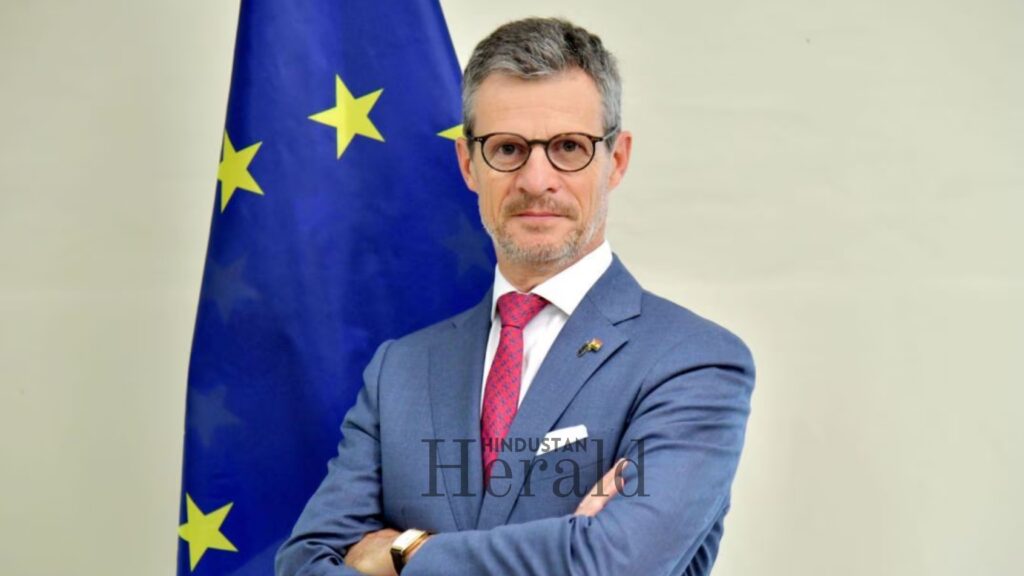
The diplomatic side is anchored by Ambassador Herve Delphin and ambassadors and senior representatives from multiple EU member states. These are the people who held the political conversations with Chief Minister Sarma and the state government, as reported by ANI.
The commercial side is a separate business delegation, led by the Federation of European Businesses in India (FEBI), running its own parallel talks with state officials to map out specific trade and investment possibilities, as per the European External Action Service statement.
In most diplomatic engagements, these two tracks are sequential. Diplomats arrive, assess the terrain, file their reports, and then business delegations follow months later once the political groundwork has been prepared. Running them at the same time cuts that gap considerably.
For states competing for foreign capital, the difference between a diplomatic visit and a diplomatic-plus-commercial visit is the difference between being put on a list and being actively evaluated.
Ambassador Delphin told ANI on his arrival in Guwahati: “As the slogan says, Gateway to Goodness. I really like this place. I look forward to the meetings we are going to have with the CM.”
Simple words. But this is his third visit to Assam. Ambassadors do not return to the same state three times because it is pleasant. They come back because the state keeps giving them reasons to.
That is a more meaningful signal than anything in an official press statement.
The Workshop: Not a Pitch Event, a Working Session
The delegation participated in the “Blue Valleys: Building Ecosystems and Value Chains Between India and Europe” workshop on June 9, organised by the Government of Assam. The workshop brought European and Indian businesses together to work through partnerships in sustainable value chains, industries and innovation, as per the European External Action Service statement.
Assam has hosted a serious run of investment events over the past 18 months. The state government ran roadshows in Mumbai, Tokyo, Seoul, Thimphu, and Singapore to promote Advantage Assam 2.0. Those events are pitch events by design. The state presents its assets, the investors listen, and the conversations that matter happen afterward in private.
This workshop operated on a different logic entirely.
European and Indian businesses were in the same room, working through specific sectors, specific supply chains, and specific commercial possibilities. The intended output is not a favourable impression of Assam. The intended output is relationships that lead to deals.
According to the EU statement, the Blue Valleys initiative is built to promote industrial clusters, MSME linkages, and sector-specific value-chain integration between the EU and India, doing so without separating economic growth from environmental sustainability. Both are meant to move together.
The sectors the initiative targets are: clean energy, natural ingredients, bamboo-based industries, eco-friendly textiles, biotech, wellness, and smart manufacturing, as per the EU statement reported by ANI.
Look at that list and then look at what Assam actually has on the ground. Bamboo forests that cover large parts of the state. Tea estates that produce a substantial share of India’s total output. Medicinal plant biodiversity that has barely been touched by modern pharmaceutical value chains. River systems running through landscapes that European sustainability-focused industries actively seek out. A traditional wellness heritage rooted in AYUSH practices with genuine global demand.
The match between what the initiative targets and what Assam offers is not assembled for the brochure. It is real.
The element that deserves more attention than it is likely to receive is the MSME linkages component. The Blue Valleys framework is not designed solely for large European corporations relocating manufacturing. It is built, at least in its stated structure, to draw smaller businesses, local producers, community enterprises, and early-stage startups into the supply chain alongside bigger players.
Whether that intention holds in practice, or whether large commercial interests end up absorbing most of the benefit while MSMEs remain on the edges, is the question that will define whether this initiative actually changes the economic texture of the state.
India’s First Blue Valley Cluster: What the Launch Actually Means
The most concrete outcome of the two-day visit is the formal launch of Assam’s first Blue Valley Cluster. It is an industrial hub focused on fragrances, flavours, AYUSH products, and food processing, built on a 4P public-private-people-partnership model designed to connect Europe, Northeast India, and Bhutan through research, innovation, and sustainable manufacturing, as per the EU statement reported by ANI. The EU statement is clear that this is a pilot project. That word is doing real work here.
A pilot means Assam has been given a specific and time-limited opportunity to prove that this model functions before it gets extended to other states in the region. A cluster that attracts genuine European investment commitments, produces working commercial partnerships, and demonstrates that the 4P model can hold together across cultures, regulatory environments, and business expectations becomes the template for Manipur, Meghalaya, Tripura, and the broader Northeast.
A cluster that launches with energy and then sits quietly for two years while everyone waits for something to happen damages not just Assam’s credibility but the credibility of the entire Blue Valleys framework across India.
As per the EU statement, the visit is designed to translate broader India-EU strategic commitments into tangible economic partnerships at the state level, while unlocking the economic potential of Northeast India through investment-led and sustainable development.
“Translating commitments” is a careful phrase. It acknowledges that the commitments already exist in writing, at the summit level, in the strategic agenda, inside the FTA negotiations. The hard work is making them produce something a local business owner in Assam can actually use. Most diplomatic frameworks do not survive that translation. They produce excellent documentation and very little commercial activity.
Whether this one is different will not be visible for at least another year. But the structural elements, a named pilot cluster, a 4P governance model, an active FEBI delegation doing ground-level assessment, are more serious than the usual diplomatic framework furniture.
The Semiconductor Plant: Europeans Taking a Close Look at Jagiroad
The delegation’s programme included a formal visit to Tata Electronics’ semiconductor plant at Jagiroad, described in the EU statement as a chance to see Assam’s growing role in high-tech manufacturing up close, as reported by ANI.
The Tata Semiconductor Assembly and Test Pvt. Ltd. (TSAT) facility at Jagiroad, Morigaon is India’s first indigenous semiconductor assembly and test unit built for both domestic and global markets. Project Head Ashish Mishra confirmed in a statement to the Press Information Bureau that the facility carries an investment outlay of Rs 27,000 crore.
At the groundbreaking ceremony in August 2024, Tata Sons Chairman N. Chandrasekharan stated that the facility will produce 48 million chips daily for electric vehicles, mobile phones, and medical equipment, as reported by Newsonair. Chief Minister Sarma was present at that ceremony and called it a red letter day for the state, a major milestone for the region’s technological and industrial development, as per Newsonair.
Union Minister Ashwini Vaishnaw, after reviewing the site at Jagiroad, confirmed that construction would finish by 2025 and “Made in India” chip production would begin in 2026. He stated that roughly 40,000 employees will eventually work at the facility, with housing and a complete electronic city planned around it, as reported by Deccan Herald.
The Minister said: “It will be a matter of great pride for us that ‘Made in Assam’ chips will be utilised in the automobile industries of countries like Japan, the USA, and Germany. Through this ‘Made in India’ initiative, Assam’s contribution will further elevate India’s global standing.” Those remarks were reported by Deccan Herald.
Union Finance Minister Nirmala Sitharaman visited the facility in November 2025 and stated that Assam has demonstrated foresight and dynamism in industrial policy by bringing a semiconductor manufacturing unit to the state, as reported by ANI. The project is expected to generate around 15,000 direct and 11,000 to 13,000 indirect jobs, according to that ANI report.
Union Minister Vaishnaw also confirmed after meeting Chief Minister Sarma on May 30 that the facility is expected to begin production within the current financial year, as reported by India Today Northeast. Now consider who was walking through that plant as part of the Team Europe delegation.
The business leaders and trade representatives accompanying the ambassadors are not there to admire construction progress. These are people who supply components, testing systems, packaging materials, and specialist equipment to semiconductor facilities around the world. A plant designed for 48 million chips daily, serving the automotive, telecom, and AI device sectors globally, creates an entire commercial orbit of supporting industries.
The firms that establish supply chain relationships with Jagiroad early, before the facility ties itself to other partners, have a competitive advantage over those who wait and watch. The plant visit is commercial due diligence. The diplomatic framing is useful cover, but the business logic is what brought people there.
The Treaty That Changed What This Visit Actually Means
It is worth being direct about this. Two years ago, the same engagement in Guwahati would have been a useful diplomatic exchange and not much more. After January 2026, it is something structurally different.
On January 27, 2026, India and the EU concluded the India-EU Free Trade Agreement in New Delhi. European Commission President Ursula von der Leyen described it as creating “a free trade zone of 2 billion people, with both sides set to gain economically,” as reported by the European Commission.
The European Commission confirmed that negotiations began in 2007, were suspended in 2013, restarted in 2022, and were concluded in January 2026. It is the largest trade deal either side has ever signed, according to the European Commission.
The EU and India exchange more than €180 billion in goods and services annually, supporting nearly 800,000 jobs across the EU, according to the European Commission.
The EU-India Factsheet 2026, published by the European External Action Service, confirms that the 16th EU-India Summit on January 27, 2026 endorsed the “Towards 2030: EU-India Joint Comprehensive Strategic Agenda” across five cooperation pillars: prosperity and sustainability, technology and innovation, security and defence, connectivity and global issues, and people-to-people cooperation. The same Factsheet explicitly names Blue Valleys as a component of the agreed agenda.
As reported by Newsonair, both sides at the summit reaffirmed their commitment to strengthening trade linkages, investment avenues, and enhancing global supply and value chains.
Five months from a summit of that weight to an industrial cluster launch, a semiconductor plant tour, and a bilateral working workshop in Guwahati is fast movement. Most agreements of this scale take years to produce sub-national activity. The speed here suggests both sides have people actively pushing this past the standard diplomatic pace.
Why Northeast India Is Getting This Level of Attention
The Northeast has received diplomatic attention before without it translating into much. So the reasonable question is what is genuinely different this time.
Part of the answer is the numbers. The GSDP of northeastern states grew at a CAGR of 10.8 per cent from 2014-15 to 2021-22, against a national average of 8.1 per cent, according to the Ministry of Development of North Eastern Region, as reported by ANI.
A region growing consistently faster than the national average over nearly a decade is not a development story in the aspirational sense. It is a commercial story in the investment sense. That distinction matters to the business leaders inside the Team Europe delegation.
As per the EU statement reported by ANI, the engagement covers all eight northeastern states, with discussions spanning renewable and green energy, sustainable urban infrastructure, healthcare and pharmaceuticals, semiconductors and electronics manufacturing, tea and agri-food processing, fragrances, flavours, and AYUSH. The breadth of that sector list suggests the EU is not making a single-sector bet on the region. It is assessing the full width of the commercial landscape.
Add to that growth rate a Rs 27,000 crore semiconductor facility approaching production, an active state government that has spent 18 months running investment outreach across multiple continents, a newly concluded EU-India FTA that opens European markets to northeastern exports, and a regional GSDP sitting at Rs 9.26 lakh crore at current prices as of 2023-24, according to the Ministry of Development of North Eastern Region as reported by ANI, and the picture is materially different from what it was three years ago.
What to Watch From Here
The Blue Valley Cluster needs real investment commitments to validate itself. A launch ceremony is not a success. The first signed European investment into the cluster is the number that matters, and it has not happened yet.
The Jagiroad plant moving toward production this financial year, as confirmed by Union Minister Vaishnaw to India Today Northeast, gives European suppliers a closing window to position themselves before the facility’s supply chain relationships are established with others.
The EU-India FTA, now concluded, will progressively open tariff lines across tea, agro-processed goods, and pharmaceutical ingredients. States with existing European commercial relationships when that liberalisation takes full effect will capture more of those market gains than states still building them.
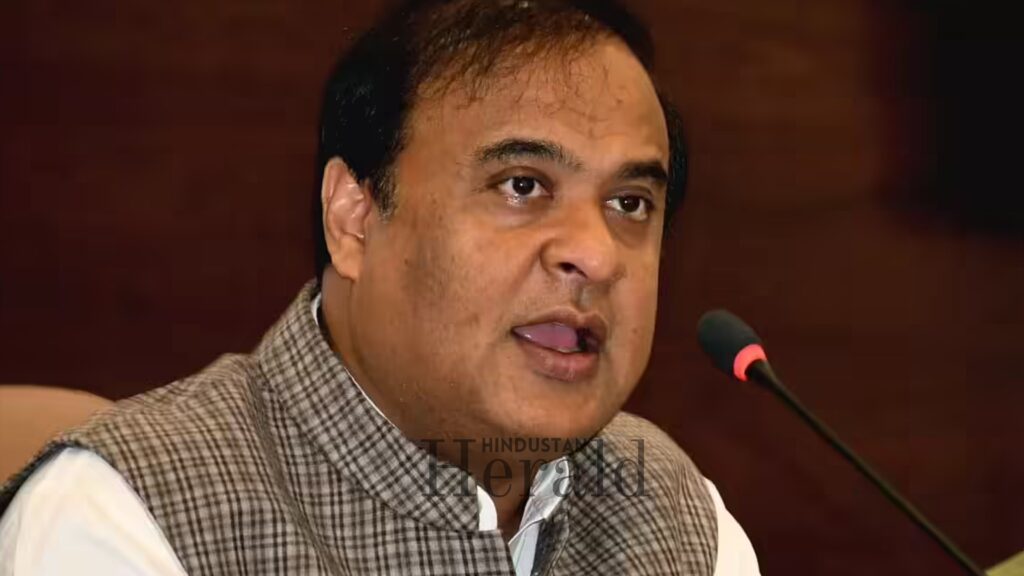
CM Sarma has been running an unusually serious investment campaign for the past year and a half. The Team Europe visit is the European chapter of that campaign, and it came with more institutional depth than any of the earlier roadshows. Ambassadors from multiple member states, a named FEBI business delegation, a cluster launch, a plant visit, and a working workshop do not come together in 48 hours without serious preparation on both sides.
The conversations in Guwahati are still at the identification stage. No European company has publicly announced a specific capital commitment to Assam off the back of this visit. That is the honest position.
But the structure of what just happened in Guwahati is more serious than a diplomatic visit. Whether it becomes something commercially decisive for the Northeast, or whether it becomes another well-structured framework that the investment world notes and then moves past, is the question 2026 still has to answer.
Stay ahead with Hindustan Herald — bringing you trusted news, sharp analysis, and stories that matter across Politics, Business, Technology, Sports, Entertainment, Lifestyle, and more.
Connect with us on Facebook, Instagram, X (Twitter), LinkedIn, YouTube, and join our Telegram community @hindustanherald for real-time updates.

Tracking world politics, global markets, trade movements, policy decisions, and the changing balance of economic power.
- Shelesh Joshi

- Shelesh Joshi
- Shelesh Joshi
- Shelesh Joshi





Former financial consultant turned journalist, reporting on markets, industry trends, and economic policy.
- Kavita Iyer
- Kavita Iyer
- Kavita Iyer
- Kavita Iyer