
 By hindustanheraldin@gmail.com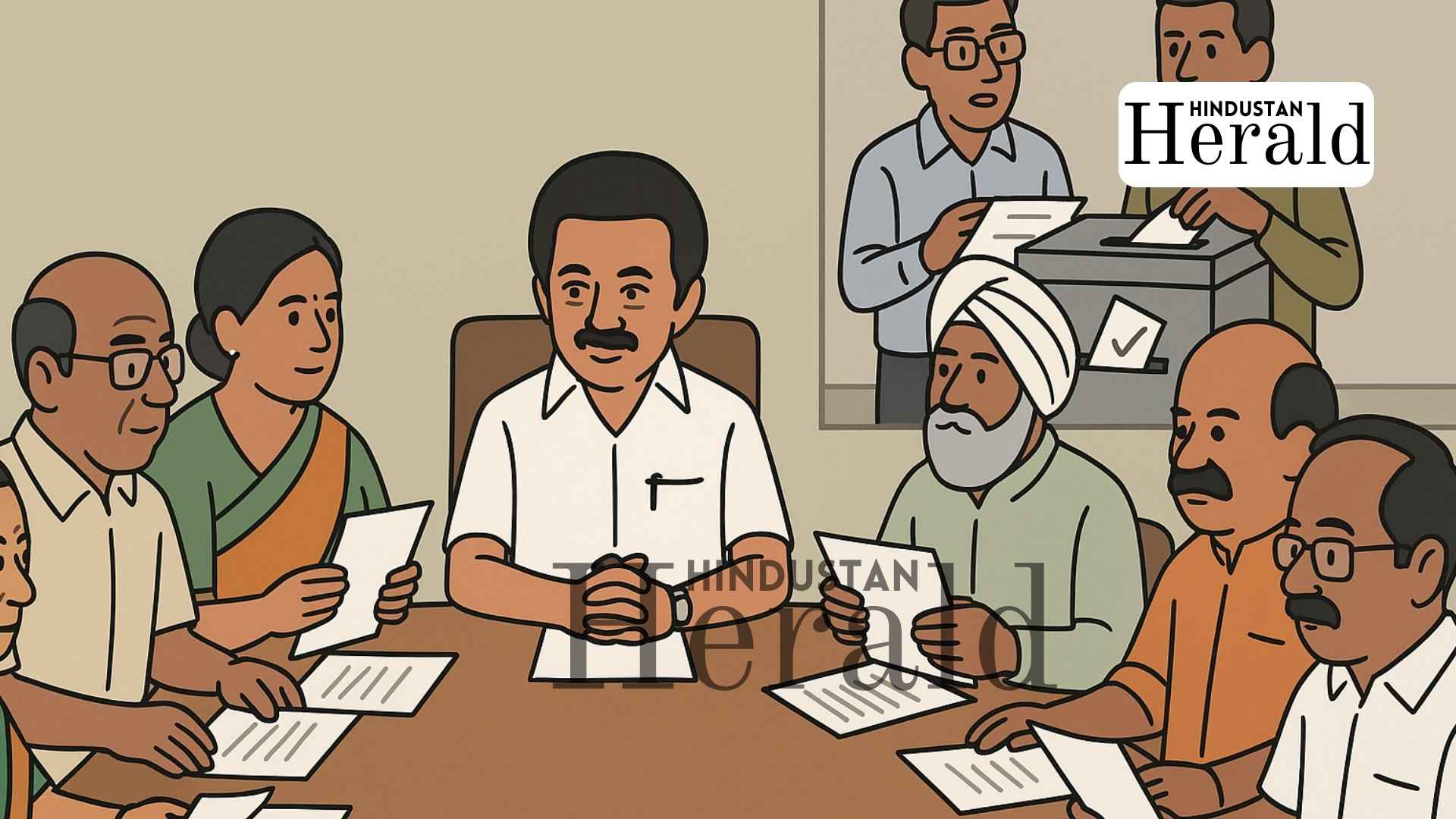
Chennai, November 2: A quiet administrative order from the Election Commission of India has snowballed into a full-blown political contest in Tamil Nadu. On Sunday, Chief Minister M. K. Stalin brought together leaders from almost every major political party at the Secretariat, urging them to oppose what he described as a “rushed and ill-conceived voter roll revision” ahead of the 2026 Assembly elections.
Stalin Draws a Line
The meeting was less about procedure and more about timing. Stalin, according to those present, made it clear that his government is not against updating the rolls, but finds the schedule unworkable. “The enumeration is to begin in two days and finish in a month. For a state with over six crore voters, that is neither realistic nor fair,” he told party leaders, according to the Free Press Journal.
The Chief Minister warned that such a rapid revision, so close to the election year, could cause genuine voters to lose their names. “A flawed roll is a threat to democracy itself,” he reportedly said. His argument struck a chord with allies from the Congress, CPI, CPI(M), and VCK, who also spoke against what they called the Centre’s disregard for state-level planning.
As reported by NDTV, Stalin stressed that the issue was about process, not principle. “No one objects to accuracy. What we oppose is haste,” he told the media later.
BJP Stands Its Ground
The Bharatiya Janata Party rejected those concerns outright. Its senior leader Tamilisai Soundararajan accused the DMK of “creating confusion for political gain.” In her remarks to DTNEXT, she said the revision was “transparent, routine and carried out under ECI supervision across twelve states.”
According to her, the exercise was not targeted at any one state or party. “New voters must be added, and errors must be cleaned up. It’s a national process, not a political one,” she said. BJP leaders in Chennai echoed her view, suggesting that the DMK’s protest was an attempt to pre-emptively question the 2026 verdict.
Still, the optics are complicated. In Tamil Nadu’s deeply polarised landscape, even routine administrative acts are read through a political lens. What the ECI calls maintenance, parties call interference.
Work on the Ground
In districts such as Madurai, officials have already started preparations. As reported by The Times of India, the district has 2.74 million voters on its current roll 1.34 million men, 1.39 million women, and 291 third-gender individuals. Booth-level officers will begin door-to-door verification on November 4, a process set to last a month.
The draft rolls will be released on December 9, and the final version is expected by February 7, 2026. Officials admit the task is daunting. “We have limited time and a massive population. But the plan is to ensure accuracy without disruption,” one election officer said after the collector’s review meeting.
ECI’s Broader Plan
The revision is part of a nationwide Special Intensive Revision, covering 12 states and Union Territories. According to News On Air, the programme was approved in October with the same timeline across all participating states. The ECI says the process will help include young voters turning 18 by January 1, 2026, and delete the names of the deceased and duplicates.
The Commission insists that these updates are a regular part of election management, done well before every major poll cycle. Yet, what is routine elsewhere has turned contentious in Tamil Nadu, where political suspicion between the ruling DMK and the BJP-led Centre runs deep.
The Political Undercurrent
At its core, this is not a technical dispute. It is a test of trust. The DMK sees the revision as another instance of what it calls “central overreach.” For the BJP, which is still working to expand its presence in Tamil Nadu, the confrontation offers a chance to position itself as a champion of cleaner elections.
Political analyst Ramu Manivannan says the clash is inevitable. “In Tamil Nadu, every administrative act carries political meaning. The voter roll is more than a list, it’s a statement of who counts.”
For the AIADMK, which has kept a quieter stance so far, the controversy offers both risk and opportunity. Aligning with the DMK’s criticism may weaken its anti-incumbency argument, but staying silent could alienate voters who fear exclusion.
A Tough Task for Officials
Beyond politics, there is the raw arithmetic of administration. The verification drive will cover over 90,000 polling stations. Each booth-level officer will handle hundreds of households, verifying names and collecting forms for inclusion, deletion, or correction.
In cities like Chennai and Coimbatore, constant migration complicates the job. In rural belts, many homes lack clear documentation. Election officials often rely on local knowledgeteachers, panchayat members, and ward volunteers to confirm who still resides where.
Awareness remains a problem. Many first-time voters don’t know they need to apply separately. Civil society groups in Chennai have urged the government to launch district-level outreach before the enumeration starts. Without that, they warn, the “cleanup” could erase eligible names rather than add new ones.
A Familiar Pattern
Tamil Nadu has seen this movie before. In 2016 and again in 2021, voter deletions became a flashpoint during campaigning, with opposition parties alleging targeted omissions. Complaints were filed, hearings held, and most of the errors were eventually corrected but the perception lingered.
That memory fuels today’s caution. The DMK, conscious of how such issues can snowball during elections, wants the ECI to slow down and allow wider scrutiny before finalising the rolls. The BJP, sensing political opportunity, insists that any delay would only “help those who benefit from inflated rolls.”
What Comes Next
The revision will proceed as planned from November 4, unless the ECI decides otherwise. The draft list on December 9 will be the first test of whether the concerns raised by the DMK are substantiated in the data. Parties are expected to pore over booth-level numbers to check for anomalies.
By February 2026, when the final rolls are published, the state will already be in campaign mode. The voter list normally a matter of paperwork will stand as the first political battlefield of the next election.
For now, Tamil Nadu’s democracy turns on a straightforward question: Who gets to be on the list?
Stay ahead with Hindustan Herald — bringing you trusted news, sharp analysis, and stories that matter across Politics, Business, Technology, Sports, Entertainment, Lifestyle, and more.
Connect with us on Facebook, Instagram, X (Twitter), LinkedIn, YouTube, and join our Telegram community @hindustanherald for real-time updates.

 Ananya Sharma
  Rajiv Menon and Ananya Sharma