
 By Arun Upadhayay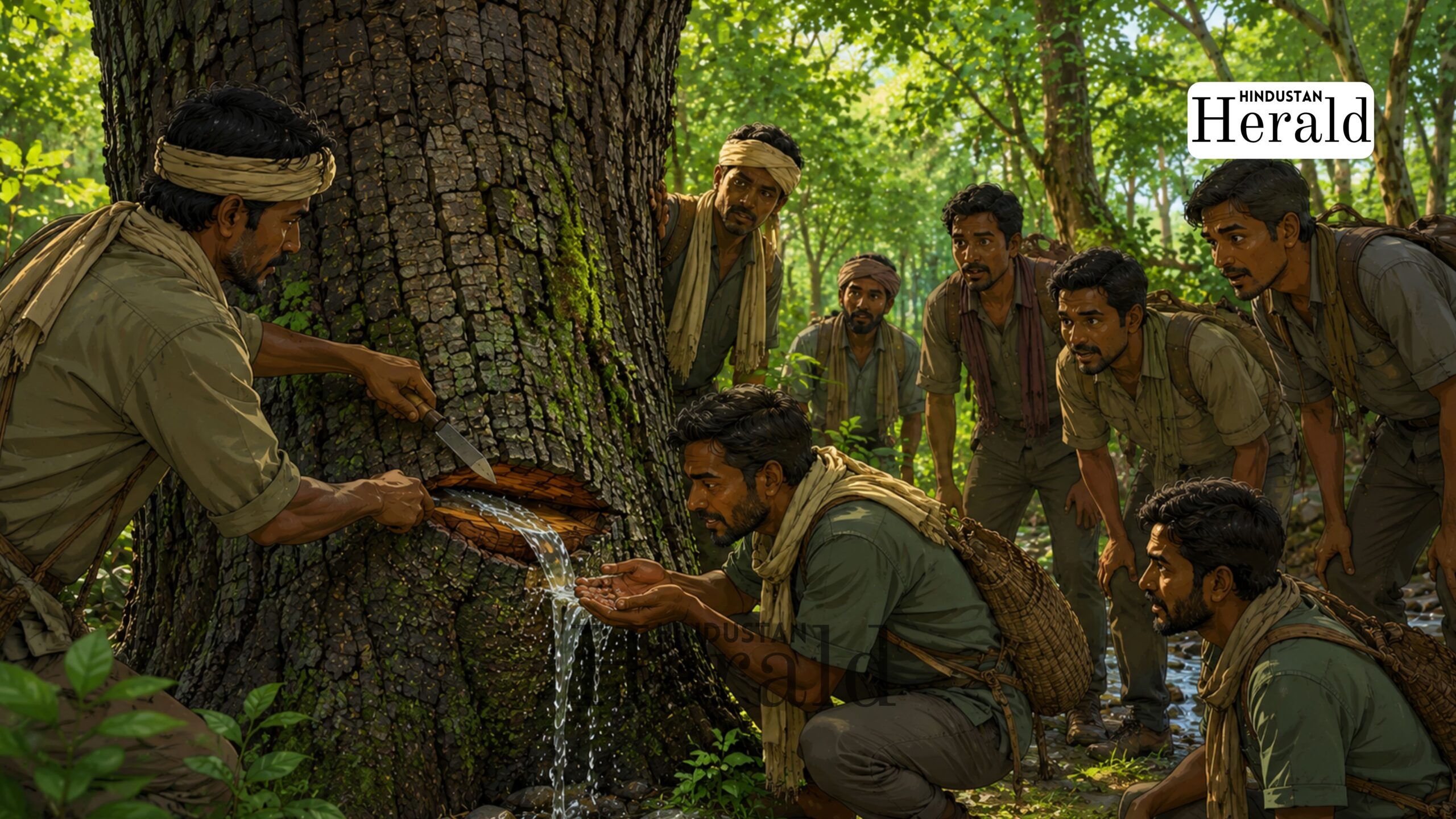
New Delhi, May 18: The Tree That Quenches Thirst Nobody tells you about the Saj.
You find out the way most things worth knowing get passed on inside a forest from someone who has spent enough time walking those trails to stop treating trees as scenery. A tracker, maybe. Or an old tribal elder who mentions it the way he would mention any other practical thing, without ceremony, the way you would tell someone where the nearest stream is.
Except there is no stream. It is May. The streams dried up weeks ago.
And the water is inside the tree.
A Crocodile Bark, A Hidden Reserve
Terminalia tomentosa is not a tree that introduces itself gently. The bark is the first thing. Thick, deeply ridged, intersecting in a pattern that genuinely does look like crocodile skin when you get close enough, which is why people have been calling it the crocodile bark tree for as long as anyone can remember. It grows tall, up to 30 metres in a good stand, trunk expanding to nearly a metre across in older specimens. It is a dominant presence in dry deciduous forests, the kind that covers large parts of central and peninsular India, the kind that goes utterly quiet in the weeks before the monsoon.
It is known as Saj in Hindi-speaking forest belts, Asan in others, Matti in Karnataka, Marutham in Tamil Nadu, Ain in Maharashtra. In Myanmar they call it Taukkyan. Across Nepal, Bangladesh, Thailand, Laos, Cambodia, Vietnam, the tree shows up in different forms but the same genus. It is, in the broadest sense, a tree of the Asian dry forest. Commercially it has always been valued for its hardwood, used in furniture, boat-building, railway sleepers, decorative veneers. Its leaves feed the Antheraea paphia silkworm, the one that produces tassar silk. Bark extracts have been used medicinally. It is a useful tree in every conventional sense.
None of that is what makes it worth writing about.
The Part The Tribals Always Knew
The Konda Reddi tribe, who live across the Godavari region’s Papikonda hill range in Andhra Pradesh, have known about this for generations. They are a vulnerable tribal group, classified as such, and their relationship with the forests of Papikonda is one built over centuries of living inside those hills rather than studying them from outside. Among the things they knew was this: certain Terminalia tomentosa trees hold water in their trunks during peak summer, the water has a sharp smell and sometimes a sour taste, and it can be released from the right place on the bark.
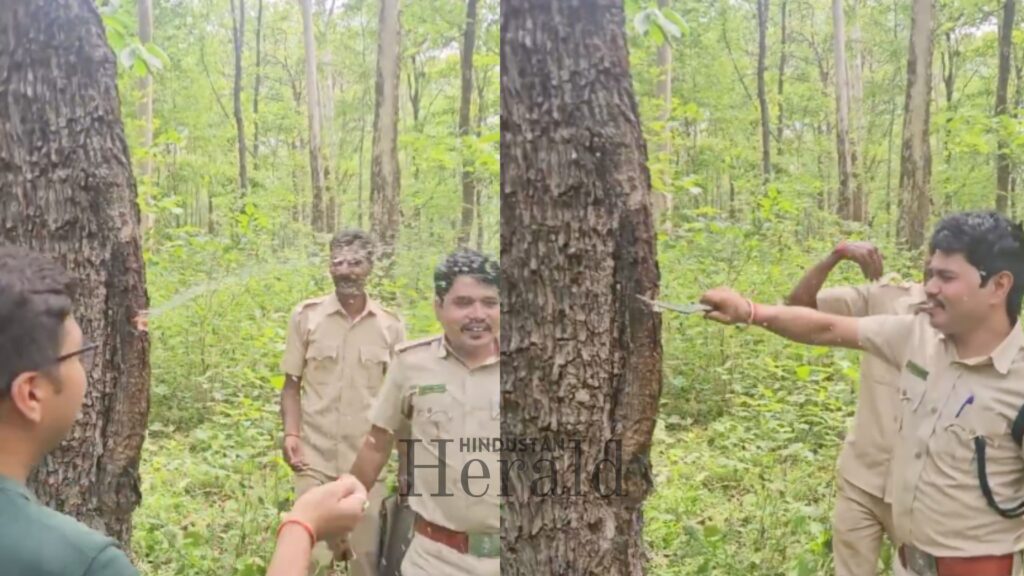
The Andhra Pradesh Forest Department eventually ran a formal experiment in Papikonda National Park to test the claim. The Rampachodavaram Divisional Forest Officer, G.G. Narentheran, led the team. They cut bark from Indian laurel trees, as reported by The Hindu, and confirmed exactly what the Konda Reddis had said. The knowledge had been accurate all along. It simply had not been written in a journal yet, which in the broader world apparently makes the difference between something being known and something being verified.
That gap, between what forest communities have always understood and what gets entered into the scientific record, is a story by itself. But for now the point is simpler: the tree does hold water. The tribes knew it first.
What The Science Has Found, And What It Hasn’t
A survey conducted at Bandipur National Park in Karnataka confirmed that a proportion of Terminalia tomentosa trees do store water during the dry season. The finding also noted something worth paying attention to: the larger and older the tree, the more likely it is to be holding water. Girth matters. Younger trees in the same stand may have nothing. A wide, ancient specimen with that deep crocodile pattern running across its trunk is the one worth approaching.
What the science has not yet resolved is why. The exact mechanism by which water accumulates inside the trunk, and what it means for the tree’s own survival strategy, is still not fully understood. This is not unusual for forest ecology, which is full of phenomena that are documented before they are explained. The tree stores water. That much is confirmed. The full picture of how and why will take longer.
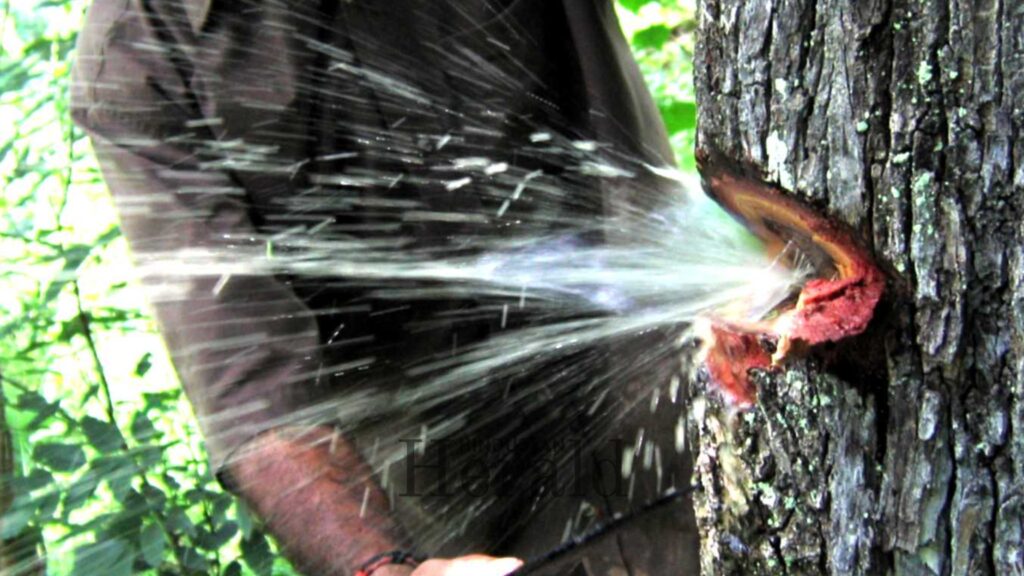
According to natural history documentation, the water in a mature tree can be reached up to 25 to 30 feet from the ground. A careful incision at the right point along a lateral ridge can yield somewhere between 5 and 6 litres from a single tree. The taste, people consistently note, is slightly saline. Not unpleasant. Actually, not unpleasant at all. Studies have confirmed the water is potable. There are accounts from forest communities of it being used specifically for stomach ailments, though that sits somewhere between documented practice and oral tradition at this point.
Still, drinkable water from a trunk in the middle of a summer forest is not nothing. It is, depending on where you are and how long you have been walking, exactly everything.
What A Forest Keeps To Itself
India’s water crisis gets talked about in the language of infrastructure: dams, pipelines, groundwater levels, urban demand projections, monsoon deficits. All of it real, all of it urgent. But forests are part of that story in ways that rarely get enough attention. The trees hold water in their roots, their trunks, their canopies. The forest floor, when it has not been cleared or compacted, absorbs rainfall and releases it slowly. Forests are water infrastructure. They just do not come with a budget line or a ribbon-cutting ceremony.
The Saj is a minor example of this. One species among hundreds, and even within the species, not every individual tree carries water. But the fact of it, a tree that survives fire with its resistant bark, feeds silk production with its leaves, gives timber for furniture and boats, and then on top of all of that holds drinking water in its trunk through the worst months of the year, suggests something about what the forest is actually doing when it is left intact.
Forest-dwelling communities figured that out without any of the frameworks scientists and policymakers currently use. They figured it out by being present in those forests across generations, by paying attention at a level and consistency that most people will never manage. The Konda Reddis were not conducting ecophysiological surveys. They were just living there, and they noticed.
The Moment Itself
There is not much to add to what the encounter actually feels like. The bark rough under your hand. The temperature somewhere above forty. Every stream you passed a couple of hours back was dry, just sand with a memory of water. And then this, the slow seep or the steady flow from a cut in the right place on a very old tree, and water that is cool enough to matter and clean enough to drink.
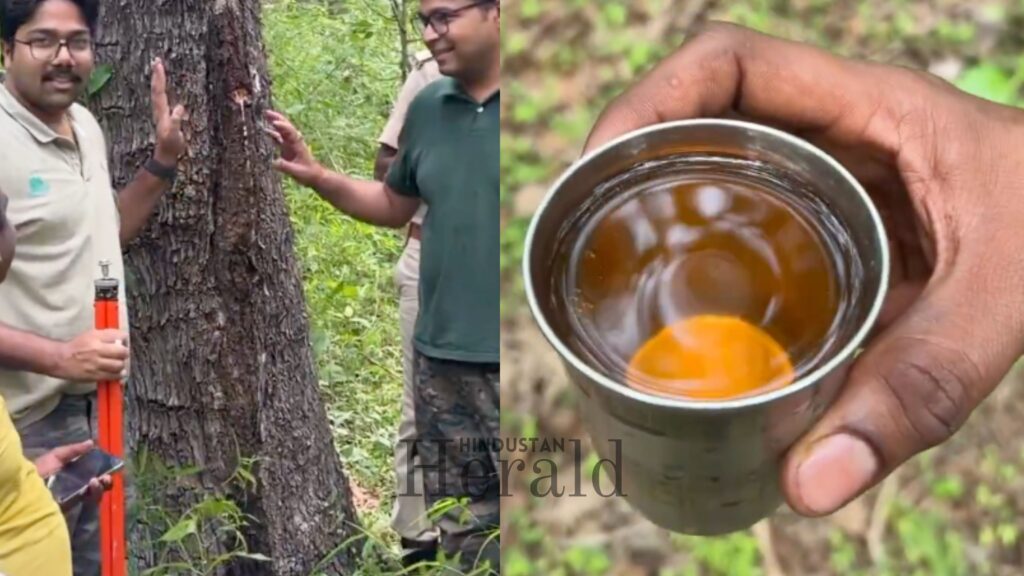
The taste is there. Faintly mineral, a little saline, not sweet. Real. The kind of thing you remember not because it was dramatic but because it was so completely itself. A tree doing what it has always done, in a forest that has been here far longer than anyone currently arguing about water policy.
You drink. You put your hand back on the bark. The ridges are deep and cool, and the tree goes on being what it is.
For now, and for everyone who has ever walked into a dry Indian forest in May and understood suddenly why the people who grew up inside those trees never needed to be told what to do when the streams ran out, that is the whole story. The Saj knew. The forest kept the secret. And somewhere in Papikonda or Bandipur or a dozen unnamed corridors across the subcontinent, it is still doing exactly this, holding water inside a crocodile skin, waiting for whoever needs it next.
Stay ahead with Hindustan Herald — bringing you trusted news, sharp analysis, and stories that matter across Politics, Business, Technology, Sports, Entertainment, Lifestyle, and more.
Connect with us on Facebook, Instagram, X (Twitter), LinkedIn, YouTube, and join our Telegram community @hindustanherald for real-time updates.

- Arun Upadhayay

- Arun Upadhayay
- Arun Upadhayay
- Arun Upadhayay




 Ananya Sharma
  Ayesha Khan and Ananya Sharma
  Sandeep Verma