
 By Arun Upadhayay
New Delhi, May 22: Four women. Four constables. One summit. And somewhere at 8,848 metres above sea level, where most humans cannot stand upright without a mask over their face, they sang.
Not in a drill. Not at a passing-out parade. At the top of the world.
That is what the Border Security Force’s first all-women Everest expedition achieved on the morning of May 21, and if the reaction from South Block to social media is any indication, India is still processing what just happened.
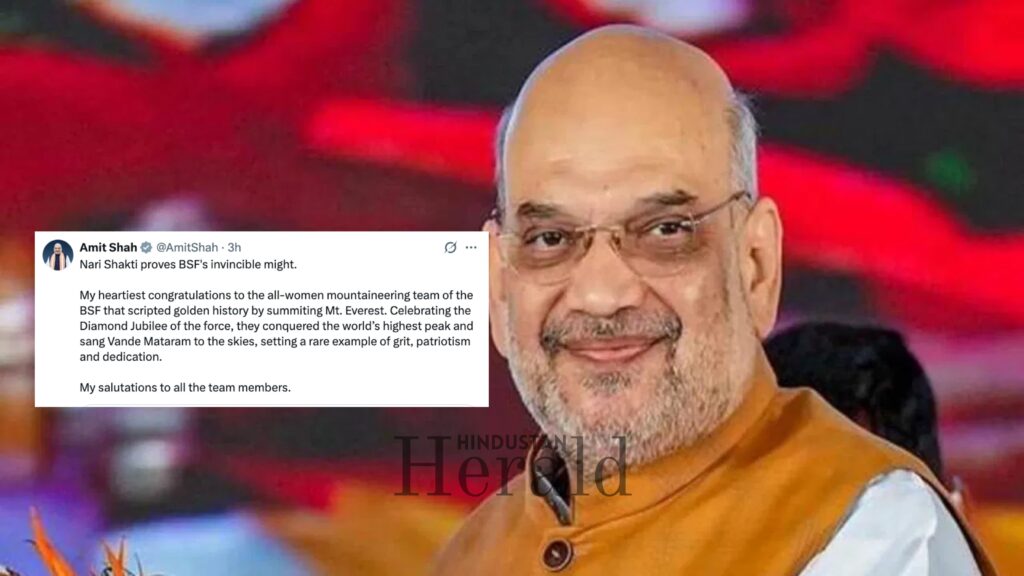
Union Home Minister Amit Shah put it plainly on X the following morning. “Nari Shakti proves BSF’s invincible might,” he wrote, extending his “heartiest congratulations” to the team for what he called a historic achievement. The phrase was short. It did the job. What the four constables did on that mountain required a great deal more than a social media post to fully describe.
Four Women Who Did Not Make Headlines Until Now
Their names deserve to lead, not trail, the story.

Constable Kouser Fatima is from Ladakh, the cold, sparse, sky-high frontier she was recruited to protect. Constable Munmun Ghosh comes from West Bengal. Constable Rabeka Singh from Uttarakhand, a state that has quietly produced more than its share of mountain-hardened people over the years. And Constable Tsering Chorol is from Kargil, a name that carries a particular weight in India’s military memory.
Four women from four different corners of a vast, complicated country. None of them career mountaineers in the conventional sense. All of them in uniform, all of them trained for border duty, and all of them standing together on the highest point on Earth at 8:00 in the morning on a Thursday in May.
The expedition, which the BSF christened Mission Vande Mataram, was flagged off from New Delhi on April 6, 2026, by BSF Director General Praveen Kumar. From there, it was roughly six weeks of altitude acclimatisation, weather watching, physical rationing, and the kind of grinding mental discipline that no amount of base-camp prep can fully simulate. As per the BSF’s official communication, the team had completed the acclimatisation phase and was holding at the South Col before making its final push. The weather cooperated. The team did not flinch.
At 8:00 AM IST on May 21, Mission Vande Mataram reached its destination.
What the Singing Means
The BSF said the Mahila Seema Praharis sang Vande Mataram at the summit. “In one unwavering voice,” the force’s statement read, “at an altitude where most people require oxygen support and even standing upright is a challenge.”
It is a detail that could easily be dismissed as theatrical. It is not.

Singing at that altitude is genuinely difficult. The lungs are working at a fraction of their sea-level capacity. The body is cold in a way that penetrates clothing, muscle, and bone simultaneously. The brain, starved of oxygen, is not running at full speed. And yet these four women, who guard borders and not headlines, managed to hold a note together at the top of the world.
The choice of Vande Mataram was deliberate on two counts. The expedition was conceived in part to mark the 150th anniversary of the national song, composed by Bankim Chandra Chatterjee, alongside the BSF’s own Diamond Jubilee. The force turns sixty this year, having been raised on December 1, 1965, in the aftermath of the India-Pakistan war, when the country recognised it needed a dedicated organisation to hold its borders. Six decades on, four of its women constables have carried its flag higher than any point on the planet.
That is a fact worth sitting with for a moment.
The Institution Behind the Achievement
The BSF is not a small organisation. It guards India’s frontiers with Pakistan and Bangladesh, thousands of kilometres of boundary running through deserts, wetlands, river deltas, and mountain passes. Its women personnel, known as Mahila Seema Praharis, have been part of the force for years, pulling the same rotations, enduring the same remote postings, doing the same border duty that their male colleagues do.
Still, there is a tendency in institutions like these, and this is true well beyond India, to celebrate women’s achievements in ceremonial terms while keeping structural barriers quietly in place. The promotions, the command postings, the recognition that compounds over a career rather than arriving in a single burst of national attention during an exceptional moment. These things move slowly, when they move at all.
That said, Mission Vande Mataram is not a small symbolic gesture. It is a genuine, verifiable, physically brutal accomplishment. It required months of preparation, a particular kind of courage that is hard to manufacture, and the specific, unglamorous resilience of women who spend their working lives on India’s borders rather than in its spotlight.
If the BSF’s internal culture absorbs even a fraction of what these four constables demonstrated on that mountain, it will matter in ways that no ceremony can fully capture.
The Political Layer
Amit Shah’s post landed quickly, as these things tend to when the Home Ministry has a genuine win on its hands. The framing, “Nari Shakti proves BSF’s invincible might,” is politically efficient. It links women’s empowerment to institutional strength, wraps both in the language of national pride, and delivers a clean headline. That is not a criticism exactly. It is how government communication works, and in this case the underlying achievement is real enough that the framing does not need to stretch.
What the posts and the official statements will not mention, at least not today, is the quieter set of questions that achievements like this tend to raise. Whether the women who guard India’s most difficult borders have adequate infrastructure at remote postings. Whether career advancement within the BSF reflects the capabilities these constables have now demonstrated. Whether the next generation of Mahila Seema Praharis will have more than inspiration to work with. Inspiration matters. It is not sufficient on its own.
For now, though, the country is congratulating four constables who did something genuinely extraordinary, and that is the right response.
What Happens Now
The team will descend, recover at base camp, and return to India in the days ahead. There will be a reception of some kind, probably at BSF headquarters or South Block. Medals, citations, photographs with senior officials. The machinery of institutional recognition will do what it does.

The more lasting question is what Mission Vande Mataram plants inside the minds of young women in Ladakh, West Bengal, Uttarakhand, and Kargil who are watching what four constables from their own regions just did. That kind of signal travels in ways that press releases cannot map.
On May 21, 2026, at eight in the morning, at a height where the atmosphere barely holds itself together, Kouser Fatima, Munmun Ghosh, Rabeka Singh, and Tsering Chorol stood at the summit of the Earth and sang. Whatever the institutional politics, the policy gaps, the slow-moving machinery of recognition, that moment is permanent.
Nobody gets to undo a summit.
Stay ahead with Hindustan Herald — bringing you trusted news, sharp analysis, and stories that matter across Politics, Business, Technology, Sports, Entertainment, Lifestyle, and more.
Connect with us on Facebook, Instagram, X (Twitter), LinkedIn, YouTube, and join our Telegram community @hindustanherald for real-time updates.

- Arun Upadhayay

- Arun Upadhayay
- Arun Upadhayay
- Arun Upadhayay




 Ananya Sharma