 By Shelesh Joshi and Rajiv Menon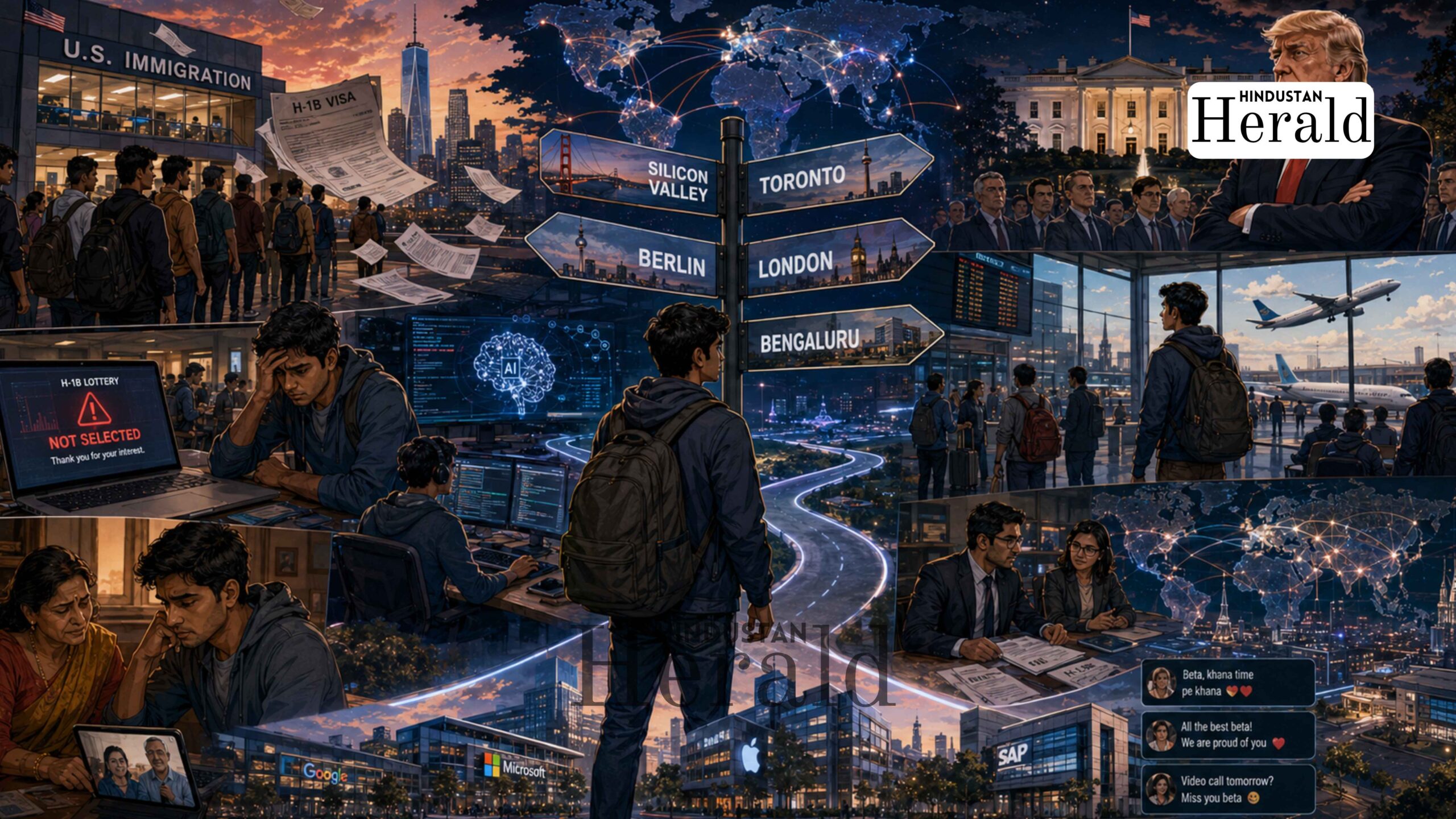
Washington D.C., May 23: Every April, something predictable happens in thousands of Indian households spread across the world. Phones light up. Screenshots get shared. A cousin in Pune forwards a message to a group chat that has not been active since Diwali. The anxiety is collective, even ritualistic. Because April is when USCIS announces the results of the H-1B Visa lottery, and for hundreds of thousands of Indian engineers and their families, those results carry the kind of weight that is difficult to explain to anyone who has not lived it.
This April felt different. Not louder. Quieter. Fewer forwards. Fewer questions. Some of the engineers who would normally have been refreshing their attorneys’ emails had already made other plans. Canada. Germany. A company in London that had been patient about waiting for an answer.
The formal explanation for that quiet arrived in immigration data: H-1B Visa applications have fallen 38 percent under the Trump administration, according to figures tracked by US immigration analysts. One of the sharpest drops the H-1B Visa programme has seen in recent memory. But numbers do not really explain what is happening here. People do.
What The H-1B Visa Programme Is, And Why India Is Its Centre Of Gravity
Before getting into why the numbers fell, it helps to understand what the H-1B Visa actually is and why its contraction lands so differently for India than for any other country. The H-1B Visa is a work authorisation for foreign nationals in what the US government calls speciality occupations, essentially any professional role that requires a bachelor’s degree or higher. Software engineers, data scientists, doctors, architects, financial analysts. The annual cap sits at 65,000 slots, with an extra 20,000 carved out for people with advanced degrees from American universities.
The demand is, to put it simply, enormous. In recent years, USCIS has received between 400,000 and 500,000 registrations for those 85,000 combined H-1B Visa slots. It is a lottery in the most literal sense. Your career trajectory, your family’s plans, sometimes the entire arc of the next decade of your life, hinging on a random selection.
India wins more of those draws than any other country by a wide margin. Roughly 70 to 75 percent of all approved H-1B Visa petitions go to Indian nationals, according to US Department of Homeland Security figures. That share has held, more or less, for the better part of two decades. Why? Because the pipeline runs deep.
IIT graduates who went to American universities in the 1990s got jobs at technology companies, climbed the ranks, became hiring managers, and started pulling in people from their home institutions. IT firms like Infosys, TCS, Wipro, and HCL built entire business models around placing Indian engineers at American client sites on H-1B Visa sponsorships. Silicon Valley grew so accustomed to drawing from this pool that it became structural, built into the hiring process the way coffee is built into the morning. For a generation of young Indians, the H-1B Visa was not really a visa. It was a plan.
So What Actually Caused The H-1B Visa Drop
The 38 percent drop in H-1B Visa applications did not happen because of one policy or one announcement. It accumulated, the way pressure accumulates before something gives. The Trump administration came in with a clearly stated scepticism about the H-1B Visa programme, framing it publicly as a tool that American companies had used to replace domestic workers with cheaper foreign labour. Most economists push back hard on that characterisation. But in this administration, the political framing mattered more than the economic literature.
Early executive orders tightened scrutiny on third party staffing arrangements, the model where Indian consulting firms place engineers at American client sites on H-1B Visa approvals. Revised USCIS guidance made the documentation requirements heavier, forcing employers to prove not just that the applicant was qualified but that the job itself genuinely met the legal definition of a speciality occupation. None of this was dramatic on paper. In practice, it made every H-1B Visa petition more expensive, more time consuming, and more uncertain. And here is the part that the official statistics do not fully capture.
A large share of the H-1B Visa decline came not from rejections but from decisions never made. Companies, especially smaller technology firms and startups, looked at the process, looked at the approval odds, looked at the political environment, and quietly decided to look elsewhere.
No denial letter. No appeal. Just a job offer that went to someone with a different visa status, or a hiring plan that shifted toward local talent, or a role that got restructured to avoid the H-1B Visa complexity altogether. Immigration lawyers call it the chilling effect. It is invisible in the data but it is arguably the most powerful force driving the H-1B Visa numbers down.
The Indian IT Industry Is Pivoting. But Pivoting Hurts.
India’s large IT companies have not been sitting still. They recognised the direction of travel a few years ago and started adjusting. Infosys made a public commitment to hire tens of thousands of American workers in the United States, reducing direct dependence on H-1B Visa deployments. TCS made similar noises in earnings calls. The logic is straightforward: if you cannot reliably bring Indian engineers to American clients on an H-1B Visa, you build a local workforce that does not require one. As reported by The Economic Times, these firms have also been expanding their delivery operations in Canada, the UK, Poland, and Mexico, spreading the geographic risk so that no single country’s immigration policy can disrupt the entire business model.
It is smart strategy. It is also a significant shift from what these companies were built to do. Hiring American engineers in San Francisco or Austin costs meaningfully more than deploying Indian engineers on H-1B Visa salaries. That cost difference is not just a line item in a spreadsheet. It is the margin that has funded decades of growth for India’s technology sector.
For the big firms with deep balance sheets, the adjustment is painful but manageable. For smaller Indian companies without that cushion, or for the individual consultant who built a career around the H-1B Visa staffing model, the adjustment is something harder to name.
The H-1B Visa Backlog Nobody Talks About Enough
There is a layer of this story that rarely makes it into international headlines, and it is arguably the most important layer of all. Even before this administration’s restrictions, the situation for Indian H-1B Visa holders already living in the United States was quietly unjust in a way that had become so normalised most people had stopped being outraged by it.
US immigration law limits the number of employment based green cards that can go to nationals of any single country to seven percent of the annual total. Every country, regardless of how many people it contributes to the H-1B Visa applicant pool, gets the same seven percent ceiling.
India accounts for roughly 70 percent of H-1B Visa applicants. It gets seven percent of green cards. Researchers at the Cato Institute have worked out the math on what this means in practice. An Indian engineer who enters the EB 2 employment based category today and joins the back of the queue is looking at a wait of 30 to 50 years. In some sub categories, longer.
Fifty years. These are not hypothetical people. They are engineers in their late thirties who have lived in the United States for fifteen years on an H-1B Visa. They own homes. Their children were born in American hospitals and know no other home. They coach weekend soccer teams and vote in local school board elections and pay federal taxes, and they are still, legally speaking, temporary.
Every H-1B Visa renewal cycle, every policy shift, every uptick in Request for Evidence rates lands on them with a particular kind of weight. Because they are not aspiring to something. They are trying to hold on to something they have already built, in a country that has not yet decided, in any formal legal sense, that they are allowed to stay. The 38 percent drop in new H-1B Visa applications is one story. The backlog is another story entirely. And together, they describe a system that is broken in two different directions at once.
Everyone Else Noticed The H-1B Visa Crisis. And They Are Moving Fast.
The rest of the world has been watching what is happening in Washington around the H-1B Visa programme. And some governments are not just watching. They are actively recruiting. Canada figured this out before most. Its Express Entry immigration system was already well designed for high skilled applicants, but in recent years Ottawa has been quietly tuning it to attract exactly the engineers and professionals that the H-1B Visa process is pushing away.
The results are showing. Indian applications for Canadian permanent residency have been climbing steadily, and communities in Toronto, Calgary, and Vancouver that barely registered on the map twenty years ago are now significant enough to have their own ecosystems of Indian restaurants, temples, regional associations, and startup networks.
The United Kingdom, rebuilding its immigration architecture after Brexit, has been marketing its Skilled Worker visa to Indian professionals with real intent. Germany, which looked at its own demographic charts and quietly panicked, passed the Skilled Immigration Act to reduce the barriers for non EU professionals. It has been direct about the fact that Indian engineers and healthcare workers are central to what it needs.
Australia and several European nations are making similar moves, each one reading the same opportunity into America’s retreat from the H-1B Visa pathway. The talent itself has not gone anywhere. The engineers are the same engineers. The skills are the same skills. What is shifting is the destination, and once those patterns settle, they are historically difficult to reverse. As it turns out, the United States does not have a monopoly on ambition. It just used to act as though it did.
What New Delhi Is Doing About The H-1B Visa Situation
The Indian government has been careful about how loudly it makes noise on this issue. There is a reason for that. Raising H-1B Visa concerns publicly with the Trump administration creates a political dynamic where any concession looks like weakness. That is not a conversation anyone in Washington wants to have in the current climate. And New Delhi knows it. So the engagement has been quieter and more technical. According to reporting by The Hindu BusinessLine, the Ministry of External Affairs has been working through bilateral framework discussions to make the case that professional mobility, including the H-1B Visa pathway, is economically beneficial to both sides, not just to the Indian professionals who want to come.
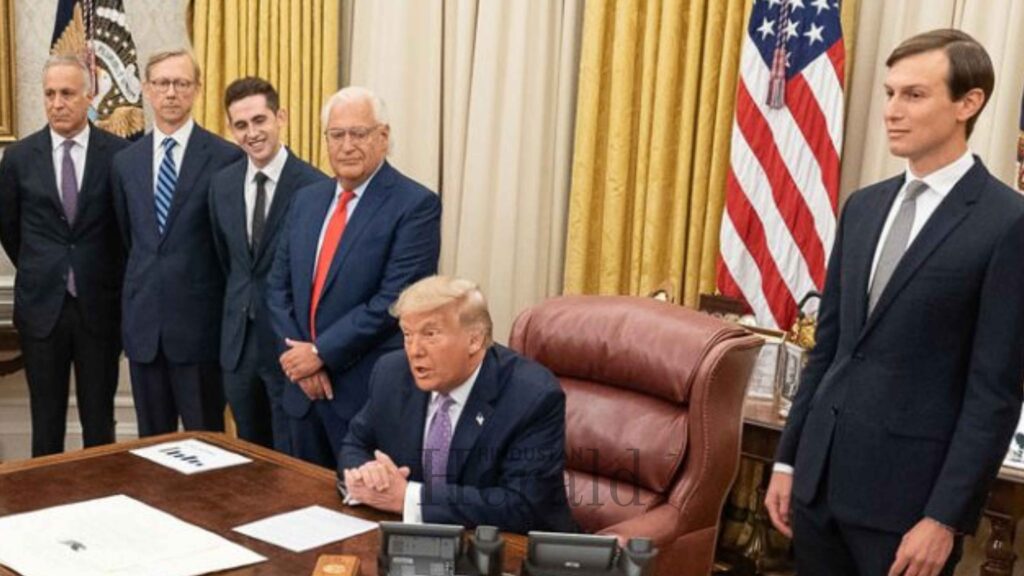
It is the right argument. Whether it is landing is a harder question to answer. What is certain is that the broader India US relationship, which has been carefully built up over two decades and which carries genuine strategic weight on questions of technology, defence, and regional stability, is carrying this H-1B Visa friction in ways that are not always visible but are steadily accumulating.
For The People Actually Living The H-1B Visa Reality
Step away from the policy for a moment. Think about the engineer who got a job offer last year from a mid size software company in Austin, went through the H-1B Visa lottery, did not get selected, and watched the company rescind the offer because they could not afford to try again next year. Think about the couple in New Jersey who had been waiting fourteen years for their green card application to move and finally decided that Canada made more sense for where they wanted their kids to grow up than another cycle of H-1B Visa renewals.
Think about the fresh graduate from NIT Trichy who sat in a campus placement interview last winter and heard, for the first time, a recruiter from an Indian IT firm say that US based H-1B Visa roles were getting harder to guarantee. Immigration Voice, the organisation that has been advocating for employment based immigrants in Washington for years, has been collecting these stories and bringing them to congressional offices. The reception, according to sources within the organisation, has not improved.
If anything, the current climate has made it harder to push even the H-1B Visa reforms that carry no financial cost, like lifting the per country cap or creating a faster path from H-1B Visa status to permanent residency. For the people living inside this system, the data is not abstract. It is the difference between staying and leaving. Between building here and building elsewhere.
Where The H-1B Visa Story Goes From Here
Nobody knows with confidence where the H-1B Visa programme goes from here. It depends on decisions this administration has not yet made, on lawsuits working their way through courts, on whether American technology companies grow loud enough about talent shortages to shift the political calculus, on whether Congress finds any appetite for H-1B Visa reform, which, given everything, seems unlikely in the near term.
What is knowable is that a 38 percent drop in H-1B Visa applications is not a rounding error. It is a direction. And directions, in immigration policy, tend to accumulate into long term patterns before anyone in power decides to reverse them. For India, there is something quietly significant happening beneath all of this that goes beyond the H-1B Visa statistics. A generation that was raised to see America as the singular destination, the place where ambition gets its fullest expression, is for the first time genuinely entertaining other answers to that question.
Some of those answers are in Toronto. Some are in Berlin. Some, increasingly, are in Bengaluru and Hyderabad and Chennai, where a different kind of quiet conversation is starting to happen about what it would take to build something here that makes the H-1B Visa question less necessary. That is the deeper story inside the 38 percent. And it is only just beginning.
Stay ahead with Hindustan Herald — bringing you trusted news, sharp analysis, and stories that matter across Politics, Business, Technology, Sports, Entertainment, Lifestyle, and more.
Connect with us on Facebook, Instagram, X (Twitter), LinkedIn, YouTube, and join our Telegram community @hindustanherald for real-time updates.

Tracking world politics, global markets, trade movements, policy decisions, and the changing balance of economic power.
- Shelesh Joshi

- Shelesh Joshi
- Shelesh Joshi
- Shelesh Joshi





Specializes in South Asian geopolitics and global diplomacy, bringing in-depth analysis on international relations.
- Rajiv Menon
- Rajiv Menon
- Rajiv Menon
- Rajiv Menon