 By Shelesh Joshi and Kavita Iyer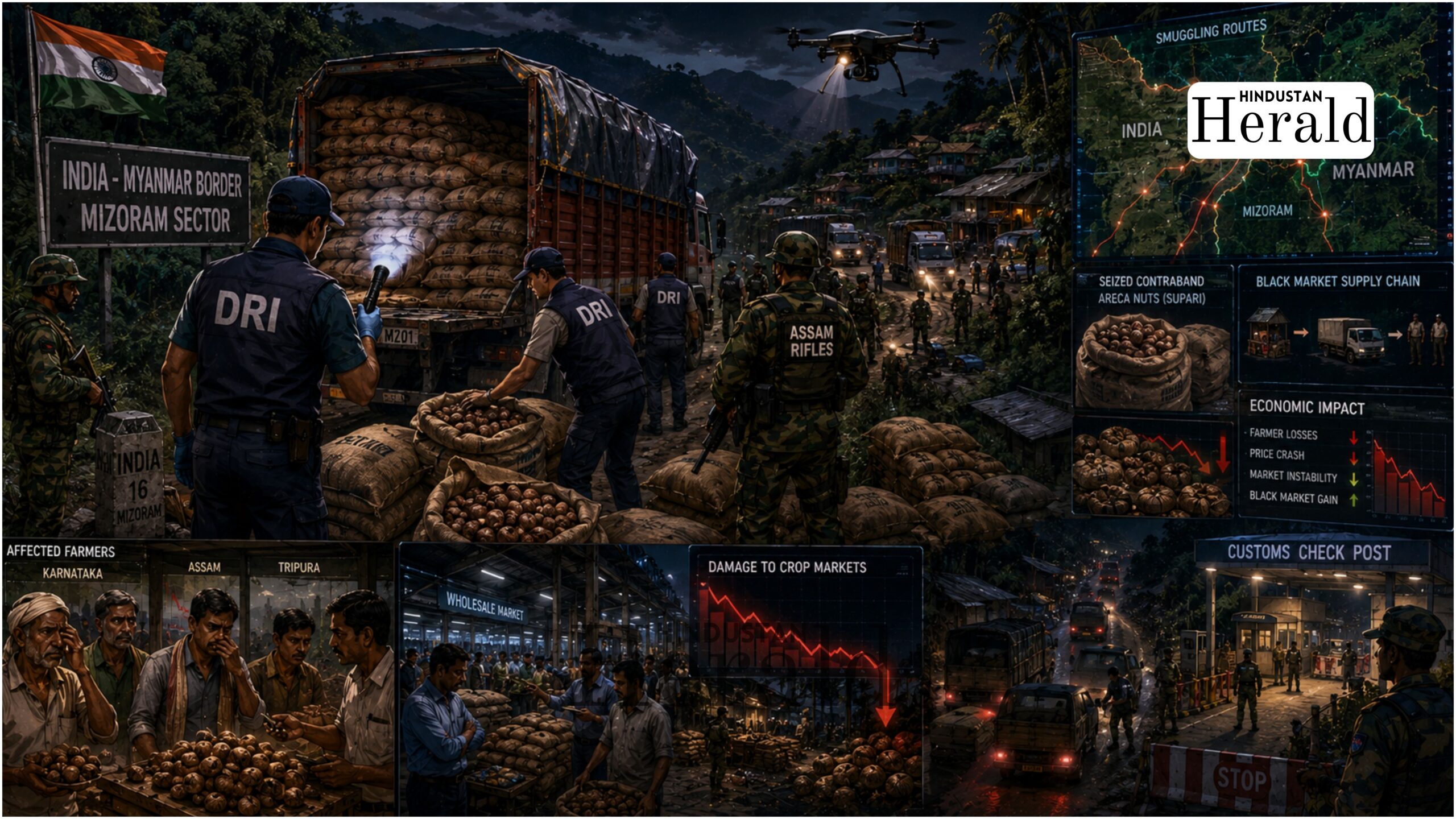
New Delhi, May 23: Let’s be honest about something. When the Ministry of Finance puts out a press release about a customs seizure, most people scroll past it. Sixty thousand kilograms of areca nuts confiscated somewhere in the Northeast does not exactly compete with election news or a cricket controversy for attention.
But sit with the story for a moment and something starts to emerge. Not just a smuggling tale from India’s forgotten frontier, but a quiet economic crisis playing out across farming communities, border districts, and wholesale markets that most of urban India has never heard of.
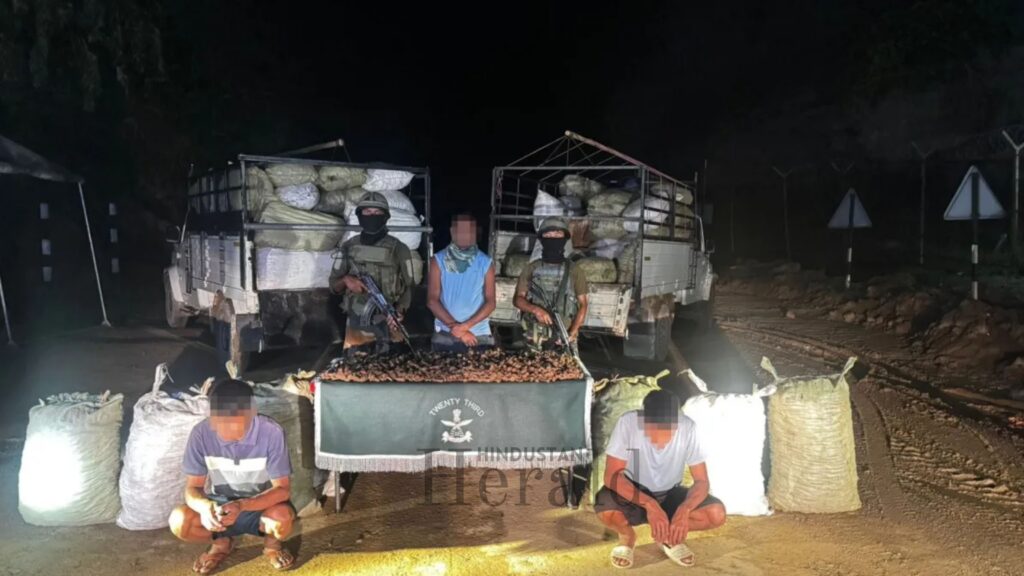
This week, Directorate of Revenue Intelligence (DRI) officers ran two operations in Assam and Mizoram. DRI pulled around 60,000 kilograms of smuggled areca nuts out of the system. Five people were arrested. The nuts had come from Myanmar, crossed into India without touching customs, and were moving steadily toward domestic markets when DRI moved in. It sounds contained. It is not.
The Border That Works Against You
People who have not spent time in the Northeast tend to imagine India’s eastern frontier as something like its western one. A fence. Floodlights. Soldiers at checkpoints. That is not what Mizoram’s border with Myanmar looks like.
What it actually looks like is jungle. Dense, thick, unbroken forest running across mountain ridges for hundreds of kilometres. Six of Mizoram’s districts, Champhai, Siaha, Lawngtlai, Hnahthial, Saitual, and Serchhip, press directly against Myanmar’s Chin State across a 510-kilometre stretch that has no wall, no fence, and in large sections, no physical marking of any kind. The same footpaths that village communities have used for generations to visit family across the border are the paths that move contraband today.

There are roughly 1,643 kilometres of unfenced border between India and Myanmar across four northeastern states. DRI officials and security personnel will tell you privately that comprehensive surveillance across that terrain is not a realistic objective with current resources. What DRI can do is build informant networks, run intelligence-led operations when credible information comes in, and move decisively when windows open.
So things move through regardless. Heroin moves. Yaba tablets move. Counterfeit goods, wildlife parts, arms, and dried areca nuts, all using the same informal pathways, often in the same trucks, sometimes in the same load. The 38 Battalion of the Assam Rifles joined DRI for one of this week’s two operations. When paramilitary units are needed to support a DRI customs enforcement action, it tells you something about the nature of the territory and the people running these supply chains.
As recently as March 2025, joint operations in Champhai district recovered 180 bags of areca nuts worth Rs 1.08 crore, hidden under jungle cover near Zote village. That was measured in hundreds of bags. This week DRI is pulling 60,000 kilograms out of circulation in a single operational window. The volumes are not declining.
The Part Nobody Puts in the Press Release
Here is the honest commercial logic of what is happening. India protects its areca nut farmers with a 100 percent basic customs duty on imported betel nuts. The policy has a genuine rationale. Millions of smallholder farmers across Karnataka, Kerala, Assam, and Tripura grow areca nut as their primary cash crop. Without tariff protection, cheaper foreign supply would undercut them badly. The problem is what that same duty structure looks like from the other side of the Champhai border.
A truckload of dried areca nuts sourced from Myanmar and brought into India through the jungle, bypassing the customs checks that DRI is responsible for enforcing, lands in a Guwahati wholesale market at a fraction of what legally grown Indian supari costs. The buyer saves significantly. The smuggler pockets the duty differential as profit. And back in Karnataka’s Dakshina Kannada district or Tripura’s Jampui Hills, a farmer notices that prices have softened again and cannot quite pin down why.
This is not a small market. India produces over 14 lakh tonnes of areca nut annually across 7.7 lakh hectares of cultivation land, according to the National Horticulture Board. The country accounts for more than 45 percent of global areca nut production. The global market was valued at USD 878 million in 2024 and is projected to cross USD 2,000 million by 2033.
What makes the structural problem even harder to ignore is this: India formally imported areca nuts worth USD 178 million in 2024 through legitimate channels. Domestic production is not fully meeting domestic demand even in normal conditions. That unmet demand is the standing invitation that smuggling networks have been accepting for years, and the same invitation that keeps DRI returning to the same border corridor season after season.
The Farmers Who Got Hit From Both Sides
Go and speak to areca nut growers in Tripura’s Jampui Hills and what you hear is a particular kind of frustration. Not dramatic anger, but the worn-down exhaustion of people who feel like the system keeps finding new ways to work against them.
The smuggled Burmese nuts have been pressing down on their prices for a while. Wholesale buyers know cheaper supply is available informally and use that knowledge in price negotiations with legal sellers. Farmers absorb the discount that should belong to the smugglers.
Then last year, Assam tried to help. The state government imposed restrictions on transporting areca nuts across its territory, trying to stop illegal consignments from reaching other states. The intention was protective. The outcome created serious problems for the wrong people.
Officers on the ground, including those assisting DRI at interstate checkpoints, had no practical way to tell a bag of legally grown Tripura areca nuts from a bag of smuggled Burmese areca nuts. They look the same. They travel in identical jute sacks. So trucks carrying Tripura’s legitimate produce started getting stopped at Assam’s borders alongside contraband. Farmers who had already sold their harvest to traders found consignments stranded. Income that should have arrived simply did not.

Chief Minister Manik Saha had to personally step in, writing to Himanta Biswa Sarma in Assam and raising the issue separately with Union Home Minister Amit Shah. A partial resolution was eventually worked out. The underlying problem, that nobody can reliably tell legal Indian areca nuts from illegal Burmese ones at a checkpoint, was never fixed.
That is the trap the Northeast is caught in right now. Smuggling hurts farmers. Cracking down on smuggling, without the right tools, ends up hurting the same farmers again. The people who most need protection keep getting caught between the problem and the attempted solution.
Five Arrests and an Uncomfortable Question
The DRI Guwahati Zonal Unit deserves credit for how this week’s operation was structured. Two phases, across two states, based on specific intelligence rather than random checks. The quality of recent DRI operations in the Northeast suggests that informant networks within trading and transport communities have genuinely sharpened over the past couple of years. Good intelligence work is harder than it looks, and the operational precision DRI demonstrated this week reflects real institutional investment in that capability. But five arrests from a 60,000-kilogram seizure raises a question that should be asked plainly.
Who exactly are these five people?
If they are drivers and loaders, the people who physically moved the consignment, then the network that organised and financed the shipment is entirely intact. The person who sourced the nuts in Myanmar, the person who arranged the border crossing, the trader who placed the order, the financier who fronted the capital, none of them are in custody. They are calculating whether the seized consignment was worth the risk and deciding whether to run the next one.
Earlier DRI enforcement data from the Northeast gives some perspective on this cycle. Over a 100-day period of concentrated operations, authorities seized areca nuts worth Rs 31.73 crore, registered 19 FIRs, and arrested 61 people. The networks absorbed all of that and kept operating.
Cases under India’s Customs Act, 1962 also tend to move slowly through the courts. By the time a conviction comes, the smuggling operation has long since restructured around new routes and new carriers. The deterrent effect of even a large DRI seizure fades faster than the legal process moves.
What Actually Changes in the Market After a DRI Action
For people tracking this commercially, the short-term effect of DRI pulling 60,000 kilograms off informal supply channels is real but temporary.
Tighter availability in wholesale markets tends to nudge prices upward on legally traded supari. Growers in Karnataka and Kerala who supply premium domestic areca nuts to processors and manufacturers tend to see some benefit in these windows. Whether that price support lasts depends entirely on how long DRI maintains enforcement intensity before the next wave of supply finds its way through.
For manufacturers in the pan masala and smokeless tobacco sector, which uses areca nut as a core raw material, the compliance question is becoming harder to sidestep. Both DRI and the Directorate General of GST Intelligence have been increasingly coordinating scrutiny of input sourcing in this industry. A company quietly buying cheap, undocumented areca nuts from northeastern intermediaries to manage input costs is carrying regulatory exposure that is growing, not shrinking.
There is also a quiet irony in India’s overall areca nut trade position. The country exported 11,800 metric tonnes of premium areca nut through formal channels in 2023-24. At the same time, cheaper Burmese nuts were flowing in illegally through Mizoram’s forests. Premium Indian supari goes out the front door for export revenue. Illegal foreign supari comes in the back door at below-market prices. Both sides of the trade run simultaneously, and the arbitrage funding the illegal side has been consistent enough to sustain organised smuggling networks for years, keeping DRI perpetually occupied along the same corridors.
One Week, Two DRI Seizures, and a Bigger Story
The same week DRI was working the areca nut operations in the Northeast, the agency also announced it had seized 3,00,000 e-cigarettes and vapes worth Rs 120 crore in a separate nationwide sweep. Consignments from China, declared as furniture to get past customs. Two very different products, two very different entry points, both moving through the same basic logic: find a tariff gap, find a gap in enforcement, move the goods before DRI closes in.
The Ministry of Finance announced both in the same window. It reads, if you step back from the individual press releases, as a DRI that is widening its operational scope and moving more decisively on intelligence. That is genuinely encouraging if it represents a sustained shift rather than a seasonal push.
The harder conversation, though, is the one that DRI enforcement alone cannot have. At some point, policymakers need to seriously examine whether the current tariff architecture around areca nuts is creating more damage than it is preventing. A 100 percent import duty is protecting farmers in principle, but those same farmers are being hurt by the smuggling the duty incentivises. A more sophisticated import management framework, one that combines reasonable duty rationalisation with strong origin verification and traceability, could actually serve domestic growers better than the current blunt instrument. Until that conversation happens, DRI will keep seizing consignments in Champhai’s forests, pressing releases will keep going out, and the networks will keep finding the next truck.
For this week, at least, 60,000 kilograms of areca nuts are off the market. Five people are in custody. And somewhere in rural Karnataka, Assam, and Tripura, farmers will wake up to prices that are, very briefly, slightly less distorted than they were yesterday. How long that lasts is anybody’s guess.
Stay ahead with Hindustan Herald — bringing you trusted news, sharp analysis, and stories that matter across Politics, Business, Technology, Sports, Entertainment, Lifestyle, and more.
Connect with us on Facebook, Instagram, X (Twitter), LinkedIn, YouTube, and join our Telegram community @hindustanherald for real-time updates.

Tracking world politics, global markets, trade movements, policy decisions, and the changing balance of economic power.
- Shelesh Joshi

- Shelesh Joshi
- Shelesh Joshi
- Shelesh Joshi





Former financial consultant turned journalist, reporting on markets, industry trends, and economic policy.
- Kavita Iyer
- Kavita Iyer
- Kavita Iyer
- Kavita Iyer