 By Shelesh Joshi and Kavita Iyer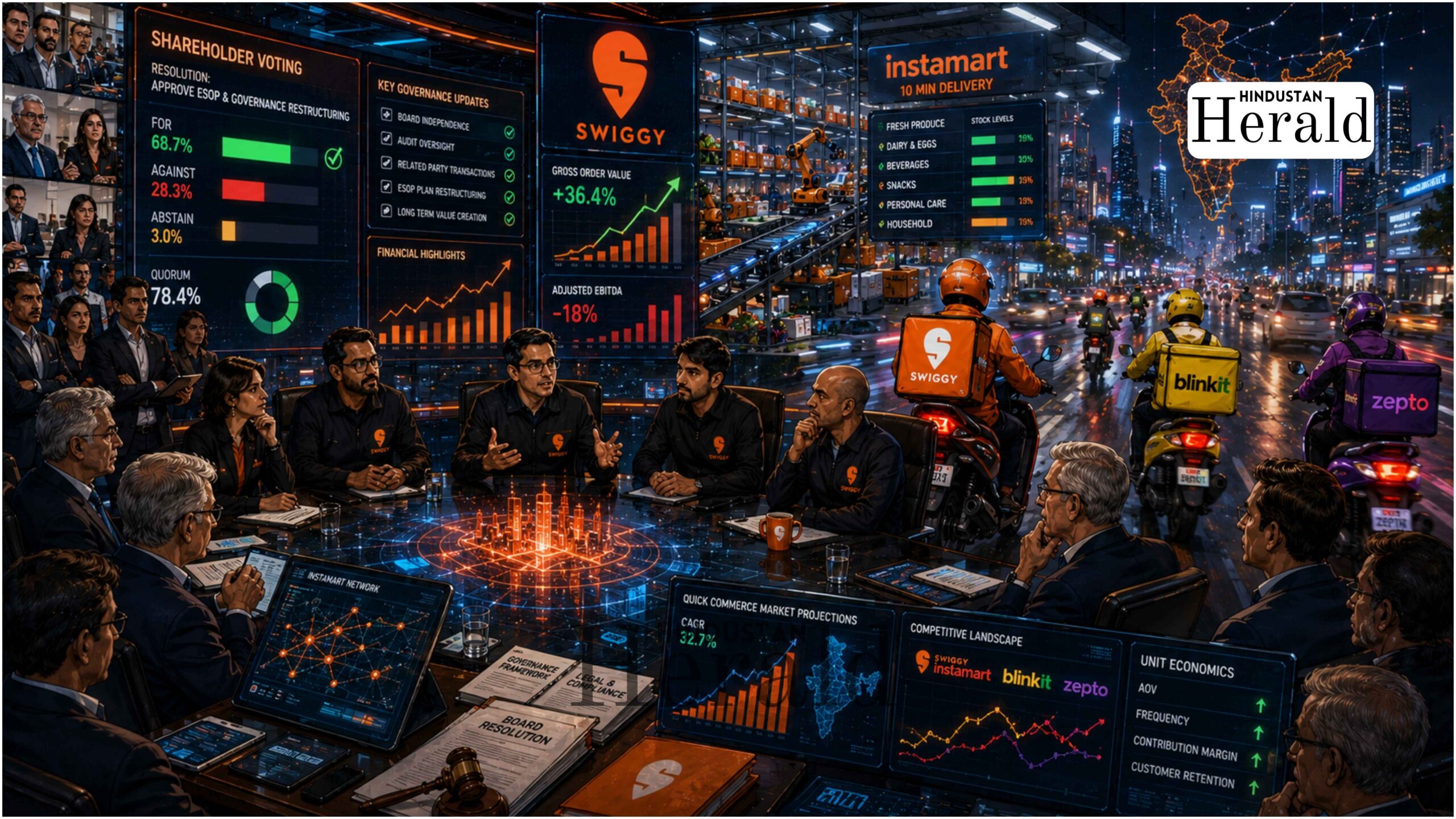
Mumbai, May 22: Let us start with what actually happened, because the details matter more than the headline suggests. Swiggy conducted a postal ballot among its shareholders between April 21 and May 20, 2026, seeking approval for two resolutions. One sailed through without difficulty. The other did not come anywhere close enough.
The resolution that failed was a proposal to amend Swiggy’s Articles of Association. It received 72.36 per cent of votes in favour. Under Section 14 of the Companies Act, 2013, that is not enough. Changing a company’s AoA requires a special resolution, which means at least 75 per cent of votes cast must be in favour. Swiggy fell short by 2.65 percentage points. The resolution was declared not passed.
This is the first time shareholders have voted down a resolution since Swiggy went public in November 2024. That context matters. It did not take long.
What Swiggy Was Actually Trying to Do
This is the part that has been underreported in the immediate coverage, and it is the part that makes this story significantly more interesting than a routine governance stumble.
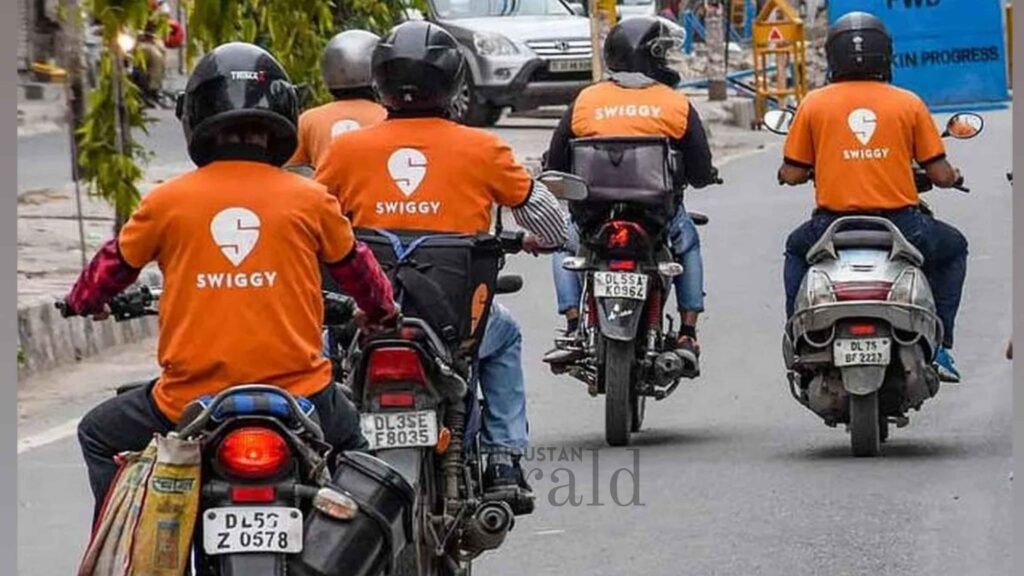
Swiggy was not simply tidying up old clauses in its founding document. The proposed amendment was specifically designed to restructure the company’s board nomination framework in a way that would help Swiggy eventually qualify as an Indian Owned and Controlled Company, or IOCC, under India’s Foreign Exchange Management Act regulations.
Under FEMA, a company qualifies as an IOCC only when both ownership and control rest substantially with resident Indian citizens or eligible Indian entities. For Swiggy, which counts Prosus and SoftBank among its major foreign shareholders, meeting that threshold is not a simple exercise. The company clarified in a stock exchange filing that the proposed AoA changes formed part of a broader effort to align its governance structure with IOCC requirements, specifically by modifying how board nominations work so that domestic management representation is formally embedded in the company’s rulebook.
Crucially, Swiggy also clarified that the AoA amendment alone would not have automatically resulted in IOCC classification. Additional regulatory and shareholder approvals would still have been required down the line. This was a preparatory step, not a finishing one. Shareholders were essentially being asked to lay a piece of foundation work for a transition that would require considerably more building on top of it.
So why does the IOCC tag matter so much to Swiggy? The answer lies directly in Instamart, its quick commerce vertical. Swiggy has been preparing for some time to pivot Instamart to an inventory-led model, where the company owns the goods it sells rather than acting purely as a marketplace connecting buyers to sellers.
That kind of model requires Swiggy to hold inventory directly, which under Indian foreign exchange regulations is significantly easier to execute, and in some product categories only permissible, for a company classified as an IOCC. Without that classification, Swiggy’s ability to fully execute the inventory pivot at Instamart remains constrained by regulatory boundaries that its competitors operating under different ownership structures do not face in the same way.
In May 2025, Swiggy rolled out a separate Instamart app, a clear signal that the quick commerce business was being positioned as its own distinct entity with its own brand identity. In September 2025, Swiggy hived off the quick commerce vertical into a step-down subsidiary, a structural corporate move that appeared designed specifically to prepare Instamart for exactly this kind of model transition. The AoA amendment was the next logical step in that sequence. As per reporting by Inc42, shareholders said no, and for now that sequence has stalled.
The Vote That Did Pass, and Why the Contrast Tells You Everything
While the AoA amendment failed, the second resolution on the postal ballot passed with remarkable ease. Shareholders approved the appointment of Renan De Castro Alves Pinto as a Non-Executive, Non-Independent Nominee Director with 98.98 per cent of votes in favour.
That contrast is worth sitting with for a moment. The same group of shareholders that gave 98.98 per cent support to a director appointment gave only 72.36 per cent to the AoA amendment. This was not generalised shareholder discontent with Swiggy or its management. It was a specific, targeted objection to one particular proposal. Shareholders were not broadly unhappy with the company. They were unconvinced by this specific amendment, or at least not sufficiently persuaded to push it over the 75 per cent line.

As a direct consequence of the failed AoA resolution, Swiggy confirmed that the proposed appointments of additional executive, non-independent directors, which were entirely contingent on the amendment passing, will not take effect on June 1, 2026 as originally planned. The only board change that now proceeds is the appointment of Renan De Castro Alves Pinto, effective from April 11, 2026. The board composition Swiggy had planned for the start of next month will simply not materialise.
Why 2.65 Percentage Points Is a More Significant Gap Than It Appears
On the surface, falling short by 2.65 percentage points sounds like a near miss. Swiggy got 72.36 per cent when it needed 75 per cent. The instinct is to read that as close. But consider what it actually takes to move 2.65 percentage points in a supermajority vote among a dispersed institutional shareholder base, and the picture looks considerably more difficult.
Swiggy’s promoter group holds approximately 34 per cent of the company according to exchange filings. The remaining roughly 66 per cent is distributed across domestic mutual funds, foreign portfolio investors, insurance companies, and retail shareholders, none of whom are obligated to follow the promoter’s lead on any resolution. Getting three quarters of that diverse and independent group to agree on a governance change requires near-perfect alignment across institutional camps that do not always move together and do not share the same investment mandates or governance philosophies.
Proxy advisory firms like IiAS and SES sit at the centre of how large domestic institutional funds vote at Indian company meetings. These firms read every resolution and its accompanying explanatory statement, publish detailed recommendations ahead of the voting deadline, and a significant portion of the organised institutional vote follows their guidance.
If either firm advised shareholders to withhold support from this particular amendment, the vote shortfall can accumulate quietly and decisively in the days before the ballot closes. Moving those votes back into the yes column requires substantive engagement, revised communication, and in many cases revised proposal text that directly addresses the specific concerns raised. None of that happens quickly or easily.
The Communication Gap That Cost Swiggy the Vote
One pattern clearly visible in how this situation developed is that Swiggy was not ahead of the communication curve on this amendment. The company eventually filed a clarification with the stock exchanges explaining the IOCC rationale and the board nomination framework changes, but that clarification came after institutional investors had already raised queries about the proposal. A clarification issued in response to questions already being asked is not the same as proactive disclosure provided at the outset of the voting period.
Listed companies are required to attach explanatory statements to postal ballot notices, and those statements are supposed to equip shareholders with everything they need to make an independent and informed decision.
Whether Swiggy’s original notice adequately explained the IOCC connection in terms that institutional fund managers and their proxy advisors could fully evaluate from the beginning is a legitimate question given the outcome. If the strategic rationale only became clear after investors started pushing for answers, it is not surprising that enough of them decided the conservative vote was to withhold support.
This matters beyond the immediate failed resolution. Institutional shareholders who feel they were asked to approve something without complete information from the start tend to carry a heightened level of scrutiny into every subsequent interaction with that company. The trust deficit created by one poorly communicated proposal has a habit of showing up in vote counts on future resolutions as well. Swiggy needs to take that dynamic seriously as it maps out its governance path forward.
India’s Institutional Shareholders Are Not What They Used to Be
There is a version of this story you could have told ten years ago that would have had a completely different ending. A decade back, domestic mutual funds and public sector insurance companies largely voted with management on anything that was not spectacularly egregious. The stewardship culture simply did not exist in any meaningful form. Resolutions passed with comfortable margins, and management teams walked away from shareholder votes having received everything they asked for.
SEBI spent years methodically dismantling that dynamic. The regulator strengthened its stewardship code requirements through successive circulars, eventually making it mandatory for institutional shareholders to vote at company meetings, disclose their voting decisions publicly, and explain their reasoning in a transparent and reviewable format. This created accountability where none had previously existed. Fund houses that had previously avoided controversy by abstaining on everything now had to take positions and stand behind them.
The behavioural change that followed was gradual but real and cumulative. Today, large domestic fund houses push back on governance amendments they find inadequately explained. They withhold support from proposals they cannot fully evaluate. They engage with proxy advisory services and treat their recommendations as a meaningful input. Swiggy ran directly into this evolved institutional environment. The company put forward a governance proposal, did not build sufficient consensus around it before the ballot opened, and lost the vote. That is the system functioning more or less as it is supposed to.
The Strategic Cost of Getting This Wrong
If Swiggy were operating in a comfortable competitive environment with its strategic roadmap proceeding on schedule, the governance setback would be a manageable inconvenience. The company is not in that position, and the implications of the failed vote extend well beyond the immediate question of board composition.
The inventory pivot at Instamart is central to Swiggy’s long-term quick commerce strategy. Competitors in the quick commerce space who operate under different ownership and regulatory structures are not facing the same constraints on inventory ownership. Every month that Swiggy spends rebuilding shareholder consensus on the AoA amendment rather than executing the strategic transition is a month in which that competitive gap can widen in ways that are difficult to close later.
Blinkit, operating under Zomato’s financial umbrella, has been expanding its dark store network at a pace that has extended its lead in several major metro markets. Zepto continues to raise capital and push aggressively into new geographies and product categories. The quick commerce market in India is moving fast, and strategic delays carry real costs even when they are not immediately visible on any financial statement.
This is what makes the failed AoA vote more consequential than a straightforward governance stumble. It is not just about the rulebook. It is about whether Swiggy can execute the operational transformation that its own leadership has publicly committed to, on the timeline that the competitive environment demands.
What Swiggy Needs to Do From Here
Indian company law imposes no mandatory waiting period before Swiggy can re-table the AoA amendment. The company could issue a fresh postal ballot notice within weeks. That approach would almost certainly produce the same result or worse. Shareholders who have just voted against a proposal and are immediately presented with an identical request without any substantive change or additional explanation rarely reverse their position out of goodwill or deference.
The realistic path forward requires Swiggy to work through several things deliberately. The company needs to understand specifically which institutional shareholders drove the shortfall and what their precise objections were. It needs to engage directly with the proxy advisory firms whose recommendations likely shaped the outcome, provide the additional disclosure they require, and work toward a position where those firms can recommend a yes vote with confidence. If the proposal text itself contributed to the problem, Swiggy needs to revise it in a way that directly addresses institutional concerns without undermining the strategic objective of qualifying as an IOCC.
That entire process requires time, genuine engagement, and the willingness to approach the institutional shareholder base as genuine partners in governance rather than obstacles to be managed. Companies that invest in that kind of relationship tend to find future shareholder votes considerably smoother. Companies that treat the re-engagement process as a compliance exercise tend to find the same resistance waiting for them the next time.
What This Episode Really Comes Down To
Swiggy is a real business with a credible and meaningful shot at building something durable in Indian consumer technology. The quick commerce opportunity is large and real. The Instamart inventory pivot is a strategically sound ambition if the regulatory and governance conditions can be put in place to support it. The IOCC transition is a legitimate goal, and the AoA amendment was a reasonable step toward it.
But in a public company, even reasonable and well-intentioned steps require genuine consensus-building, transparent communication from the outset, and the institutional humility to bring shareholders along rather than assuming their support. Swiggy did not do enough of that this time. The postal ballot result on May 20, 2026 delivered that verdict plainly.
The question now is whether Swiggy treats this as a genuine governance learning moment, invests in rebuilding the institutional trust required to pass the amendment on a future attempt, and uses that process to become a more transparent and shareholder-conscious public company. Or whether it treats the failed vote as a procedural inconvenience to be worked around as quickly as possible.
The way Swiggy answers that question will matter well beyond its own shareholder register.
Stay ahead with Hindustan Herald — bringing you trusted news, sharp analysis, and stories that matter across Politics, Business, Technology, Sports, Entertainment, Lifestyle, and more.
Connect with us on Facebook, Instagram, X (Twitter), LinkedIn, YouTube, and join our Telegram community @hindustanherald for real-time updates.

Tracking world politics, global markets, trade movements, policy decisions, and the changing balance of economic power.
- Shelesh Joshi

- Shelesh Joshi
- Shelesh Joshi
- Shelesh Joshi





Former financial consultant turned journalist, reporting on markets, industry trends, and economic policy.
- Kavita Iyer
- Kavita Iyer
- Kavita Iyer
- Kavita Iyer