
 By Rajiv Menon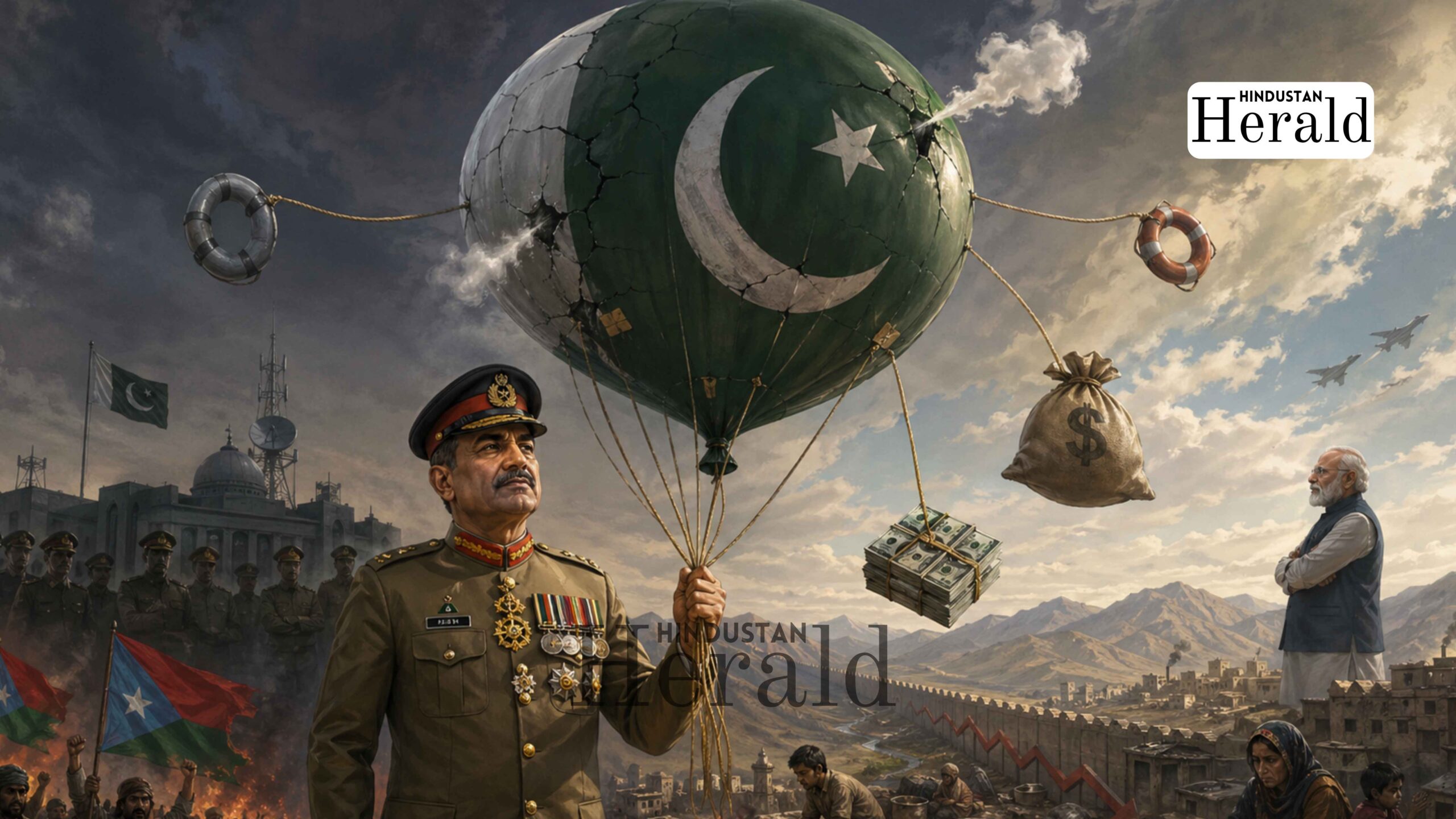
New Delhi, April 29: There is a question that keeps coming up in foreign policy conversations, in editorial meetings, in the kind of off-the-record chats that happen over tea in South Block corridors. Nobody asks it loudly. But everyone is asking it.
Is Pakistan actually a state anymore?
Not in the legal sense. On paper, the answer is obvious: it has borders, a flag, nuclear weapons, a seat at the United Nations, and a prime minister who posts on X. But paper is not the same as reality. And the reality of Pakistan in April 2026 is something that resists easy categorisation. It is a country that is simultaneously hosting US-Iran peace talks and watching its own lawyers get sentenced to seventeen years for criticising the army on social media. A country that is diplomatically ascendant and domestically coming apart. A balloon, to use an image that keeps suggesting itself, that looks impressively full but only because someone keeps pumping gas into it from outside.
The Borrowed Air
Let us start with the economics, because that is where the structural rot is most visible.
Pakistan entered 2026 on IMF life support. Its foreign exchange reserves are chronically low. Its debt burden is punishing. The stabilisation that officials in Islamabad and some cheerful analysts in Washington have pointed to as evidence of recovery rests almost entirely on borrowed money, Gulf remittances, and loan rollovers from friendly governments, China, Saudi Arabia, and the UAE. As Dawn’s own editorial board noted in January, this is a short-term gain sitting on an unsustainable foundation. Meaningful structural reform of the tax system, the energy sector, and public expenditure has simply not happened. The privatisation of PIA, long delayed and politically painful, was finally pushed through. But it is one transaction in an economy that needs a dozen systemic overhauls.
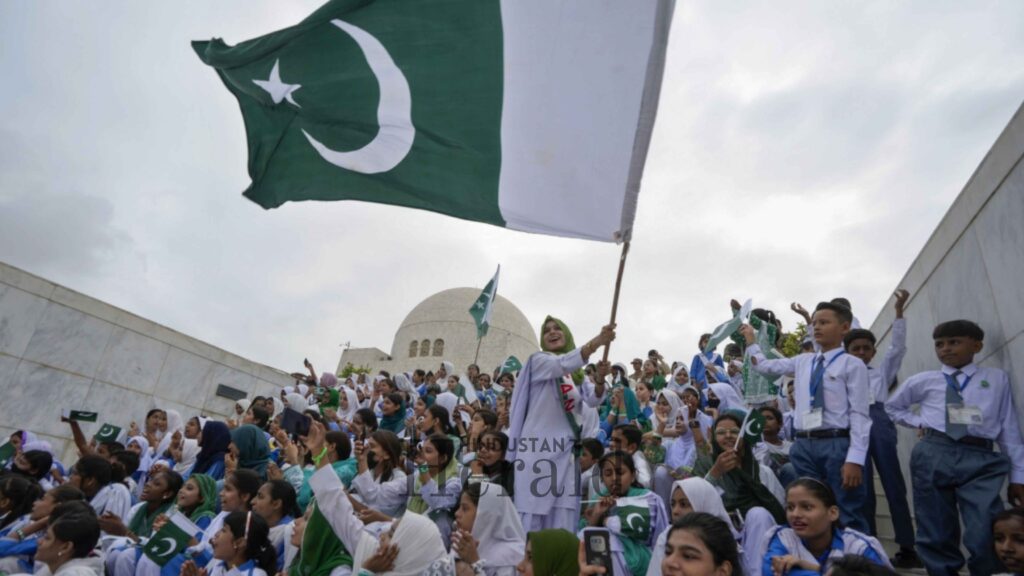
Meanwhile, the World Bank puts Pakistan’s poverty rate at 44 per cent. Four in ten children under five are stunted from malnutrition. The population is growing at 2.5 per cent annually, which means roughly six million new mouths every year in a country that already cannot adequately feed, school, or employ the people it has. These are not the numbers of a state in recovery. These are the numbers of a state in slow collapse, dressed up in diplomatic victories.
What Happened in May
To understand where Pakistan is now, you have to go back to last spring.
On April 22, 2025, gunmen attacked tourists in a meadow near Pahalgam in Indian-administered Kashmir. Twenty-six people were killed, most of them Hindu tourists from across India. The attack was brutal in a particular way victims were reportedly shot execution-style, singled out by religion. India blamed Pakistan. Islamabad denied any involvement. The Resistance Front, a group New Delhi considers a front for the Pakistan-based Lashkar-e-Taiba, initially claimed responsibility and then retracted the claim in a manner that satisfied nobody.
What followed was the most dangerous fortnight in South Asian history since the nuclear tests of 1998.
India launched Operation Sindoor on May 7 missile strikes on nine sites across Pakistan and Pakistan-administered Kashmir, targeting infrastructure linked to Jaish-e-Mohammed and Lashkar-e-Taiba. Pakistan called it an act of war. There were retaliatory strikes, drone warfare, border skirmishes along the Line of Control, and three days in which both governments were making decisions under the kind of pressure that historically produces catastrophic miscalculations. Airports shut down on both sides. Stock markets convulsed. An aircraft carrier was repositioned in the northern Arabian Sea within operational range of Karachi.
A ceasefire, brokered by the United States, held from May 10. But nothing was resolved. The Indus Waters Treaty remains suspended. There are virtually no official contacts between New Delhi and Islamabad. And Indian forces had struck deeper into Pakistani territory than at any point in the last fifty years. That is not a small thing. That is a benchmark shift.
Prime Minister Modi called it a new normal. He was probably right, though not quite in the way he intended. Because Pakistan also drew its own conclusions from May. And those conclusions have driven everything that has happened since.
The Balloon Rises
Here is the part that India finds genuinely uncomfortable to sit with.
The country that came off worst from May 2025 in strategic terms has, within eleven months, reinvented itself as one of the most consequential diplomatic actors on the planet. Pakistan mediated a ceasefire between the United States and Iran. It hosted direct talks between Washington and Tehran in Islamabad. Its army chief flew to Tehran when no other regional military leader would. When the ceasefire announcement came, it was Shehbaz Sharif who posted it on X first.

This did not happen by accident. Field Marshal Asim Munir promoted after the India-Pakistan conflict has spent the past year methodically building Pakistan’s positioning as an indispensable Muslim-world interlocutor. He signed a Strategic Mutual Defence Agreement with Saudi Arabia, the first such pact Pakistan has ever concluded. He met US Vice President JD Vance and Special Envoy Steve Witkoff in direct consultations over the Iran crisis. He visited the Trump White House twice. Trump has publicly praised him, repeatedly, using the phrase “favourite field marshal” which is the kind of presidential branding that opens doors and closes off rivals.
As one University of Western Australia analyst put it, writing in The Conversation this month, Pakistan harnessed long-running relationships, shared histories, and security arrangements to insert itself into a conflict it had no obligation to touch. It worked because of specific geography, specific alliances, and the specific calculations of a military establishment that understood its own interests with clear eyes. Pakistan did not want a weakened Iran on its western flank particularly not one under Israeli and Indian influence. Munir knew that. He moved accordingly.
The result is a Pakistan that is diplomatically ascending at precisely the moment its domestic situation is most precarious. The contradiction is jarring. But it is real.
The State That Jails Its Lawyers
Back inside Pakistan, the picture is grimmer.
The political crisis that began with Imran Khan’s ouster in 2022 has not been resolved. If anything, it has calcified into something more corrosive. Khan remains in prison, convicted on multiple charges that his supporters and many independent observers regard as politically motivated. The government’s response to dissent has been to reach for the legal system as a blunt instrument. An anti-terrorism court sentenced multiple journalists and social media personalities to life imprisonment. Human rights lawyer Imaan Mazari and her husband were handed seventeen years in prison for social media posts critical of state institutions. International condemnation followed, as it always does, and as it always does in Pakistan, it changed very little.
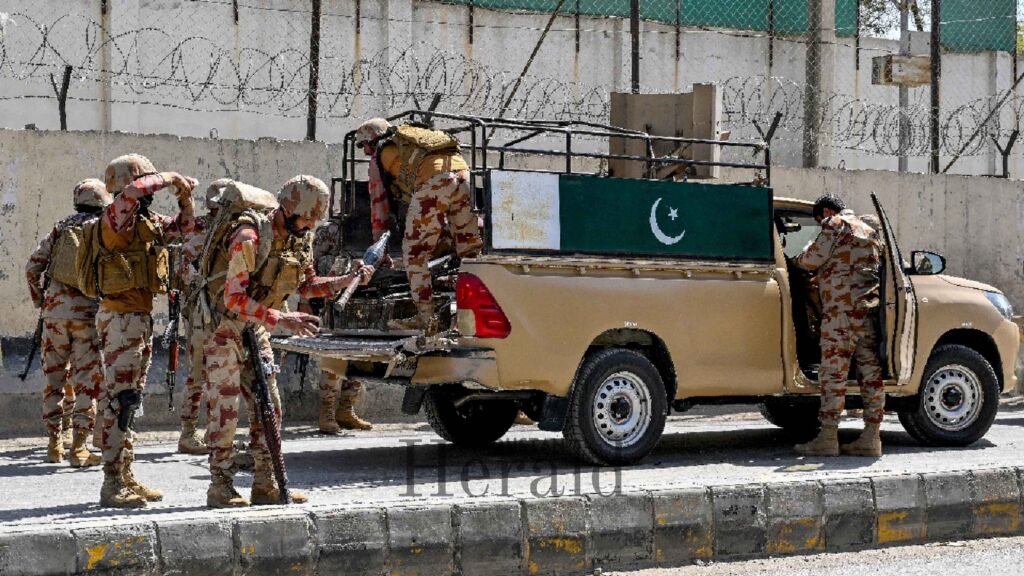
Balochistan is bleeding. The Baloch Liberation Army’s insurgency reached its most intense levels in a decade last year. A series of coordinated BLA attacks between late January and early February 2026 left 36 civilians dead, along with more than 200 militants and two security personnel. Bombings, ambushes, and checkpoint attacks have become a near-weekly rhythm. The government responds with military operations, arrests, and enforced disappearances, a cycle that has been running for twenty years without producing a resolution.
To its west, the Afghanistan problem has not gone away either. Pakistan launched airstrikes on Afghan territory in February. Afghanistan retaliated. A ceasefire held until late March before hostilities spiked again. More than a hundred thousand civilians were displaced from their homes near the border. Defence Minister Khawaja Asif declared “open war” against Afghanistan at one point in February a statement that was either a serious escalation or political theatre, and the ambiguity itself is alarming.
This is the domestic reality that Pakistan’s diplomatic successes are papering over.
The Military Is the State
It has become fashionable, in certain foreign policy circles, to treat Pakistan’s military dominance as a stable feature rather than a structural problem. The argument goes: the army runs things, but it runs them competently enough to keep the country together and pursue coherent strategic interests. Trump seems to have bought this argument entirely. Washington has, in various forms, been buying it since the 1950s.
The problem is that a military-run state wearing the costume of civilian democracy is not, in any meaningful sense, a democracy. And democracies, even imperfect ones, tend to have feedback mechanisms that prevent the worst outcomes. When the parliament is a rubber stamp, when the judiciary has been defanged by constitutional amendments pushed through in the night, when lawyers go to prison for social media posts, the feedback mechanisms are gone. What you have left is a system that is good at projecting power outward and very bad at addressing the legitimate grievances of its own people.
Munir now commands Pakistan’s entire strategic direction with a guaranteed tenure running to at least 2030. He is, by most accounts, the most powerful military figure Pakistan has had in decades. The civilian prime minister, Shehbaz Sharif, is a competent administrator who operates within limits that Munir defines. This is not a secret. It is not even particularly contested within Pakistan. It is simply the arrangement.
That arrangement works, up to a point, for managing Pakistan’s external relationships. It is a disaster for managing Pakistan’s internal ones.
India’s Uncomfortable Arithmetic
For New Delhi, the calculation is genuinely difficult.
India fought and broadly prevailed in May 2025. It established a new threshold: terrorist attacks traceable to Pakistan-based groups will be met with military force, nuclear deterrence notwithstanding. That deterrence doctrine has shifted, meaningfully, and Pakistan knows it.
But deterrence is not a strategy. And India now finds itself diplomatically outmanoeuvred by the country it went to war with eleven months ago. Pakistan is hosting great-power talks. Pakistan’s field marshal is Trump’s favourite. Pakistan has a defence pact with Saudi Arabia. India, by contrast, is dealing with US friction, a complicated relationship with Iran, and the optics of having been seen as the aggressor in portions of the global south.
Relations between the two countries have deteriorated to the point where, as Al Jazeera reported in January, a simple handshake between India’s External Affairs Minister S Jaishankar and a Pakistani official at a funeral in Dhaka was treated as a possible diplomatic signal. That is how far things have fallen. A handshake is news.
Reviving any form of dialogue will require confidence-building measures that neither government currently has the domestic political space to offer. The IWT suspension is, as analysts have noted, potentially a permanent new obstacle. Back-channel contacts between national security advisers, which worked during previous crises, appear to have gone cold.
Slow Deflation
A plastic balloon filled with gas looks full today. Tomorrow, it will look slightly less full. The gas escapes slowly, through the polymer walls, through microscopic gaps, molecule by molecule. From the outside, the process is almost invisible until it suddenly isn’t.
Pakistan’s borrowed air the IMF money, the Gulf remittances, the Washington goodwill, the Beijing patience, and the Saudi patronage is not inexhaustible. Each of those relationships comes with conditions and timelines. The IMF wants structural reforms that Pakistan’s establishment finds politically threatening. The Gulf states want returns on their investments. Washington’s enthusiasm for Munir is tied to Pakistan’s usefulness to Iran; the moment that equation changes, so does the warmth. China has its own strategic interests in Pakistani stability, but those interests have limits.
Internally, the pressures are accumulating. An imprisoned opposition leader with massive popular support. A Baloch insurgency with no political solution in sight. An Afghanistan border that is functionally lawless. A judiciary that has been stripped of independence. A population growing faster than the economy can absorb it. A press that is, increasingly, afraid.
None of this means Pakistan is about to collapse. It is not. It has survived crises that looked terminal before 1971, the nuclear tests, Musharraf’s ouster, the TTP insurgency at its peak. Pakistanis are, among other things, remarkably resilient. The institutions, such as they are, keep functioning.
But there is a difference between surviving and thriving. Between floating and flying. Pakistan is floating. The gas that keeps it up is borrowed, the valve is in someone else’s hands, and the slow leak has been running for years.
For India, the question is not whether to celebrate or mourn Pakistan’s condition. Neither posture serves Indian interests. The question is how to deal with a neighbour that is dangerous precisely because it is neither strong enough to be stable nor weak enough to be irrelevant. That combination, fragile but armed, stressed but nuclear, is the most complex security problem on India’s immediate horizon.
The balloon is still in the air. For now.
Stay ahead with Hindustan Herald — bringing you trusted news, sharp analysis, and stories that matter across Politics, Business, Technology, Sports, Entertainment, Lifestyle, and more.
Connect with us on Facebook, Instagram, X (Twitter), LinkedIn, YouTube, and join our Telegram community @hindustanherald for real-time updates.
Specializes in South Asian geopolitics and global diplomacy, bringing in-depth analysis on international relations.
- Rajiv Menon

- Rajiv Menon
- Rajiv Menon
- Rajiv Menon




 Shelesh Joshi and Rajiv Menon