 By Shelesh Joshi and Rajiv Menon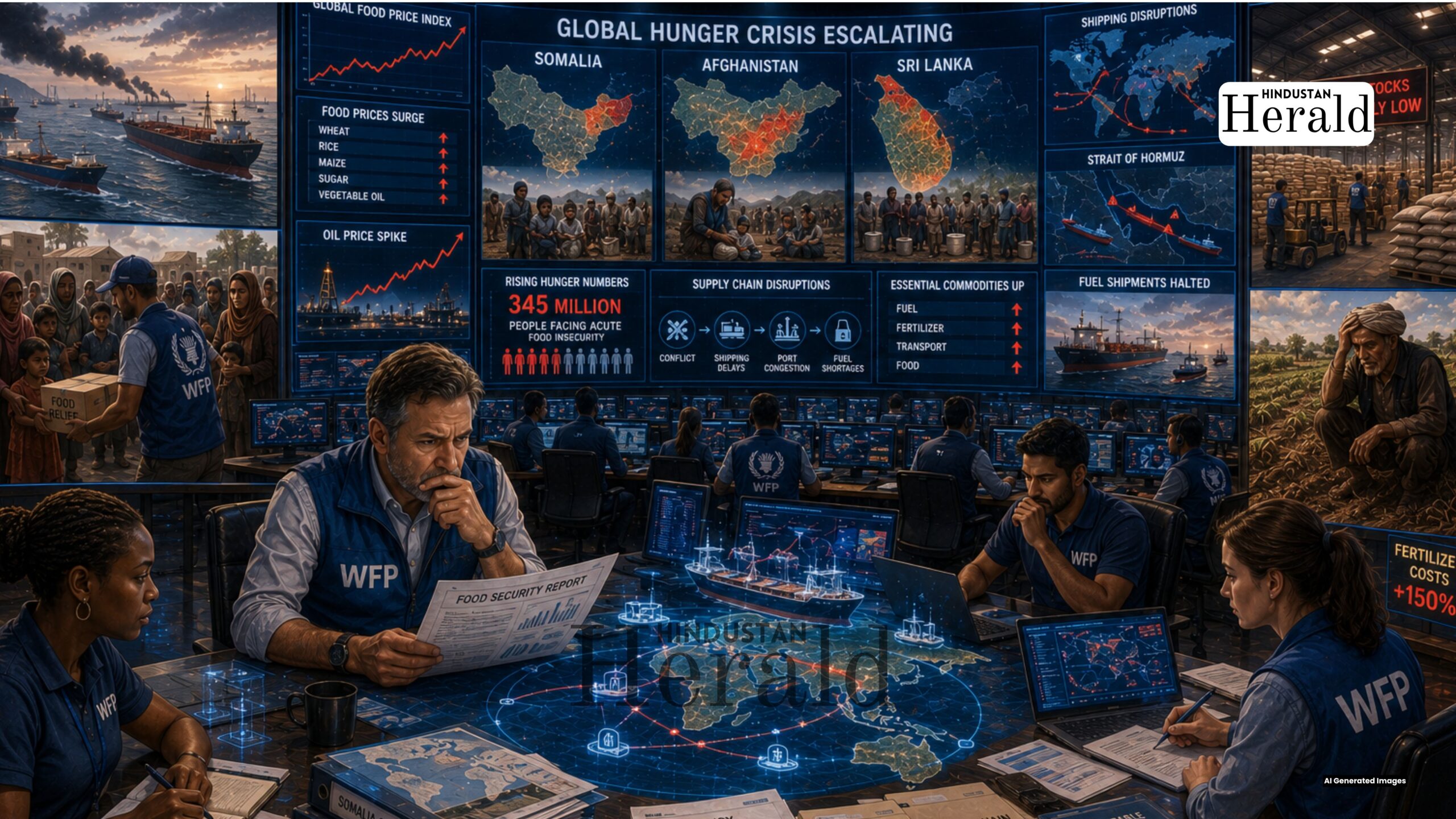
New Delhi, June 6: Somewhere in Mogadishu right now, a mother is deciding which child eats today. The Iran war did that and the World Food Programme has now confirmed she is one of six million people pushed into hunger by a conflict she had no part in. She does not know where the Strait of Hormuz is. She has probably never heard of the World Food Programme.
What she knows is that the grain she buys from the local market costs more than it did last month, and that the money she had is running out faster. This is the world hunger crisis that the Iran war has quietly made worse, and most of the world is still not paying attention.
Nobody will write about her specifically. But the WFP counted her this week. Her and 2.5 million others like her in Somalia alone. Add 2.3 million in Afghanistan and 1.3 million in Sri Lanka and you have, in three countries, over six million people who were not in acute hunger before February 28 and are now. That number comes from a report the agency circulated Friday. It is already out of date. Things are getting worse, not better.
The war started on February 28. American and Israeli forces struck Iran. Within days the Strait of Hormuz was essentially shut. Within weeks, oil prices had done what oil prices always do when a major transit chokepoint closes: went up sharply and stayed there. Within months the consequences had travelled through shipping lanes and fertiliser supply chains and cold storage logistics until they arrived, as they always do, at the people least equipped to handle them.
This is the part of war coverage that gets skipped. Not the strikes, not the geopolitics, not the press conferences. The part where a price shock generated in the Persian Gulf quietly restructures what a family in Kabul can afford to eat. That part rarely makes the lead.
Quick Summary
- The WFP confirms an additional 6.1 million people across Somalia, Afghanistan, and Sri Lanka are now in acute hunger as a direct consequence of the Iran war, with the figure still climbing.
- In March 2026, the WFP warned that 45 million people globally could be tipped into food insecurity by end-June, on top of the 318 million already going without enough food before the conflict began.
- The Strait of Hormuz, responsible for around 25 percent of global maritime oil trade according to the International Energy Agency, dropped from an average of 129 daily ship transits to fewer than 10 after Iran declared it closed, as confirmed by Congressional Research Service and IMF PortWatch data.
- India imports 88 percent of its crude oil and watched its crude basket monthly average climb from USD 69.01 per barrel in February to USD 111.39 in March, with intraday prices peaking as high as USD 146 per barrel on March 19, according to data from the Petroleum Planning and Analysis Cell.
- The WFP will reach 1.5 million fewer people than planned in 2026 and warns that 9 million people could lose food assistance entirely if fighting continues for six months.
- Global urea prices shot up roughly 50 percent after the war began, according to Oxford Economics cited by CNBC and confirmed by the American Farm Bureau Federation, threatening the Northern Hemisphere’s planting season and setting up a food crisis that will fully arrive months after the news cycle has moved on.
The World Hunger Crisis Warning That Sat on a Shelf in March
Two weeks after the first strikes, Carl Skau stood in front of reporters in Geneva and said something that should have been impossible to ignore in the context of a deepening world hunger crisis. He is the WFP’s acting Executive Director. He does not do dramatic. He is the kind of official who chooses words carefully and underplays things by instinct.
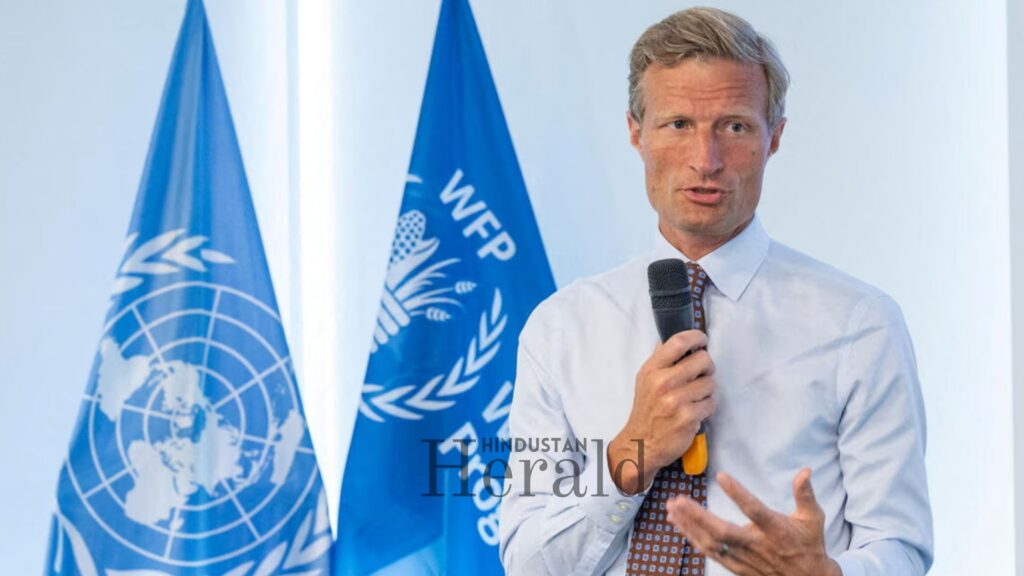
Even he called it “a perfect storm where hunger has never been as severe as now, in terms of numbers and how deep that hunger is.” He then said the conflict was about to make everything substantially worse and that 45 million additional people could tip into acute food insecurity by end-June if things continued as they were. Forty-five million. On top of 318 million already struggling to eat before any of this began.
The Geneva briefing room took notes. Editors elsewhere wrote headlines. The number circulated for a day or two. Then the news moved on. The world hunger crisis that Skau was describing did not move on. It kept building, quietly, in supply chains and fertiliser markets and shipping routes, while the headlines chased other things.
This week Skau was back at a microphone, this time in New York. A reporter asked whether the March projections still held. He said: “We remain by that prognosis.” Three words.
Translated out of UN-speak: the 45 million figure has not budged. The trajectory the agency predicted is the trajectory that arrived. The models were right. The warnings were right. The response was not sufficient. Now here we are.
How Fuel Becomes Famine
This is worth explaining properly because it gets glossed over constantly. Oil is not just what goes into a car or a power plant. It runs every stage of how food gets grown, moved, stored, and sold. The fertiliser a farmer spreads on a field in Punjab or Kandahar is manufactured from natural gas. The ship carrying wheat across the Indian Ocean runs on bunker fuel. The truck moving rice from warehouse to market in Nairobi runs on diesel. The cold storage keeping food from spoiling runs on electricity.
When energy prices double, all of that gets more expensive at once. Not one thing. Everything. Simultaneously. Those costs travel down the supply chain until they reach someone who cannot pass them on any further. In the world’s poorest countries, that someone is a household already spending most of its income on food.
Skau put it plainly when he spoke to UN reporters this week: “The correlation between the prices of energy and food is so tight in many places, and also that in the poorest countries people are already spending all their money on food, and hence when food prices rise, they eat less.”
They eat less. That is what the graphs and the projections and the policy language all eventually reduce to. Research from Purdue University’s Farm Policy Study Group put numbers to this. Households in low income countries spend roughly 52 percent of their income on food. A 10 percent rise in food prices is, for them, roughly equivalent to a 5 percent cut in income. Wealthy households face a fraction of that exposure from the same global price signal. The war hits everyone differently and that difference is not random.
A Narrow Channel and a Very Large Problem
The Strait of Hormuz is 33 kilometres wide at its narrowest navigable point. Before February, most people outside shipping and energy had never thought about it. An average of 129 vessels moved through it daily: oil tankers, LNG carriers, ships loaded with fertiliser and chemicals and manufactured goods, according to Congressional Research Service and IMF PortWatch data.
It handled around 25 percent of the world’s seaborne oil trade and 20 percent of global LNG exports, according to the International Energy Agency, without most of the world noticing it existed. Then Iran closed it. Ship transits dropped to fewer than 10 a day.
Then Iran closed it. Ship transits dropped to fewer than 10 a day, according to IMF PortWatch tracking data. The International Energy Agency, in its published Oil Market Report of March 2026, stated directly: “The war in the Middle East is creating the largest supply disruption in the history of the global oil market.” That is the IEA, which does not reach for superlatives without reason.
Qatar declared force majeure on LNG exports after its Ras Laffan facility sustained damage from missile strikes, as confirmed by the International Energy Agency’s published Gas Market Report of April 2026 another major pillar of global energy supply knocked out at the same moment the strait was collapsing.
Global urea prices jumped approximately 50 percent, according to Oxford Economics cited by CNBC and confirmed by the American Farm Bureau Federation. Farmers across the Northern Hemisphere who had planned their spring planting around certain input cost assumptions found those assumptions completely wrong.
According to data from India’s Petroleum Planning and Analysis Cell, the Indian crude basket averaged USD 69.01 per barrel in February. By March, that monthly average had climbed to USD 111.39, a rise of over 61 percent in a single month. Within that same month, intraday prices hit a recorded peak of USD 146 per barrel on March 19, the highest level the basket had ever reached. As reported by BusinessToday, drawing on official PPAC data, the sharp rise followed missile attacks on oil infrastructure in Iran, Qatar, and Saudi Arabia in the immediate aftermath of the conflict’s opening weeks.
The WFP’s Friday report described the downstream effect as “significant spillovers” on food and fuel prices and trade disruption. What that means practically: the war stopped being a Middle East problem a long time ago. It is now reshaping food economics in countries with no connection to the conflict whatsoever.
The agency added something that received less attention than it warranted: these impacts “are expected to intensify in the coming months, even if the crisis in the Middle East de-escalates.”
A ceasefire tomorrow would not reverse what is already embedded in supply chains and price levels. The hunger being caused right now has a momentum that runs ahead of whatever happens at the negotiating table.
Somalia Is Not a Number
There is a problem with big numbers in humanitarian reporting. 2.5 million sounds large and therefore somehow manageable, as though its size makes it abstract rather than concrete. It is not abstract. Each of those 2.5 million people in Somalia is a specific person with a specific life that is getting harder in specific ways.
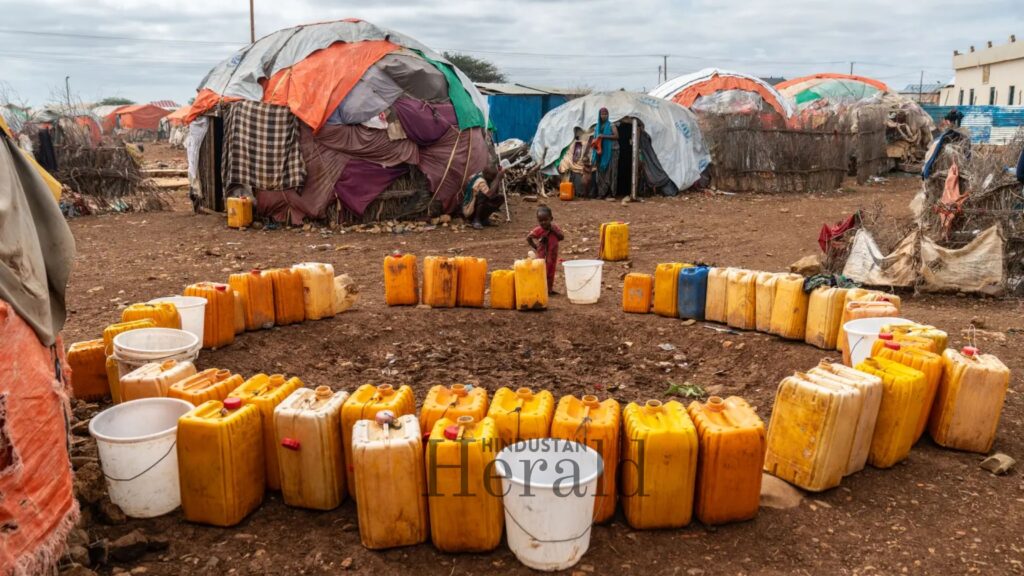
Somalia has been in crisis for so long that it risks becoming wallpaper in international coverage. Decades of conflict. Recurring drought. A humanitarian system that has been treating symptoms for years because the underlying causes have proved impossible to fix from outside. The people who have survived all of that are not fragile. They are remarkably resilient. But resilience has limits, and every new shock pushes those limits.
Afghanistan carries a different weight. The country is effectively cut off from international financial systems. There is no government apparatus capable of cushioning an economic shock of this scale. The 2.3 million additional people now struggling to eat there have nothing beneath them. When food prices rise in Kabul or Jalalabad, there is no subsidy programme, no social transfer, no state mechanism standing between the price signal and the empty stomach. The shock arrives directly.
Sri Lanka is the most painful of the three to look at clearly, because of where it was before this started. Three years of grinding recovery from the worst economic crisis in the country’s history. An IMF programme. Inflation brought down from devastating levels. A sense, in early 2026, that the worst might finally be behind them. Then the Hormuz closure hit fuel prices again. The 1.3 million additional people in Sri Lanka now struggling to eat represent a recovery being quietly undone years of hard work by ordinary people who had already lost so much, threatened now by a war they had no part in and no protection against.
India’s Exposure
India imports 88 percent of its crude oil, according to the Observer Research Foundation. That is not a marginal dependency. It is structural. Over 60 percent of household LPG comes from imports, as confirmed by both the Observer Research Foundation and a Government of India Press Information Bureau press release dated March 11, 2026.
The country imports roughly 90 percent of its potash from abroad and depends heavily on imported urea to sustain the yields that feed over a billion people, according to the Food and Agriculture Organisation of the United Nations, documented in its published Triple Squeeze report of April 2026. These numbers looked fine during years of stable global energy markets. They look different now.
The government has shielded farmers from the worst of the fertiliser price spike through subsidies. That matters without it, the Kharif planting season would be in real trouble. But subsidies come from the public budget, and a sustained 50 percent increase in global urea prices does not get absorbed quietly. It shows up somewhere. Fiscal pressure. Competing budget priorities. Harder choices about what else gets funded.
According to the Centre for Strategic and International Studies, the full impact of an energy price shock on food prices typically peaks around four months after a conflict begins. Four months from February 28 is the end of June, beginning of July. The heart of the Kharif sowing season.
The moment when farmers most need inputs available and affordable. India has roughly two months of strategic petroleum reserves more than Pakistan, more than most of Southeast Asia, where several countries including Vietnam have fewer than 20 days of cover, according to Time Magazine, citing data from the Asia Media Centre. That buffer matters. It is also not unlimited. And nobody in official circles seems to be discussing it with the urgency the situation requires.
The Aid System Is Failing at the Worst Possible Moment
The WFP did not arrive at this crisis in a strong position. Before the war began, the agency was already underfunded, already cutting programmes, already making the triage decisions nobody in humanitarian work wants to make.
Then the conflict hit and did two things at once. It massively increased the number of people who needed help and simultaneously made it more expensive to reach them. WFP’s own shipping costs rose 18 percent from the day the strikes began. Operational costs across multiple theatres went up. Donors, many of them redirecting money toward their own defence budgets in a world that feels increasingly unstable, did not compensate.
The result: the WFP will serve 1.5 million fewer people in 2026 than it had planned. If the conflict continues for six months, more than 9 million people could lose food assistance altogether.
Skau told UN reporters this week: “The human consequences of not doing more will be massive.” He also listed the other crises the system is simultaneously trying to hold together: Sudan, Gaza, southern Lebanon, Yemen, Haiti. Every one of those is a real emergency involving real suffering, drawing from the same shrinking pool of international humanitarian funding. The system was not designed to hold all of this at once. It is being asked to do exactly that.
This Has Happened Before
After the oil shock of 1973, the world took years to properly reckon with the food security implications for the poorest countries. After the 2008 commodity price spike, the hunger it produced in sub Saharan Africa and South Asia arrived before the aid did. After the Russia-Ukraine war of 2022, the disruption to wheat and fertiliser supplies hit import dependent nations in Africa and the Middle East months before the international response had found its footing.
Each time, the analyses were produced. The warnings were issued. The mechanisms that should have kicked in moved too slowly. The people who suffered most had the least ability to make noise in the rooms where decisions were being made.
UNCTAD noted in its March assessment that most developing countries were already carrying heavy debt loads with almost no fiscal room to absorb a shock of this size. The IMF, with the directness it reserves for moments of genuine concern, concluded that regardless of how the conflict evolves, higher prices and slower growth are where things are headed. The pattern holds. The warnings are thorough. The response lags. And the lag is measured, always, in hunger.
Where Things Stand
The WFP came to the UN this week not with new projections but with confirmation. The March numbers were right. The six million person figure in Somalia, Afghanistan, and Sri Lanka is real and documented. The 45 million global projection has not been walked back. The agency says impacts will intensify even if the guns go quiet tomorrow.
None of the structural questions have been resolved. The Strait of Hormuz remains functionally closed. Donor funding has not been restored to the levels the situation demands. The fertiliser price shock is still working its way through agricultural systems across the Northern Hemisphere.
What happens next depends on decisions that have not yet been made. Whether the conflict de-escalates. Whether donor governments restore humanitarian funding. Whether countries with regional weight India included choose to use it in ways that make a difference for their neighbours. The WFP counted. It projected. It warned. It was right. It is still warning.
The question is not whether the information exists. It does. Every data point, every projection, every consequence of inaction has been laid out clearly by multiple credible institutions over multiple months. Whether the people with the power to act will do so before the numbers get worse that is the question nobody has answered yet. And the numbers will get worse. The WFP has already said so.
Stay ahead with Hindustan Herald — bringing you trusted news, sharp analysis, and stories that matter across Politics, Business, Technology, Sports, Entertainment, Lifestyle, and more.
Connect with us on Facebook, Instagram, X (Twitter), LinkedIn, YouTube, and join our Telegram community @hindustanherald for real-time updates.

Tracking world politics, global markets, trade movements, policy decisions, and the changing balance of economic power.
- Shelesh Joshi

- Shelesh Joshi
- Shelesh Joshi
- Shelesh Joshi





Specializes in South Asian geopolitics and global diplomacy, bringing in-depth analysis on international relations.
- Rajiv Menon
- Rajiv Menon
- Rajiv Menon
- Rajiv Menon