 By Shelesh Joshi and Kavita Iyer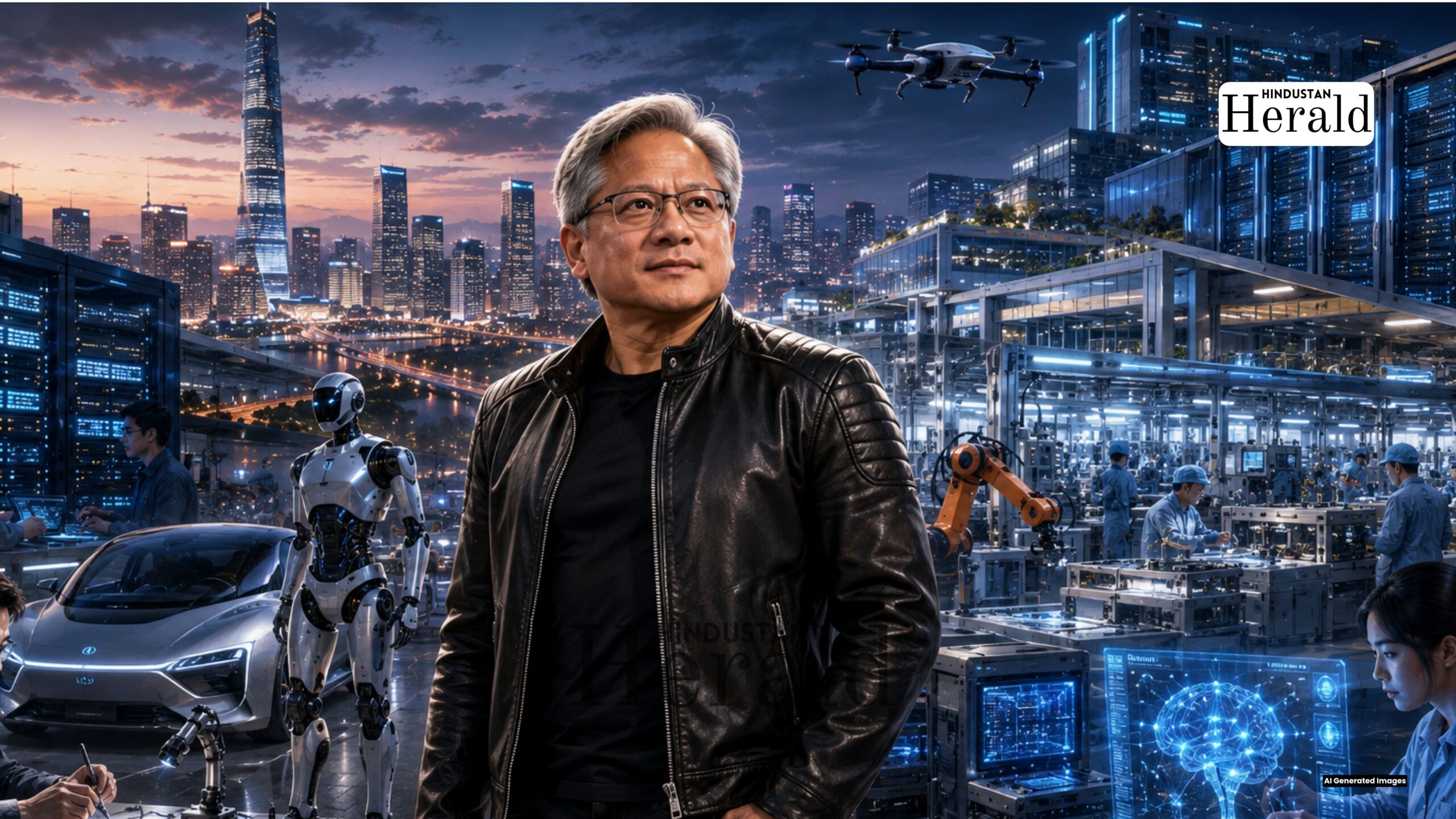
New Delhi, June 8:Jensen Huang threw a baseball pitch in Seoul on Sunday. The Nvidia South Korea AI Deals that followed reshaped the global AI supply chain in a single week. Not signed at a press conference. Not at some corporate event with a banner and a moderator. The groundwork was laid at an actual baseball stadium, in front of actual fans, beside the chairman of the company that owns the team.
Then he went to a gaming café and met a man who has won the League of Legends world championship six times. Then he had pork belly and soju with four of the most powerful men in South Korean industry at a neighbourhood restaurant that was almost certainly not chosen by accident. And then, somewhere after all of that, he announced deals that touched nearly every layer of the AI supply chain simultaneously.
That is the week Jensen Huang just had in Seoul. And if it sounds like a lot, it is because it was meant to. South Korean business culture does not respond well to executives who fly in, sit in a conference room for three hours, and fly out again. The relationship comes first. The visible effort comes first. Huang has either learnt this or he understood it instinctively, and the week was arranged accordingly. Whether the theatrics were genuine or calculated probably does not matter much. The agreements are real either way.
Quick Summary
- Nvidia signed a multi-year memory co-development partnership with SK Hynix, covering chips for Vera Rubin AI supercomputers, RTX Spark PCs, and Jetson Thor robotic platforms.
- SK Telecom committed to building a gigawatt-scale AI cloud using Nvidia’s DSX platform, with the first facility coming online in 2027.
- Nvidia CEO Jensen Huang publicly stated that Nvidia already spends “billions and billions of dollars” annually with SK Hynix, and that figure will “grow substantially.”
- LG Group signed the broadest agreement of the week, spanning six business divisions including robotics, autonomous driving, data centres, and South Korea’s sovereign AI model EXAONE.
- Doosan Group joined as a physical AI and industrial partner across four divisions covering robotics, construction machinery, power generation, and chip materials.
- Hyundai Motor Group and Boston Dynamics are targeting mass production of the humanoid robot Atlas at 30,000 units annually from 2028, with Nvidia’s Jetson Thor expected to be its onboard computing platform.
The Nvidia South Korea AI Deals Begin With Memory, And Memory Is Everything
There is a story that gets told again and again about AI hardware, and it always centres on the GPU. The chip. The thing Nvidia makes. When Nvidia clinches deals with South Korean partners, what gets left out of the conversation almost every time is the component that actually determines whether any of these Nvidia South Korea AI Deals run properly at scale.
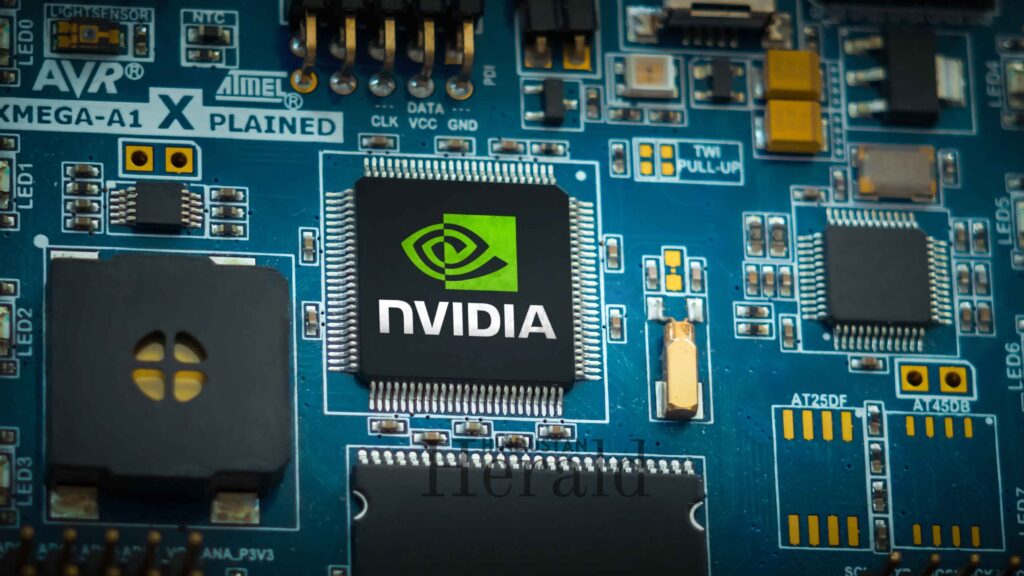
High-Bandwidth Memory. HBM. It is the specialised chip that sits beside the GPU and feeds it data fast enough to actually execute the models everyone cares about. Without it, Nvidia’s most advanced processors are expensive and largely useless. The GPU is the engine. HBM is the fuel. You can have the most powerful engine in the world but if the fuel is constrained, rationed, or unreliable, the engine does not matter.
SK Hynix makes more of this fuel, at the quality Nvidia requires, than any other company in the world. Which makes SK Hynix not just a supplier but something closer to a structural necessity. And this week, Nvidia formalised that reality through the first and most critical of its Seoul partnerships. This is precisely why Nvidia deals with South Korean giants including SK Group to advance AI boom strategies that go far deeper than a simple procurement arrangement.
The official announcement came jointly from Nvidia Investor Relations and the SK Hynix Newsroom on June 7. A multi-year technology partnership to co-develop next-generation memory for AI factories. The agreement runs for more than two years with options to keep extending. It covers memory for Vera Rubin AI supercomputers, Vera CPUs, RTX Spark personal computers, and Jetson Thor robotic platforms. Essentially Nvidia’s full product roadmap, now developed in partnership with one Korean chipmaker.
At the press briefing after his meeting with SK Group Chairman Chey Tae-won, Huang said something that caught people off guard. He told reporters, quoted directly by Reuters: “We already procure and we buy from SK Hynix already billions and billions of dollars each year, and it’s going to grow substantially.”
That is not the kind of sentence that goes through a normal corporate communications process. Lawyers and investor relations departments exist specifically to prevent chief executives from making open-ended financial commitments at street-level press conferences in foreign countries. Huang said it anyway. Either he forgot the rules apply to him or he decided they did not apply in this moment. The market heard it either way.
The official SK Hynix Newsroom release added what the press conference did not. The two companies are using Nvidia CUDA-X libraries and Nvidia PhysicsNeMo to apply AI directly to how semiconductors are designed and manufactured, cutting down development timelines for chips that currently take years from concept to production. SK Hynix is also building factory digital twins through Nvidia Omniverse, working toward chip fabrication that runs with minimal human intervention.
Chairman Chey’s statement was worth reading carefully. “Together, we are co-developing the next generation of memory for AI factories and applying AI to how we design and manufacture semiconductors, work that will shape the future of AI infrastructure.”
Ryu Young-ho at NH Investment and Securities told Reuters something that, if true, is probably the most structurally significant observation of the entire week. Memory chips, he said, are moving from commodity products, things traded at spot prices on an open market, to customer-specific components designed around the requirements of individual buyers. If that is actually what is happening, and this agreement looks like evidence that it is, the entire memory industry’s economics are changing under the surface in ways that have not yet fully shown up anywhere.
Industry analysts cited by TechTimes estimated SK Hynix holds somewhere between 60 and 70 percent of the HBM4 volume allocated for Nvidia’s Vera Rubin platform. Samsung and Micron share the rest. Vera Rubin deliveries to the big cloud providers are scheduled for the third quarter of this year. The supply decisions being made in Korean factories right now are the reason those schedules hold or they do not.
A Number That Deserves a Second Look
SK Telecom announced it plans to build a gigawatt-scale AI cloud in South Korea, using the Nvidia DSX platform, with the first facility online in 2027. The Nvidia Newsroom confirmed this. Gigawatt-scale.

Amazon’s biggest data centres run a few hundred megawatts. So do Microsoft’s. A gigawatt is roughly five to ten times that. SK Telecom is saying it will build this, from the ground up, in South Korea, and have the first piece of it running in under two years.
Whether that is achievable is a fair question. That it is being stated plainly, without hedging, by a major national telecommunications operator is worth noting on its own. This is not a startup with a pitch deck. SK Telecom has the money and the infrastructure relationships to actually attempt what it is describing. Whether it succeeds is a different matter. The ambition itself is the signal.
The deal also includes SK Telecom expanding its procurement of Nvidia products. Korean companies supply Nvidia’s memory. Nvidia supplies the platforms Korean companies build their clouds on. It is the same bilateral architecture showing up again, the kind where everyone becomes increasingly difficult to replace for the other.
Naver and Its Somewhat Urgent Problem
Readers outside Asia probably do not have a clear picture of Naver. Inside South Korea it is the search engine and the news and the shopping and increasingly the AI. It is the internet infrastructure of daily Korean life, in the way that Google is for most of the English-speaking world except more concentrated.
It has been building its own large language model, HyperCLOVA X, for several years. Reuters confirmed this week that Nvidia is supporting Naver’s AI data centre buildout. Analysts at Invezz put the facility’s target at 55 megawatts of capacity by early 2027.
The problem Naver is solving is not complicated. If you train and run a proprietary AI model but the compute underneath it belongs to someone else, you are permanently exposed to whatever that someone else decides to charge you next year. There is no natural ceiling on that exposure. The only real solution is to own the compute. Naver is doing that. The Nvidia partnership is how it gets there without building everything from scratch.
The Company That Should Not Be Here But Is
The most revealing detail from Seoul this week is not the SK Hynix numbers or the gigawatt cloud or the humanoid robots. It is the presence of Doosan Group at the table, and what that presence says about what the AI industry is actually becoming.
Doosan does not make chips. It does not run a cloud. It makes industrial robots, compact construction equipment, gas turbines, steam turbines, small modular reactors, hydrogen fuel cells, and the advanced chemical materials that go into fabricating semiconductor chips. If you were asked to identify the company least likely to appear in an AI partnerships story, Doosan would be a reasonable answer. Except here it is.
The official Nvidia Blog confirmed the collaboration spans Doosan Robotics, Doosan Bobcat, Doosan Enerbility, and Doosan Corporation Electro-Materials BG.
Doosan Robotics is building what it calls an Agentic Robot OS, using Nvidia’s Isaac Sim, Isaac Lab, Cosmos world foundation models, and Jetson Thor, working toward industrial robots that can look at an environment, figure out what needs doing, and do it without a human approving each step.
Doosan Enerbility makes the turbines and the reactors and the fuel cells. As AI data centres push toward gigawatt power demands, the company that makes your power generation equipment stops being a vendor and starts being something you need to have a strategic relationship with. Doosan has apparently understood this, or Nvidia has helped it understand, and the agreement reflects it.
Doosan Bobcat makes compact outdoor machinery. Construction equipment. Agricultural machinery. Its inclusion is a signal that physical AI is not going to stay on controlled factory floors. It is heading into the genuinely messy outdoor environments where things are unpredictable and machines have to make real decisions without supervision.
Doosan Corporation Electro-Materials BG supplies materials used directly in Nvidia’s Blackwell chips. Doosan was already inside Nvidia’s supply chain before this week. These agreements formalise that position and extend it across every other business the group runs.
Huang stood beside Doosan Group Chairman Park Jeong-won at the baseball stadium and threw a pitch. It made for a pleasant photograph. It also documented a relationship that now covers energy, robotics, industrial machinery, and chip materials simultaneously. The crowd probably thought it was a nice moment. It was also a business meeting in disguise.
What LG Actually Committed To
The LG Group partnership is the widest of anything announced this week. Six divisions. One framework. A scope that covers nearly everything LG touches as a business.
Per the official Nvidia Blog, the two companies are building an AI factory together, covering robotics, autonomous driving, data centres, and GPU cloud services, connecting AI model development, physical AI data generation, robot simulation, edge deployment, and factory digital twins in a single workflow.
LG Electronics is building a humanoid robot called CLOiD, designed for household tasks. The Nvidia Blog confirmed it is being trained and validated using Nvidia Isaac Sim and Isaac Lab, with the company exploring Nvidia Isaac GR00T to give the robot something approaching genuine situational reasoning in real home environments, where things are rarely where they are supposed to be and instructions are rarely precise.
The Korea Herald reported that the meeting between Huang and LG Group Chairman Koo Kwang-mo was their first in person. It finalised months of earlier preparation, including conversations between Nvidia’s senior director and LG Electronics leadership about combining CLOi with the Isaac platform and building a dedicated robot reasoning model.
LG AI Research is developing EXAONE, a South Korean sovereign AI language model, built on Nvidia Blackwell GPUs and the Nvidia NeMo framework. The Nvidia Blog confirmed this. It is already deployed across LG Group’s enterprise operations through a chatbot called ChatEXAONE. LG’s own AI model, trained on Nvidia hardware, running on Nvidia software, used inside one of South Korea’s largest corporations every day. That is not a future plan. It is already happening.
LG Energy Solution is working on energy systems for next-generation AI data centres. LG Uplus is building GPU data centre capacity. LG Innotek is developing autonomous vehicle hardware optimised for Nvidia’s architecture. LG CNS is building factory and logistics automation using Nvidia’s Isaac and Cosmos platforms.
LG looked at Nvidia’s ecosystem and apparently decided that its future across every major business line runs through it. That is a significant commitment. It is also, if you believe AI infrastructure decisions made now will be difficult to reverse in five years, a logical one.
The Atlas Question
Hyundai Motor Group and Boston Dynamics complete this week’s picture, building on an agreement signed at APEC in October 2025, reported at the time by TechCrunch.
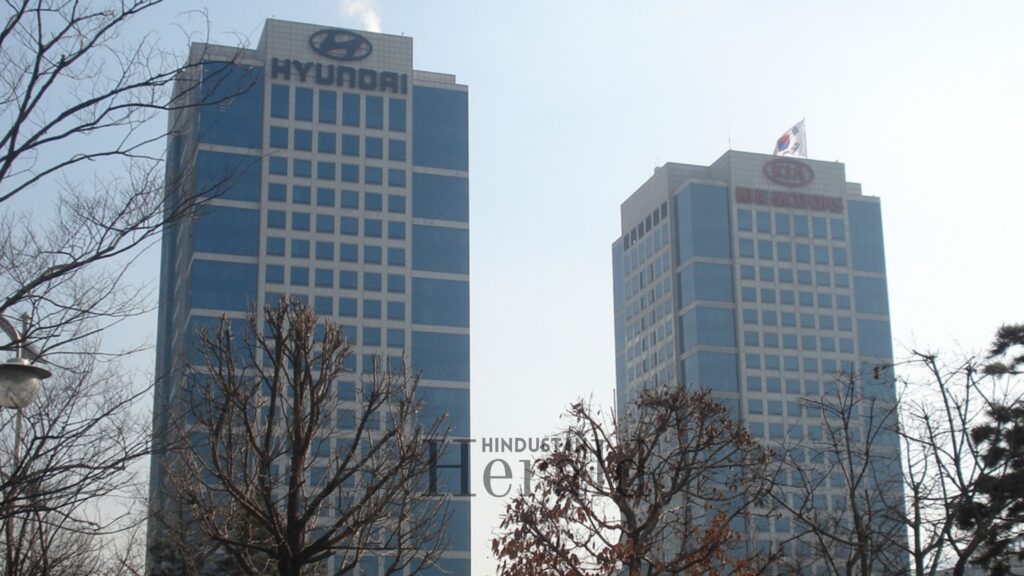
Boston Dynamics has been developing the humanoid robot Atlas for years. It is genuinely impressive hardware. The computing platform inside it has been an open question in robotics circles for some time. Kim Doo-un at Hana Securities told the Korea JoongAng Daily that Nvidia’s Jetson Thor processor is widely expected to be the answer.
Hyundai plans to start mass producing Atlas in 2028, targeting 30,000 units a year. Per UPI, the Seoul meetings this week may extend into a joint AI and robotics research hub at Saemangeum, with expanded cooperation in robot learning, simulation, and AI model development.
30,000 humanoid robots a year is a large number. The computing stack running inside all of them will trace back, in a fairly direct line, to what was agreed in Seoul this week.
Why Any of This Should Concern India
There is a pattern here that extends well beyond South Korea and well beyond this week. Nvidia has been running the same strategy across multiple countries for a couple of years now. Find a place with serious industrial infrastructure and a government that has decided AI capacity is a national interest. Go in person. Build the personal relationships that make the commercial agreements durable. Leave with a web of partnerships so interlocked that unwinding any single one of them disrupts all the others.
Each time, it is a more complete version of the same thing. South Korea is the most comprehensive execution yet. The Korea Herald reported the country is targeting 200,000 high-performance GPUs deployed by 2030. The APEC framework from November 2025, reported by TechCrunch, already committed more than 260,000 Nvidia Blackwell chips to Korean companies and government institutions. What was announced this week is the ecosystem that turns those chip numbers into something real. The co-development agreements, the cloud buildouts, the robotics programmes, the energy systems, the sovereign AI model infrastructure. All of it, assembled in one week, after months of preparation.
For Indian readers following business news India and the global technology economy, the honest version of this story is uncomfortable in ways worth sitting with directly.
South Korea could do all of this because it came to the table with decades of accumulated industrial depth already in hand. Semiconductor fabs. Robotics. Large-scale power generation. Consumer electronics manufacturing at global volume. A sovereign AI model already running. These things did not appear because Huang visited Seoul. They existed long before he landed. His visit was the moment when all of that capacity got formally attached to the AI infrastructure stack that will define the next decade.
India’s India Semiconductor Mission is real and making genuine progress. The Production Linked Incentive schemes are producing results that were not there three years ago. But the runway is longer, and the Seoul agreements are a practical reminder that the window for early positioning in these strategic AI partnerships is not permanent. The HBM4 memory and Blackwell-class GPUs that Indian cloud operators and AI companies will need over the next two years are being committed to long-term frameworks right now. Buyers outside those frameworks will find tighter supply, longer lead times, and less pricing leverage. That is not a forecast. That is arithmetic.
None of the financial terms from Seoul will be disclosed. Everyone involved has confirmed that, and it is not surprising. But the strategic architecture is plainly visible in the announcements if you read all of them together rather than one at a time.
Nvidia is in the business of making itself the platform that countries build their AI futures on. South Korea decided this week, across memory and cloud and robots and energy and autonomous vehicles and sovereign AI, that its future runs on Nvidia. The pork belly was probably excellent. The deals will last considerably longer.
Stay ahead with Hindustan Herald — bringing you trusted news, sharp analysis, and stories that matter across Politics, Business, Technology, Sports, Entertainment, Lifestyle, and more.
Connect with us on Facebook, Instagram, X (Twitter), LinkedIn, YouTube, and join our Telegram community @hindustanherald for real-time updates.

Tracking world politics, global markets, trade movements, policy decisions, and the changing balance of economic power.
- Shelesh Joshi

- Shelesh Joshi
- Shelesh Joshi
- Shelesh Joshi





Former financial consultant turned journalist, reporting on markets, industry trends, and economic policy.
- Kavita Iyer
- Kavita Iyer
- Kavita Iyer
- Kavita Iyer