 By Shelesh Joshi and Kavita Iyer
New Delhi, June 5: Something quiet happened in the capital on Wednesday, and most people missed it. The EU-India Tech Partnership just entered a new phase, and it did not announce itself loudly.
No summit stage. No matching flags. No ministers holding up a signed document while cameras clicked. Just a Thursday in New Delhi, a conference hall, and over a hundred technology companies from India and Europe sitting across from each other trying to work out, without ceremony, how to stop circling this relationship and get on with it.
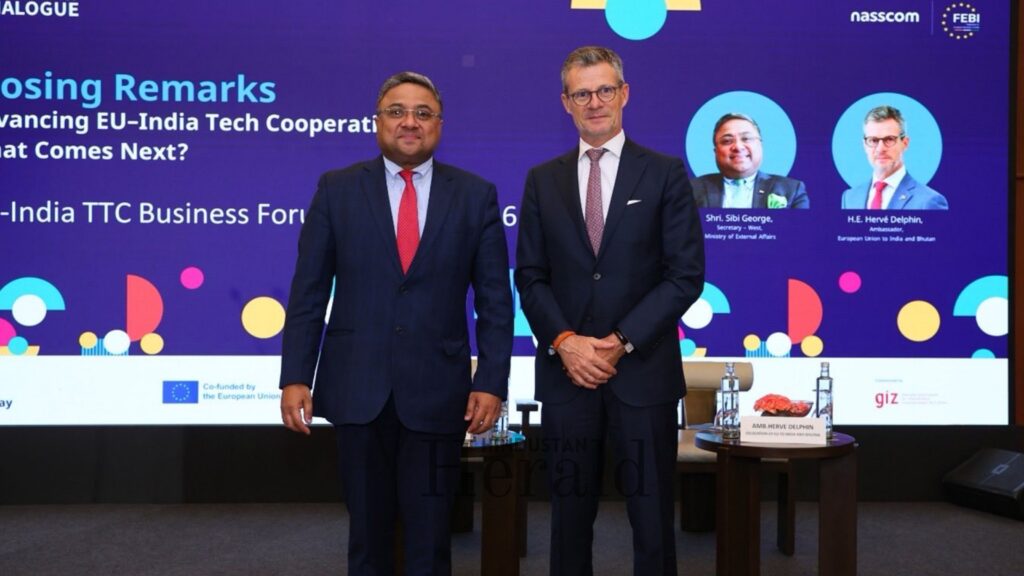
The first EU-India Tech Business Forum wrapped up on June 4. According to the official statement published by the European External Action Service on June 5, it was organised by the EU Delegation to India and Bhutan alongside MeitY, India’s technology ministry. NASSCOM and the Federation of European Business in India provided the industry backbone, which meant the room had actual companies in it, not just government staff. Ambassadors from Lithuania, Sweden, Belgium, Estonia, France, Germany, Italy, and Spain turned up alongside EU Ambassador Herve Delphin, who was there the whole day.
It will not lead any bulletin. But if you follow where India’s technology economy is heading, or where serious bilateral trade and investment are moving over the next ten years, this one deserves a proper read..
Quick Summary
- According to the EEAS official statement of June 5, 2026, over 100 European and Indian technology companies attended the forum on June 4, the first time industry was formally brought inside the TTC process since the council was set up in 2022.
- The forum was co-organised by the EU Delegation to India and Bhutan and MeitY, with FEBI and NASSCOM providing industry support, and ambassadors from 8 European countries in attendance, per the EEAS statement.
- According to the European Commission’s Key Outcomes document of February 28, 2025, EU-India bilateral trade in goods and services reached 184 billion euros in 2023, with goods alone at 124 billion euros and services at 60 billion euros, of which 20 billion euros were digital services.
- The European Commission’s official FTA chapter by chapter summary confirms bilateral goods trade at 120 billion euros in 2024, with India cutting tariffs on 86 percent of tariff lines and the EU on over 90 percent, and total liberalisation reaching 96.6 percent for India and 99.3 percent for the EU.
- At the February 2025 TTC ministerial meeting, per the European Commission’s Key Outcomes document, both sides committed a joint investment of around 60 million euros through Horizon Europe research calls covering marine plastic litter, waste to renewable hydrogen, and EV battery recycling.
- The EEAS statement of June 5 confirms a European Legal Gateway Office is now open in India to facilitate mobility of Indian ICT professionals, students, and researchers to the EU, tied to the bloc’s Digital Decade target of 20 million ICT specialists by 2030.
It Has Been a Long Time Coming
To understand why Wednesday was worth noting at all, you need some background. The Trade and Technology Council between India and the EU was announced in April 2022 and formally launched on February 6, 2023, according to the European Commission’s Key Outcomes document. The same document confirms it is “the first one established with any partner for India.” Prime Minister Modi and European Commission President Ursula von der Leyen set it up as a formal mechanism for working through the hardest problems at the intersection of trade, technology, and security.
That institutional fact matters more than it looks. India has no equivalent arrangement with any other country in the world. That choice was made in a specific global environment, one where supply chains were fracturing, where technology was being used as a trade instrument, and where both India and Europe were actively reconsidering what trusted partnerships actually meant in practice. The TTC was the architecture India chose to represent where it saw its deepest long term alignment.
In the years since, the TTC has produced real outcomes. The European Commission’s Key Outcomes document from February 28, 2025 records the second ministerial meeting, co chaired on the EU side by Executive Vice President Henna Virkkunen, Commissioner Maros Sefcovic, and Commissioner Ekaterina Zaharieva, and on the Indian side by External Affairs Minister Dr. S. Jaishankar, Commerce and Industry Minister Piyush Goyal, and Electronics and IT Minister Ashwini Vaishnaw.
That meeting produced a memorandum of understanding between the EU 6G Smart Networks and Services Industry Association and the Indian Bharat 6G Alliance on trusted next generation telecommunications. It confirmed financial backing for a research project called GANANA, with nearly 5 million euros from EuroHPC JU under Horizon Europe, for high performance computing and AI applications cooperation.
Real work. But most of it stayed government to government. Companies could read what was being agreed. They had no direct way in. Wednesday changed that specific thing.
What the EU-India Tech Partnership Actually Put on the Table
Per the EEAS statement, the forum covered five areas: semiconductors, artificial intelligence, cybersecurity, data governance, and digital public infrastructure.
None of these are on the agenda by accident. Each is a specific place where Indian and European companies have complementary things to offer each other, and where the absence of working frameworks at the business level has cost both sides real commercial opportunity.
Semiconductors because the global supply chain is being reconfigured right now, and both sides want to be inside the new architecture rather than dependent on it. The TTC’s February 2025 ministerial session, per the European Commission’s Key Outcomes document, already committed both sides to exploring “joint research and development in the field of chip design” to strengthen semiconductor supply chain resilience. Wednesday was the first time industry was in the room to discuss what that actually looks like commercially. That is the gap the EU-India Tech Partnership was always supposed to close, and it is now closing.
AI because, as the same Key Outcomes document records, the European AI Office and the India AI Mission were formally tasked with deepening cooperation on large language models and ethical AI frameworks. That mandate exists on paper. The question the forum was designed to answer is how private companies plug into it.
Cybersecurity, data governance, and digital public infrastructure because the legal and technical frameworks governing how data moves across borders, and how digital systems operate internationally, will determine whether entire categories of services can scale between the two markets at all. This is where the EU-India Tech Partnership either delivers concrete interoperability or stalls at the level of good intentions.
The EEAS statement confirms participants explored how to build genuine interoperability between systems on both sides, align on technical standards, and reduce the friction in market access that persists despite the scale of the existing relationship. The story that India-EU host first tech business forum captured in a single headline took years of groundwork to make possible, and the co-creation emphasis inside that room, pulling universities, startups, and research institutions in alongside large companies, was the clearest sign of how seriously both sides are treating it.
Co-creation is different from procurement. It implies joint ownership of what gets built. That has direct implications for intellectual property arrangements and for how both sides approach the question of who captures value when the collaboration produces something commercially significant. These questions get answered, for better or worse, in the first rooms where people talk about them. Wednesday was that room.
Three People Said Things Worth Reading Twice
Herve Delphin, EU Ambassador to India, did not open with remarks about the historical depth of the relationship. He opened with fragmentation. The EEAS statement carries his words directly: “Working with trusted partners like India is essential to diversify supply chains and reduce over reliance on certain sources and geographies.”

He then said something more useful than most diplomatic statements produce: “Europe brings strengths in advanced technology, innovation and regulation, while India offers scale, talent, and dynamic technological applications.” No hedging. A clear description of where the comparative advantages sit, and useful precisely because of that clarity. A business development team trying to position a cross border proposition can work with that sentence.
He closed with a challenge, not a compliment. “Businesses, researchers, and investors have a key role in turning policies into concrete realisations.” The governments have done their part. The next move belongs to the people sitting in front of him.
S. Krishnan, Secretary of MeitY, used the word “architects” in the opening session. The EEAS statement records him saying: “India and the EU stand on common ground, not just as allies, but as architects of a future where technology serves humanity, not the other way around. Our collaboration is essential and can deliver real global impact.”
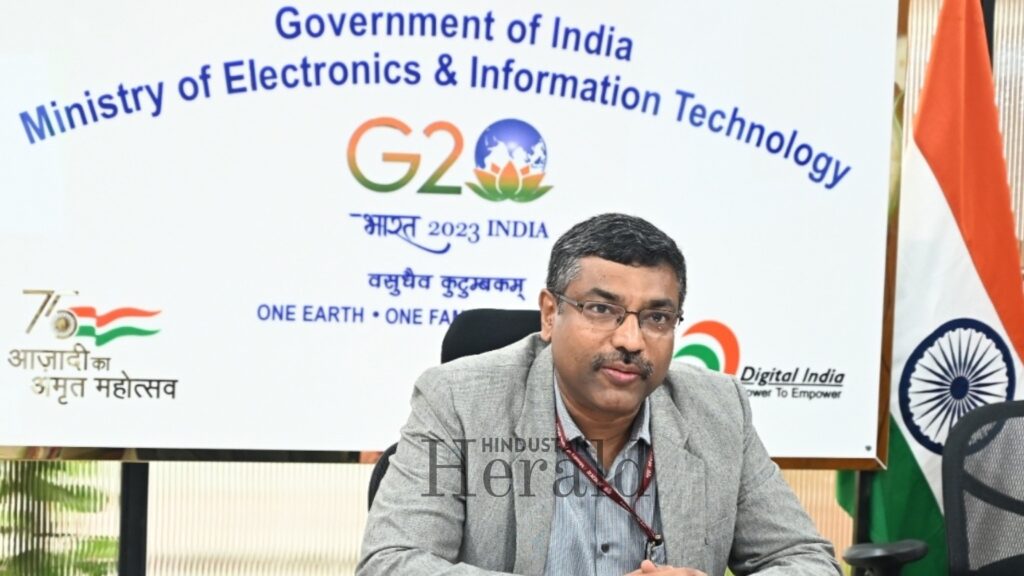
That word choice is deliberate and commercially relevant. India is not positioning itself as a service provider for European technology ambitions. It wants to help write the standards and frameworks that govern how technology gets built globally. For Indian companies building products for international markets, their government’s posture on that question affects what gets negotiated in standards bodies, what ends up in trade agreements, and what regulatory conditions their products will face in Europe.
Sibi George, Secretary (West) at the Ministry of External Affairs, closed the day. The EEAS statement records his closing line: “The India-EU partnership stands out for its predictability, credibility and strategic depth.”
Predictability is an odd word to lead with until you remember what the global trade environment has looked like recently. Companies have spent years repricing risk across bilateral relationships that turned unreliable without warning. A senior government official ending a full business day by committing specifically to predictability is making a promise with real financial content. CFOs building five year investment cases in an uncertain world hear that word differently from how journalists covering diplomacy hear it.
The Trade Numbers That Set the Scale
The commercial context behind all of this sits in two documents. The European Commission’s Key Outcomes document from February 2025 records EU-India bilateral trade in goods and services at 184 billion euros in 2023, with goods trade at 124 billion euros and services at 60 billion euros, of which 20 billion euros were digital services.
The European Commission’s FTA chapter by chapter summary updates the goods figure: bilateral goods trade reached 120 billion euros in 2024. EU imports from India stood at 71 billion euros. EU exports to India reached nearly 49 billion euros. That is the existing floor, before a single tariff cut under the new agreement has been applied.
The FTA’s tariff commitments are documented specifically in that same European Commission summary. The EU eliminates duties on over 90 percent of its tariff lines, covering 91 percent of trade value. India eliminates on 86 percent of tariff lines, covering 93 percent of trade value. Including partial liberalisation, total coverage reaches 96.6 percent for India and 99.3 percent for the EU.
At the sector level, the European Commission’s summary gives specific timelines. Indian duties on chemicals, currently up to 22 percent, come down at entry into force. Car part duties phase out over five to ten years. Machinery splits: half liberalised at entry into force, the rest over up to a decade. On wine and spirits, where Indian tariffs have historically reached as high as 150 percent in some categories, the agreement brings those down to 30 percent for most wines, 40 percent for spirits, and 50 percent for beer. Olive oil, currently facing duties of up to 45 percent, gets eliminated at entry into force or within five years.
The EEAS statement confirms that the forum’s specific job is to begin operationalising this agreement at the business level, alongside the Administrative Arrangement on Advanced Electronic Signatures and Seals signed in January 2026. That arrangement creates the legal infrastructure for cross border digital contracting. Not the headline story. The thing without which the headline story cannot function.
Sixty Million Euros That Did Not Get Enough Coverage
The European Commission’s Key Outcomes document of February 28, 2025 records a financial commitment that was largely passed over in coverage of this relationship at the time and has remained underreported since.
Through Horizon Europe coordinated research calls, India and the EU committed a joint investment of around 60 million euros across three areas: marine plastic litter, waste to renewable hydrogen, and battery recycling for electric vehicles. The calls on marine plastics and hydrogen were set to publish in 2025. Battery recycling calls were planned for 2026.
The same document records an Ideathon on marine plastic pollution, designed to bring Indian and EU partners together on practical, scalable responses. On electric vehicles, a dialogue was launched to align India and EU charging infrastructure standards, with both sides eyeing mutual market access in a fast growing segment.
On pharmaceuticals, the Key Outcomes document records that both governments committed to “cooperating on the establishment of early warning systems to anticipate and mitigate disruptions in the supply of active pharmaceutical ingredients.” This is not a new concern. The document also notes that the EU aims to reach net zero by 2050 and India by 2070, and that cooperation on battery recycling for electric vehicles had already connected Indian and EU startups with potential partners and investors ahead of the ministerial.
The Legal Gateway Office: Not a Small Thing
One announcement appeared near the back of the EEAS statement and got almost no attention in subsequent coverage. A European Legal Gateway Office is now open in India. The EEAS statement describes it as a pilot initiative, with the explicit purpose of facilitating the mobility of Indian ICT professionals, students, and researchers to the EU. The statement ties it directly to the EU’s Digital Decade target of 20 million ICT specialists by 2030, a number Europe’s domestic talent supply alone cannot produce.
This is not a streamlined visa process. It is a formal institution, physically in India, managing talent mobility as a bilateral strategic priority. That distinction matters.
For Indian engineering graduates and early career technology professionals, it is an official pathway that was not there six months ago. For Indian IT companies building European practices, it sits alongside the FTA’s mobility provisions rather than competing with them. The FTA handles experienced professionals on commercial engagements. The Gateway Office works at the earlier stage, students and researchers building their international footing. Together, they cover the talent relationship across most of its span.
The EU’s decision to put a physical office in India specifically for this purpose says something about how seriously the talent dimension of this partnership is being taken. It is an operational commitment, not a gesture.
The Work That Still Has to Happen
The forum’s own language, per the EEAS statement, was honest. Outcomes will “help shape the next steps.” That is what a beginning sounds like, and it should be taken at face value.
The FTA needs ratification by the European Parliament, the Council of the European Union, and India’s Parliament before any tariff reduction takes effect. The longest phase in timelines run to ten years. A business case built around FTA benefits needs to map specific commitments to specific timelines, not point at the headline liberalisation coverage figure and call it a plan.
The Horizon Europe research calls need to be published and competed for. The TTC’s working groups need to produce their sector specific roadmaps before procurement frameworks and R&D priorities become something you can build a real strategy around. The standards alignment work across semiconductors, AI governance, and digital infrastructure is a multi year process requiring sustained attention from both sides.
The one instrument that does not require waiting is the Administrative Arrangement on Advanced Electronic Signatures and Seals. The EEAS statement confirms it was signed in January 2026. It is not tied to FTA ratification. Companies doing cross border digital business with European counterparts should already be looking at how it fits into their contracting setup.
What June 4 delivered, stripped of the press release language, was simpler than any official summary managed to convey. One room. One day. Industry people and government people from two economies that have been promising each other more than they have delivered, sitting together inside a structure specifically designed to make the next step harder to avoid than all the previous ones. Four years of institutional groundwork. Three officials who said specific things rather than general ones. And a forum that, for the first time, put the private sector inside the TTC rather than outside reading about it.
It is not a conclusion. Whether it becomes one will be visible over the next few years in investment figures, partnership announcements, and commercial activity that does not appear in diplomatic statements. That is the story. It starts here.
Stay ahead with Hindustan Herald — bringing you trusted news, sharp analysis, and stories that matter across Politics, Business, Technology, Sports, Entertainment, Lifestyle, and more.
Connect with us on Facebook, Instagram, X (Twitter), LinkedIn, YouTube, and join our Telegram community @hindustanherald for real-time updates.

Tracking world politics, global markets, trade movements, policy decisions, and the changing balance of economic power.
- Shelesh Joshi

- Shelesh Joshi
- Shelesh Joshi
- Shelesh Joshi




Former financial consultant turned journalist, reporting on markets, industry trends, and economic policy.
- Kavita Iyer
- Kavita Iyer
- Kavita Iyer
- Kavita Iyer