
 By Sandeep Verma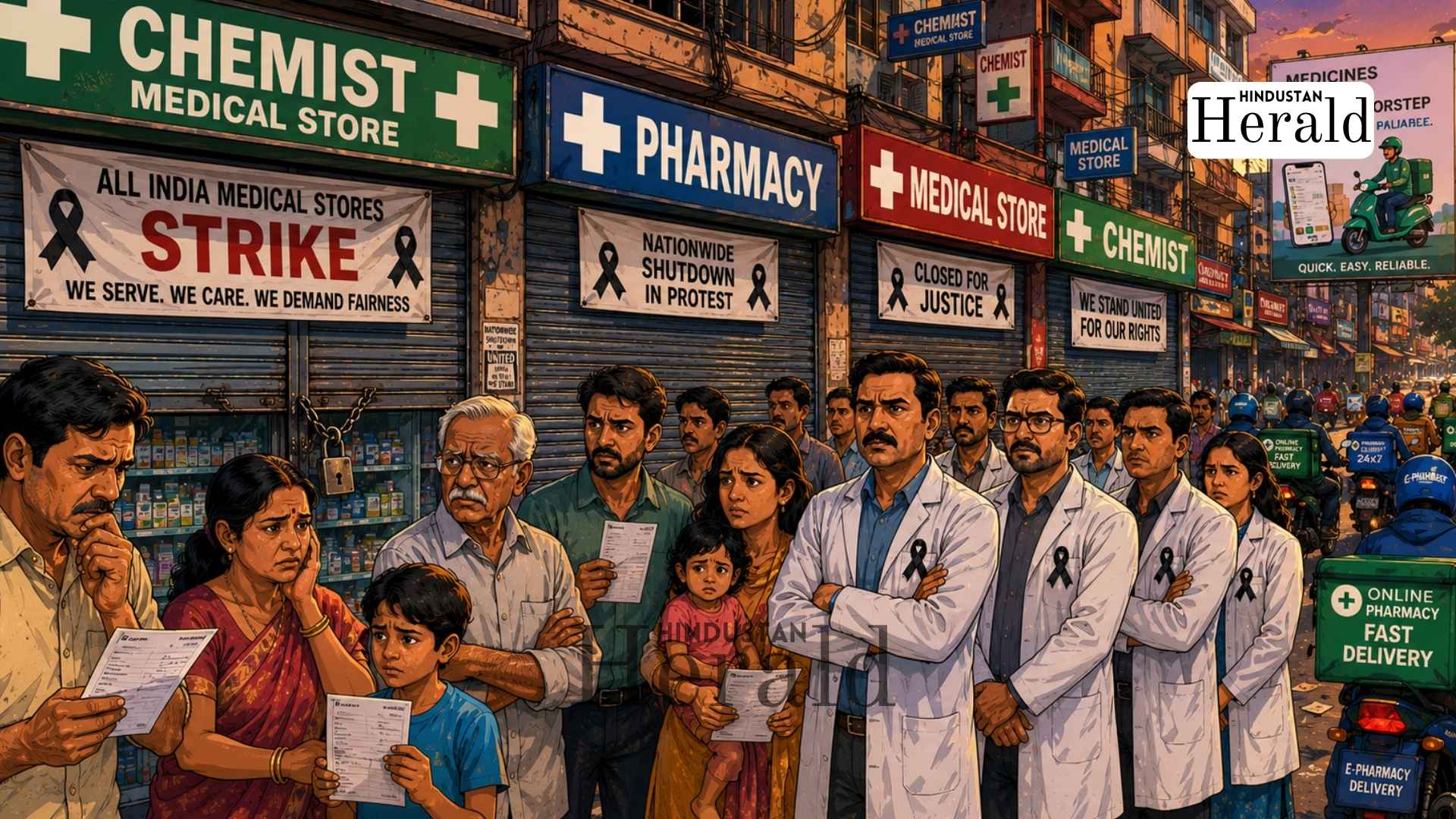
New Delhi, May 8: Videos and sticker images have been circulating widely on Instagram over the past few days, warning people that medical shops across India will remain shut on May 20. Reaction to these posts has been a mix of panic and confusion, with many users dismissing them as rumours or misinformation. A fact-check, however, confirms that the closure is real, officially announced, and rooted in a serious ongoing dispute between India’s retail chemist trade and the rapidly expanding e-pharmacy industry.
This is not a hoax. The shutdown on May 20 is a formally declared nationwide bandh called by the All India Organisation of Chemists and Druggists (AIOCD), the country’s largest body representing retail medicine traders.
What The Stickers Actually Say
The stickers circulating on Instagram typically read something along the lines of: “20 May ko sabhi medical shops band rahenge” (All medical shops will remain closed on May 20), sometimes accompanied by the AIOCD name or local chemist association branding.

Several users flagged these posts as potentially false, with some suggesting the stickers looked too informal to be credible. That skepticism is understandable, given the volume of misinformation that floods social media platforms every week. Still, in this particular case, the core claim checks out completely. The stickers appear to be awareness material circulated by local AIOCD-affiliated bodies to alert customers well in advance.
The Shutdown Is Official And Nationwide
As part of an escalating protest programme, the AIOCD has announced a 24-hour All India Chemists Bandh on May 20, 2026. Medical shops across the country are expected to remain shut from midnight to midnight.
The AIOCD announced the nationwide strike by medicine traders on May 20, 2026, protesting against what it describes as illegal online medicine sales and unfair competition created by corporate companies.
The scale of participation is already taking shape. Over 35,000 chemists across Gujarat are set to participate, with around 3,200 medical stores in Ahmedabad also expected to remain shut. The Federation of Gujarat State Chemists and Druggists Associations has extended support, claiming that several key concerns of retail chemists remain unresolved despite repeated representations to authorities.
From the northeast, the All Tripura Chemists and Druggists Association of Dharmanagar and Kanchanpur divisions has also extended support to the strike. In Uttar Pradesh, it was unanimously decided at a chemist association meeting in Prayagraj on May 7 that the entire pharmaceutical industry in the city would close its shops on May 20 to register its protest.
Maharashtra too is firmly on board. State association secretary Anil Navandar stated that members across Maharashtra are fully prepared to make the bandh 100% successful in the state, adding that members are deeply angered as democratic efforts by the organisation have allegedly not received proper and positive responses from the government.
Why The Chemists Are Striking
Understanding why this is happening matters just as much as knowing that it will happen. This is not a spontaneous walkout. It is the result of what the AIOCD describes as years of inaction by the government on a crisis that is slowly decimating India’s network of small and independent pharmacy owners.

AIOCD President Jagannath S. Shinde stated that the pharmaceutical business in India is regulated under the Drugs and Cosmetics Act, 1940 and its Rules of 1945. However, there is currently no provision under the law permitting online sale of medicines. Despite this, e-pharmacies have expanded rapidly and now operate in a legal grey zone.

The Central Government had issued a notification under GSR 817(E) dated August 28, 2018, regarding online medicine sales through internet platforms. However, despite the notification not yet being converted into law, illegal online medicine sales continue across the country. A writ petition regarding the matter is pending before the Delhi High Court, which has also granted a stay on online medicine sales. That stay, the AIOCD argues, is being routinely ignored in practice.
The three core demands of the association, as articulated at multiple press conferences, are: a complete ban on online sale of medicines, an end to deep discounting by corporate e-pharmacies, and strict action against counterfeit or spurious drugs.
On the discounting issue, the numbers are stark. According to the AIOCD, discounts ranging from 20% to 60% are being extended to consumers by online platforms and corporate pharmacy chains, levels that it claims are not viable under existing regulatory norms. Citing guidelines of the National Pharmaceutical Pricing Authority (NPPA), which permit a retail margin of around 16%, the Association has argued that such pricing models are sustained through capital infusion aimed at capturing market share and establishing monopolies.
Trade bodies have alleged that pharmaceutical companies are offering higher profit margins to large online platforms and bulk distributors while smaller retailers are left behind. For lakhs of independent chemists who have run neighbourhood pharmacies for decades, this represents an existential threat.
The Public Health Argument
The AIOCD’s protest is not framed purely around economic survival. The organisation has raised pointed concerns about what the e-pharmacy model means for patient safety.

The AIOCD has pointed to the lack of direct interaction between pharmacists and patients in the e-pharmacy model, which it says increases the risk of self-medication and misuse of prescription drugs. It also flagged the possibility of repeated use of scanned prescriptions to procure habit-forming medicines. “There is a real danger of irrational drug use and increasing dependency if such practices go unchecked,” said AIOCD President J. S. Shinde.
The Association further warned of the risk of substandard or spurious medicines entering the supply chain, along with logistical challenges in maintaining drug potency during transportation, particularly in the absence of assured cold-chain systems.
These concerns are not entirely theoretical. Sedatives, sleeping pills, and prescription-only painkillers have reportedly been procured through online platforms without adequate prescription verification, a pattern that pharmacists say is visible on the ground across cities.
The Government’s Role And What Is Being Demanded

Rajiv Singhal, General Secretary of the AIOCD, described the situation as a case of regulatory inconsistency. “It is difficult to understand why provisions meant for emergency use are being extended in a manner that could compromise both public health and the interests of registered pharmacists,” he said.
The Association has specifically called for the withdrawal of notifications GSR 220(E) and GSR 817(E), arguing that these create an uneven playing field. In its efforts to build pressure, the AIOCD has submitted memoranda to several Union Ministers, including those handling health, commerce, and home affairs. It is also engaging with Members of Parliament across states to mobilise support for its demand to regulate or prohibit e-pharmacy operations.
The AIOCD has also written to the Prime Minister’s Office, seeking direct intervention. Despite these efforts, the organisation says no concrete policy response has been forthcoming, which is what pushed it to announce the bandh in the first place.
A Phased Agitation, Not Just One Day
The shutdown on May 20 is not an isolated event. The protest will begin with state-level press conferences on May 13, followed by a week-long demonstration from May 15, during which chemists will wear black ribbons as a visible mark of protest.
The Association has indicated that further action, including an indefinite strike, could follow if its demands are not addressed. That warning should be taken seriously. An indefinite closure of medical shops would cause significant public distress, particularly in areas with limited digital infrastructure or access to hospital pharmacies.
As it turns out, the lead-up to May 20 will itself be a sustained show of pressure. Chemists in cities from Surat to Siliguri are being mobilised, with state-level associations coordinating closely with the national body.
What Patients And Families Need To Know
With May 20 now confirmed as a day when the vast majority of retail pharmacies across India will be shut, people managing ongoing prescriptions or chronic conditions should plan ahead. Those requiring regular medicines for diabetes, hypertension, thyroid conditions, or other chronic illnesses should ideally stock up within the next few days.

Government hospitals and their attached pharmacies are likely to remain operational. Jan Aushadhi Kendras run by the government may also stay open, though confirmation of their status on the day of the bandh is yet to come. Individuals in medical emergencies should contact nearby government health facilities directly.
Regarding emergency services during the strike, officials from the Tripura association stated that a decision will be taken during a crucial meeting with the Deputy Drug Controller on May 11. It is likely that similar consultations are underway in other states, and some provision for emergency medical supply may be announced closer to the date.
The Bigger Picture
The chemists’ bandh is a symptom of a tension that has been building for nearly a decade: the collision between India’s traditional retail pharmacy network and the fast-growing digital health commerce sector. Platforms like PharmEasy, Tata 1mg, Apollo Pharmacy, and Flipkart Health Plus have reshaped how urban Indians buy medicines, often at prices that a corner medical store simply cannot match.

For regulators, this is genuinely difficult terrain. The convenience and price benefits of e-pharmacies are real and reach a large population, including many who previously had no easy access to certain medicines. At the same time, the legal framework governing drug sales in India was never designed with online commerce in mind, and the regulatory gap has been exploited unevenly.
The Delhi High Court stay on online medicine sales, which exists on paper, has done little to slow the growth of the sector. That ambiguity is precisely what the AIOCD wants resolved, one way or another, before another lakh of retail chemists is forced to pull down the shutters permanently.
For now, the message from India’s pharmacy owners is unambiguous. They want the government to choose a side. And if no answer comes before May 20, they are prepared to make their silence heard by shutting every medical shop in the country for an entire day.
Stay ahead with Hindustan Herald — bringing you trusted news, sharp analysis, and stories that matter across Politics, Business, Technology, Sports, Entertainment, Lifestyle, and more.
Connect with us on Facebook, Instagram, X (Twitter), LinkedIn, YouTube, and join our Telegram community @hindustanherald for real-time updates.

Regional journalist bringing grassroots perspectives and stories from towns and cities across India.
- Sandeep Verma

- Sandeep Verma
- Sandeep Verma
- Sandeep Verma




 Ananya Sharma
  Arun Upadhayay