
 By Ananya Sharma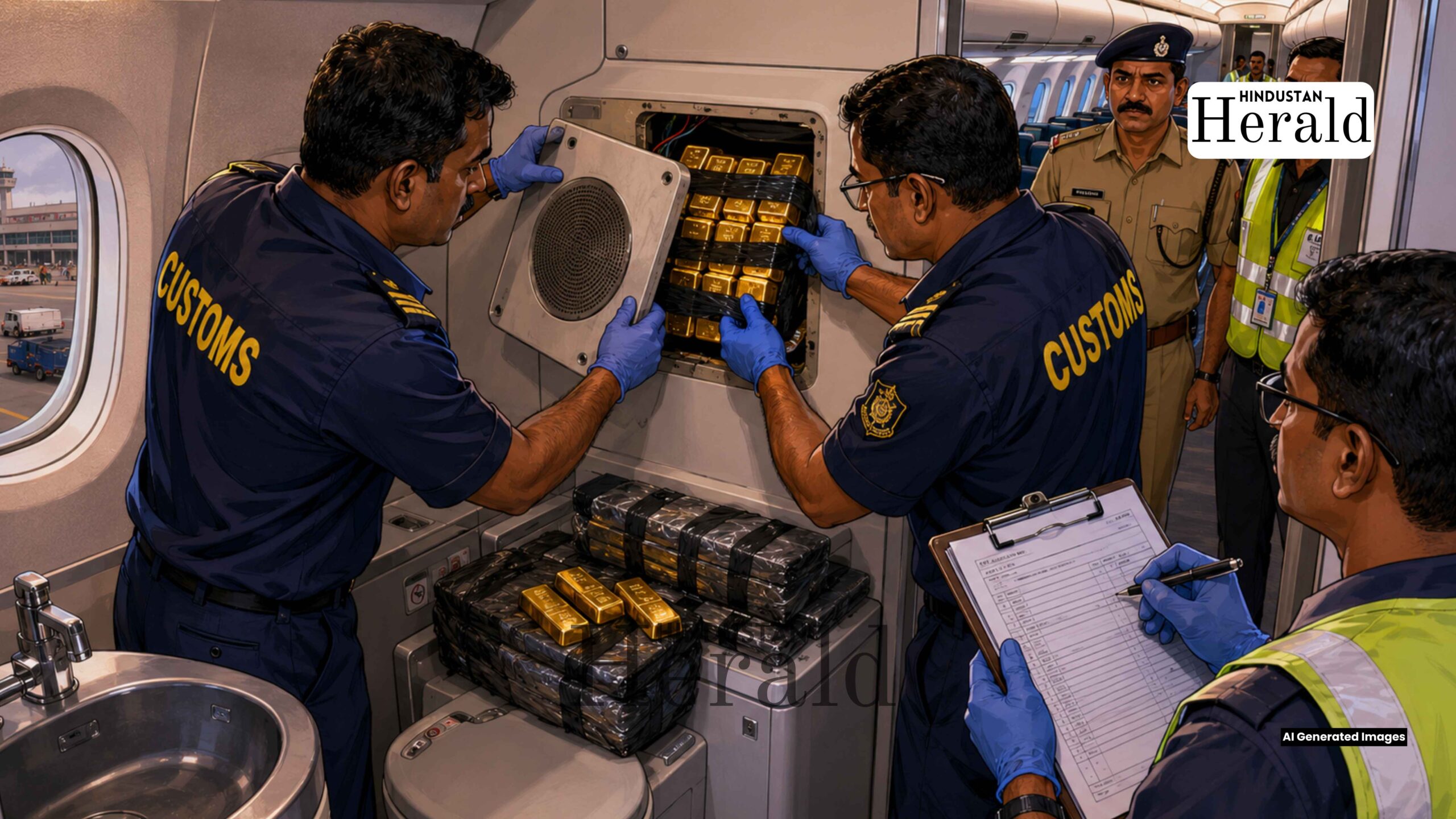
Ahmedabad, June 14: A bathroom speaker box on a passenger aircraft is not where most people would think to hide Rs 4.26 crore worth of gold. Somebody did, and for a while, it nearly worked.
On June 12, customs officers at Sardar Vallabhbhai Patel International Airport in Ahmedabad tore open the speaker assembly fitted inside the front lavatory of an IndiGo aircraft that had just touched down from Dubai. Inside, wrapped in black plastic tape so tight it looked industrial, were two pouches. Inside those pouches sat 24 gold biscuits, 24-carat pure, 999.0 purity, weighing 2,799.3 grams in total. Domestic market value: a clean Rs 4,26,89,325.

Flight 6E-1478. Dubai to Ahmedabad. And when the gold came out, not one person on that aircraft, or anywhere near the arrival gate, stepped forward to say it belonged to them.
What Customs Actually Found, and How
This was not the kind of bust that comes from a suspicious-looking bag or a passenger who blinks too many times at the scanner. The gold was not on anyone. It was in the plane.

Customs officers at SVPI Airport were running what the department calls a rummaging operation, a structured, intelligence-driven sweep of the aircraft itself once it has landed, not the passengers walking off it. For this particular search, they brought in aircraft engineers to help access compartments that a standard security check would never reach. The front lavatory was examined closely. The speaker box on the wall, the kind of fixture nobody on a two-hour flight from Dubai would look at twice, had been used as a vault.
Two pouches, sealed in layers of black plastic tape, had been fitted inside. The gold within them was foreign-origin, flawless, and completely unclaimed. As per officials, the seizure was made under the Customs Act, 1962, and a full investigation has been launched to identify who placed the gold there, who was meant to collect it, and what network connects the two ends of this operation.
The Method Is the Message
Passengers trying to carry undeclared gold past customs, that is a familiar story. A person takes a risk, gets caught or does not, and the case is more or less self-contained. What happened on flight 6E-1478 is a different category of problem entirely.

Placing gold inside an aircraft component means no individual passenger needs to carry anything. The metal flies in with the plane, tucked inside a fixture, completely outside the zone of routine passenger screening. To pull that off, someone needed access to that aircraft before it departed from Dubai. Someone with enough familiarity with the aircraft’s interior layout to know that a lavatory speaker box could hold two pouches and attract no attention. That points away from a solo opportunist and toward a network with resources, planning, and probably more than one run behind it.
On the Ahmedabad end, the presumption is that someone was supposed to retrieve the gold, likely during the aircraft’s turnaround, maintenance window, or cleaning cycle, well before the next set of passengers boarded. That person either knew the operation had been compromised and stayed away, or the timing simply did not work out. Investigators are now going through aircraft movement logs, ground handling records, and boarding footage from the Dubai departure to trace the origin of the concealment.
The gold gave up its hiding place. The people behind it have not.
Ahmedabad Airport Has Been Watching This Pattern Build
Seasoned customs officers at SVPI will tell you that this seizure did not arrive from thin air. The airport has been a recurring site of gold smuggling intercepts through 2026, and the cases have been getting more sophisticated with each passing month.

In February, a passenger off a Dubai flight was stopped and found to be carrying 601.9 grams of 24-carat gold worth close to Rs 96 lakh, hidden in paste form inside his underwear. Uncomfortable by any measure, but traceable to one person. Around the same time, a separate operation at the same airport led to the detention of four women who had arrived from Jeddah. Between them, officers recovered 945.57 grams of 24-carat gold jewellery valued at over Rs 1.52 crore. The ornaments had been coated in rhodium, chains and bangles dressed up to look less like what they were.
Three major seizures at one airport in under five months. Each time, the concealment method was a step removed from the last. The lavatory speaker case is the furthest step yet.
The Price Gap That Keeps This Business Alive
Gold in Dubai costs what it costs because the emirate charges no import tax on the metal. Prices are low, availability is high, and the Indian community moving between the two countries is large enough to provide natural cover for anyone who wants to blend in as a regular traveller. India, by contrast, imposes substantial customs duty on gold, a long-standing policy instrument aimed at controlling import volumes and managing the current account deficit.
That gap in price between what gold costs in Dubai and what it fetches on the Indian domestic market without duty paid is the engine behind all of this. Smuggling networks have built entire operational models around it. Carry enough gold across often enough without getting caught, and the returns are significant. Getting caught is a cost of doing business, not a shutdown of the enterprise.

What changes over time is the method. Thermos flasks. Trolley bag linings. Gold paste under clothing. Rhodium-coated ornaments. Nuts and bolts cast from crude gold. Each technique was eventually cracked by customs, and each cracking prompted a pivot to something harder to find. Hiding gold inside the aircraft itself, inside a component bolted to the lavatory wall, is the logical end-point of that escalation. At least for now.
A Question Worth Sitting With
Customs officials confirmed that this operation was triggered by intelligence inputs, meaning someone had specific reason to believe that flight 6E-1478 warranted a closer look than routine procedure would deliver. The rummaging operation was not random. It was targeted.
That detail matters because it means this discovery was not accidental. It also means that without the intelligence tip, those 24 gold biscuits would likely have completed their journey through the airport’s system quietly, collected by whoever was waiting, and melted into the domestic market before the week was out.
A speaker box in a lavatory. Rs 4.26 crore. No claimant. The gold is sitting with customs now, but the investigation is very much alive, working backwards from Ahmedabad to Dubai, from the aircraft to the hands that loaded it, from a seized pouch to whatever operation was careful enough to use a bathroom speaker as a safe.
Careful, as it turns out, was not quite careful enough.
Stay ahead with Hindustan Herald — bringing you trusted news, sharp analysis, and stories that matter across Politics, Business, Technology, Sports, Entertainment, Lifestyle, and more.
Connect with us on Facebook, Instagram, X (Twitter), LinkedIn, YouTube, and join our Telegram community @hindustanherald for real-time updates.

Covers Indian politics, governance, and policy developments with over a decade of experience in political reporting.
- Ananya Sharma

- Ananya Sharma
- Ananya Sharma
- Ananya Sharma




 Arun Upadhayay
  Neeraj Kapoor