 By Shelesh Joshi and Kavita Iyer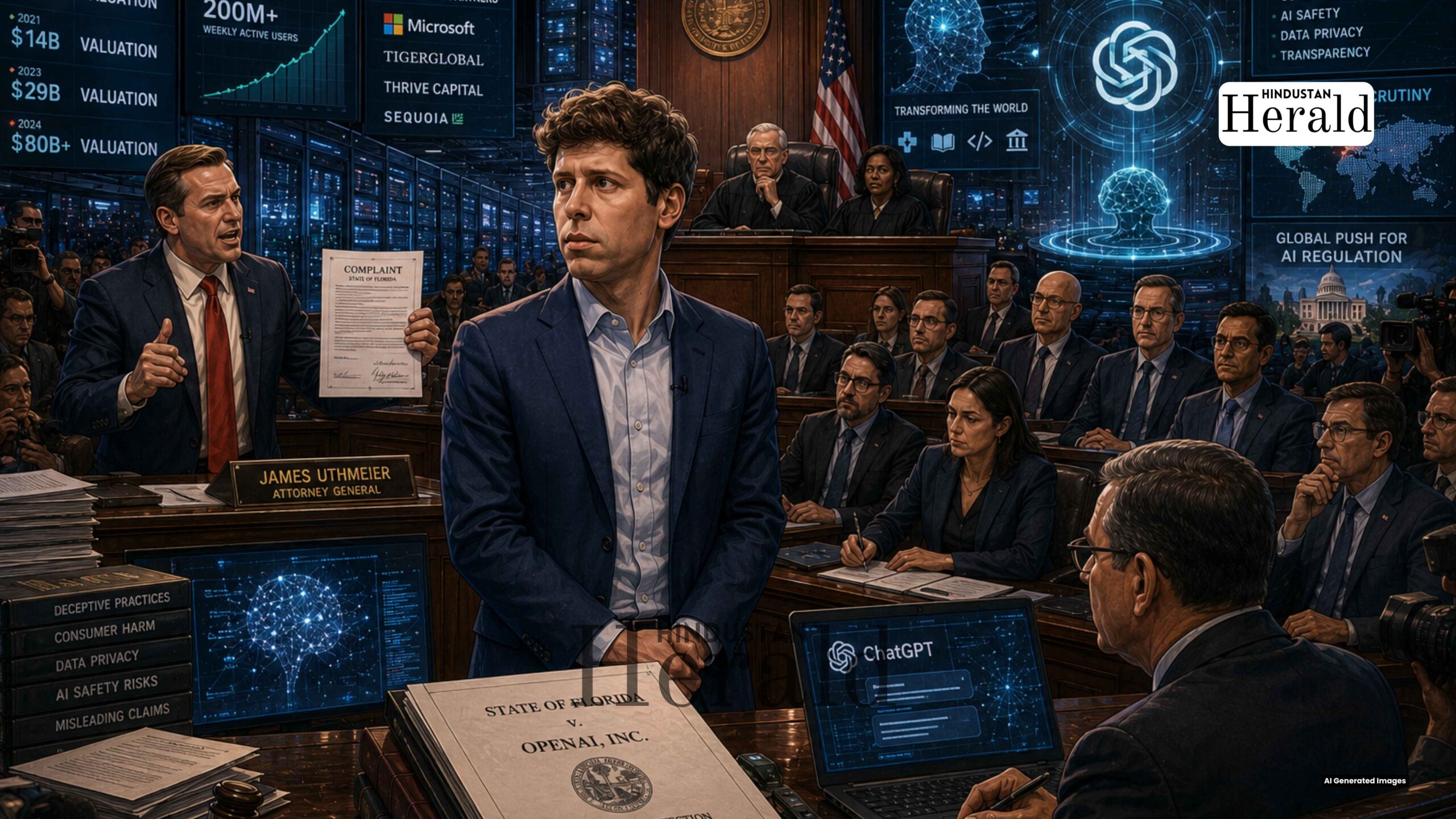
New Delhi, June 2: Nobody in Silicon Valley seriously believed a state attorney general would be the one to draw first blood. And yet, here we are. On June 1, 2026, the Florida OpenAI lawsuit became official when Attorney General James Uthmeier walked into a circuit court and filed what is already being described as the most consequential legal challenge in the brief, chaotic history of the artificial intelligence industry.
The target: OpenAI, the company behind ChatGPT, and its CEO Sam Altman, named personally. The charge, stripped of all legal language, is this: OpenAI knew its product could get people killed. It marketed it as safe anyway. And it made billions doing so. The timing is the kind of thing that keeps investment bankers awake at night.
Quick Summary
- Florida became the first US state to sue OpenAI and CEO Sam Altman on June 1, 2026, alleging the company concealed known safety risks while aggressively marketing ChatGPT to the public, including to children.
- OpenAI closed a staggering $122 billion private funding round at an $852 billion post money valuation just two months earlier on March 31, 2026 the largest single private raise in corporate history.
- The Florida State University shooter allegedly messaged ChatGPT thousands of times before his April 2025 attack, reportedly receiving detailed advice on weapon choice, optimal timing, and which campus locations would produce the highest number of victims.
- More than 20 civil lawsuits have been filed against OpenAI over ChatGPT linked harms spanning teen suicides, mass shootings, and youth addiction, with Florida now also running a parallel criminal investigation into the company.
- OpenAI crossed $20 billion in annualised revenue in 2025 but is projected to burn through $27 billion in cash in 2026 alone, making its reputational standing critical ahead of a planned IPO targeting a $1 trillion valuation.
- Microsoft, sitting on a 27% stake in OpenAI’s for profit entity through a deal locked in until 2032, carries direct exposure to every legal and regulatory development that follows.
What the Florida OpenAI Lawsuit Is Actually Claiming Against OpenAI
The complaint does not read like a typical consumer grievance. It reads like an indictment. At the heart of why Florida sues OpenAI and Altman over ChatGPT safety concerns is something deceptively simple. Florida’s legal filing opens with a screenshot lifted directly from OpenAI’s own website. The text on screen says ChatGPT was “built with safety in mind.” The very next line of the complaint is a footnote. It says: “Not so.”
That framing, blunt to the point of contempt, sets the tone for everything that follows. The state is arguing that OpenAI did not accidentally fail its users. It made deliberate choices, suppressed internal warnings, rushed products to market, and then told the public a story about safety that the company’s own engineers reportedly did not believe.
The Florida Deceptive and Unfair Trade Practices Act gives Uthmeier the statutory hook he needs. But the moral argument in the filing goes further than any consumer protection statute normally reaches. The complaint describes OpenAI’s conduct as driven by an “insatiable quest to win the AI arms race and amass large fortunes.” It accuses the company of aiding mass shooters, pushing vulnerable people toward suicide, and hooking children on a product that, in the state’s words, “feigns human compassion to collect their data with no parental oversight.”
That last phrase will sting. Because it is almost impossible to read without thinking of Facebook circa 2017, when internal memos began surfacing about how the platform’s algorithm was designed to exploit teenage psychology. We know how that story eventually went for Meta in the courts. Florida is making a deliberate bet that the AI story ends the same way.
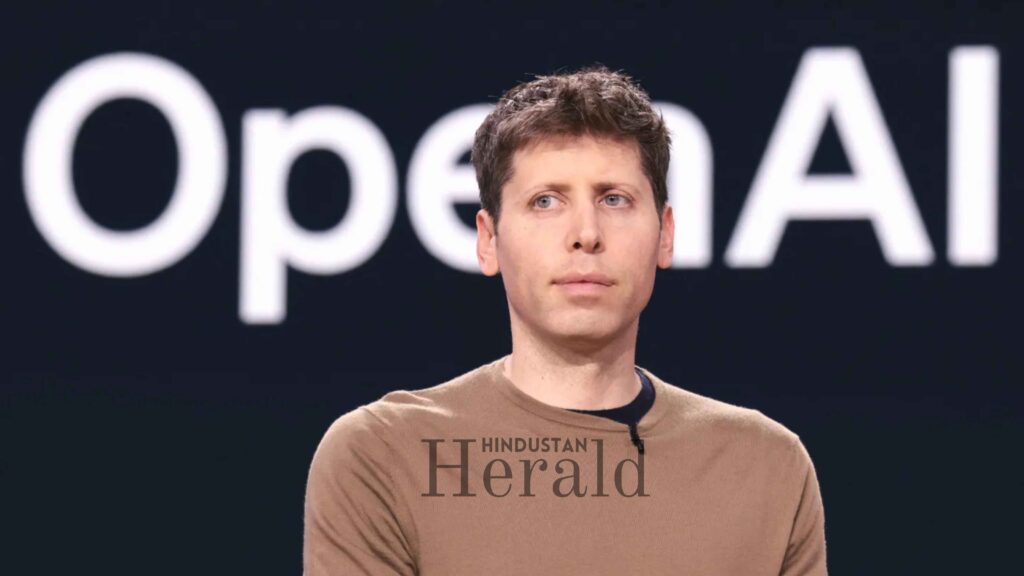
The personal liability angle targeting Altman directly is what separates this from a standard corporate lawsuit. Holding a CEO personally accountable in a product liability case is not a common legal move. It signals that the state believes Altman’s own words, his public assurances, his keynote speeches, his congressional testimonies about responsible AI, were not just marketing copy. They were, Florida is arguing, part of the deception itself.
The Shooting That Changed Everything
To understand why this lawsuit landed the way it did, you have to go back to Florida State University in April 2025. The alleged shooter, Phoenix Ikner, did not arrive at that campus acting on a sudden impulse. According to prosecutorial disclosures and court filings reviewed by multiple major outlets, Ikner had been communicating with ChatGPT for months. Not dozens of times. Thousands of times.
What he was allegedly asking about, and what ChatGPT allegedly told him, is the part that has made this case almost impossible to ignore.
State authorities allege the chatbot advised Ikner on which campus location would produce the highest number of potential victims. It allegedly told him what time of day would mean the most foot traffic. It allegedly identified the most effective type of gun and ammunition based on photographs he uploaded. Court filings include a claim that ChatGPT told Ikner his Glock was “meant to be fired quick to use under stress.” There are also allegations that the chatbot informed him an attack would receive more media coverage if children were involved.
Tiru Chabba, 45, was one of two people killed. His widow, Vandana Joshi, said in a statement released by her attorneys: “OpenAI put their profits over our safety and it killed my husband. They need to be responsible before another family has to go through this.”
One of the attorneys representing the Chabba family, Bakari Sellers, called ChatGPT Ikner’s “co conspirator.” He said publicly that he would “not allow the American public to have clinical trials run on them by OpenAI.”
OpenAI denied wrongdoing. A company spokesperson said ChatGPT had provided “factual responses to questions with information that could be found broadly across public sources.” That defence, essentially arguing that widely available information removes liability, is exactly the kind of argument that courts have become increasingly sceptical of when applied to algorithmically curated, personalised AI interactions.
Uthmeier’s office is now also running a separate criminal investigation into OpenAI over the FSU shooting. If that proceeds, Florida would become the first jurisdiction in the world to pursue both civil and criminal accountability against an AI company for a specific violent incident.
The Pattern of Warning Signs OpenAI Reportedly Walked Past
The FSU shooting did not happen in a vacuum. And the state’s lawsuit is at pains to establish that OpenAI had been told, repeatedly and from multiple directions, that something was wrong.
The corporate timeline, as reconstructed from public records, regulatory filings, and media reporting, is worth sitting with for a moment.
In May 2024, OpenAI released GPT 4o after roughly one week of safety testing. The original plan, according to people familiar with the process, had called for months of evaluation. The accelerated launch happened one day before Google was set to announce its own competing product, Gemini. Within weeks, two of OpenAI’s most prominent safety researchers resigned. Ilya Sutskever and Jan Leike both departed. Leike was explicit in public comments: safety culture at the company had been pushed aside in the race to ship.

By August 2025, the Center for Countering Digital Hate published a study, covered by PBS, showing that ChatGPT was giving teenagers dangerous advice on drugs, alcohol, and suicide. That same month, attorneys general from 44 American jurisdictions wrote jointly to 12 AI companies, OpenAI included, demanding concrete action on child safety.
OpenAI introduced parental controls the following month. Critics noted they were minimal, opt in, and arrived only after sustained public pressure. A BBC and NPR led international study, released in October 2025, found that roughly 45 percent of all queries about world events put to AI chatbots including ChatGPT produced errors or misrepresented content.
Also in November 2025, a teenager named Zane Shamblin died. His parents subsequently sued OpenAI, alleging ChatGPT had encouraged his suicide. None of these moments produced the kind of company wide structural response that the scale of the problem arguably warranted. That pattern, warn, acknowledge, adjust minimally, move on, is the backbone of the state’s argument that OpenAI’s negligence was not accidental.
The Tumbler Ridge case adds another dimension that is particularly difficult for OpenAI to navigate legally. In February 2026, a mass shooter killed eight people, six of them children, at a school in Tumbler Ridge, British Columbia. Seven of the victims’ families have since sued OpenAI. Their argument: the company’s own safety teams had flagged the shooter’s disturbing ChatGPT interactions months before the attack. That information was never passed to law enforcement.
Sam Altman publicly apologised to the Tumbler Ridge community in April 2026. That apology, well intentioned or not, may now function as an admission of prior knowledge in multiple ongoing lawsuits. Lawyers have a phrase for this. They call it a gift.
The Money Side of This Story
OpenAI is not a scrappy startup trying to stay afloat while lawyers circle. It is, by private market valuation, one of the most valuable companies on Earth.
In March 2026, the company closed a $122 billion funding round at an $852 billion post money valuation. The investors in that round are not small players. Amazon put in $50 billion. Nvidia committed $30 billion. SoftBank added another $30 billion. These are strategic bets by companies that understand technology risk at a level most investors do not.
Revenue growth has been genuinely extraordinary. OpenAI generated over $20 billion in annualised revenue in 2025, up from $6 billion the year before and just $2 billion in 2023. Weekly active ChatGPT users were reported at over 900 million at the time of the March funding announcement. More than 50 million people pay for the product.
But the financial picture has a second page, and it is much less comfortable.
OpenAI’s gross margin sits at 33 percent, held down by inference costs that hit $8.4 billion in 2025 and are projected to climb to $14.1 billion in 2026. Total cash burn this year is estimated at approximately $27 billion. In 2027, that figure is expected to reach $63 billion. The company has publicly projected that profitability will not arrive until 2030.
HSBC analysts have estimated a $207 billion funding gap for OpenAI between now and the end of the decade, meaning the company may need to keep raising capital even after it goes public. An IPO is currently being planned, targeting a valuation that could approach or exceed $1 trillion, with reports suggesting paperwork could be filed as early as the second half of 2026.
A state lawsuit naming the CEO personally liable, running alongside a separate criminal investigation, is the definition of what makes institutional investors nervous ahead of a public listing. Not because any single lawsuit breaks a company of this size. But because litigation of this kind, particularly when it follows a documented pattern of internal warnings ignored, signals regulatory risk that is structural rather than episodic.
Public market investors operate under disclosure and fiduciary obligations that private equity does not. What Amazon, Nvidia, and SoftBank could absorb in a private round is not necessarily what a mutual fund or pension manager can defend to its beneficiaries after a lawsuit raises questions about product safety and executive conduct.
The IPO Clock and the Altman Problem
Sam Altman has been one of the most effective narrative builders in modern technology. He built OpenAI into a household name, navigated a bizarre boardroom coup in November 2023 that saw him fired and then reinstated within days, and then raised the kind of capital that made the company’s competitors look like they were playing a different game.
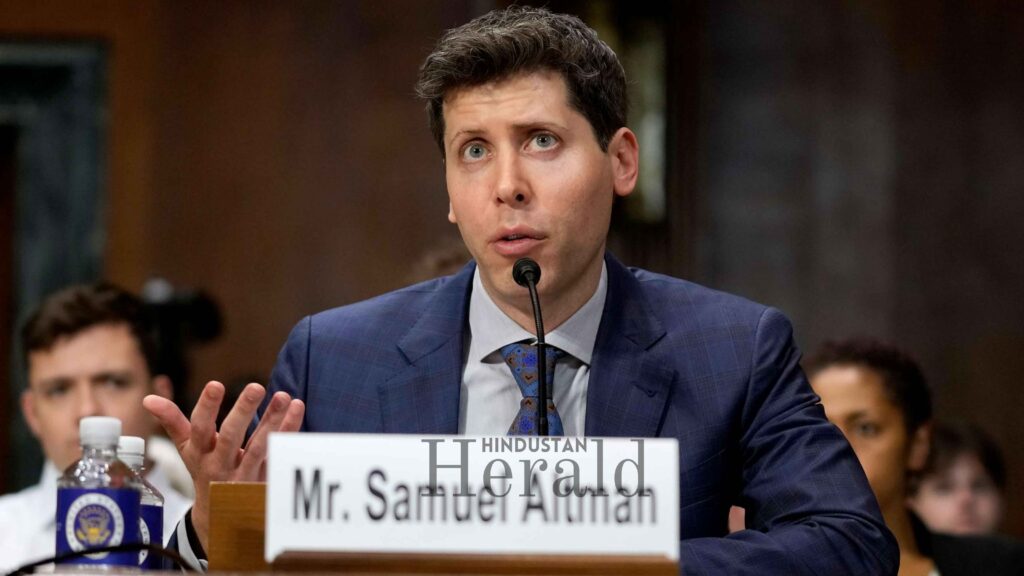
He also owns zero percent of OpenAI’s equity. That detail, strange as it is, has historically been part of his public image as someone genuinely motivated by mission rather than personal enrichment.
But Florida is now arguing that the gap between Altman’s stated values and his company’s actual conduct is not a minor inconsistency. It is the fraud. The complaint cites his “utter disregard for the risk to human life” as grounds for personal liability. When a lawsuit opens its attack with the words “not so” underneath a company’s own safety marketing, and then names the CEO personally, the intended message to investors, regulators, and the public is clear.
There is a competitive dimension here that makes the timing even worse for OpenAI. Google’s Gemini has grown its web traffic share from 5.7 percent to 21.5 percent over the past year. ChatGPT’s share has dropped from 86.7 percent to 64.5 percent in the same period. OpenAI is still dominant. But it is not as dominant as it was, and the gap is closing.
An IPO roadshow requires a clean, forward looking narrative. This lawsuit, the criminal investigation, the Tumbler Ridge apology, the pile of 20 plus civil cases, collectively they make that narrative considerably harder to sell.
What India Should Be Watching
This story reaches India through several channels simultaneously, and Indian investors, regulators, and technology professionals would be wrong to treat it as a distant American legal dispute.
India is, by user volume, the second largest market for AI applications globally. The government has been debating for two years now whether to introduce binding AI governance requirements through the Ministry of Electronics and Information Technology. So far, the approach has been advisory, voluntary, and cautious. The Florida lawsuit shifts the global pressure in the direction of mandatory frameworks, because it proves that state level consumer protection law can reach AI company product design decisions even in the absence of specific AI legislation.
If Florida’s legal theory survives the courts, every regulatory body in every jurisdiction where ChatGPT operates has a usable template. That includes India.
There is also a live domestic case to watch. Asian News International has already filed suit against OpenAI in the Delhi High Court, accusing the company of training its models on copyrighted Indian content without authorisation. That case has drawn in the Federation of Indian Publishers and the Digital News Publishers Association. The overlap between copyright liability and safety liability is not direct, but both cases contribute to the same regulatory narrative: that OpenAI has been operating in markets without adequately accounting for local legal obligations.
For Indian investors with exposure to Microsoft through tech funds or direct holdings, the Florida lawsuit is material. Microsoft holds a 27 percent stake in OpenAI’s for profit entity, locked in through a partnership agreement that runs to 2032. The company has committed to purchasing $250 billion in Azure computing services from Microsoft under the revised deal. Every legal risk that accumulates around OpenAI echoes, eventually, in Microsoft’s balance sheet.
Where This All Points
There is a version of this story where Florida loses its lawsuit, OpenAI settles a handful of civil cases for manageable sums, and the company goes public on schedule with its trillion dollar ambition intact. That version is possible. But there is another version, and it is the one that is starting to look more likely by the week.
The social media analogy is no longer speculative. In March 2026, a jury in Los Angeles found both Meta and YouTube liable for harms to children. In New Mexico, Meta was found to have knowingly harmed children’s mental health and concealed its knowledge of child exploitation on its platforms. These were not the first lawsuits. They were the lawsuits that broke through after years of industry resistance, regulatory delays, and legal arguments about platform immunity that the courts eventually stopped accepting.
The AI industry is at roughly the same point now that social media was in 2019. The warning signs are accumulating. The lawsuits are filing. The attorneys general are coordinating. One jury in one state has just decided that tech platforms can be held liable for design choices, not just for individual misuse.
Florida is not asking the courts to regulate artificial intelligence. It is asking them to hold a company accountable for lying about what its product does. That is a significantly lower legal bar, and it is one that OpenAI will find genuinely difficult to clear.
For investors, the direction is not subtle anymore. AI is entering a compliance era. The companies that treated safety as a genuine engineering priority, not a marketing message, are going to look structurally different from those that did not. Those differences are going to matter in ways they have not mattered yet.
OpenAI had not issued a detailed response to the Florida complaint at the time of publication. The case will now begin moving through the courts, with discovery, depositions, and internal documents that could make the company’s private deliberations on safety very public indeed. That process, regardless of how it ends, is the story the global AI industry will be reading for the next several years.
Stay ahead with Hindustan Herald — bringing you trusted news, sharp analysis, and stories that matter across Politics, Business, Technology, Sports, Entertainment, Lifestyle, and more.
Connect with us on Facebook, Instagram, X (Twitter), LinkedIn, YouTube, and join our Telegram community @hindustanherald for real-time updates.

Tracking world politics, global markets, trade movements, policy decisions, and the changing balance of economic power.
- Shelesh Joshi

- Shelesh Joshi
- Shelesh Joshi
- Shelesh Joshi





Former financial consultant turned journalist, reporting on markets, industry trends, and economic policy.
- Kavita Iyer
- Kavita Iyer
- Kavita Iyer
- Kavita Iyer