
 By Ananya Sharma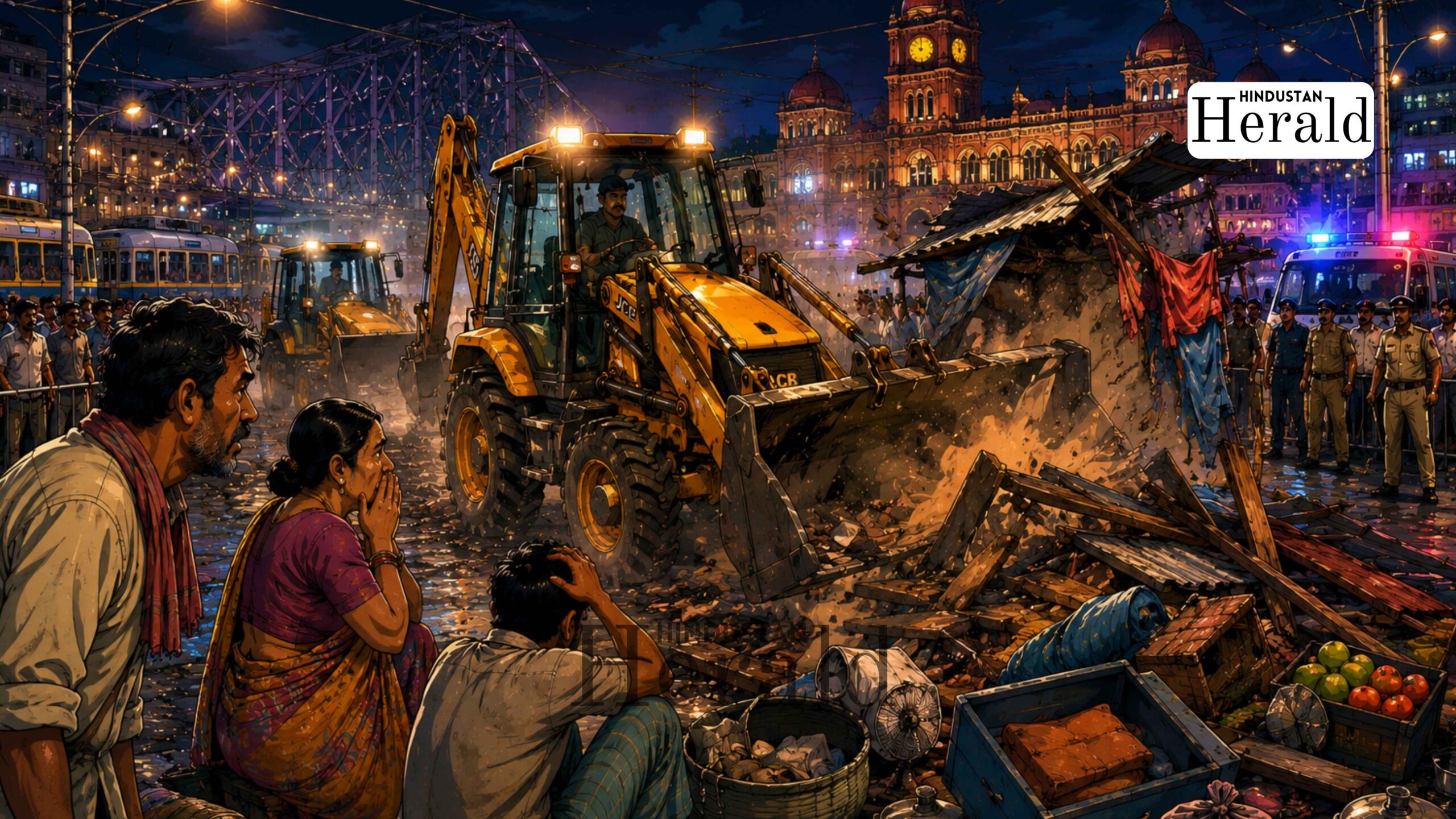
Kolkata, May 18: The bulldozers came at midnight. That is when the Howrah operation began, late Saturday, while most of the city slept. By the time the sun came up, roughly 150 stalls and makeshift shops along the stretch from the Ganga ghat to the station premises were gone. The vendors who had been there for years, in some cases for decades, woke up to rubble.
West Bengal’s new BJP government has been in office for nine days. And by Sunday, Park Circus was already on fire.
The Night Howrah Was Cleared
The operation was conducted jointly by the Railway Protection Force, Government Railway Police, railway authorities and Howrah City Police, with heavy deployment of security personnel across the area. Bulldozers and earthmovers moved through the footpaths and public spaces near the bus stand and Ganga ghat, taking down whatever had been built there without permission.
A crowd gathered to watch. Police tried to keep people moving. Officers were heard on loudspeakers saying: “Don’t crowd here. Passengers, go to the station, take the bus. There is no drama happening here. You do your job. Let the administration do its job.”
The crowd did not really listen. Because there was drama, whatever the loudspeakers said.
There was a commotion as bulldozers entered the area, with squatters initially resisting. The footpath traders alleged that the Railways had given them a notice to vacate their premises only a day earlier. One day of notice. After years of being there.
The railways framed it as passenger convenience, and that framing is not entirely wrong. Howrah’s approach roads have been genuinely congested for years. Platforms crammed, footpaths impassable during rush hour, commuters navigating gaps that should not exist at one of the busiest rail terminals in the country. The problem was real. But the way this was done raised harder questions that a press statement about passenger convenience cannot fully answer.
Sealdah Was Already Done
While Howrah was being cleared through Saturday night, Sealdah had already been swept. The Sealdah division cleared hawkers and stalls from platforms 1 to 21 to ensure smoother passenger movement inside the terminal. Around 250 hawkers and stalls were removed. Railway authorities declared all platforms hawker-free, to be reserved exclusively for passenger movement going forward.
Between the two stations, roughly 400 people lost their working spot over a single weekend. Some will find other locations. Many will not, and the government has not announced any plan to help them figure that out.
One hawker said: “There should be beautification and proper management, but poor vendors should also be rehabilitated.” Another told reporters: “We will have to resort to suicide if no rehabilitation is provided.”
No rehabilitation package has been announced as of Sunday evening.
Park Circus Broke on Sunday
If the station drives were tense but controlled, Sunday afternoon in Park Circus was neither.
The neighbourhood, densely populated and predominantly Muslim, had been on edge since earlier in the week. The demolitions were part of it, but so was something else, a directive the new BJP government had issued almost immediately after taking office. The state government directed police to ensure roads are not blocked due to prayer congregations, except on special occasions. Tensions had already erupted in Kolkata’s Rajabazar area on Friday when a group tried to offer namaz on the road.
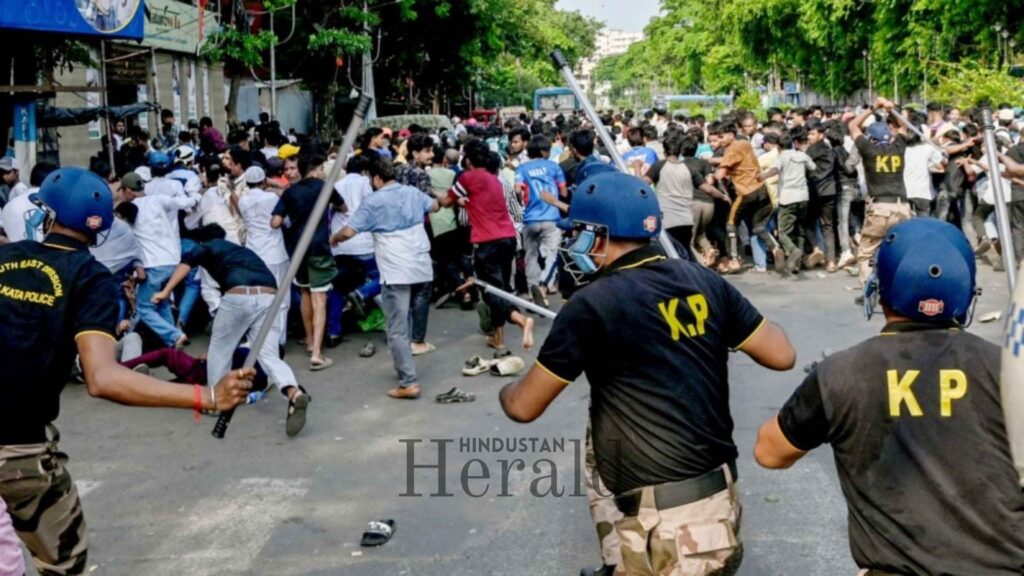
That Friday friction carried into Sunday. Protesters gathered at Park Circus, opposing both the restrictions on public prayers and the ongoing demolition drives. Traffic seized up. When police and CRPF personnel reached the seven-point junction and tried to disperse what they described as an unlawful assembly, a section of protesters responded with stone-pelting. A CRPF vehicle was severely damaged. Several parked vehicles in the area were also vandalised.
The police responded with a lathi-charge. Three officers were injured. Arrests followed. A flag march was conducted through the neighbourhood, the administration’s way of restating its presence.
Protesters maintained that the newly-elected BJP government was purposefully taking steps to curtail the rights of minority communities. The government’s counter was that unlawful assemblies blocking roads would not be tolerated, full stop.
Mamata Comes Out Swinging
Mamata Banerjee responded the way she usually does, quickly and loudly, but this time there was something sharper underneath the political messaging.
In a post on X, she called the drives “bulldozer politics” and said the poor were paying the price of political arrogance. She wrote: “The massive eviction drive around Howrah Station, the unrest and anger erupting on the streets of Tiljala and Park Circus, and the growing desperation among those suddenly stripped of shelter and livelihood expose a government more obsessed with optics than humanity.”

She added: “A government that demolishes first and listens later has forgotten the very spirit of Bengal.”
She had already used similar language a few days before. On May 14, she appeared personally before the Calcutta High Court, wearing a lawyer’s gown, to argue a public interest litigation concerning alleged post-poll violence, where she declared that “Bengal is not a bulldozer state.”
The BJP’s response was partly to dispute the framing. Some party supporters and commentators pointed out that the Howrah clearance involved railway land and railway authorities, not a state government demolition order, and that the two should not be conflated for political purposes. It is a fair distinction in a narrow technical sense. Whether the average displaced vendor or the average Park Circus resident draws that distinction is less certain.
Nine Days In
Understanding the pace of all this requires understanding just how new this government is.
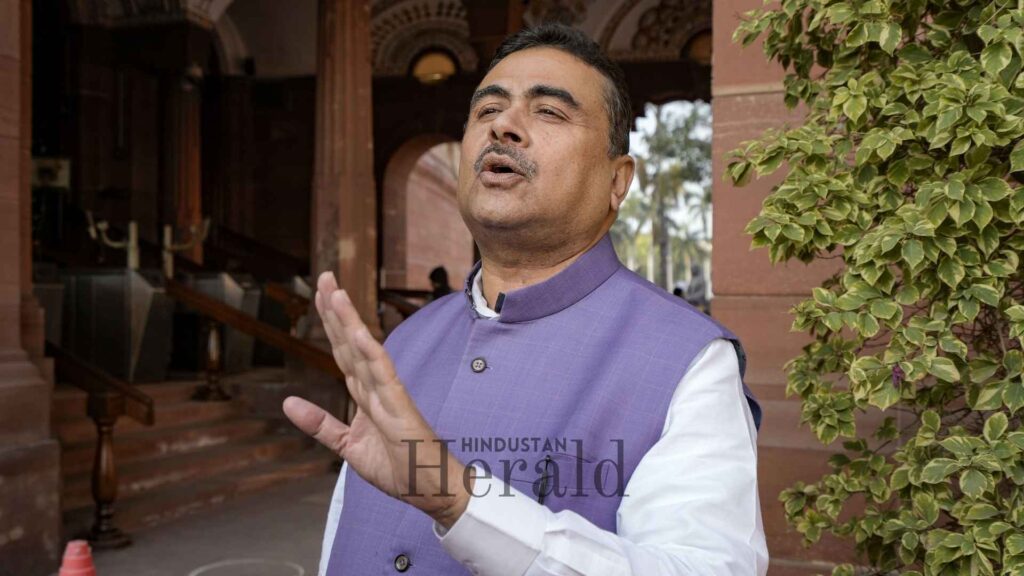
Suvendu Adhikari was sworn in on May 9, becoming the first BJP chief minister in West Bengal’s history. The party had campaigned for years on a promise to clean up what it called TMC-era illegality: illegal constructions, encroachments, political protection of criminal networks. They won, decisively. And they are governing exactly the way they campaigned.
The Tiljala demolitions that preceded the Park Circus unrest were ordered after a fire at an illegal factory there killed two people. There was a specific trigger in that case, and it matters. But even with a specific trigger, the pattern emerging across the first week and a half of this government is one of rapid, visible action with limited warning and no announced safety net for those caught in the sweep.
The administration has also announced strict action against cattle smuggling and stone-pelting, both of which were BJP campaign issues. The government is working through its list. The question West Bengal is beginning to ask is whether speed and governance are the same thing.
The Part That Gets Lost
The hawkers at Howrah and Sealdah were not occupying railway land out of defiance. They were there because the city’s formal economy never made space for them anywhere else. They were there because for years, under multiple governments, the encroachments were quietly tolerated. Votes were at stake. Livelihoods were visible. Nobody wanted to be the one to clear them out.
Now someone is clearing them out. And doing so without a parallel plan for the people being cleared is not law enforcement in any complete sense. It is the state collecting the cost of its own previous neglect from the people who can least afford to pay it.
That argument does not mean the stations should stay congested. They should not. Howrah and Sealdah are genuine public infrastructure and deserve to function properly. But a drive conducted with a day’s notice and no follow-up is not a solution. It is half of one.
The Park Circus situation is connected but different. The BJP had been openly critical of roadside prayers throughout the campaign. Voters knew this position. The government is not hiding that it is delivering on it. But moving from a campaign position to a policing directive in the first week of office, in a city as communally layered as Kolkata, was always going to produce friction. The stone-pelting on Sunday and the lathi-charge that followed were not surprises. They were the foreseeable result of speed without sequencing.
For now, the platforms are clear. The flag march is done. The BJP government has given no sign it plans to slow down.
Somewhere in Kolkata tonight, the vendors who lost their stalls are trying to work out what Monday looks like. No one has told them yet.
Stay ahead with Hindustan Herald — bringing you trusted news, sharp analysis, and stories that matter across Politics, Business, Technology, Sports, Entertainment, Lifestyle, and more.
Connect with us on Facebook, Instagram, X (Twitter), LinkedIn, YouTube, and join our Telegram community @hindustanherald for real-time updates.

Covers Indian politics, governance, and policy developments with over a decade of experience in political reporting.
- Ananya Sharma

- Ananya Sharma
- Ananya Sharma
- Ananya Sharma




 Arun Upadhayay
  Ayesha Khan and Ananya Sharma