
 By Neeraj Kapoor
New Delhi, April 23: The man building one of the world’s most powerful artificial intelligence systems is also the one telling the world to be very afraid of what it is building. Dario Amodei, co-founder and CEO of Anthropic, the San Francisco-based AI safety company behind the Claude family of models, has spent the better part of 2026 issuing increasingly stark warnings about how AI will reshape, and in his view, badly destabilise, the global labour market. His warnings carry a particular weight precisely because they come from the inside.
In January, Amodei published what can only be described as a landmark document in the AI discourse. Titled “The Adolescence of Technology,” the roughly 20,000-word essay warned that AI was about to test who we are as a species, and that humanity is about to be handed almost unimaginable power while it remains deeply unclear whether our social, political, and technological systems possess the maturity to wield it. The essay was published on Amodei’s personal blog and triggered a wave of debate across the technology, policy, and business worlds that has not settled since.
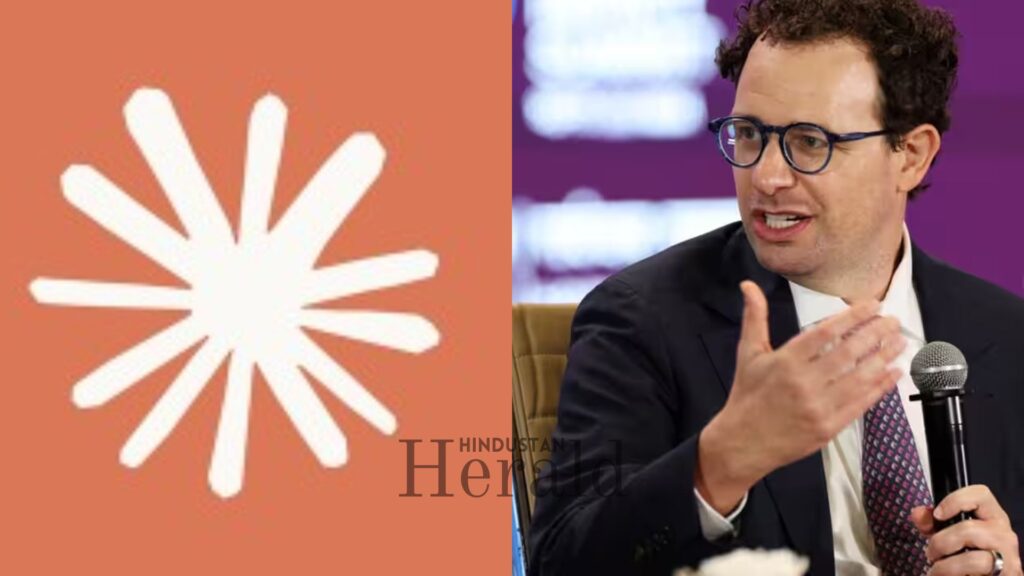
This week, nearly three months after the essay’s publication, the conversation has only intensified. Fresh reporting and commentary continue to surface, asking whether Amodei’s warnings are prescient analysis or calculated alarm from someone with an obvious commercial stake in how AI is perceived and regulated.
The Warning in Plain Language
Strip away the philosophical framing and Amodei’s core argument on jobs is fairly direct. He told Axios that AI could eliminate half of all entry-level white-collar jobs within five years, a shift he said could push US unemployment to between 10 and 20 per cent. That is not a fringe prediction from an academic modelling worst-case scenarios. It is coming from the person who runs one of the companies most responsible for the technology driving those fears.
In the essay, Amodei elaborated on his concern by arguing that new technologies have always brought labour market shocks, and that humans have historically recovered from them. But he expressed worry that this was only possible because previous shocks affected a small fraction of the full range of human abilities, leaving room for people to expand into new tasks. AI, he argued, will have effects that are broader and occur much faster.
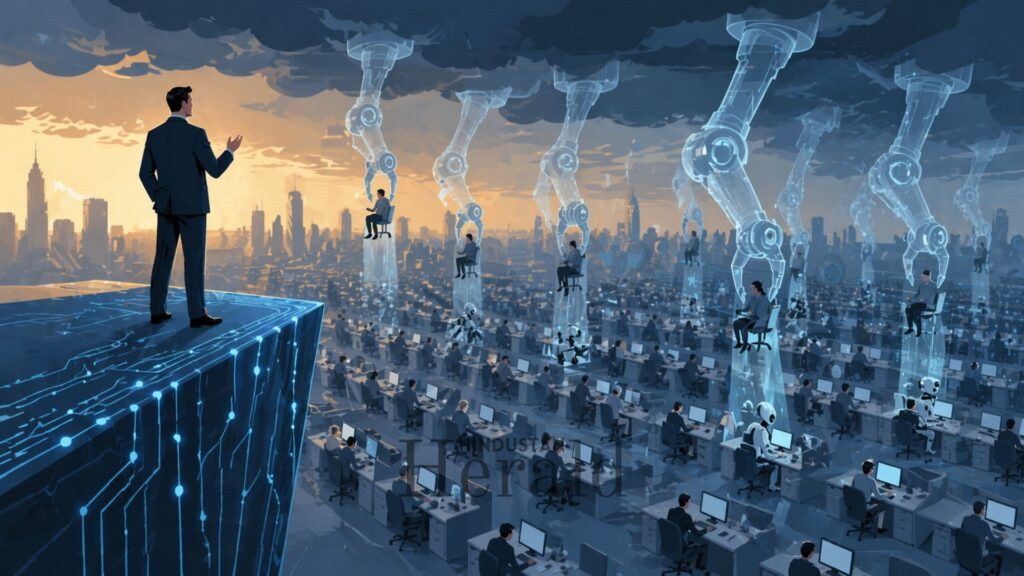
That is the crux of what makes his warning different from earlier rounds of automation anxiety. At Davos in January 2026, he warned that AI’s “cognitive breadth” means it will not disrupt one industry at a time. It could simultaneously affect finance, consulting, law, and tech, leaving workers with fewer options to switch fields. The technology, he said, is not replacing a single job but acting as a general labour substitute for humans.
The distinction matters enormously. When factories automated in the 20th century, displaced factory workers could, in theory, move into office and service jobs. When AI moves into office and service jobs at the same pace, there is no obvious alternative lane to shift into. That is the scenario Amodei is trying to force people to confront.
Which Jobs Are at Risk and When
The essay names specific sectors where disruption will be sharpest. Software development is one: while coding assistants have increased productivity, Amodei warns that the next generation of models will essentially act as autonomous engineers, reducing demand for junior and mid-level developers significantly. Corporate law and finance are cited for similar reasons, as tasks like contract analysis, risk assessment, and financial auditing are rapidly becoming zero-marginal-cost computations. Creative industries, from technical writing to graphic design, face the same pressure as AI systems decouple content creation from human labour hours.

Amodei suggests that a significant proportion of entry-level positions across finance, consulting, and technology sectors could vanish within the next one to five years, as AI systems increasingly take on roles traditionally filled by human workers. He also noted that AI systems, which once functioned at the level of a high school graduate, are now operating at levels comparable to a college graduate. That trajectory, he argues, is moving fast enough that the reskilling rhetoric that governments typically fall back on simply will not have time to take hold.
His concern about entry-level jobs specifically carries a dimension that goes beyond employment numbers. The elimination of foundational jobs is likely to hinder opportunities for young professionals to cultivate the essential skills and judgment that form the bedrock of their careers. A law associate who never reviews contracts, a financial analyst who never builds a model from scratch, a junior coder who never debugs a live system: these are not just unemployed workers. They are professionals whose path to expertise has been structurally removed.
The Data That Gives His Warnings Weight
Amodei’s predictions are not happening in a vacuum. Several datasets support the broad direction of what he is describing, even if the precise scale remains debated.
AI was cited as the reason for nearly 55,000 layoffs in the United States in 2025, according to data from consulting firm Challenger, Grey and Christmas. A study by the Massachusetts Institute of Technology found that AI can already perform the work of 11.7 per cent of the US labour market, saving up to 1.2 trillion dollars in wages across finance, healthcare, and other professional services.
Big Tech’s new graduate hiring has fallen nearly 50 per cent from pre-pandemic levels, according to a SignalFire report. Mercer’s Global Talent Trends 2026 report, which surveyed 12,000 people worldwide, found that 40 per cent of employees feared losing their jobs to AI, up from 28 per cent in 2024.
These are not speculative indicators. They describe a labour market that is already beginning to behave differently in response to AI capability. Whether that constitutes the start of the crisis Amodei describes, or a manageable adjustment, is where serious analysts disagree.
What He Says Needs to Happen
Amodei does not stop at warning. The essay devotes considerable space to what he believes should follow. He argues that businesses have an obligation to be creative about how to reassign employees whose existing jobs are being disrupted by AI, rather than simply laying them off. He also raises the idea that in the long term, in a world of enormous total wealth, companies that increase greatly in value due to AI-driven productivity gains may find it feasible to pay human employees even long after they are no longer providing economic value in the traditional sense.
On the policy side, Amodei calls for government intervention to redistribute wealth, saying the most obvious mechanism would be a progressive tax system, one that could be general or targeted specifically at the outsize profits he believes AI companies will soon be making.
He also suggests that wealthy individuals who benefit most from AI should contribute through meaningful private philanthropy, while a progressive tax on the winners could help counterbalance extreme levels of inequality.
Amodei and Anthropic’s co-founders have reportedly pledged to donate 80 per cent of their combined wealth, estimated at over 3.7 billion dollars, to philanthropy, framing it as a personal commitment to mitigating the inequality their industry may generate.
Still, critics have pointed out the tension in all of this. The person calling for redistribution and regulation is the same person whose company is building the tools causing the disruption, is expected to profit enormously from those tools, and is not yet profitable by its own admission.
The Pushback: Who Disagrees and Why
Not everyone in the industry accepts Amodei’s framing, and the pushback cuts from multiple directions.
NVIDIA’s CEO Jensen Huang has said that AI will actually create a lot of jobs, particularly for plumbers, electricians, construction workers, and people building AI-related infrastructure, with six-figure salaries for workers building chip factories and computer factories. Huang also publicly responded to Amodei’s earlier warnings by suggesting, pointedly, that Amodei thinks AI is so scary, but only Anthropic should be building it.

The data-driven counterargument is offered by Yale University. Yale’s Budget Lab said in an October report that AI had not yet caused widespread job losses, based on its analysis of US labour market data from 2022 to 2025. It found that the share of workers in different occupations had not changed significantly since ChatGPT’s debut.
There is also the “AI redundancy washing” critique. Deutsche Bank analysts said in a note that AI redundancy washing will be a significant feature of 2026, as major companies blame the technology for job cuts that actually have other causes. That is a meaningful observation. Attributing every layoff to AI may obscure rather than clarify what is actually happening in the labour market.
The Register, in a critical reading of the essay, noted that Amodei’s insistence on framing the fraught state of the world in AI terms reflects a kind of occupational bias. If you are the head of an AI company, it is AI everywhere, all the time.The publication also pointed out that Amodei predicted in March 2025 that AI would be writing 90 per cent of code within three to six months, a prediction that did not come true.
Amodei himself, in the essay, acknowledged that he is no fan of AI doomerism, which he believes hit peak levels between 2023 and 2024, often using exaggerated language reminiscent of religion or science fiction. But he argued that the recent shift toward a narrative focused on AI opportunity ignores real threats, and that we are considerably closer to real danger in 2026 than we were in 2023.
The Deeper Stakes
Read carefully, Amodei’s essay is not purely about unemployment figures. His central worry is what he calls “temporal compression”: that AI is compressing what would historically be a century of economic evolution into a timeframe of five to ten years, and that while the long-term destination might be a post-scarcity economy, the transition period will be defined by extreme volatility in the labour market.

That framing has a specific implication for how governments and societies should respond. Reskilling programmes work when there is time to retrain workers, when industries are absorbing them on the other side, and when the disruption is sector-specific enough to plan around. Amodei argues that none of those conditions will hold.
He contends that within a year or two, machines with Nobel Prize-winning genius across numerous sectors will be able to build things autonomously and perpetually, and that if the exponential progress continues, it cannot possibly be more than a few years before AI is better than humans at essentially everything. Whether or not one accepts that timeline, the directional concern that we are moving faster than our institutions can absorb is shared by an increasingly wide range of economists and researchers outside the AI industry.
For India specifically, the implications are acute. The country’s services sector, which includes finance, IT, legal support, and business process outsourcing, employs millions in precisely the categories of entry-level white-collar work Amodei is describing. Any significant contraction in global demand for that category of labour, whether driven by AI or attributed to it, would hit India’s urban professional class and its outsourcing industry disproportionately hard. That is a conversation Indian policymakers have been notably slow to engage with at any serious depth.
For now, the debate around Amodei’s warnings continues to unfold against a backdrop of actual hiring freezes, actual layoffs attributed to AI, and actual surveys showing rising worker anxiety. Whether his timeline is accurate or compressed, the direction he is pointing to is one that governments, companies, and individuals are going to have to reckon with, whether they are ready for it or not. As Amodei himself put it, the question is no longer if AI will reshape the world of work, but how much pain we are willing to endure during the reshaping.
Stay ahead with Hindustan Herald — bringing you trusted news, sharp analysis, and stories that matter across Politics, Business, Technology, Sports, Entertainment, Lifestyle, and more.
Connect with us on Facebook, Instagram, X (Twitter), LinkedIn, YouTube, and join our Telegram community @hindustanherald for real-time updates.

Tech writer passionate about AI, startups, and the digital economy, blending industry insights with storytelling.
- Neeraj Kapoor

- Neeraj Kapoor
- Neeraj Kapoor
- Neeraj Kapoor




 Shelesh Joshi and Rajiv Menon