
 By Neeraj Kapoor
New Delhi, April 22: BMW 7 Series 2026: We Drove India’s Most Expensive Everyday Car Here’s the Truth
Let’s be honest about something first.
Most of us will never buy this car. At Rs 1.82 crore ex-showroom which quietly becomes Rs 2.10 crore plus once Delhi’s RTO and insurance gets done with you the BMW 7 Series exists in a world that most Indians only see from the outside. Usually from a distance, usually at a red light, usually wondering who is sitting behind that tinted glass.
But here is why this review still matters to you even if you are nowhere close to that budget: the 7 Series is where the entire car industry takes notes. Whatever technology, comfort feature, or safety system feels futuristic in this car today will quietly trickle down to cars costing a fifth of the price in five to seven years. The touchscreen your next Hyundai has? That came from somewhere. The seat ventilation in your friend’s mid-size SUV? Same story. The 7 Series is essentially a laboratory that BMW sells to rich people, and the rest of us eventually benefit.
So let us talk about what BMW has actually built here.
First Impression: It Does Not Beg for Attention. It Just Gets It.
There is a type of expensive car that wants you to notice it. Loud exhaust, aggressive bodykit, the automotive equivalent of someone walking into a room and immediately announcing their own arrival. The 7 Series is not that.
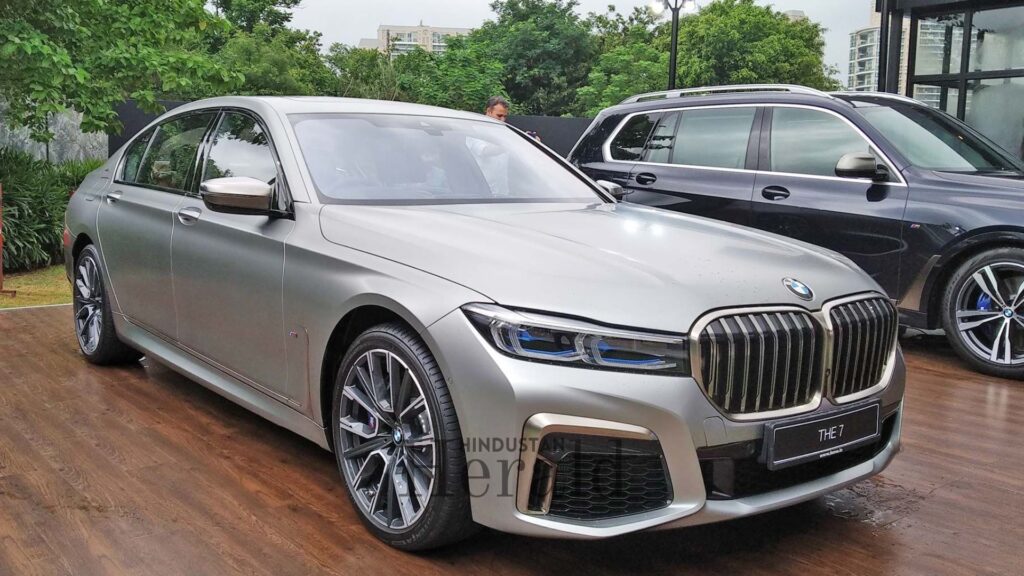
It is long over five metres of car and it carries that length with a strange elegance. The front has this split headlamp design where the daytime running lights sit in a separate housing above the main beam, which sounds complicated but in person reads as genuinely distinctive. At night, the kidney grille lights up. Not flashily. Just quietly, confidently, like a hotel lobby that does not need a neon sign to tell you it is expensive.
A few people will find this design too dramatic for a luxury limousine. That is a fair opinion. BMW knew it when they drew this car and made their peace with it. The rest most people who see it on the road tend to stop and look.
Getting In: The Moment Everything Changes
Okay, so you open the door and sit in the back. This is where the review really starts, because the 7 Series is at its core a car you are meant to be driven in, not necessarily drive yourself.
The first thing you notice is the quiet. Not just road noise reduction actual, physical quiet. Like someone has turned the volume of the world down three notches. Then you notice the leather, which is not the stretched, vaguely plasticky leather that passes for luxury in most cars. This is Merino leather, the kind that has a specific weight and texture to it that your hands register before your brain does.
Then you look up and see the screen.
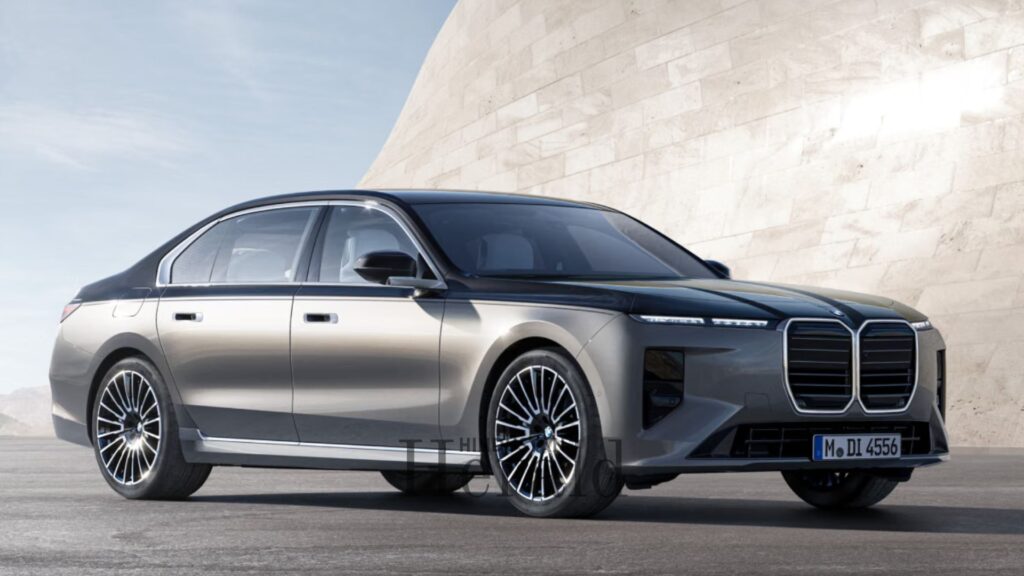
The optional 31.3-inch theatre display folds down from the roof. It is 8K resolution, it runs Amazon Fire TV, it has a 5G SIM built in for streaming, and it has an HDMI port if you want to plug in a laptop or a gaming console. The first time you watch something on it inside a moving car, there is a genuine moment of disbelief. Not because the technology is hard to understand, but because nothing in your experience of cars has prepared you for a screen that size inside a cabin that quiet, with that audio system playing underneath it.
The optional Bowers and Wilkins sound system has 35 speakers and nearly 2,000 watts. In a car. Thirty-five speakers. For context, most decent home theatre setups run on five or seven. This is not a car audio system anymore. It is genuinely something else.
Each rear door has its own small 5.5-inch touchscreen. You use it to adjust your seat, change the temperature, control the theatre screen, activate the massage function. Yes, massage function. Eight different programmes. On a highway, after an hour, with the right setting on, you begin to understand why certain people refuse to take flights for distances under four hours.
The Dashboard: Designed Like It Is From 2030
Up front, the driver gets what BMW calls the Curved Display one continuous glass surface that curves around to hold both the instrument cluster on the left and the main infotainment screen on the right. No bezel. No separate screens bolted awkwardly together. Just one elegant sweep of glass with information behind it.
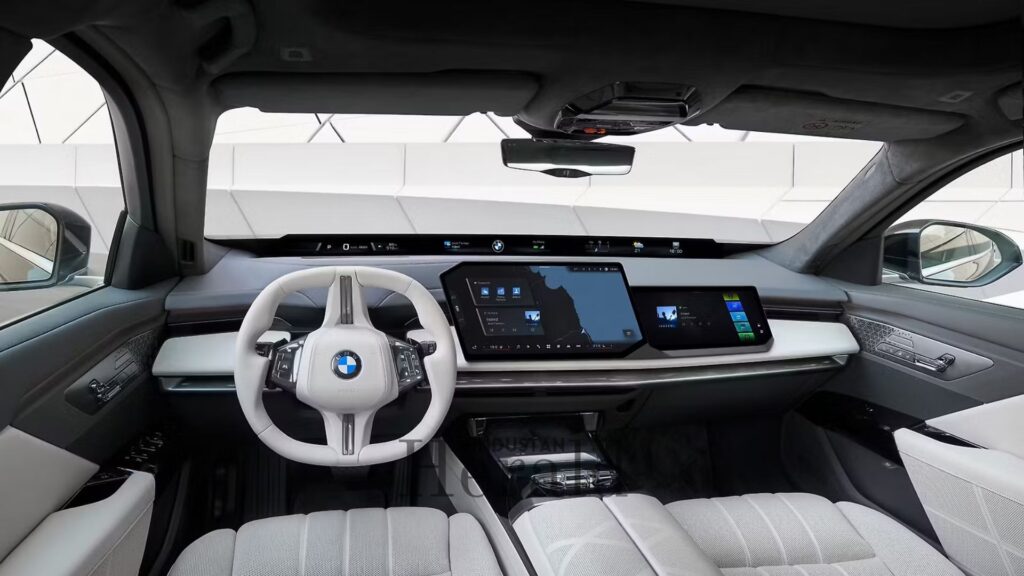
Running across the full width of the dashboard and into the doors is something called the Interaction Bar, a crystalline, backlit strip that is part ambient lighting, part control surface. At night, it glows in whatever colour you set, and the overall effect is less car interior and more somewhere you would actually want to spend time.
Physical buttons are mostly gone. Drive modes, suspension height adjustment, everything lives in the touchscreen or on a dial on the centre console. Takes a few days to get used to. After that, you stop thinking about it.
The voice recognition is good enough that you can just talk to the car in normal sentences, and it mostly understands what you want. That sounds like a small thing until you have used systems that require you to speak in specific commands, like you are filing a government form.
On the Road: Smooth Is Not a Strong Enough Word
Both Indian variants use a 3.0-litre six-cylinder engine, petrol in the 740i making 381 horsepower, diesel in the 740d, making 286 horsepower but 650 Nm of torque, which is the number that matters in daily driving. Both get a 48-volt mild hybrid system that adds a small electric motor to fill in any gaps in power delivery.
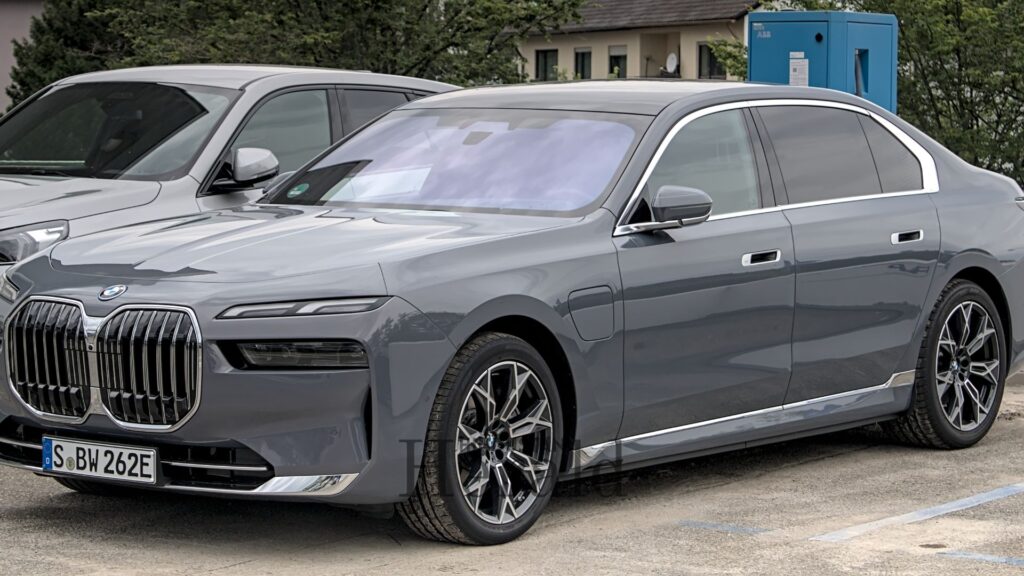
The petrol is quick. But the diesel is the one you want for India.
That 650 Nm torque figure means overtaking on a national highway is something that just happens. You think about it, your foot moves slightly, and the car is already past. No drama, no downshift noise, no waiting. The claimed fuel efficiency of 16.55 kmpl for the diesel is genuinely achievable on highways, which takes some of the sting out of the running costs.
Now, about those running costs, we should be straight with you. This car will cost you serious money to maintain. Tyres on 20-inch wheels are not cheap. BMW authorised service is not cheap. Insurance on a Rs 2 crore-plus vehicle is not cheap. The on-road price in Delhi is already around Rs 2.10 crore, and that is before you add any options from the considerable list BMW will happily show you.
The air suspension deserves its own paragraph because nothing else quite explains the ride quality until you feel it. Indian roads, real Indian roads, not a test track, have a particular character. Broken edges at toll booths, the sudden dip before a speed breaker, the rough patch between a repaired section and the original tarmac. The 7 Series processes all of it and delivers to the cabin something that feels almost dishonestly smooth. Not floaty. Not bouncy. Just settled, always, in a way that makes every other car feel like it is working harder than it should.
The optional rear steering system, where the back wheels turn slightly opposite to the front wheels at low speed, is worth every rupee if you are navigating Mumbai traffic or a tight Delhi basement parking. It genuinely makes a five-metre car feel like something considerably smaller.
Who Actually Buys This Car?
In India, the 7 Series buyer sits in one of two camps.
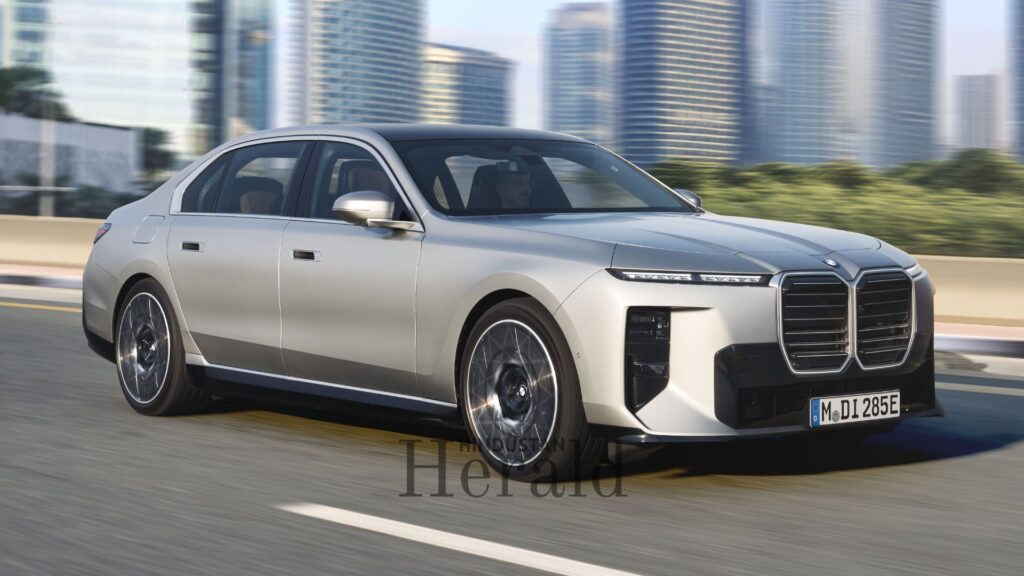
The first is the business owner or senior executive who is almost always in the back seat and rarely at the wheel. For this person, the theatre screen, the massage seats, the Bowers and Wilkins audio, and the executive lounge seating that reclines almost flat are the whole point. The car is an office. A moving decompression chamber. A signal, too, if we are being honest about how the world works.
The second is the car person with serious money who actually wants to drive. For this buyer, the 381 horsepower petrol, the air suspension, the M Sport bodykit, and the way the 7 Series handles corners for something its size, these are the talking points. This is not a sports car, but it is a very large car that handles better than it has any right to.
Both buyers are right about what they are getting. The 7 Series genuinely works in both roles, which is rarer than it sounds at this price point.
Worth buying in 2026, specifically?
One thing buyers should know: BMW is refreshing the 7 Series for 2027 with a mid-life facelift. A cleaner front design, updated headlights, and revised grilles. The updated car begins production in July 2026. So the 2026 model year is effectively the last of the original design before changes arrive.
If you prefer the current bold look, buy now. If you want to wait and see what the facelift brings, that is equally sensible. There is no wrong answer here, the car underneath will remain largely unchanged regardless.
The Simple Version, For Everyone Reading This
Is the BMW 7 Series worth Rs 2 crore plus?
If you have the money and this is genuinely the segment you are shopping in, yes. It is one of the most complete luxury cars currently sold in India. The technology is real, not just marketing. The ride quality is genuinely better than the competition on real Indian roads. The rear cabin, properly specced, has no equivalent at this price.
If the Mercedes S-Class is your other option, the choice comes down to this: the S-Class feels more traditionally prestigious, more heritage, more old-money boardroom. The 7 Series feels more forward-looking, more technology-led, more willing to show you something new. Both are excellent cars, and neither is a wrong choice.
But if someone asks you what the most interesting luxury sedan in India right now actually is?
It is this one. And it is not particularly close.
Stay ahead with Hindustan Herald — bringing you trusted news, sharp analysis, and stories that matter across Politics, Business, Technology, Sports, Entertainment, Lifestyle, and more.
Connect with us on Facebook, Instagram, X (Twitter), LinkedIn, YouTube, and join our Telegram community @hindustanherald for real-time updates.

Tech writer passionate about AI, startups, and the digital economy, blending industry insights with storytelling.
- Neeraj Kapoor

- Neeraj Kapoor
- Neeraj Kapoor
- Neeraj Kapoor




 Shelesh Joshi and Kavita Iyer