 By Neeraj Kapoor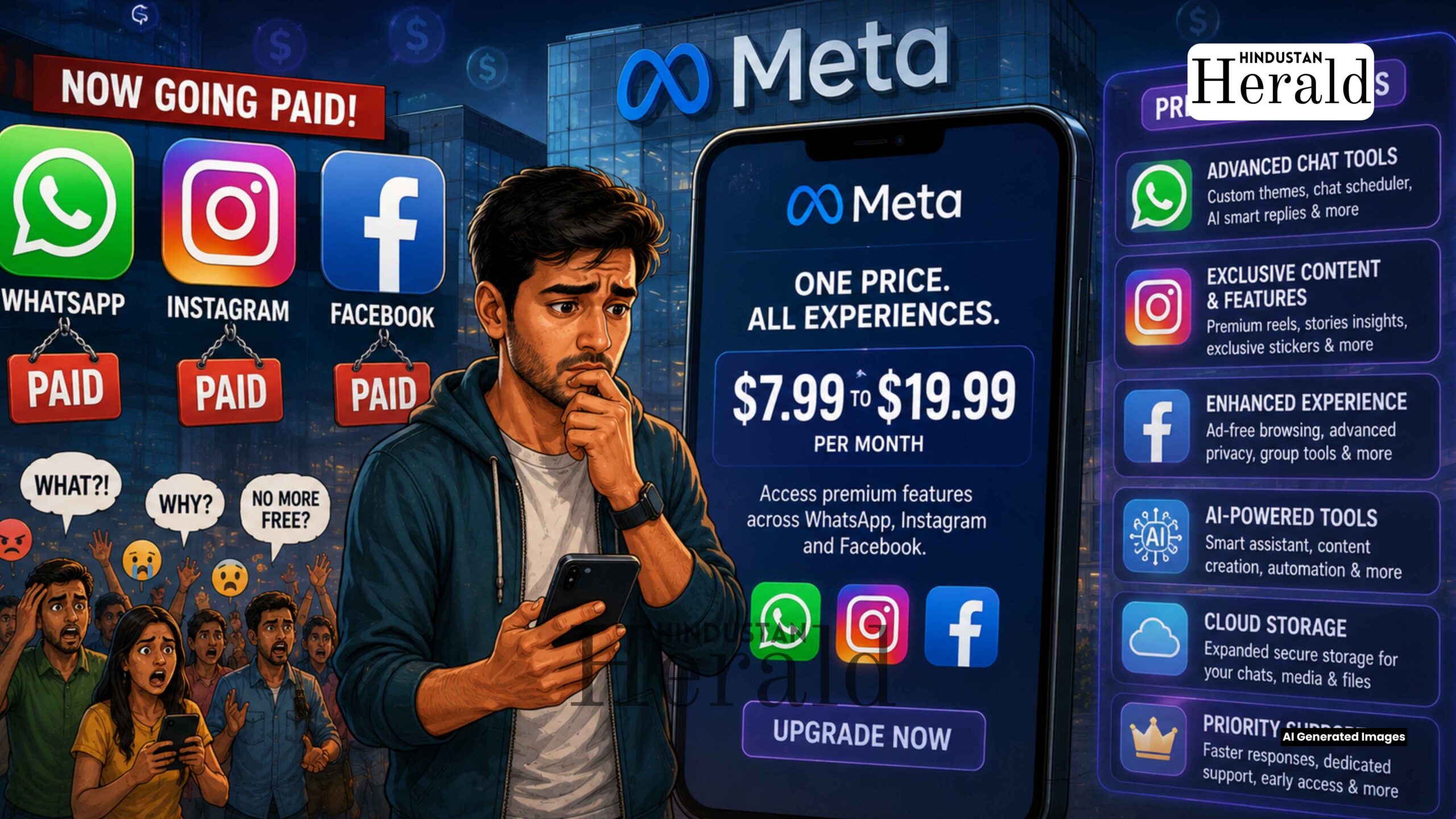
New Delhi, May 31: For years, the deal between Meta and its billions of users was simple enough to understand: you hand over your data, your attention, and your time, and in return, Instagram, Facebook, and WhatsApp cost you nothing. That bargain, which has underpinned one of the most profitable advertising empires in history, is now beginning to shift.
On May 27, 2026, Meta officially announced the global rollout of paid subscription plans for all three of its flagship apps, while simultaneously revealing plans to test premium artificial intelligence tiers under an entirely new brand called Meta One. It is the company’s most significant push yet toward subscription-based revenue, and it carries consequences that will ripple all the way from Silicon Valley to cities like Mumbai, Bengaluru, and Hyderabad, where hundreds of millions of users depend on these platforms every single day.
What Meta Has Actually Launched
The new plans are straightforward in design, even if their long-term implications are not. Instagram Plus and Facebook Plus are priced at $3.99 per month, while WhatsApp Plus is available at $2.99 per month. Each plan is tailored to the individual app rather than offered as a single unified bundle.
Instagram Plus subscribers gain access to a suite of new capabilities: the ability to see how many people have rewatched a Story in aggregate, unlimited audience lists for Stories beyond the standard “Close Friends” option, the ability to spotlight a Story once a week for additional views, extend a Story beyond its standard 24-hour window, and preview a Story anonymously without alerting the original poster.
WhatsApp Plus, by contrast, focuses on personalization and communication preferences, offering app themes, custom ringtones, additional pinned chats, list customization, and premium stickers.
Importantly, free access to Facebook, Instagram, and WhatsApp remains fully available. Users who choose not to subscribe will continue to experience the platforms as they currently exist, and Meta has not announced any limitations to the free tier linked to this subscription launch.
The new plans also do not replace Meta Verified, the company’s existing paid offering that provides verification, impersonation protection, and extra support. Meta says it is not winding down the older plans, though it acknowledged this could change over time.
The Bigger Play: Meta One and the AI Tier
The “Plus” plans are only the visible tip of what Meta is building. The more consequential announcement concerns Meta One, a new subscription ecosystem that the company is beginning to test across select markets.
Meta One introduces two AI-focused tiers priced at $7.99 and $19.99 per month, with the premium tier unlocking deeper reasoning capacity and greater image and video generation across Meta’s apps.
Meta One Plus at $7.99 and Meta One Premium at $19.99 are currently being tested in Singapore, Guatemala, and Bolivia. Creator and business plans priced at $14.99 and $49.99 are beginning tests in Saudi Arabia, Morocco, Thailand, and Bangladesh.
Meta’s Head of Product Naomi Gleit described the vision plainly in an Instagram post: “What if subscriptions could give you more from your apps? Instagram Plus, WhatsApp Plus, and Facebook Plus are rolling out globally, with more plans on the way for creators, businesses, and Meta AI power users. You may start seeing these come together under a new name: Meta One.”
The Advanced creator tier also includes tools aimed at driving traffic to external websites and online stores through enhanced linking integrations across Facebook and Instagram. For Indian creators and small business owners who have long relied on these platforms to drive sales, that kind of reach amplification tied to a paid tier is worth watching closely.
Why Meta Is Making This Move Now
The timing of this launch is not accidental. Meta faces intense investor scrutiny over its massive AI spending, with the company projecting capital expenditure, mainly for AI data centres, of between $125 billion and $145 billion for the year alone. That is an extraordinary number, and shareholders have been asking pointed questions about how it gets paid for.
According to Bloomberg, OpenAI and xAI are actively targeting Meta’s advertising base with their own AI-driven offerings, adding competitive pressure that has pushed Meta to broaden its monetisation model.
Kelly O’Grady, a Moneywatch correspondent and CBS Saturday Morning co-anchor, put it bluntly: “Meta is following the trend of many other companies, like X, like YouTube, and saying we’re spending tons of money on AI, we need other revenue streams and social media is becoming sort of tiered. It’s pay to play if you’re a heavy user.”
Markets responded positively to the announcement, with Meta’s stock rising nearly three percent on the news. Investors seem to agree that diversifying away from a purely ad-dependent model makes the company more resilient, even if the subscription revenues remain a fraction of ad income for now.
Still, this is not merely a financial story. It is a story about what kind of internet we are building, and who gets to use it fully.
What This Means for India’s 500 Million Meta Users
India presents a uniquely complicated picture for Meta’s subscription ambitions. WhatsApp alone has an estimated 500 million active users in the country. It is not just a messaging app here; it is the medium through which families stay in contact, through which small traders take orders, through which political campaigns run their ground operations, and through which millions of rural Indians access information for the first time. The same is true, in varying degrees, for Facebook and Instagram.
The pricing for Indian users is expected to be localized, though specific amounts in rupees have not been confirmed by the company as of late May 2026. That localization is critical. Even at a fraction of the dollar price point, a monthly subscription is a real expense in a country where average household incomes remain significantly below those of Meta’s Western markets.
The risk is a gradual stratification of access. If the most useful features, whether anonymous Story viewing, AI-powered tools, or boosted content reach, progressively migrate behind a paywall, the platforms could evolve into a two-speed experience. Casual users get the basic feed. Paying users get tools that help them grow, reach more people, and communicate more effectively. Over time, that gap compounds.
For Indian content creators and small businesses that built their audiences organically on free tools, the calculus changes considerably. A creator with a modest income who runs her fashion boutique out of an Instagram shop does not necessarily have $3.99 to spare on a subscription, especially once currency conversion and GST come into the picture. Business plans at $49.99 per month are even further out of reach for micro-entrepreneurs. If reach is increasingly tied to payment, the platform’s promise of a democratic megaphone begins to look shakier.
That said, Meta is not the first company to attempt this, and it will not be the last. YouTube has long offered a premium tier. X, formerly Twitter, has made verification and prominent features available only to paying subscribers. The freemium model has become the default architecture of the attention economy.
The AI Angle: Paying for Intelligence
Perhaps the most consequential part of Meta’s subscription push is the one that gets the least attention in the early coverage: the Meta One AI tiers.
What these tiers are selling, at their core, is access to more capable artificial intelligence integrated directly into apps that people already use every day. The Meta One Premium tier is designed for users requiring greater computing capacity for complex AI tasks, promising deeper reasoning and expanded image and video generation across Meta’s surfaces.
This puts Meta directly in competition with OpenAI’s ChatGPT Plus, Google Gemini Advanced, and emerging rivals, but with one significant tactical advantage: Meta already has the distribution. Billions of users are already inside Instagram, WhatsApp, and Facebook. Meta does not need to convince people to download a new app or visit a new website to try its AI. It only needs to convince them to pay a little more inside apps they are already on.
For India, where Meta AI has already been integrated into WhatsApp and has seen significant adoption, this is a meaningful development. If the AI tiers arrive with genuinely useful capabilities, whether that is drafting business pitches in local languages, generating product images for small sellers, or offering real-time research support, there is a real market here. But that market depends entirely on whether the pricing is calibrated for Indian purchasing power, and whether the features actually deliver value that free alternatives do not.
The Backlash and the Questions It Raises
Not everyone has greeted this announcement warmly. The announcement was met with significant backlash on social media, with commenters pushing back sharply against the idea of paid subscriptions. “What a bad and stupid decision,” one commenter wrote. “You want to turn Meta into X with their stupid subscriptions???”
The hostility is understandable. These platforms were built on the implicit promise of free access, and any perceived walkback of that promise triggers a sense of betrayal, even if the free tier nominally remains in place. The psychological shift from “free” to “you’re missing out without paying” is significant, even when no features are technically removed from the free version.

There is also a legitimate privacy question that several analysts have raised: subscribing to a Meta service means handing over payment information to a company that has faced repeated regulatory scrutiny over how it handles user data. For many users, the existing model, where they pay with their data rather than their money, felt at least somewhat abstract. Paying with a credit card is concrete, and it raises new concerns about what Meta does with financial data on top of behavioural data.
As it turns out, the most interesting test of this initiative will not come from early adopters in the United States or Western Europe. It will come from markets like India, Brazil, Indonesia, and Nigeria, where Meta has its largest user bases and where the economics of subscription pricing are most fraught. If Meta can crack the affordability question in those markets, its subscription play becomes genuinely transformative. If it prices them out, it risks creating a digital divide within its own ecosystem, a premium internet for the few sitting alongside a stripped-down version for the many.
For Now, Watch How This Unfolds
The global rollout of the “Plus” plans is live as of May 27. The Meta One AI tiers and professional plans remain in limited testing, with broader availability not yet announced. Meta itself has acknowledged that it is still experimenting with these AI and professional plans, and the wider rollout of Meta One subscriptions could differ from what is currently being tested.
What is clear is that the social media landscape is entering a new phase. The era of purely free, ad-supported social platforms is not ending, but it is being complicated. The platforms that shaped a generation’s understanding of the internet are now asking, for the first time at scale, whether you are willing to actually pay for more.
For most Indian users, the answer to that question will depend on something Meta cannot fully control: whether the features behind the paywall feel essential enough to justify the cost. That calculation, multiplied across half a billion users, will determine whether this gamble pays off.
Stay ahead with Hindustan Herald — bringing you trusted news, sharp analysis, and stories that matter across Politics, Business, Technology, Sports, Entertainment, Lifestyle, and more.
Connect with us on Facebook, Instagram, X (Twitter), LinkedIn, YouTube, and join our Telegram community @hindustanherald for real-time updates.

Tech writer passionate about AI, startups, and the digital economy, blending industry insights with storytelling.
- Neeraj Kapoor

- Neeraj Kapoor
- Neeraj Kapoor
- Neeraj Kapoor