
 By Ananya Sharma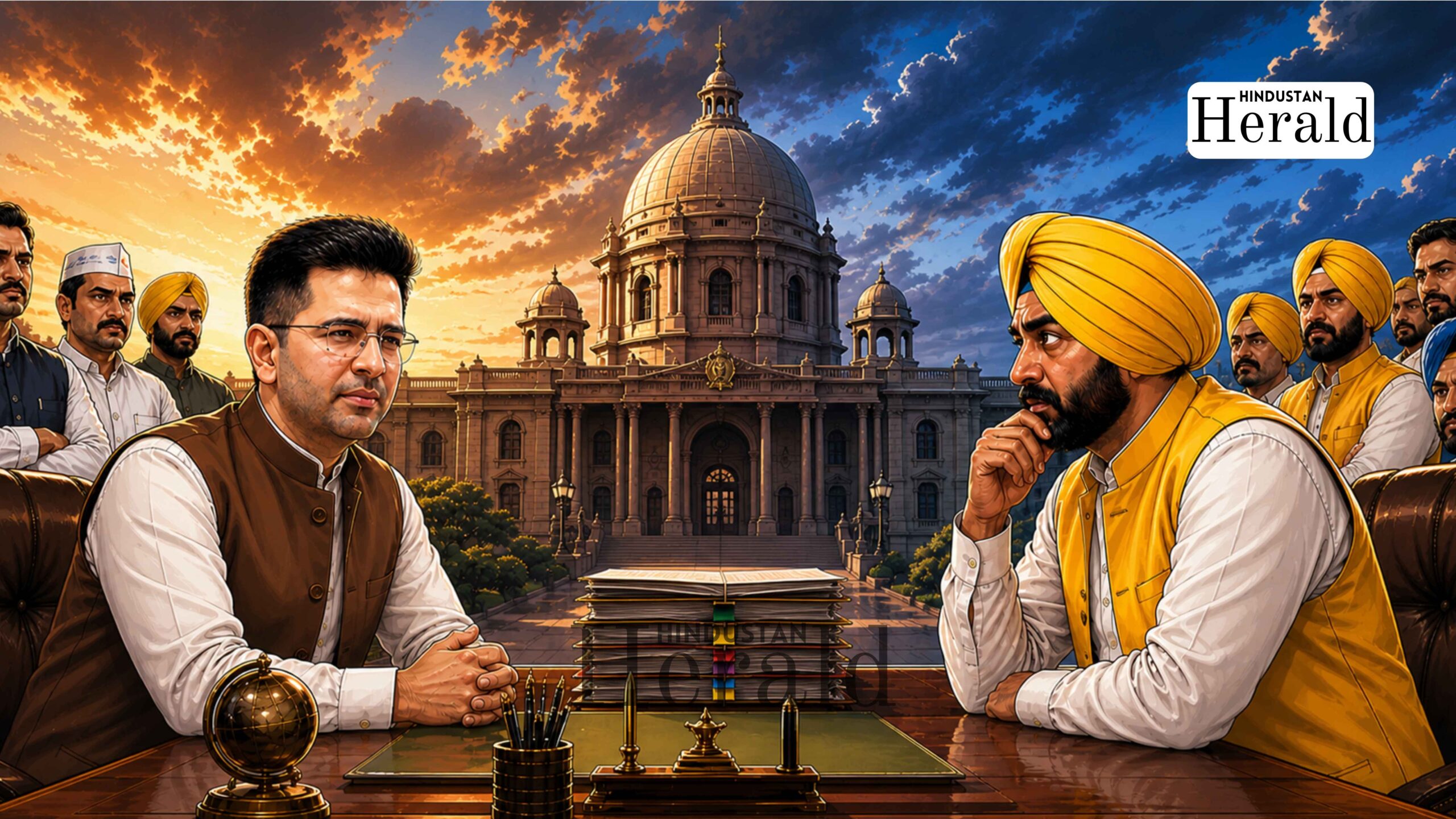
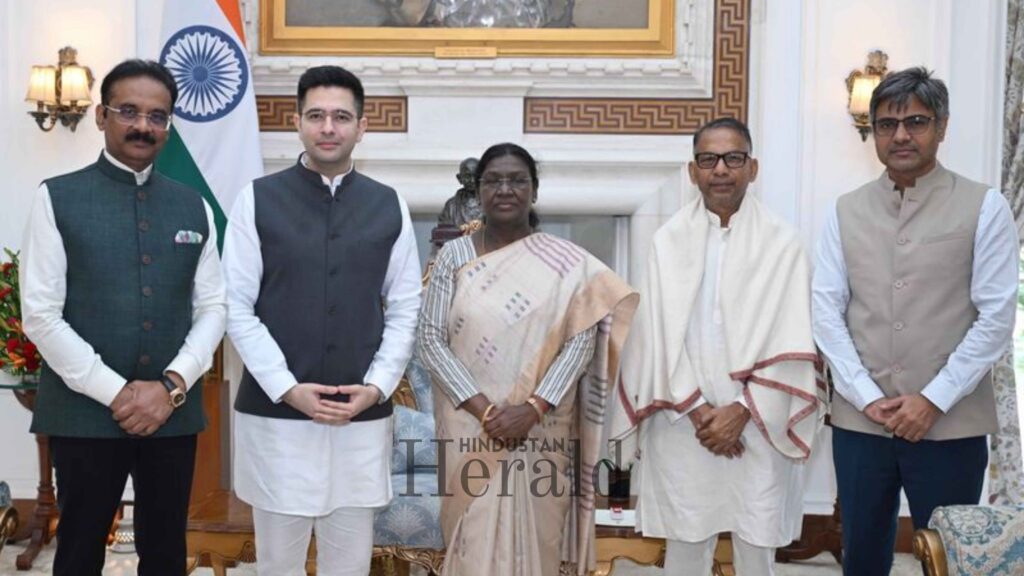
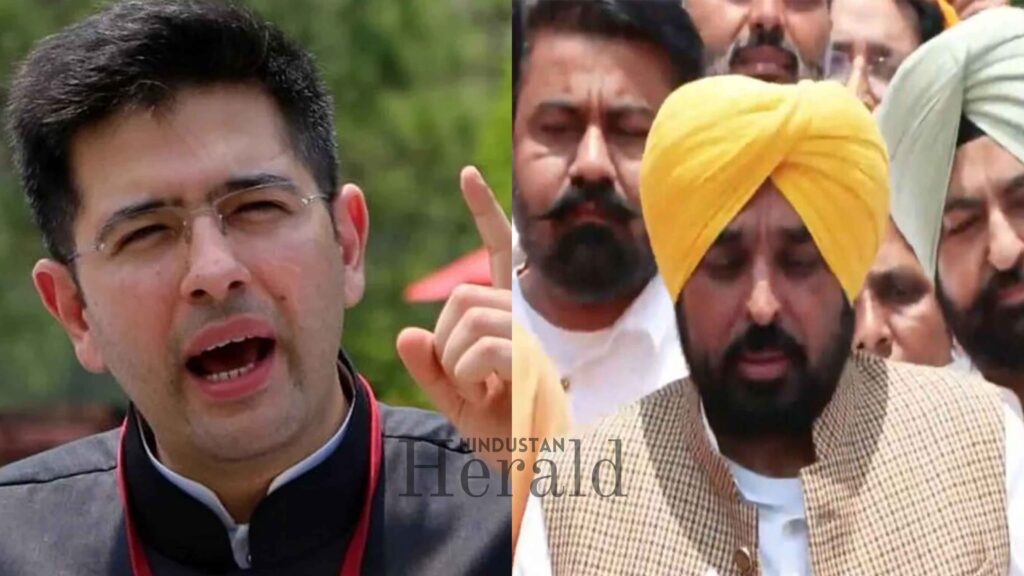
New Delhi, May 5: Raghav Chadha did not waste time once he stepped out of Rashtrapati Bhawan on Tuesday morning. The meeting with President Droupadi Murmu had barely ended, and he was already in front of the cameras, words sharp, tone deliberate. What he said, in essence, was this: the Aam Aadmi Party government in Punjab is running a vendetta operation against those who left the party, the state machinery is being misused, and the whole thing will collapse in a matter of months. “No one should be scared of their threats,” he said. The people behind this, he added, will all be riding the Shatabdi Express back to Delhi soon enough.
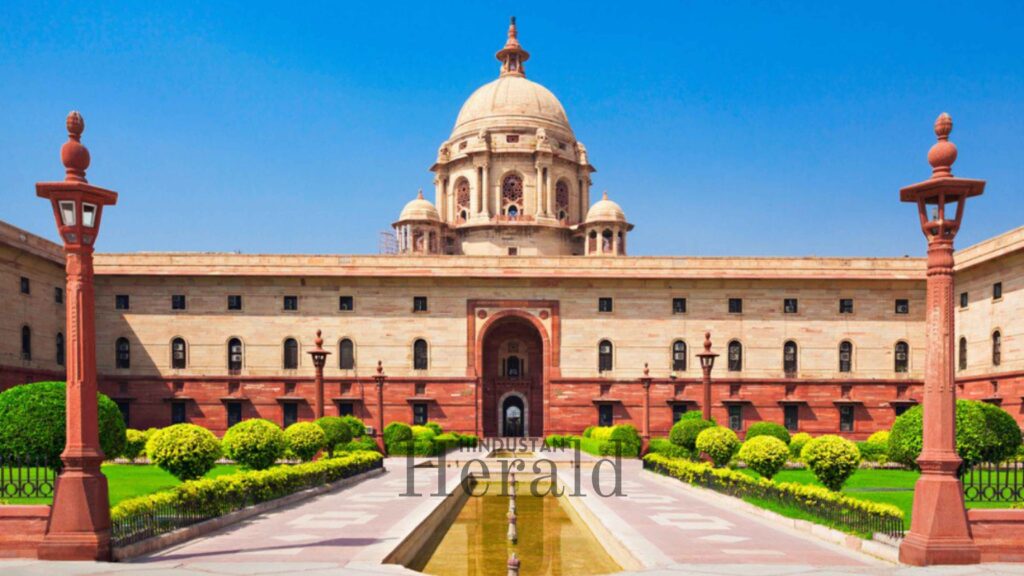
That kind of language lands differently when the man saying it had just walked out of the President’s house.
How Seven MPs Walked Out of AAP
The backstory matters here. On April 24, seven of AAP’s ten Rajya Sabha MPs announced they were done with the party. Raghav Chadha, Sandeep Pathak, Ashok Mittal, Harbhajan Singh, Rajendra Gupta, Vikramjit Sahney, and Swati Maliwal merged with the BJP in the upper house, citing what they called a steady drift from the party’s founding values. Chadha later spoke of a “toxic work environment” inside AAP. Maliwal had her own grievances, long in the making. The others pointed to what they described as a compromised leadership running the party from behind closed doors.
For a party that built itself on the idea of clean, principled politics, losing seven of ten Rajya Sabha MPs in a single afternoon was not a small thing. It was a fracture. AAP’s response made clear it saw the defection the same way, and it was not going to let it pass quietly.
What Raghav Chadha Alleges
Standing outside Rashtrapati Bhawan on Tuesday, Chadha laid out a series of incidents that, taken together, read like a pattern rather than a coincidence.
The word “Deshdrohi” was painted outside the home of Harbhajan Singh, the former India cricketer and now BJP MP, allegedly with help from the Punjab Police. Slogans were raised outside his house, targeting his family. Writing “traitor” on the wall of a man who won a World Cup for the country is the kind of image that sticks, and Chadha knew it.
Then there was Rajendra Gupta, a Padma Shri awardee whose factory in Punjab’s Malwa region reportedly employs around 30,000 people. According to Raghav Chadha, the Punjab government cut the factory’s water connection and sent the Pollution Board in to conduct raids aimed at forcing it to shut down. That is not a bureaucratic inconvenience. That is, livelihoods are being threatened to settle a political score, if the allegation holds.
The third case was Sandeep Pathak, who stood beside Chadha at the press conference. The Punjab government registered two FIRs against him, and word was reportedly spread through media channels that his arrest was imminent. Pathak said he was not scared of fake FIRs and that he would fight back legally. His voice was steady. Whether that steadiness was genuine or performed calmly, it came across clearly.
Raghav Chadha also went further, claiming the Punjab government had hired outside agencies, using public funds, specifically to threaten the seven former MPs on social media. That is not a throwaway allegation. If true, it would mean state resources were deployed for political harassment, which is a different category of problem altogether.
Why Go to Rashtrapati Bhawan
This is worth thinking about. Taking a complaint to the President of India is not the default move when a politician wants to make noise. It signals something specific: that you believe your constitutional rights are under attack, and you want the highest symbolic authority in the country to know about it. It is part legal manoeuvre, part theatre, but it is not nothing.
Raghav Chadha said the President assured him and the others that their protection was assured and that the Constitution would be upheld. Whether anything formal follows from that assurance is another question. But walking out of that building and saying “the President has assured us” is a powerful line to have in your pocket when you are dealing with a state government that has the police, the Vigilance Board, and the Pollution Board at its disposal.
Mann’s Counter
Here is the thing, though Bhagwant Mann was at Rashtrapati Bhawan the same morning. Just not at the same time.
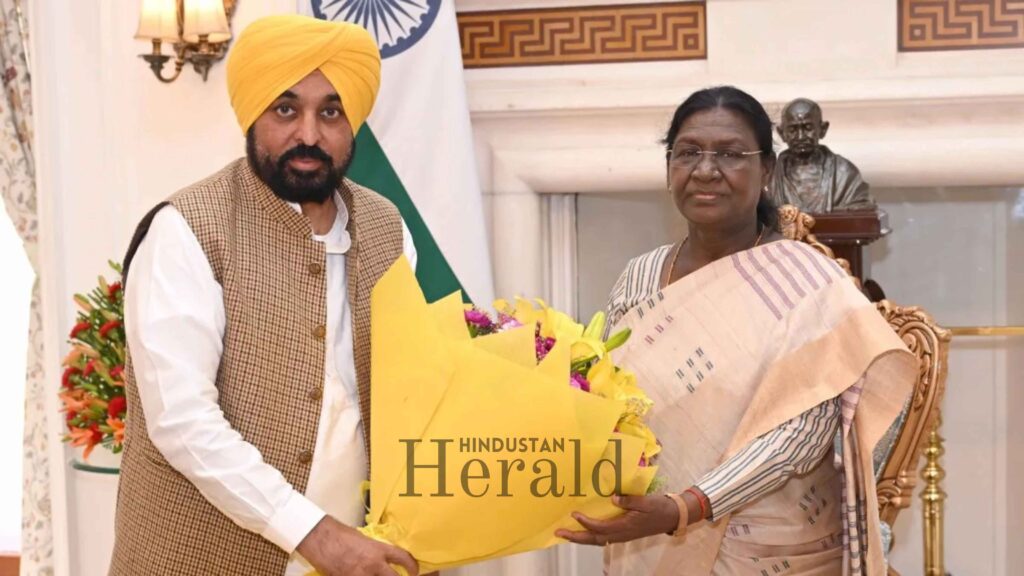
Raghav Chadha and his colleagues had the 10:40 AM slot. Punjab’s Chief Minister arrived at noon. The scheduling itself tells a story. Both sides had sought access to the same constitutional authority on the same day, with opposite versions of events. It was as close to a face-off as you can get without being in the same room.
Mann came carrying papers signed by all AAP’s Punjab MLAs, asking the President to cancel the membership of the six MPs who defected. His argument, put simply, is that these MPs were not elected by the public. They were chosen by AAP’s Punjab MLAs to represent the state in the Rajya Sabha, and those same MLAs now want them removed.
“There is a difference between selected and elected,” he said after his meeting. It is a politically smart line, one that frames the defectors as agents of the very assembly that gave them their seats, rather than as independent representatives with constitutional protections.
The Anti-Defection Tangle
This is where it gets legally interesting. The Tenth Schedule of the Constitution, the anti-defection law, says a merger is valid only when at least two-thirds of a party’s legislative group in the House decides to merge. AAP had ten Rajya Sabha MPs. Seven left, which mathematically clears the two-thirds bar. That is the defectors’ defence.
AAP disputes this. Their position appears to be that the six Punjab-sent MPs constitute a distinct entity from any national parliamentary group, and that the merger threshold should be calculated differently. It is a creative legal argument. Whether it survives scrutiny before the Rajya Sabha Chairman or in court is genuinely unclear.
For now, the matter sits in that uncomfortable zone between legal ambiguity and political warfare, which, in Indian politics, is where the most interesting battles tend to play out.
Reading the “Few Months” Remark
When Raghav Chadha told Punjab government officers to “beware” because the AAP government had “only a few months remaining,” he was sending a message that had less to do with electoral timelines and more to do with nerve. Punjab goes to the polls in February 2027. AAP holds 95 assembly seats. The Mann government is not under any immediate threat. Chadha knows this.
What the remark was really doing was putting bureaucrats and state functionaries on notice: implement politically motivated orders today, and you may find yourself answering for them under a different government tomorrow. It is an old tactic in Indian politics, but it works, especially in states where the civil service tends to hedge its bets as election season approaches.
On social media, Raghav Chadha framed it differently, accusing AAP of behaving less like a political party and more like an “obsessed, jilted ex,” adding that the party, which once screamed about vendetta, was now practising its worst version. That line was written for circulation, and it got it.
The Bigger Picture
What Tuesday really was, stripped of the drama, is the opening move in a long campaign for Punjab.
The BJP has never cracked the state. It has tried alliances, it has tried going alone, and it has consistently underperformed. Now it has, in its camp, a group of Punjab-connected faces with real profiles: a cricket icon, a Padma Shri industrialist, a former AAP insider who knows where the bodies are buried. Whether that translates into genuine electoral traction is a different matter, but the party now has material to work with.
AAP, for its part, is fighting a two-front battle. It has to hold its majority and narrative in Punjab while also managing the optics of what its critics are calling heavy-handed retaliation. Every raid, every FIR, every cut water connection adds a line to a story the BJP is very happy to keep writing. The party that built its identity on opposing abuse of power cannot easily shake off allegations that it has become precisely that.
The President has heard from both sides. The courts will likely have their say next. And somewhere in all of this, the people of Punjab are watching their representatives scramble between Chandigarh and Delhi, filing complaints, signing petitions, appearing on news channels, and doing everything except the governing they were sent to do.
That part, for now, seems to be on hold.
Stay ahead with Hindustan Herald — bringing you trusted news, sharp analysis, and stories that matter across Politics, Business, Technology, Sports, Entertainment, Lifestyle, and more.
Connect with us on Facebook, Instagram, X (Twitter), LinkedIn, YouTube, and join our Telegram community @hindustanherald for real-time updates.

Covers Indian politics, governance, and policy developments with over a decade of experience in political reporting.
- Ananya Sharma

- Ananya Sharma
- Ananya Sharma
- Ananya Sharma