
 By Shelesh Joshi and Kavita Iyer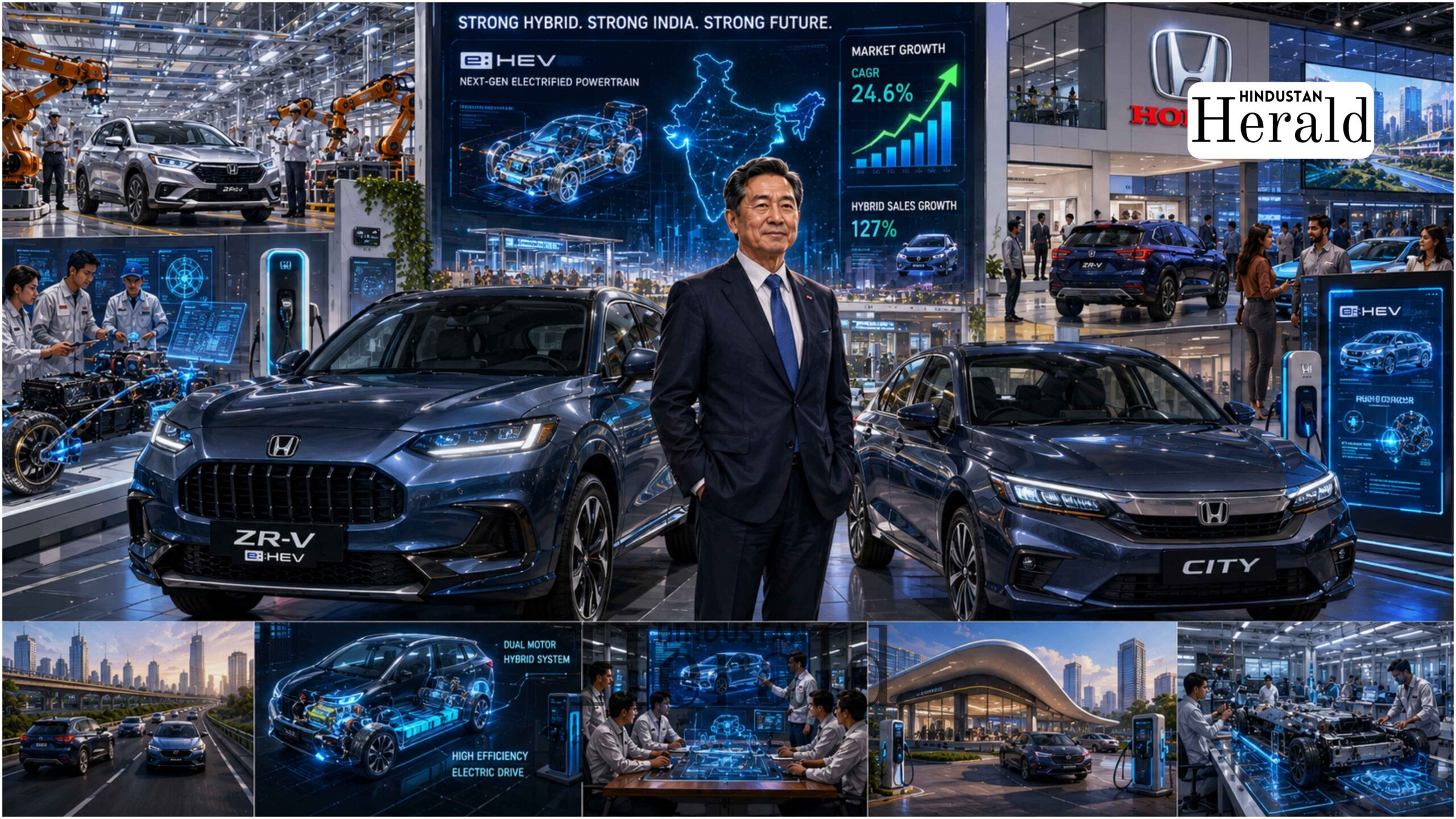
New Delhi, May 22: Honda Cars India had a busy Friday morning. The company launched the refreshed 2026 Honda City and pulled the covers off the ZR-V e:HEV hybrid SUV at the same event, making it two launches in a single day and setting the tone for what HCIL President and CEO Takashi Nakajima is calling a landmark year.
Four more launches are still to come before March 2026 closes. For a brand that has spent the better part of the last five years watching the Indian market sprint in a direction it was not fully prepared for, Friday felt like the moment Honda finally decided to stop watching and start running.
Two Cars, One Event, One Clear Message
The 2026 City starts at Rs 11.99 lakh and goes up to Rs 20.99 lakh for the top-end strong hybrid variant. On the outside, Honda has given it a reworked front end with a Blade Eye Signature LED setup, bi-LED projector headlamps, a connected light bar running through the grille, and split LED daytime running lamps with turn indicators.
The car has grown slightly too, now measuring 4,594 mm in length. That is 11 mm longer than before and the longest measurement in its segment, a detail Honda’s product team clearly did not arrive at by accident.
Step inside and you get ventilated front seats, a freshened cabin layout, and updated features throughout. The engine options, petrol and strong hybrid, carry over from the previous generation. Deliveries are already underway at Honda dealerships across the country. The ZR-V e:HEV is a different story altogether.
It is coming into India as a Completely Built Unit imported from Japan. It packs a 2.0-litre hybrid system delivering 184 PS and carries ADAS as standard equipment. Honda is backing it with a warranty structure that stands out by any measure in the Indian market: three years unlimited kilometres as the base, extendable to seven years, an Anytime Warranty programme that goes all the way up to 10 years or 1.2 lakh kilometres, hybrid battery cover for 8 years or 1.6 lakh kilometres, and hybrid system components covered for five years or one lakh kilometres. Buyers will have to wait a little longer for it though. Deliveries start July 2026.
The ZR-V is not an unfamiliar name globally. It has crossed 800,000 units in cumulative worldwide sales since its 2022 debut, which means Honda is not bringing an untested or unproven product to India. The engineering has been validated across markets. What Honda is now betting on is whether Indian buyers in the premium SUV space are ready for it. Given the direction the market has been moving, that bet looks reasonably sound.
Nakajima’s Words Are Worth Reading Carefully
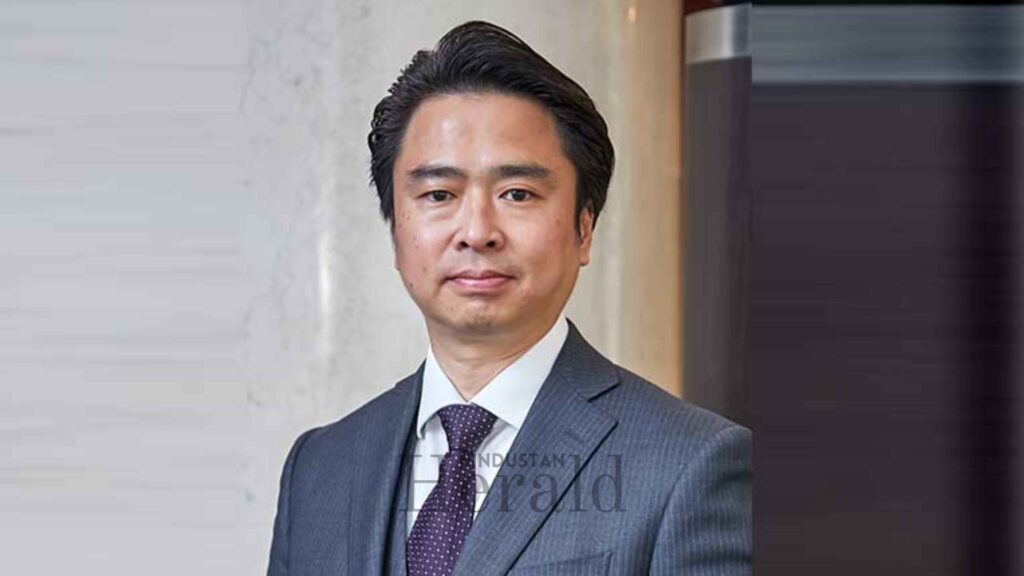
At the launch event, Nakajima did not stick to the usual script of carefully hedged corporate optimism that tends to characterise these announcements. He put India in the same sentence as North America and Japan as one of Honda’s three priority markets for future growth. He said the new City and ZR-V mark the beginning of a new phase of accelerated growth for HCIL in India. He committed, without qualification, to double-digit growth this fiscal year.
These are not throwaway lines from a press note drafted by a communications team. For a global automaker to publicly rank a market alongside its two most established territories says something real about where India sits in Honda’s global planning right now. It is the kind of statement that, once made in front of reporters, carries internal accountability alongside the external headline.
“India is among the top three focus markets to realise Honda’s future growth, which will be driven by a strong pipeline of new products and our efforts to achieve cost competitiveness,” Nakajima said at the event.
He also described FY26 as a landmark year with six strategic launches designed to sharpen Honda’s competitive edge and reinforce its brand position in the market. Coming from the head of the Indian subsidiary, with the parent company’s backing already confirmed, that reads as a commitment rather than aspiration.
Six This Year. Ten-Plus by 2030.
Friday’s two launches are the opening move in a six-launch fiscal year. The remaining four models have not been publicly named yet. But Nakajima gave away enough at the press conference to sketch out the direction with reasonable clarity. Honda is going after two segments specifically: sub-4 metre and midsize. It will approach both with a range of powertrains covering petrol, hybrid, and fully electric. HCIL officials explicitly ruled out the hatchback segment during the event. The sub-4 metre products will be compact SUVs, and that appears to be a firm call rather than a tentative one.
That focus makes strategic sense. Honda is not trying to spread itself thin across every body style and every price point simultaneously. It is picking the two fastest-growing segments in India and going after them with multiple products over the next few years. For a company that has historically struggled with portfolio breadth in India, the discipline in that approach is itself a change worth noting.
The longer view is even more ambitious. By 2030, Nakajima confirmed Honda plans to bring in over 10 new models to India, spanning electric vehicles, compact SUVs, and midsize products. When pressed for a more precise number at the event, he said the count is currently above ten and still being worked through. The fact that the number keeps growing, rather than being capped, says something about the scale of the internal commitment at the parent level.
Honda’s First Indian EV Lands This Year
Somewhere in the second half of FY2025-26, Honda will launch its first full battery electric vehicle in India. Nakajima confirmed this at Friday’s event. He did not give a specific month, but the second half of the fiscal year means the window runs from October 2025 through March 2026.
Honda has watched Tata Motors build what is now a credible and growing EV business in India while it stayed largely on the sidelines of that conversation. The Nexon EV and Punch EV have given Tata a story with urban buyers that goes well beyond fuel savings and touches on brand identity and technology aspiration. MG Motor found buyers for the ZS EV and later the Windsor in a market many assumed was not ready. Maruti Suzuki is now moving into the space with its own products.
Honda entering the EV segment this year is not early, but it is not too late either. The market is still forming its opinions about which EV brands it trusts, and Honda’s engineering reputation gives it a starting position that newer entrants would pay handsomely to have.
From 2028, the company will start bringing in models specifically developed for the Indian market in both the compact SUV and midsize categories. These will be genuinely India-specific products, designed and engineered with local use conditions, price sensitivities, and road realities in mind. Alongside them, Honda will continue importing select global products like the ZR-V for buyers who want something premium and fully differentiated.
It is a two-track approach. One track builds volume through locally relevant and competitively priced products. The other builds brand positioning through imported flagships carrying Honda’s best global technology. Both are necessary, and trying to do one without the other has been part of what limited Honda’s India story in recent years.
The Hybrid Push Is Not Accidental
Both products announced on Friday carry hybrid powertrains. That pattern will almost certainly continue through the rest of the six-launch calendar. Nakajima spoke at the event about building out Honda’s hybrid presence in India across strong hybrid systems, next-generation hybrid technology, and eventually full electric vehicles. He also pointed to India’s multi-technology policy direction as something Honda has actively factored into its planning.
That is a practical reading of where the Indian market actually is right now, as opposed to where the industry conversation sometimes suggests it should be. Strong hybrids make genuine sense for India in 2025. They deliver meaningful fuel savings, real-world efficiency that shows up in monthly running costs, and none of the range anxiety or charging dependency that keeps a significant chunk of potential EV buyers sitting on the fence.
A buyer in Nagpur or Jaipur or Bhubaneswar who is genuinely curious about electrification but not yet convinced about full EV ownership finds a strong hybrid a considerably easier decision. The fuel savings are real. The ownership experience is familiar. The compromise is minimal.
Honda has been building hybrid systems globally for close to three decades. The technology in the ZR-V’s e:HEV system is not a first-generation experiment. It is a mature, refined powertrain that has earned its reputation across hundreds of thousands of units in other markets. If Honda can bring comparable technology to competitive price points as it develops India-specific products from 2028, it has a genuine and defensible story to tell that most of its rivals simply cannot replicate on the same terms.
This Is Bigger Than Just the India Subsidiary
Honda Motor in Tokyo made a move last week that provides important context for everything that happened in India on Friday. The parent company announced that it would begin developing models tailored specifically for the Indian market from 2028 and that it plans to use its massive two-wheeler customer base in India as an active pipeline for upgrading buyers into passenger vehicles. Sit with that for a moment.
Honda Motorcycle and Scooter India is one of the two largest two-wheeler manufacturers in the country. It has tens of millions of customers spread across every state, every city size, every income bracket. Many of those customers are in smaller towns and cities where Honda passenger cars currently have almost no meaningful presence.
If Honda can build products at the right price points and use its two-wheeler dealer relationships as an extended distribution network, even a modest conversion rate from that buyer base would produce passenger vehicle volumes that the current HCIL business has never seen.
No other passenger vehicle manufacturer in India has that specific lever available to pull. Bajaj does not sell cars. Hero MotoCorp does not sell cars. TVS does not sell cars. Honda is uniquely positioned to cross-sell across two of the most trusted vehicle segments in the country under a single brand name, and the parent company is clearly aware of that advantage and now actively planning around it.
Honda has also positioned India alongside North America and Japan as priority markets for its future global growth strategy. That designation comes with resource allocation. Engineering budgets, localisation investment, management bandwidth, and manufacturing planning all follow priority market status in ways that eventually show up in product quality, pricing competitiveness, and how quickly new models arrive after their global debuts.
What Honda Actually Needs to Prove
The honest conversation about Honda India is this: the brand has terrific goodwill and historically modest market share. People who own Hondas tend to stay with Honda. The City commands one of the most loyal buyer followings in the Indian passenger vehicle segment. Resale values hold up. Service satisfaction scores are consistently high. The brand perception among existing owners is genuinely strong.
But that loyal base has not been growing fast enough, because Honda has not been in enough segments to attract buyers who were not already predisposed toward the brand. The compact SUV space, which now accounts for the single largest slice of Indian passenger vehicle volumes, has largely happened without Honda in it. Six launches changes that equation, at least on paper.
The City facelift secures and refreshes the existing base. The ZR-V opens a door to premium SUV buyers who currently consider Jeep Compass, Volkswagen Taigun, or Skoda Kushaq and might find a Honda with 184 PS, ADAS, and a decade-long warranty worth a serious look.
The compact SUV that is presumably coming later in the fiscal year, if priced within the Rs 10 to 15 lakh bracket and equipped to the standard that segment demands today, could be the single product that actually grows Honda’s total buyer pool in a number that shows up meaningfully in market share data. But let us be clear about what Honda is walking into.
The compact SUV segment in India is genuinely brutal. The Maruti Suzuki Brezza, Tata Nexon, Hyundai Venue, Kia Sonet, and Mahindra XUV 3XO are not going anywhere. These products have years of service network depth, word-of-mouth momentum, first-mover advantage in their respective positioning niches, and dealership relationships built over multiple model cycles.
Honda will need to show up with something that does not simply match those cars on a specification sheet but gives buyers a clear and compelling reason to choose it over a product they already know. That could be the hybrid technology story. It could be the warranty structure. It could be the brand trust that comes with the Honda badge on a product at that price point.
What it cannot be is a car that arrives and immediately gets lost in the noise of a crowded segment without a distinct identity. That is the real test of FY26. Not the launch events, not the press coverage, not the announcement of six launches at the start of the year. The test is what happens in showrooms three months after each launch, when the initial excitement fades and buyers are comparing notes with colleagues and neighbours. Honda has the products, the technology, the brand equity, and now the parent company’s stated commitment to make this work. The next twelve months will show whether that combination is enough.
Stay ahead with Hindustan Herald — bringing you trusted news, sharp analysis, and stories that matter across Politics, Business, Technology, Sports, Entertainment, Lifestyle, and more.
Connect with us on Facebook, Instagram, X (Twitter), LinkedIn, YouTube, and join our Telegram community @hindustanherald for real-time updates.

Tracking world politics, global markets, trade movements, policy decisions, and the changing balance of economic power.
- Shelesh Joshi

- Shelesh Joshi
- Shelesh Joshi
- Shelesh Joshi





Former financial consultant turned journalist, reporting on markets, industry trends, and economic policy.
- Kavita Iyer
- Kavita Iyer
- Kavita Iyer
- Kavita Iyer