 By Shelesh Joshi and Kavita Iyer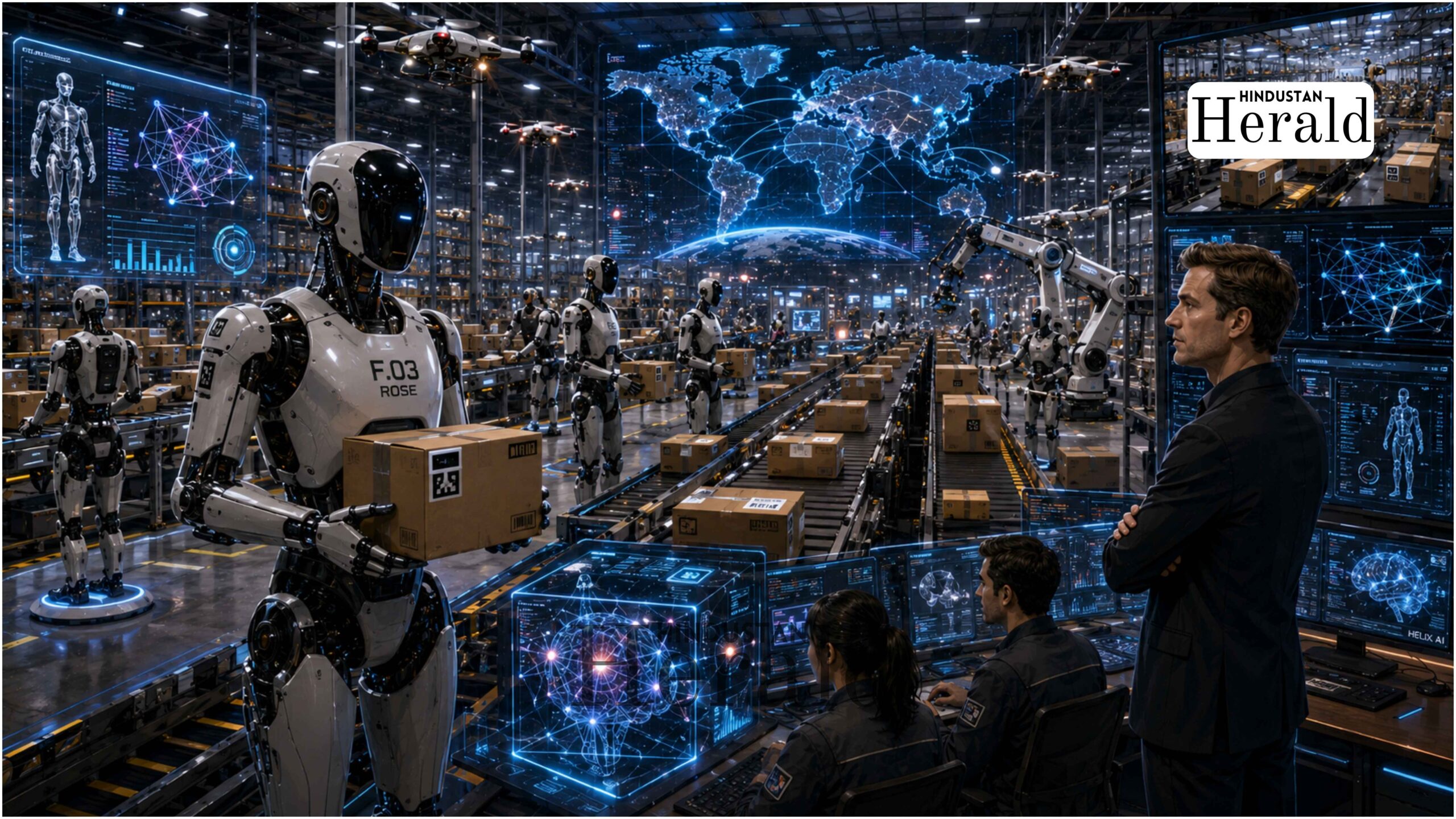
San Francisco / New Delhi, May 23: In a development drawing close attention from investors, logistics operators, and industrial automation strategists worldwide, Figure AI has confirmed that its third generation humanoid robot, designated F.03 and nicknamed Rose, completed a continuous autonomous run of 200 hours on a live warehouse conveyor sorting line. Over that period, the Figure AI fleet processed 249,560 packages without a single hardware failure, and without any human stepping in to correct or assist the machines.
What began as a response to an 8 hour industry challenge ended as a nine day public endurance test that turned Figure AI’s warehouse robotics programme into appointment viewing for millions globally, livestreamed without cuts from start to finish.
How a Simple Challenge Became a Historic Run
The trigger was a dare. Industrial automation veteran Dr. Scott Walter challenged the humanoid robotics industry to prove its machines could survive a standard shift at human speeds, without intervention. Figure AI CEO Brett Adcock accepted publicly. Before the livestream began, Adcock posted on X: “High odds something breaks.” The Figure AI team’s last public run had lasted a single hour. The stated target was eight.

At the 24 hour mark, zero failures had occurred. The Figure AI team decided to keep going. By 72 hours, the fleet had processed 88,000 packages. Adcock posted: “Our original goal was an 8 hour run. After zero failures yesterday, we decided to keep going. This is a new frontier.”
Nine days later, he posted again: “It’s been 9 days of F.03 running 24/7, fully autonomous, with no downtime. I’m going to let the team get to 200 hours and shut this puppy down.” At the close, the final Figure AI tally stood at 249,560 packages sorted, 200 hours elapsed, zero hardware failures recorded.
As reported by Humanoids Daily, Adcock confirmed on X: “We just wrapped what began as an 8 hour challenge and it ran for 200 hours without a failure. Shoutout to the team for the hardcore engineering behind F.03 and the robust Helix models powering it.”
What the Robots Were Actually Doing
The task itself was not engineered to look impressive. It was designed to stress test the Figure AI machines under real world conditions. The Figure AI F.03 fleet inspected barcodes on a continuous mix of cardboard boxes and soft padded envelopes arriving on a live conveyor line. Each robot read the barcode, picked up the package, and placed it face down on the outgoing belt.
No two packages were identical in shape, weight, or arrival angle. No human operator stood by to correct errors. According to Figure AI, the robots operated entirely on Helix 02, the company’s in house neural network. There was no teleoperation of any kind. Every action came directly from the onboard Figure AI system. When a robot encountered an unusual situation or got briefly stuck, the system triggered an autonomous reset and resumed work without human input.
The Figure AI fleet also managed its own energy independently. When a unit’s roughly five hour battery ran low, it autonomously walked to a wireless charging dock built into its feet, while another robot seamlessly took its place on the line.
As reported by Interesting Engineering, Adcock noted that the Figure AI machines had reached human parity on sorting speed. “Humans average around 3 seconds per package. F.03 is now around human parity. The robots are reasoning directly from camera pixels,“ he said.
That pace translates to roughly 1,245 packages per hour, a throughput figure that logistics operators will find operationally meaningful when benchmarked against typical human sorting rates in large scale fulfilment environments.
The Technology Stack: Helix 02 and the F.03 Platform
The performance of Rose cannot be understood without examining the technology running beneath the surface of the Figure AI platform. As reported by TechTimes, Figure AI’s Helix was developed entirely in house and unveiled in February 2025, weeks after the company severed its collaboration agreement with OpenAI. Adcock said Figure AI had achieved a breakthrough on fully end to end robot AI built entirely in house, making the external partnership unnecessary.
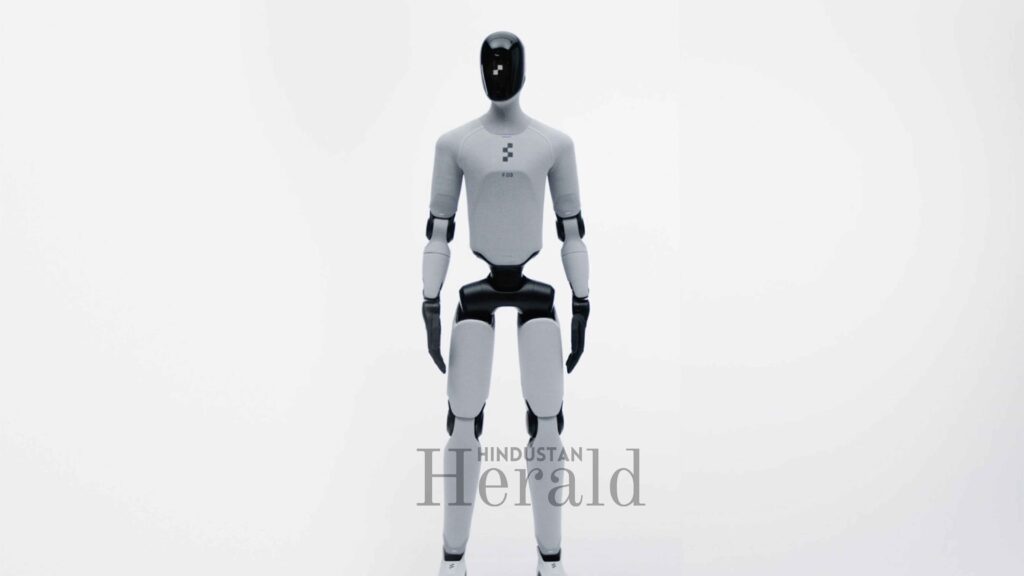
According to TechTimes, the Figure AI F.03 hardware itself was unveiled in October 2025. Each fingertip carries a tactile sensor capable of detecting forces as small as three grams of pressure, fine enough to distinguish a secure grip from an incipient slip. The vision system delivers twice the frame rate, one quarter the latency, and a 60 percent wider field of view per camera compared with the previous generation. As per Technology.org, the Figure AI whole body controller was trained on over 1,000 hours of human motion data, plus simulation time spread across more than 200,000 parallel environments, a training investment that shows in the system’s ability to handle package to package variation across nine consecutive days.
The Figure AI robot also includes 10 Gbps millimetre wave data offload, allowing the fleet to continuously upload terabytes of operational data for ongoing model improvement during live deployment. In plain terms, the Figure AI system learns from every shift it works.
Company Background and a Remarkable Funding Trajectory
Figure AI was founded in 2022 by Brett Adcock, previously known for founding Vettery, acquired by Adecco, and Archer Aviation, taken public via SPAC in 2021. The company is headquartered in Sunnyvale, California. Its funding trajectory is exceptional even by recent Silicon Valley standards. According to Sacra’s company profile, Figure AI raised a $70 million Series A in May 2023. In February 2024, it closed a $675 million Series B at a $2.6 billion valuation, backed by Microsoft, OpenAI, NVIDIA, Intel Capital, Bezos Expeditions, and Samsung NEXT.
In September 2025, Figure AI closed a Series C exceeding $1 billion, led by Parkway Venture Capital, with Brookfield Asset Management, NVIDIA, Intel Capital, and the OpenAI Startup Fund among participants. The post money valuation reached $39 billion, representing a 15x increase from the Series B in just 18 months.
As per Tech Market Briefs, total capital raised by Figure AI stands at approximately $1.9 billion across all rounds. The valuation curve tells its own story: $500 million in May 2023, $2.6 billion in February 2024, $39 billion in September 2025. That is a 78 fold step up in 28 months, against a still developing commercial revenue base. In a statement accompanying the Series C close, as published by PR Newswire, Adcock said: “This milestone is critical to unlocking the next stage of growth for humanoid robots, scaling out our AI platform Helix and BotQ manufacturing.“
BotQ: The Manufacturing Facility That Makes the Commercial Case Real
The endurance run answers the performance question. The commercial question is different: can Figure AI manufacture robots at a volume and cost that makes deployment rational for ordinary operators, not just flagship pilots? According to Figure AI’s official announcement, BotQ, the company’s vertically integrated manufacturing facility, was unveiled in March 2025 with initial capacity to produce up to 12,000 humanoid robots per year. Manufacturing was brought entirely in house to control quality, production speed, and hardware iteration cycles.
A key cost reduction came from switching away from CNC machining to tooled processes including injection moulding, die casting, and stamping. Parts that previously spent over a week on a CNC machine can now be produced in under 20 seconds with complex steel moulds. The upfront tooling investment is recovered quickly at the volumes Figure AI is now targeting.
As reported by Tech Market Briefs, the Figure AI production ramp has been steep. BotQ output went from a few units per month in late 2025, to roughly 60 units in February 2026, to 240 units in April 2026. Adcock has since posted that the facility now produces one robot every 90 minutes.
According to The Robot Report, Figure AI targets shipment of 100,000 humanoid robots over the next four years, and plans to progressively use its own robots to help manufacture additional units, a bootstrapping strategy that could scale output without proportional capital expenditure.
Commercial Deployments: BMW and the Logistics Sector
The 200 hour livestream is not Figure AI’s first real world industrial deployment. It is the most public and most sustained one. According to Thomas Net’s industry overview, Figure AI deployed its Figure 02 robots at the BMW Group Plant Spartanburg in South Carolina in 2025, supporting production of more than 30,000 BMW X3 vehicles. The robots worked 10 hour shifts Monday to Friday and helped load more than 90,000 sheet metal parts across an 11 month engagement.
As per a BMW Group press release cited by industry sources, the Figure AI robot handled the precise removal and positioning of sheet metal parts for the welding process, a task described as particularly demanding in terms of speed and accuracy while also being physically exhausting for human workers.
BMW and Figure AI are now evaluating where F.03 might fit into expanded operations, though no formal announcement has been made. Beyond BMW, Figure AI has also begun logistics deployments with at least one major unnamed customer, widely believed to operate in the fulfilment sector.
The Competitive Field
Figure AI is operating inside an increasingly crowded and well capitalised sector. As reported by industry sources, Tesla is targeting production of 10,000 Optimus humanoid robots, though CEO Elon Musk has acknowledged the timeline is aspirational. Agility Robotics, backed by Amazon, opened what it called the first dedicated humanoid manufacturing plant in the United States in Salem, Oregon in late 2024, with a target of 10,000 units per year.
1X Technologies, backed by OpenAI, is advancing bipedal and wheeled platforms for service environments. Boston Dynamics continues to operate its Spot platform extensively in industrial monitoring roles, with its Atlas humanoid undergoing further development. Still, no competitor has published a verified, publicly livestreamed autonomous run of comparable duration on a live industrial line. The 200 hour mark achieved by Figure AI, combined with the zero hardware failure outcome, currently stands without a direct public comparator in the humanoid category.
According to TSG Invest, Goldman Sachs projects the humanoid robotics sector will reach $38 billion by 2035, a market that barely existed in commercial terms five years ago. The global packaging robotics market alone is projected to hit $35.1 billion by 2033, growing at a compound annual rate of 11.1%, per analysis from Future Data Stats.
Implications for Indian Industry and Investors
For Indian investors, logistics operators, and industrial policy observers, the Figure AI milestone is not peripheral. India’s warehousing and fulfilment sector is in a period of accelerated capital investment, driven by e commerce growth under platforms including Flipkart, Meesho, and Reliance Retail, by manufacturing near shoring linked to the Production Linked Incentive scheme, and by cold chain expansion requirements.
The appeal of Figure AI’s humanoid platform in this context is structural. Unlike fixed arm industrial robots, they do not require permanent installation infrastructure. They can theoretically be redeployed across tasks and facilities as operational requirements shift, which changes the capex calculus for operators managing multi site, multi function warehouse networks.
As reported by AI2.work, the Figure AI livestream drew over 10 million views globally and temporarily boosted Chinese robotics stocks by 5% in sympathy trading, an unusual cross market spillover that underscores how closely the global investment community is now tracking Figure AI’s autonomous robotics performance data. For Indian technology and engineering companies involved in robotics components, sensor systems, and AI inference infrastructure, the commercial ramp at Figure AI signals where international procurement and partnership opportunities are likely to concentrate as these platforms move toward mass deployment.
What Comes Next
The 200 hour milestone does not resolve the Figure AI commercial pathway entirely. Several open questions remain. What is the per unit cost of a Figure AI F.03 at scale production? What is the total cost of ownership, including maintenance, software licensing, and operator training, for a mid sized logistics company? How do the unit economics compare to the all in cost of human labour in target deployment markets over a three to five year horizon?
As per Tech Market Briefs, Figure AI’s own projections forecast more than 200,000 robots deployed across factories and commercial environments by 2029, generating $9 billion in revenue. The company currently has no disclosed revenue, and the gap between current BotQ output and that forecast remains significant.
As it turns out, the trajectory on the production ramp, the calibre of the Figure AI investor syndicate, and now the sustained performance data from the 200 hour run suggest that the gap between ambition and execution is closing faster than most industrial observers had anticipated.
For now, Figure AI’s Rose has done what the industry said could not yet be done: run a live warehouse line for nine consecutive days, handle a quarter million packages, and exit without a single recorded failure. In the language of industrial automation, that is not a demonstration. That is the opening of a commercial argument.
Stay ahead with Hindustan Herald — bringing you trusted news, sharp analysis, and stories that matter across Politics, Business, Technology, Sports, Entertainment, Lifestyle, and more.
Connect with us on Facebook, Instagram, X (Twitter), LinkedIn, YouTube, and join our Telegram community @hindustanherald for real-time updates.

Tracking world politics, global markets, trade movements, policy decisions, and the changing balance of economic power.
- Shelesh Joshi

- Shelesh Joshi
- Shelesh Joshi
- Shelesh Joshi





Former financial consultant turned journalist, reporting on markets, industry trends, and economic policy.
- Kavita Iyer
- Kavita Iyer
- Kavita Iyer
- Kavita Iyer