
 By Sandeep Verma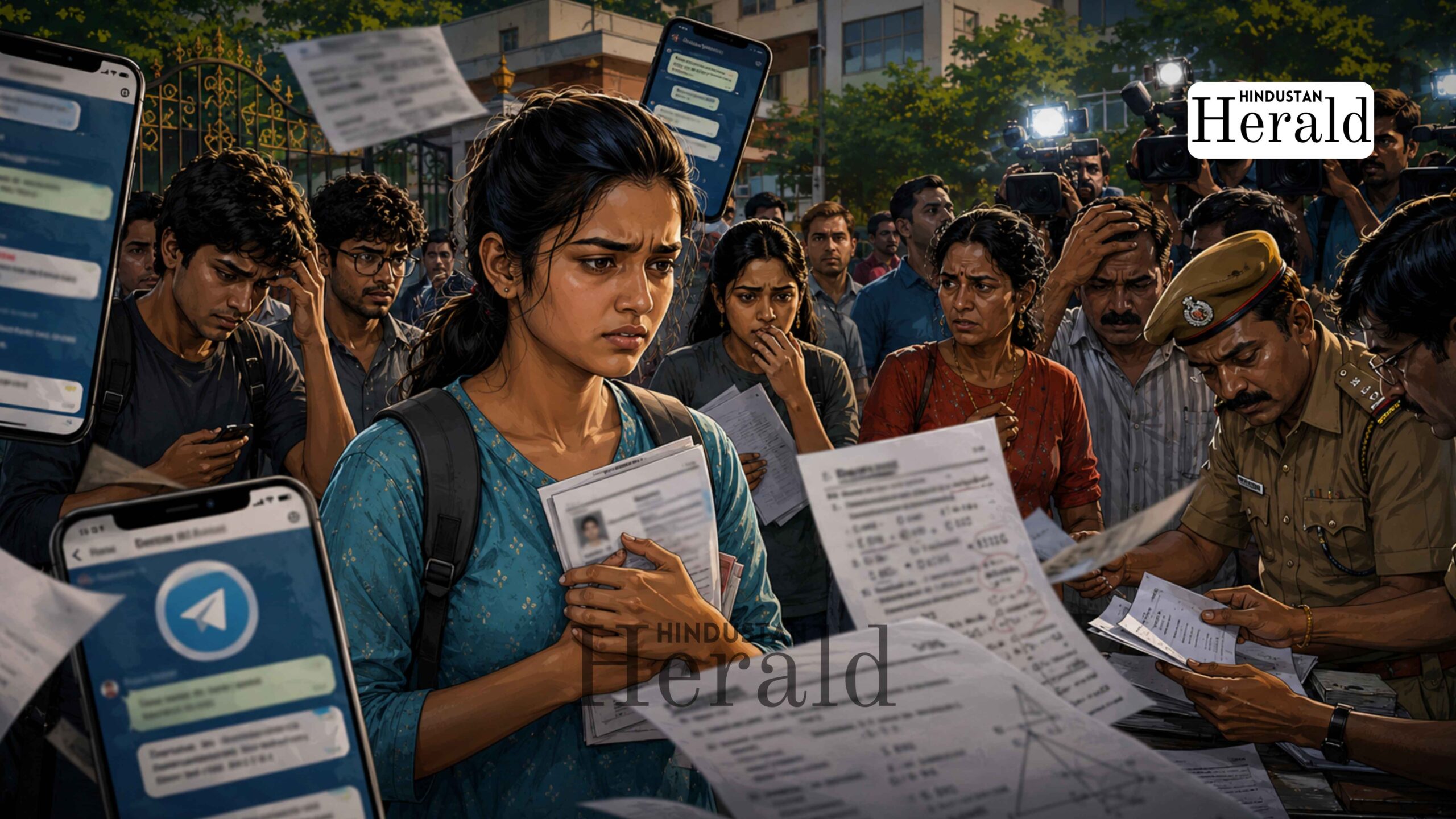
New Delhi, May 12: It started, as so many of these things do, with a video.
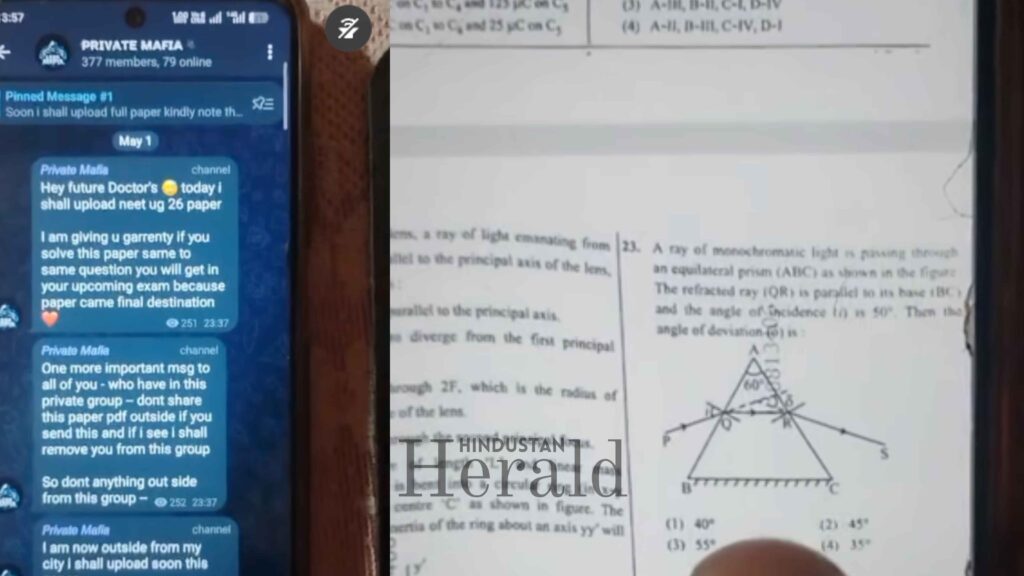
An Instagram user going by @soha.star07 posted a clip sometime after NEET-UG 2026 concluded on May 3, and within hours it had done what viral content in India always does: jumped platforms, multiplied in WhatsApp forwards, landed in every anxious parent’s phone. The video was eventually deleted. It did not matter. Screenshots were already everywhere, the damage already done, and 22-plus lakh students who had just sat through India’s most consequential medical entrance exam were left to wonder if the paper they had spent years preparing for had been circulating in a Telegram group days before they even walked into the exam hall.
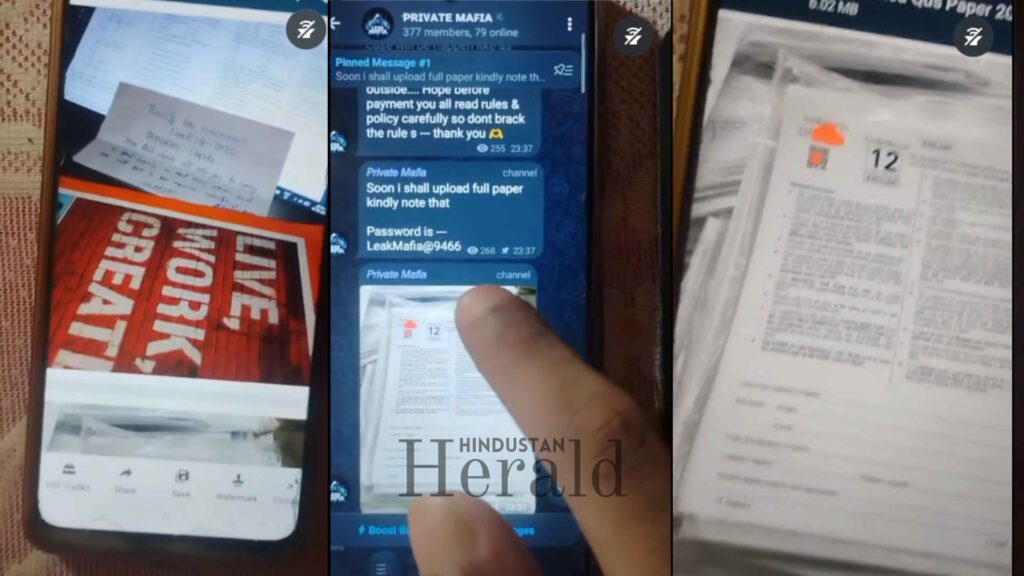
The clip reportedly showed screenshots of Telegram chats dated as early as May 1, with users allegedly claiming to be selling the NEET-UG 2026 question paper, alongside what appeared to be password-protected files purportedly containing the exam content.
The National Testing Agency responded the way it usually does, which is to say, defensively. The agency called the content fake, announced an investigation, and warned that if someone had fabricated the video, legal action would follow, adding that it had details of where every question paper was issued using watermark IDs. Whether that reassurance landed with anxious students is a different matter entirely.
The Part That Cannot Be Explained Away
Here is where the story stops being about one viral video and becomes something considerably more serious.
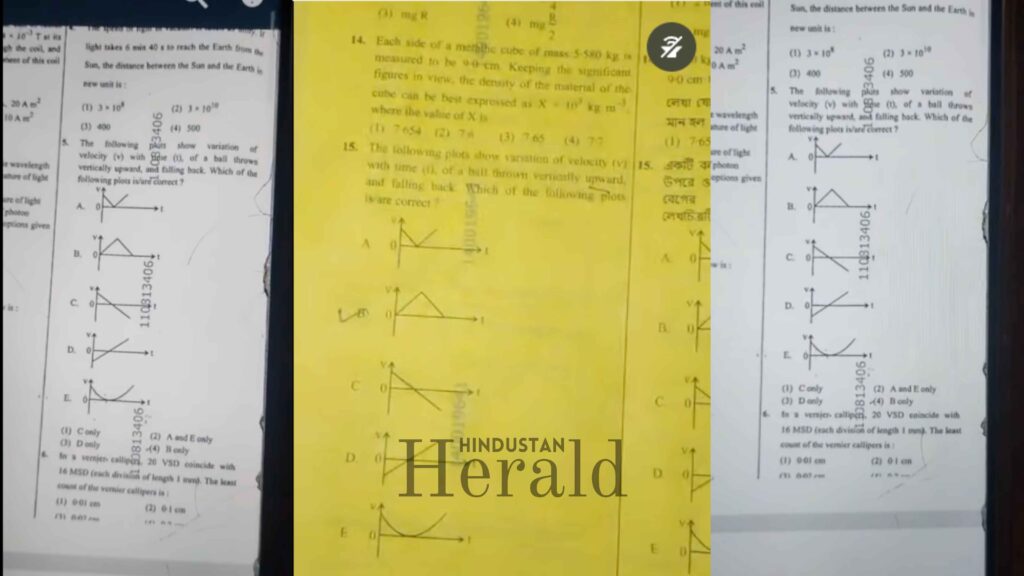
Days after the exam, investigators from the Rajasthan Police Special Operations Group discovered that a handwritten “guess paper” circulating among students in Sikar before the exam bore an uncanny resemblance to the actual NEET paper. Not a passing resemblance. Not a few overlapping topics from a popular coaching institute’s revision sheet. The handwritten document reportedly contained 140 questions matching the actual exam paper, covering approximately 600 out of 720 marks, and crucially, the sequence of answer options in several questions was allegedly identical to the final examination.
That last detail is the one that keeps investigators up at night. Questions can sometimes align if a coaching institute is skilled enough, has studied years of pattern data, and makes educated guesses about high-yield topics. That happens. It is not common but it happens. The answer option sequence, though, that is not something you predict. That is something you copy.
Experts have noted that while coaching institutes often predict trends, matching questions worth 600 marks is statistically extraordinary, and even the best prediction models typically align with only a small portion of the paper.
How the Paper Allegedly Travelled
The SOG has been working backwards through the chain of transmission, and what they have found so far reads less like a spontaneous leak and more like a structured racket with known players and clear geography.
The trail reportedly leads to an MBBS student from Churu currently enrolled at a medical college in Kerala, who allegedly sent the handwritten document to an associate in Sikar on May 1, two days before the exam. From there it apparently moved fast. A Paying Guest owner in Sikar received the material and distributed it to students staying at the facility, after which it spread further into coaching-linked networks through career counsellors.
The pricing tells its own story. Two days before the exam, the “guess paper” was allegedly changing hands for as much as Rs 5 lakh. By the night before the test, the price had reportedly fallen to around Rs 30,000. That kind of price movement is not random. It suggests either that copies were multiplying and the scarcity premium was collapsing, or that sellers were liquidating stock before the window shut. In either case, it points to people operating with market logic, not panic.
The SOG has detained 13 suspects across Dehradun, Sikar, and Jhunjhunu, and a career counsellor linked to a coaching institute in Sikar has also been arrested.
The NTA Had Been Watching, Sort Of
What makes all of this harder to absorb is that the NTA had not been asleep before the exam. Far from it.
In the weeks before May 3, the agency identified and took action against over 120 Telegram and Instagram channels that were spreading claims about a paper leak, reporting them to the Indian Cyber Crime Coordination Centre under the Ministry of Home Affairs. That number breaks down to 106 Telegram channels and 16 Instagram channels, including handles making what the agency called “suspicious claims.”
One hundred and twenty channels. Flagged and reported. And still, if the SOG probe is to be believed, material reached students in a paying guest facility in Sikar forty-two hours before the exam.
Students who had been raising alarms for weeks pointed out that sellers had reportedly shifted to WhatsApp distribution specifically because the platform is harder to monitor and block than Telegram. That is a fairly logical adaptation from people who have been running this game long enough to understand the surveillance environment. The NTA was watching Telegram. The material moved through WhatsApp. Problem solved, from the seller’s side at least.
What the NTA Built After 2024, and Why It Apparently Was Not Enough
After the NEET-UG 2024 disaster, which ended in arrests across Bihar, a Supreme Court hearing, and a country-wide reckoning about examination integrity, the NTA came into 2026 with a dramatically upgraded security architecture.
This year’s exam featured multi-stage biometric verification, AI-assisted CCTV surveillance, GPS tracking of question papers during transit, 5G signal jammers at exam centres, and a central monitoring system running in parallel. On paper, genuinely impressive. And from what is known, the physical security chain held. Question papers were not intercepted in transit. No exam centre was directly compromised in an obvious way.
The problem, if investigators are right, is that the breach happened earlier and further upstream, possibly within the question bank itself, long before any GPS tracker was activated or any biometric scanner switched on. The NTA confirmed on May 10 that it received inputs about the alleged malpractice on May 7, four days after the exam, and that it had passed the information immediately to central agencies for investigation.
Four days after. That detail alone speaks to how these things work. The exam happens, the results are pending, and only then does the full picture begin to emerge. By that point, whoever benefited has already benefited.
Twenty-Two Lakh Students Waiting for an Answer
For most of the young people who appeared on May 3, none of this reads as abstract policy failure. It reads as a question about whether their result means anything. Whether the rank they are assigned reflects what they know, or where they stood in a race that some participants had already seen the finish line for.
Social media has been full of questions about whether the exam will be cancelled, whether there will be a re-test, and whether merit will be affected, with the NTA trying to reassure candidates that the efforts of genuine aspirants will not be devalued. That reassurance is cold comfort when the investigation is still open and nobody can confirm yet whether the exam’s integrity held or did not.
Investigators are currently trying to establish whether the material was simply an unusually accurate question bank or evidence of an actual breach of the NEET paper before the examination. The distinction matters enormously because it determines what happens next: whether a result stands, whether admissions proceed, whether a few lakh families start another year of preparation or finally get to move forward.
A Crisis That Keeps Returning
It is worth saying plainly that this is not a new problem wearing new clothes. NEET has been mired in integrity controversies for years. The NEET-UG 2024 examination saw around 13 people, including four examinees and family members, arrested in Bihar, with investigators revealing that brokers had charged between Rs 30 lakh and Rs 50 lakh from each aspirant in exchange for the question paper ahead of the exam.
Two years later, with a rebuilt security system and an agency publicly committed to never allowing 2024 to repeat itself, the country finds itself in a strikingly similar conversation. Different state, different suspects, different platform. Same essential story.
Education Minister Dharmendra Pradhan had flagged Telegram specifically after the 2024 scandal, with legal experts noting that the platform’s lack of an India office made accountability structurally difficult. That observation was accurate. It was also not quite enough, because as this year has shown, the pipeline simply moves to platforms and methods that are harder to surveil.
The examination covers 551 cities in India and 14 cities abroad, running across more than 5,400 centres, touching the futures of millions of families who have invested years of savings and sacrifice in a single three-hour window. When that window is even suspected of being compromised, the anger is not just about one exam. It is about whether the system is fundamentally rigged against those who play by the rules.
The Rajasthan SOG is still working the case. The NTA is still saying wait for the findings. And somewhere in that gap, lakhs of students are waiting for someone to tell them that what they earned is actually theirs.
Stay ahead with Hindustan Herald — bringing you trusted news, sharp analysis, and stories that matter across Politics, Business, Technology, Sports, Entertainment, Lifestyle, and more.
Connect with us on Facebook, Instagram, X (Twitter), LinkedIn, YouTube, and join our Telegram community @hindustanherald for real-time updates.

Regional journalist bringing grassroots perspectives and stories from towns and cities across India.
- Sandeep Verma

- Sandeep Verma
- Sandeep Verma
- Sandeep Verma




 Ananya Sharma