
 By Ananya Sharma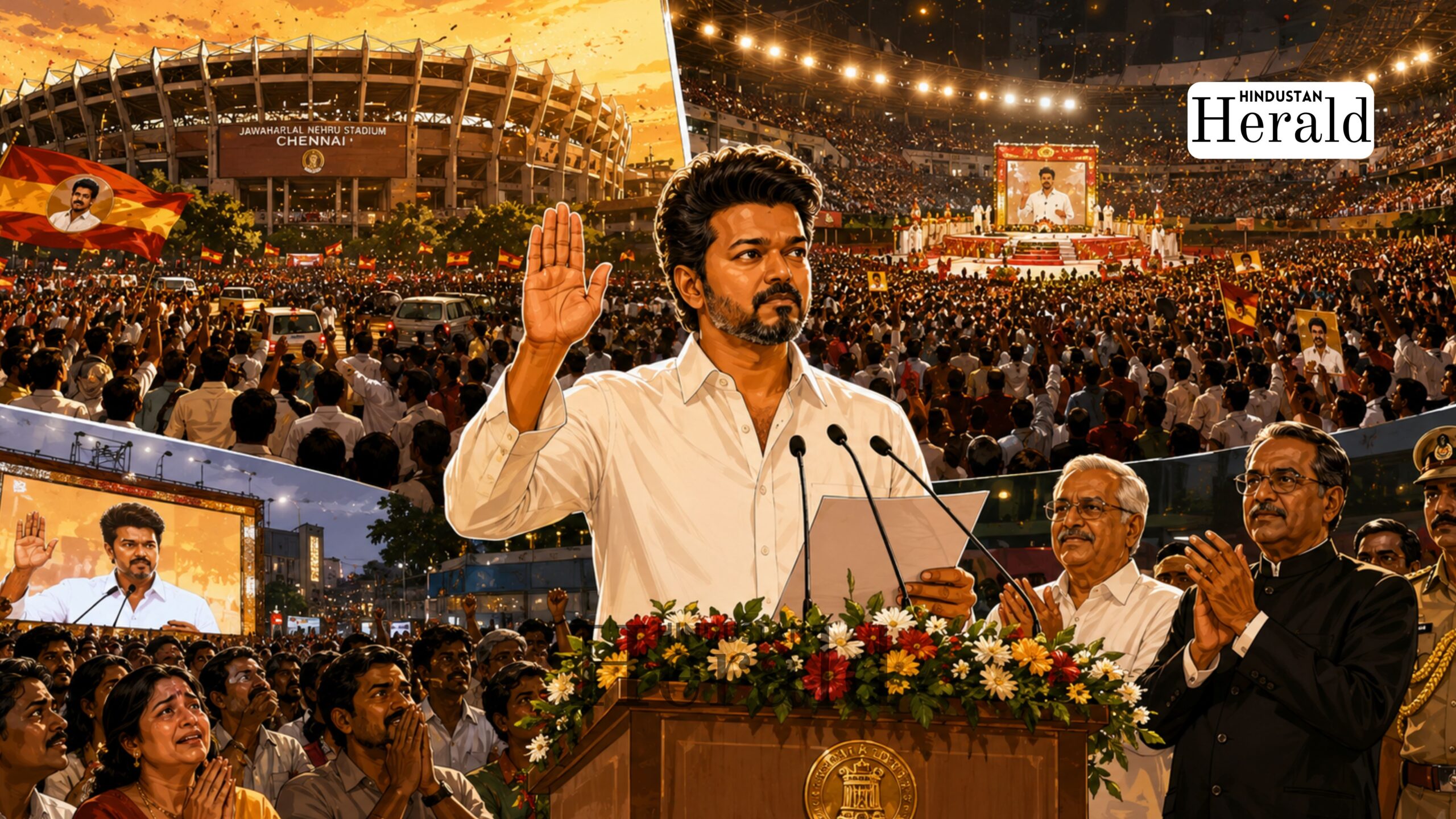
Chennai, May 10: When Vijay the man Tamil Nadu simply calls Thalapath walked into Jawaharlal Nehru Stadium on Sunday morning to be sworn in as Chief Minister, millions of people across the state were watching screens, standing in streets, and doing something that feels increasingly rare in Indian politics: genuinely feeling something. Not the manufactured enthusiasm of a party rally. Something closer to disbelief mixed with pride, the kind that takes a moment to settle.
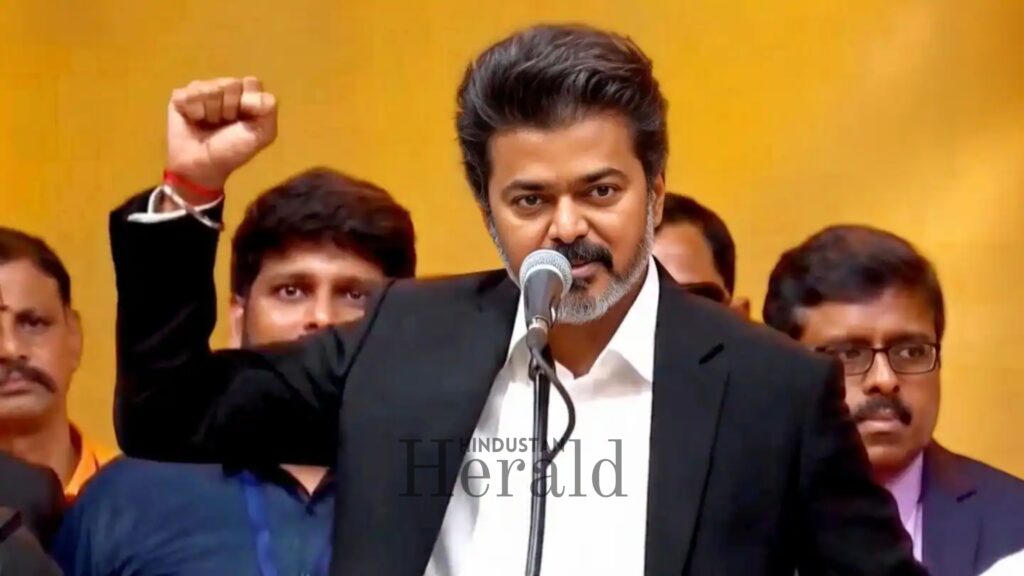
C. Joseph Vijay is now the ninth Chief Minister of Tamil Nadu. He is also the first leader in nearly six decades to hold that office without the DMK or the AIADMK behind him. The last time Tamil Nadu had a Chief Minister from outside those two formations was 1967 the year the original Dravidian wave swept C. N. Annadurai into power and effectively redrew the state’s political map for generations. What Vijay has done, in his very first election, is crack that map open again.
Four Meetings With the Governor and a Week Nobody Will Forget
Getting to Sunday morning was not clean or straightforward. Tamilaga Vettri Kazhagam (TVK), the party Vijay launched in 2024 after announcing he was done with films, won 108 seats in the 234-member Tamil Nadu Legislative Assembly. Impressive by any measure for a debut outing. But 108 is not 118, and 118 is the number that matters the majority mark in a house of this size.
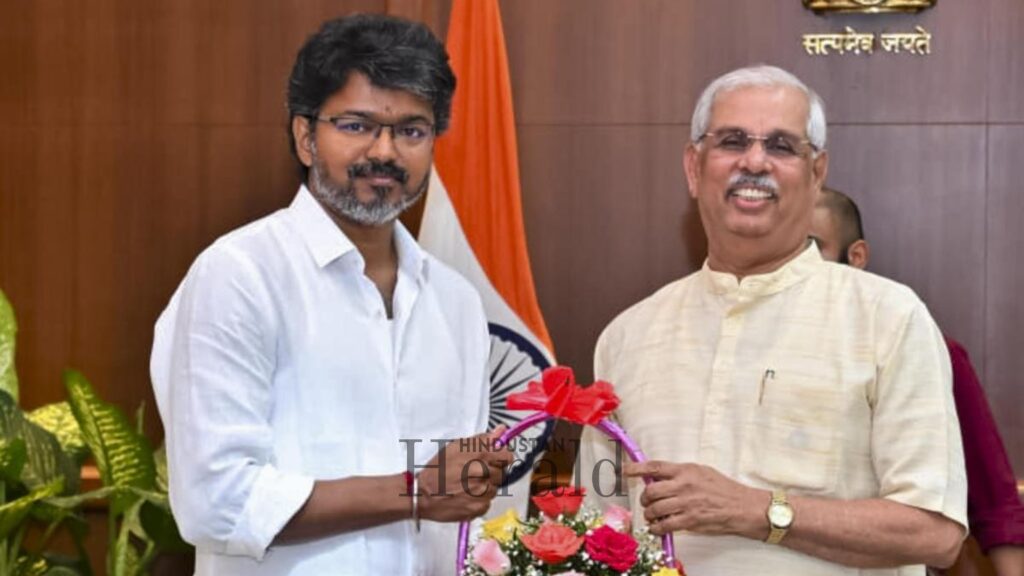
What followed was one of those weeks in Indian politics that reminds you how strange and exhausting the business of forming governments actually is. Vijay met Governor Rajendra Vishwanath Arlekar four times. He submitted letters, waited, submitted more letters. The Governor, according to The Week, was not satisfied with the majority claim as late as May 7 and declined to extend the formal invitation. TVK workers who had been celebrating since results day were left watching and waiting, unsure how this would resolve.
It resolved on Saturday evening. Vijay returned to Lok Bhavan with formal support letters from all allied parties, and this time the Governor issued the invitation. By Sunday morning, the stadium was packed and the oath was ready.
The Coalition That Held the Numbers Together
Vijay did not cross the majority line alone. The Indian National Congress, which picked up five seats, was the first party to formally back TVK after results were declared. That was followed by support from the Communist Party of India, the CPI (Marxist), the Viduthalai Chiruthaigal Katchi (VCK), and the Indian Union Muslim League (IUML). Between them, as per the official release from Lok Bhavan, these parties helped push TVK’s effective legislative backing to 120 MLAs just past the majority threshold but past it nonetheless.
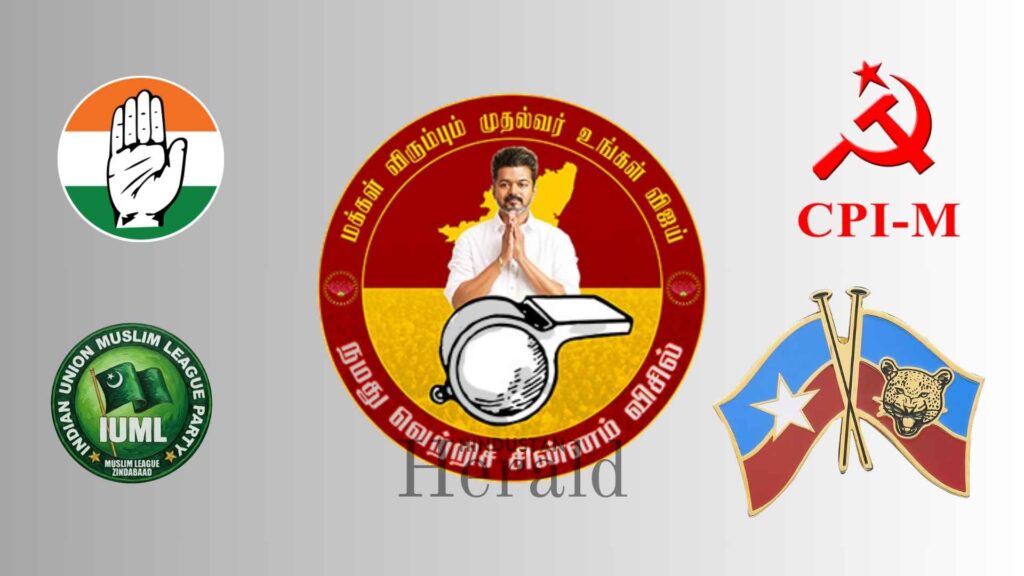
There is a complication worth naming here. The CPI, CPI(M), VCK, and IUML have reportedly indicated they remain aligned with the broader DMK-led front even while backing TVK’s government formation. That is a political position that sounds cleaner on paper than it will be in practice. These are parties with their own voter bases, their own expectations, and their own calculation of what supporting a new government gets them. That ambiguity is not going to disappear quietly.
Also worth noting: Vijay won from two constituencies Perambur and Trichy East. He will need to vacate one, which means a by-election is coming, and TVK’s functional seat count drops to 107 in the Assembly going forward.
As reported by Deccan Herald, the Governor has directed Vijay to prove his majority on the floor of the House on or before May 13. The confidence vote, due in days, will be the first real test of whether this coalition is as solid as Sunday’s ceremony suggested.
What 1967 Actually Means
Political milestones are often overstated. This one is not.
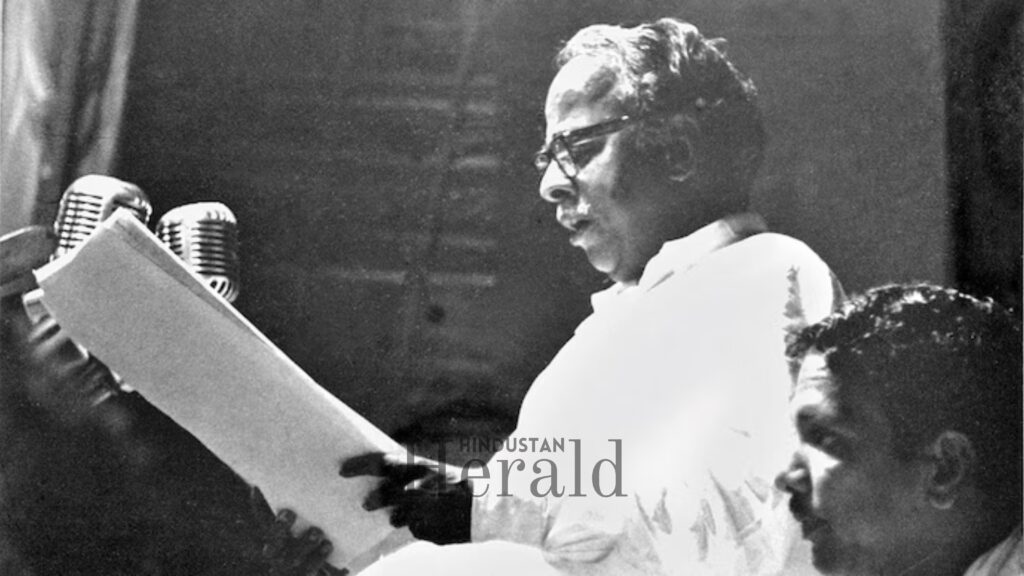
Since C. N. Annadurai brought the DMK to power in 1967, Tamil Nadu has run on a two-party rhythm that has been remarkably consistent across five-plus decades. DMK governments, then AIADMK governments, then DMK again. The faces changed, the rhetoric shifted, the welfare schemes evolved but the fundamental contest was always between these two formations. Every third party that tried to break through eventually found itself either swallowed by one side or made irrelevant by the next cycle.
MGR built the AIADMK as a breakaway, but even that was a Dravidian offspring, not an outside force. Vijay comes from a different tradition entirely. His political positioning has been deliberately outside both camps. During the campaign, he rejected alignment with the BJP in sharp terms, reportedly calling it ideologically incompatible with TVK’s vision, while also maintaining distance from the DMK. He ran as an alternative, not as a faction.
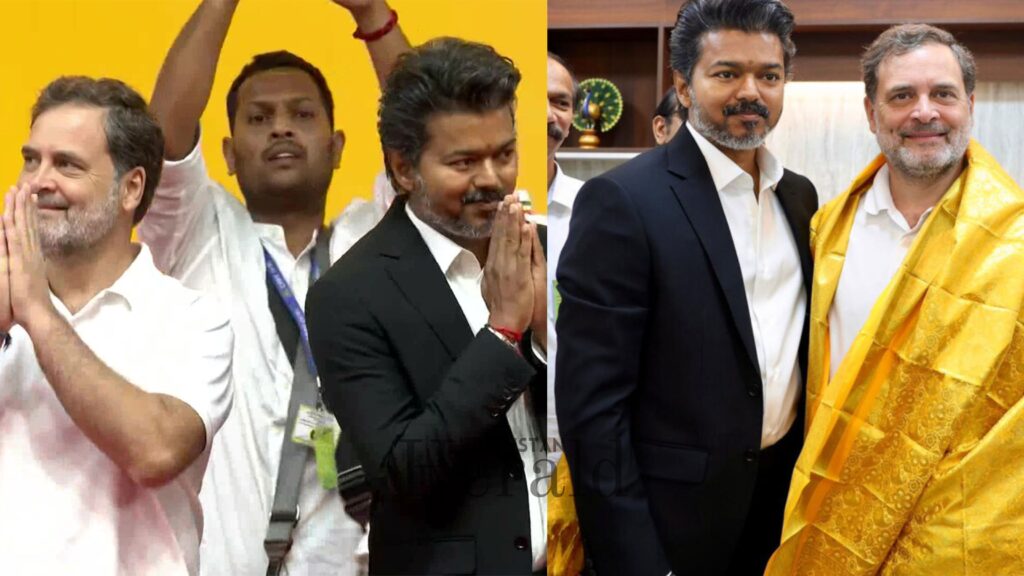
Whether voters gave him a mandate out of genuine belief in that alternative, or simply out of exhaustion with the incumbents, will only become clear over time. But the result stands. And Congress MP Rahul Gandhi was present at the stadium on Sunday, according to The Week a deliberate signal of how the INDIA bloc is thinking about Tamil Nadu ahead of the 2029 general elections.
The Career That Got Him Here
Vijay spent thirty years in Tamil cinema building the kind of following that most politicians never manage in a lifetime. Born on June 22, 1974, the son of director S. A. Chandrasekaran and playback singer Shoba Chandrasekhar, he started in his father’s films and worked his way into a different league entirely.
Ghilli, Thuppakki, Mersal, Master, Leo these are not just films. In Tamil Nadu, they are events. They shaped popular culture, generated mass emotional investment, and built a relationship between Vijay and his audience that cuts across caste, class, and geography in ways that few other public figures can claim. When he announced in February 2024 that he was leaving films and entering politics, people took it seriously partly because his films had always carried political undertones critiques of corruption, of inequality, of power exercised without accountability. The character and the man had started to look like the same person.
His final film, Jana Nayagan, directed by H. Vinoth, did not get the send-off it deserved. It ran into censorship complications, was delayed from its original January 2026 release, and was eventually leaked on piracy sites in April before any theatrical run. According to Wikipedia, there are reports that Vijay may do one more film to compensate the production house, KVN Productions, for the losses. That chapter, at least, is unresolved.
What the New Government Actually Has to Do
The floor test on May 13 is the immediate task. After that, the new government has to function.
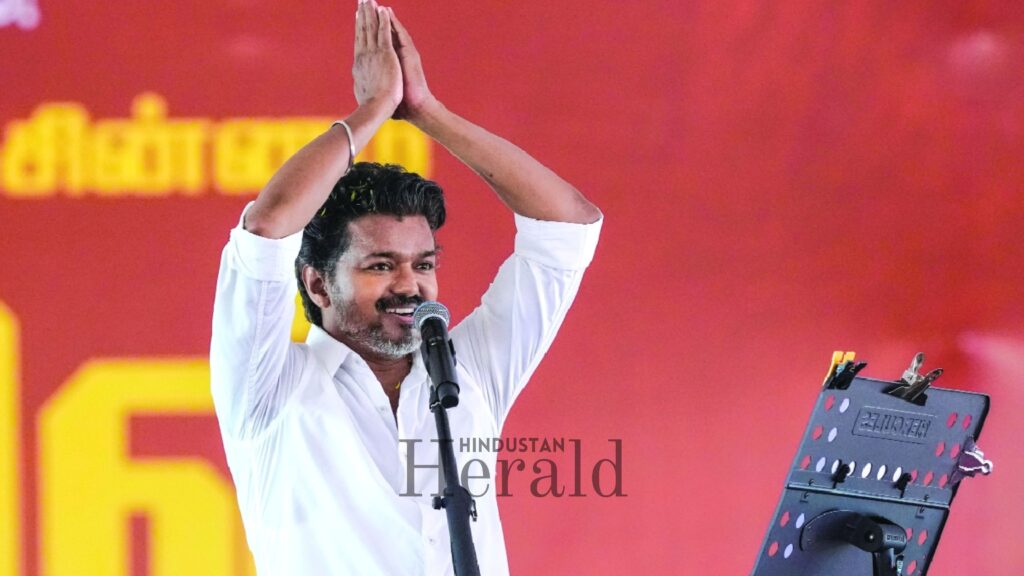
TVK campaigned on a platform centred on employment, youth welfare, digital governance, and a general promise to do things differently from the parties that came before. Vague enough to be popular, specific enough to be held accountable. According to reporting by tnupdates.com, roughly 21 ministers took oath alongside Vijay on Sunday, with key portfolios including Finance, Home, Health, Agriculture, and Public Works expected to draw early scrutiny. IT and Higher Education were departments where TVK made its most concrete campaign commitments, and observers will be watching those closely.
Coalition management is going to be a constant background pressure. Congress is the most explicitly aligned partner, with a national leadership that has reasons of its own to want this government to succeed. The left parties and VCK are more complicated they have their own ideological territory to protect and their own leadership that will not simply defer to TVK on every decision.
Tamil Nadu is also not a state where a new government gets to ease in gently. It has a large and industrialised economy, significant public sector commitments, and a population that has been accustomed to welfare schemes as a baseline expectation. The first Budget will tell you almost everything about whether Vijay’s government has worked out how to turn campaign language into actual policy.
The Longer Question
MGR entered the Secretariat as a film star who became a politician. Jayalalithaa did the same. Both presided over governments that combined genuine welfare expansion with all the complications of personality-driven politics. Their legacies are contested in ways that take lifetimes to fully assess.
Vijay is 51. Younger than either of them when they took office. He has no prior experience in government, no bureaucratic instincts built over years in opposition roles, no seasoned team of administrators who have been with him through previous terms. What he does have is a mandate narrow but real, built on a coalition that is fragile but functional for now.
Tamil Nadu has always been a state where the line between mass culture and mass politics is thin to the point of vanishing. The crowd at Nehru Stadium on Sunday understood that perfectly. Whether the man who just took oath can hold that coalition together, manage the floor test, deliver on the employment promises, and build something that lasts beyond the first term all of that is still ahead.
For now, the oath has been taken. The firecrackers have gone off outside TVK headquarters. Chandrasekaran Joseph Vijay is the Chief Minister of Tamil Nadu.
Whatever comes next begins today.
Stay ahead with Hindustan Herald — bringing you trusted news, sharp analysis, and stories that matter across Politics, Business, Technology, Sports, Entertainment, Lifestyle, and more.
Connect with us on Facebook, Instagram, X (Twitter), LinkedIn, YouTube, and join our Telegram community @hindustanherald for real-time updates.

Covers Indian politics, governance, and policy developments with over a decade of experience in political reporting.
- Ananya Sharma

- Ananya Sharma
- Ananya Sharma
- Ananya Sharma
 Sandeep Verma