
 By Shelesh Joshi and Rajiv Menon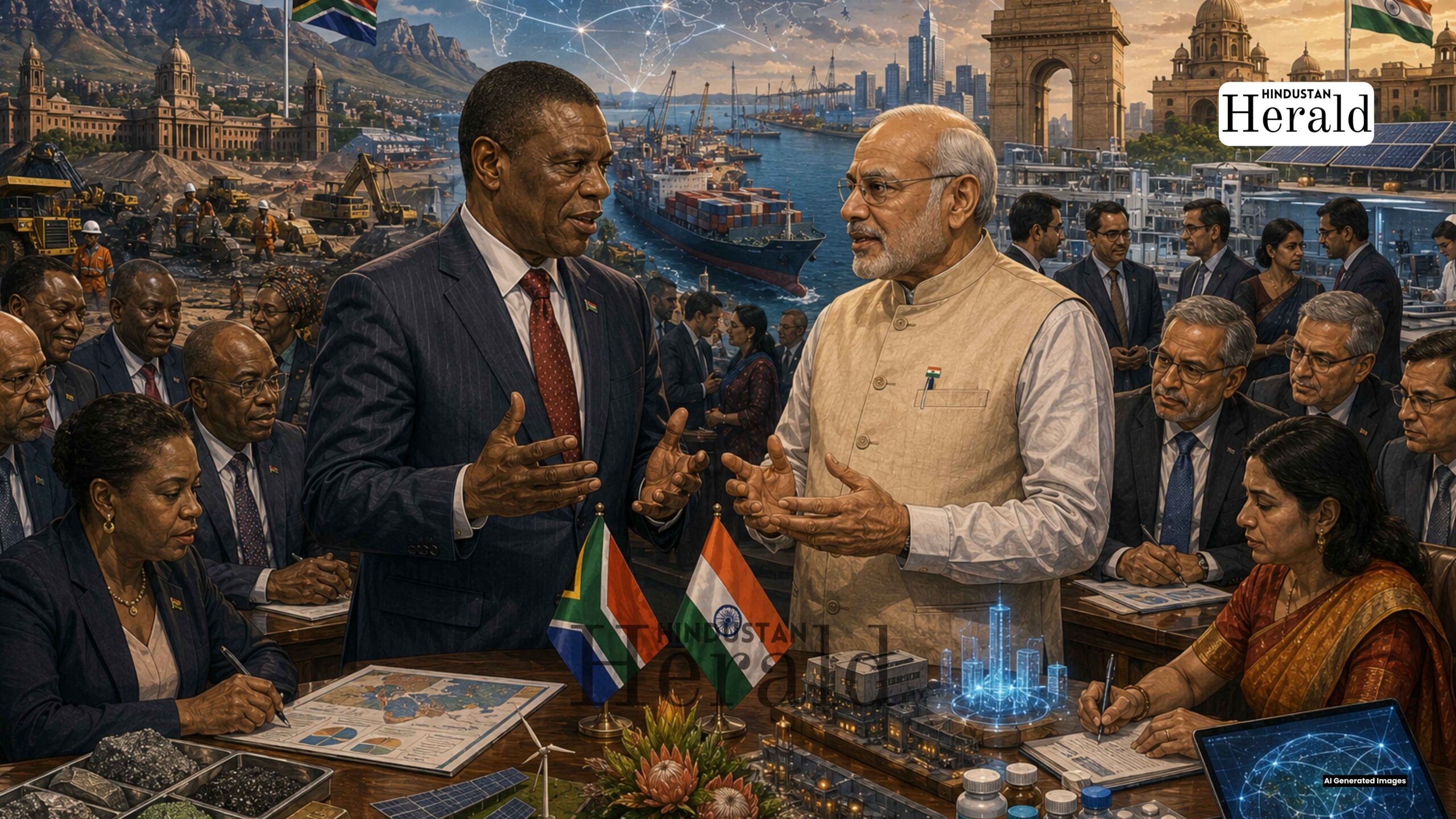
New Delhi, June 2: India-South Africa relations did not drift back to life on their own. Someone had to show up and make the case. Shipokosa Paulus Mashatile did exactly that. South Africa’s Deputy President landed in Delhi last Friday with five ministers in tow. Count them. Health. Small business. Science. Digital technology. International relations. Nobody pulls that kind of delegation together for a trip that is mostly about being seen. You do that when you have a list, and the list is long, and you want the right people sitting across the table when things get specific.
Tuesday was the main event. He met Vice President C.P. Radhakrishnan for a proper bilateral sit down. He called on President Droupadi Murmu at Rashtrapati Bhavan. Earlier in the day he was with External Affairs Minister S. Jaishankar, going through trade, investment, digital cooperation, and the kind of multilateral agenda items that both countries talk about constantly but have not always followed through on.
The Ministry of External Affairs called it an occasion to give “fresh impetus” to the relationship. Diplomats reach for that phrase when they want to say, gently, that things have been drifting.
Quick Summary
- Mashatile is only the 2nd South African Deputy President to ever set foot in India on an official visit, and he showed up with a 6 member ministerial team covering health, trade, science, and digital.
- The last South African head of state visit to India happened 7 years ago in 2019, when President Cyril Ramaphosa came as Chief Guest for Republic Day.
- India-South Africa trade went from $11.07 billion in 2019-20 to $19.25 billion in 2023-24, and the corridor is expected to punch past $25 billion in the years ahead.
- Pretoria is specifically pitching Indian investment into 3 minerals: platinum group metals, manganese, and vanadium, which happen to sit at the centre of India’s National Critical Minerals Mission from January 2025.
- All of India’s trade with Africa combined hit $103 billion in 2024-25, up 17 percent in a single year.
- The two countries are co members of 5 major multilateral formations: BRICS, IBSA, the G20, the Non Aligned Movement, and the Indian Ocean Rim Association.
Seven Years Is A Long Time To Let India-South Africa Relations Sit
The last time a South African head of state visited India was 2019. Cyril Ramaphosa came as Chief Guest for Republic Day, which is one of the more prominent diplomatic invitations India extends. He stood on the parade stand, watched the tanks roll past, did the circuit of meetings, and flew home. After that, nothing comparable for seven years.
That is a strange kind of gap for two countries that share this much institutional overlap. They sit together in BRICS. They co founded IBSA. They vote together more often than not at the United Nations. They reach for each other’s names in speeches about Global South solidarity. And yet, for seven years, no visit of this calibre.
Part of that is the pandemic, which swallowed diplomatic calendars everywhere. Part of it is just the slow drift that happens when a relationship is assumed to be in good health without anyone checking the actual pulse.
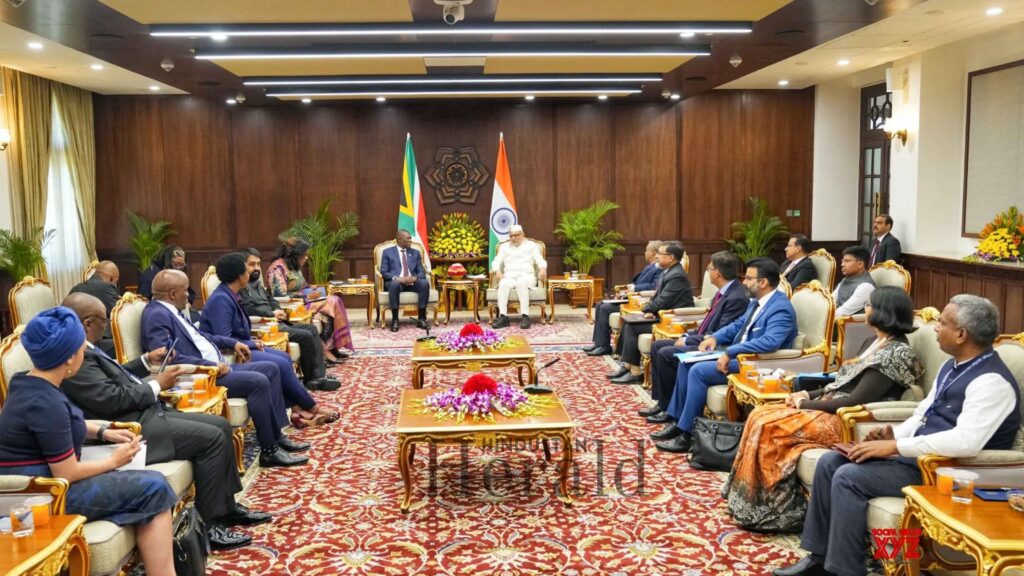
S.African Deputy President Mashatile meeting Vice President C.P. Radhakrishnan on Tuesday was, in that sense, the most visible signal that both governments had decided the drift was over. That bilateral sit down at Rashtrapati Bhavan was not just a scheduled courtesy. It was the clearest indication yet that India-South Africa relations were being actively pulled back into focus at the highest level.
Mashatile’s trip was, among other things, a pulse check. And the way both governments prepared for it, the ministerial depth, the business roundtable, the Hyderabad extension, suggested that what they found when they checked was not catastrophic, but not comfortable either.
He is, by the way, only the second Deputy President of South Africa to visit India at all. His visit ran from May 29 to June 3. He brought his wife Humile Mashatile along with the official party.
The Guest List Tells The Real Story
There is a habit in diplomatic journalism of fixating on the headline meetings and skimming past the delegation manifest. That is usually a mistake. Look at who Mashatile packed onto that flight.
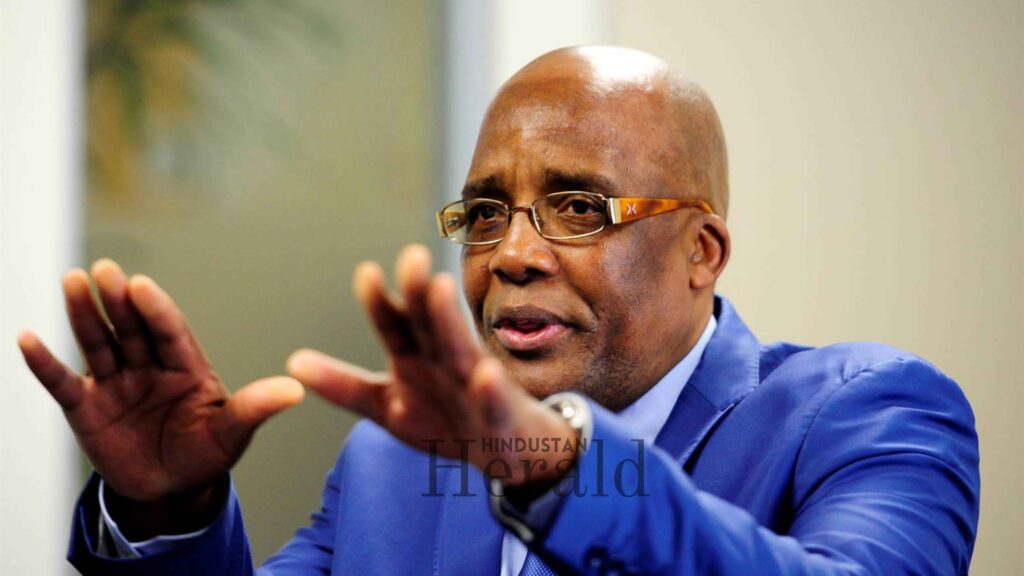
Dr. Aaron Motsoaledi is the Health Minister. His presence in Delhi is not incidental. India is already a major supplier of generic medicines to South Africa. That arrangement has worked fine commercially. But a Health Minister does not travel halfway around the world to celebrate an existing arrangement. He comes when he wants to change the terms of it, or expand it into something the existing arrangement does not cover. Co manufacturing, perhaps. Collaborative research. Health technology platforms. Something that goes beyond South Africa buying drugs from Indian companies.
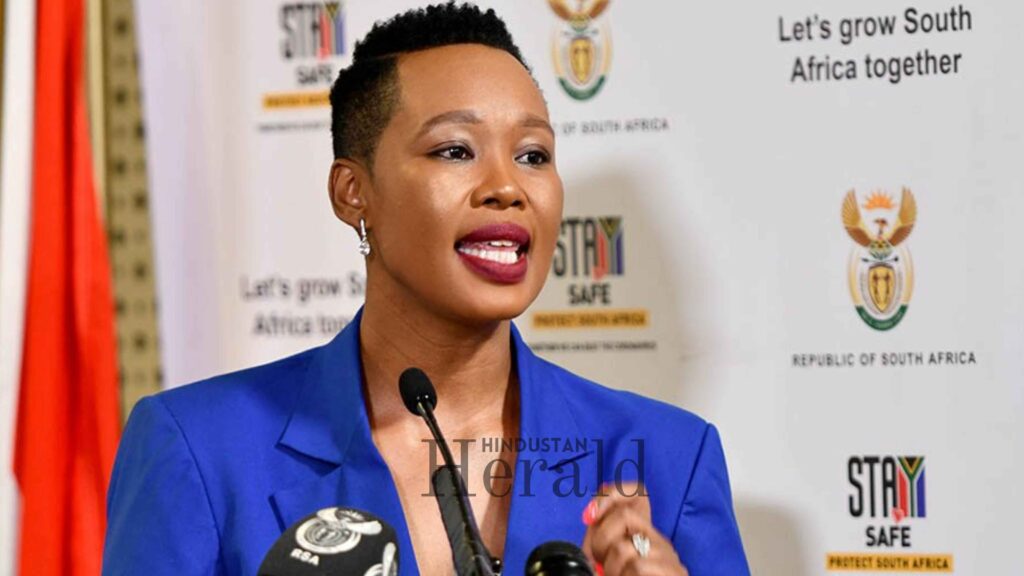
Stella Ndabeni runs Small Business Development. South Africa’s unemployment figures are deeply uncomfortable and have been for years, and a significant chunk of that problem sits in the small and informal enterprise sector. India’s ability to pull small businesses into formal digital systems, through platforms, credit access, and procurement mandates, has attracted genuine attention from governments across the developing world. Ndabeni being on this trip says South Africa wants to study the model up close, not just read about it.
The two deputy ministers covering Science, Technology and Innovation and Communications and Digital Technologies fill out the digital story. South Africa has watched UPI spread across India, watched the Aadhaar architecture embed itself into governance, watched the government seed innovation ecosystems with a combination of regulation and funding. It wants to know what travels and what does not. Thandi Moraka, holding the international relations brief, was the diplomatic glue holding the visit together.
None of these people had to be on this trip. They were there because someone, either Mashatile or the South African Presidency, decided that this visit needed to be substantive enough to justify their presence.
The Things That Were Said, And The Things Underneath Them
As reported by ANI, the Jaishankar Mashatile conversation covered trade, investments, MSMEs, digital, and infrastructure. Jaishankar described Mashatile’s visit as reflecting a “strong commitment to deepening our longstanding partnership.” Warm language. Expected. The sort of thing you say.
What was a bit less expected was the candour from the South African side afterward. Their official statement acknowledged that the strong political relationship between the two countries needed to move into economic territory. Read that slowly. Two countries that have been politically aligned for decades essentially admitting that the commercial side of the relationship has not kept up with the political side. That is honest.
Mashatile was even more direct in his public remarks, as per the African News Agency. He named the sectors South Africa was targeting for Indian investment. Platinum group metals. Manganese. Vanadium. Pharmaceuticals. Renewable energy technologies. He mentioned InvestSA’s One Stop Shop mechanism as the tool designed to make entry easier.
And then he said something that cut through the diplomatic polish. South Africa and India, he said, can together show the world what Global South collaboration looks like when it is done properly. Reshape industries. Empower communities. That is a bigger claim than trade ministers usually make. But he made it, in Delhi, in front of Indian business leaders, which suggests he believed it was worth making.
The Numbers, Without Ceremony
The Sunday Independent reported that bilateral trade between India and South Africa went from $11.07 billion in 2019-20 to $19.25 billion in 2023-24.
That growth happened during a pandemic. It happened when shipping containers were backed up at ports around the world. It happened when energy costs were volatile and supply chains were snapping in ways that nobody had planned for.
So the base is solid. India moves pharmaceuticals, automobiles, engineering goods, chemicals, textiles, rice, and gems across the ocean. South Africa sends back gold, coal, copper, manganese ore, phosphoric acid, and the industrial minerals that Indian manufacturers genuinely need. The trade makes structural sense. It is not being held together by subsidies or political pressure.
Analysts believe the number will cross $25 billion in the coming years. That would put it among the more significant bilateral corridors India runs with any single country.
Zoom out a little and it gets larger still. Per The Secretariat, India’s total trade with the entire African continent hit $103 billion in 2024-25. That is a 17 percent jump in a single year. South Africa is not the whole story, but it is a central chapter in it.
The Mineral Question, Which Is Really Everything Right Now
Let us be direct about what is underneath a lot of the diplomatic language. India needs minerals. South Africa has them. That is the structural engine of this relationship in 2026, and both governments know it.
India’s National Critical Minerals Mission, announced in January 2025, was essentially a national admission that the country’s industrial ambitions, in electric vehicles, clean energy, defence manufacturing, semiconductors, depend on materials that Indian soil cannot supply at the scale required. The mission identified more than thirty priority minerals and set about building a strategy to secure them.
The Centre for Social and Economic Progress has pointed out that more than 30 percent of global critical mineral reserves are in Africa. South Africa specifically holds significant deposits of platinum group metals, manganese, and vanadium. Those are not obscure industrial inputs. They are materials that sit directly in the middle of where the global energy transition is headed.
There is a China dimension here that Indian planners think about carefully, even when they do not say it plainly. China controls refining capacity across the vast majority of critical minerals worldwide. For India, the appeal of bypassing that chokepoint by building direct partnerships with African mineral producers is simultaneously economic, strategic, and quietly urgent.
India has been telling African governments that its approach is different from China’s. Where China has offered infrastructure in exchange for resource access, India is pitching technology transfer, local processing support, and genuine value sharing, as per Zee News. It is a different model, in principle.
South Africa knows the difference between a partner and a customer. It has had enough extractive relationships to develop strong feelings about beneficiation, about minerals being processed locally before they leave the country. That political instinct fits reasonably well with what India says it is offering. Whether the two pictures line up in practice is the question that deals in the coming months will answer.
What BRICS Actually Adds
A visit like this cannot be read purely as a bilateral trade story. The institutional backdrop is doing real work. India holds the BRICS presidency in 2026 and will host a leaders’ summit later this year, as The Diplomat has reported. South Africa was there at BRICS from the start. Both countries also share seats at IBSA, the G20, the Non Aligned Movement, and the Indian Ocean Rim Association. That is a lot of rooms they both have keys to. And right now, those rooms matter more than they did five years ago.
The United States is conducting foreign policy in ways that leave many mid sized governments uncertain about what to expect next. China is extending its influence in ways that some recipient countries are becoming visibly cautious about. In that environment, countries like India and South Africa are rethinking what their partnerships need to look like, and which relationships are worth investing in seriously.
Mashatile put it plainly enough, as per the African News Agency. South Africa and India, he said, are bound by a commitment to non alignment and to building a Global South that runs on genuine equity rather than inherited dependency. That framing is both idealistic and practical, which is usually where the most durable diplomatic positions live.
Dilli Haat Was Homework, Not Tourism
A few outlets treated the delegation’s visit to Dilli Haat as a cultural interlude. It was not really that. Mashatile said at the visit, as reported by ANI, that the delegation came to understand how India supports small enterprises, integrates digital tools into economic life, and builds infrastructure that works at scale. He was studying the mechanism, not admiring the handicrafts.
“We came here to see how India developed its own society,” he said. Businesses from various sectors were part of those meetings. South Africa is not going to solve its small enterprise problem by importing Indian craft markets. But the way India has used digital platforms to formalise, fund, and scale small businesses is a concrete policy story with transferable lessons. That is what Ndabeni’s ministry was here to look at.
Hyderabad was next, before the June 3 departure, as confirmed by the Ministry of External Affairs. Hyderabad’s pharmaceutical cluster, its biotech presence, and its concentration of technology companies make it an obvious stop for a delegation that includes a Health Minister and a Science Deputy Minister. The medicines relationship between the two countries is already real and functioning. Hyderabad was about scoping what the next chapter might involve.
The Investment Gap Nobody Wants To Mention Out Loud
Both sides know this: Indian investment in South Africa has been lighter than the relationship’s depth would suggest it should be. Indian companies have a presence there. Pharmaceuticals, retail, some manufacturing. But it has not been the kind of investment that matches the political warmth. The roundtable with Indian business leaders was, among other things, an attempt to close that gap by putting investors in a room with ministers who have the mandate to make entry faster and easier.
South Africa brought its pitch. InvestSA’s One Stop Shop. The mineral story. The market access angle. The AfCFTA gateway argument.
Whether Indian businesses move on any of that depends on things that no diplomatic visit fully controls. Regulatory predictability. Infrastructure reliability. The basic confidence that an agreement holds its shape over time.
Still. When a government sends its deputy president and five cabinet level officials to make an investment case on your doorstep, you notice. The signal was not subtle.
Gandhi Never Really Left
There is something about this relationship that does not fit neatly into economic analysis. Gandhi spent twenty one years in South Africa. He arrived as a young lawyer in Natal, got thrown off a train for sitting in the wrong carriage, and spent the next two decades developing the philosophy that would eventually change the political history of Asia. Satyagraha was born there, not in India.
The Indian diaspora in South Africa, concentrated in KwaZulu Natal and going back to the indentured labour era, has maintained connections across the Indian Ocean for more than a century without any government programme encouraging them to. It is just what communities do when the roots go deep enough.
That history does not close deals. It does not move capital. But it creates a familiarity between the two countries that makes the harder conversations feel less foreign. Both sides operate with a baseline of shared reference that most bilateral relationships take decades to build and these two inherited. It is worth something. Not everything. But something.
After The Handshakes, The Real Work
The delegation flies home on June 3. The statements will go out. The photographs will make the rounds. Mashatile will land in Johannesburg and return to the everyday business of South African politics.
And then, in the weeks and months that follow, the visit will be judged by things that have nothing to do with how the meetings felt in the room.
Do the roundtable conversations produce actual investment? Do the mineral discussions become formal frameworks before India’s BRICS summit? Do the health and science conversations between ministers turn into working relationships between institutions?
Those are questions of execution, and execution is where diplomatic enthusiasm most often goes quiet. What this week made clear is that both governments believe the relationship has been underperforming relative to its potential, and that they want to do something about it. The seven year gap between high level visits was not something anyone celebrated. Filling it with something that actually compounds, that builds on itself over time, that is the task now. Mashatile leaves tomorrow. The part that matters comes after.
Stay ahead with Hindustan Herald — bringing you trusted news, sharp analysis, and stories that matter across Politics, Business, Technology, Sports, Entertainment, Lifestyle, and more.
Connect with us on Facebook, Instagram, X (Twitter), LinkedIn, YouTube, and join our Telegram community @hindustanherald for real-time updates.

Tracking world politics, global markets, trade movements, policy decisions, and the changing balance of economic power.
- Shelesh Joshi

- Shelesh Joshi
- Shelesh Joshi
- Shelesh Joshi




Specializes in South Asian geopolitics and global diplomacy, bringing in-depth analysis on international relations.
- Rajiv Menon
- Rajiv Menon
- Rajiv Menon
- Rajiv Menon