
 By Shelesh Joshi and Rajiv Menon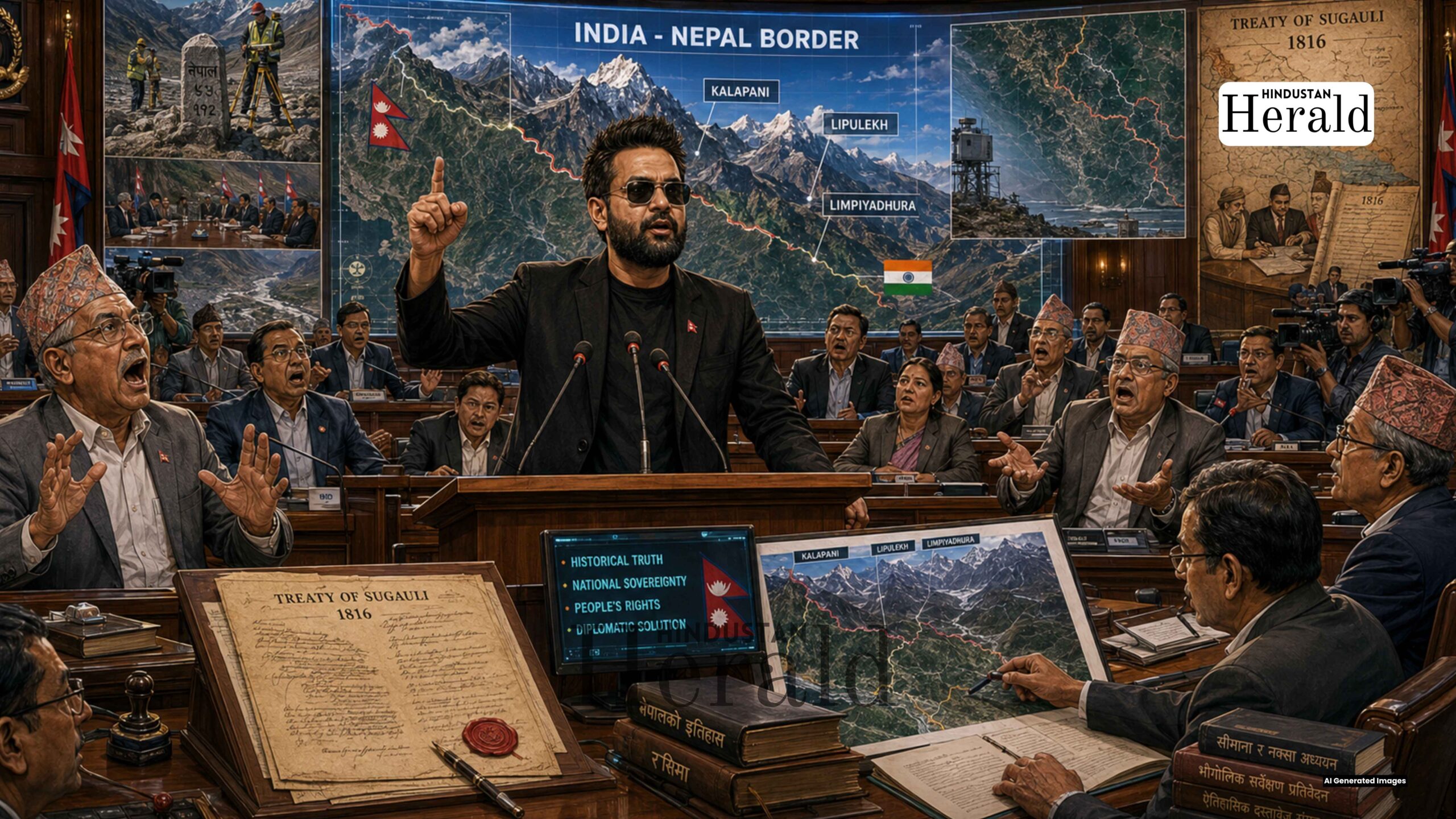
New Delhi, June 1: The Nepal India Border Dispute took a turn nobody saw coming last week, and it did not come from where anyone expected. It did not come from New Delhi issuing a fresh territorial claim. It did not come from another round of map disputes or diplomatic letters crossing the border. It came from inside Kathmandu itself, from the man currently sitting in the Prime Minister’s chair, in his very first address to Parliament, saying something out loud that no leader of that country has ever had the nerve or the honesty to say before him.
Nepal’s new Prime Minister Balendra Shah stood up in that chamber and told lawmakers that Nepal had also been encroaching on Indian land. Not just India crossing into Nepal, the story every Nepali politician has consistently told across successive governments without exception, without variation, and without anyone seriously challenging it from the inside. Both sides. Nepal included. Mutual and reciprocal. Half the room probably did not believe what they had just heard. The other half almost certainly wished they had not heard it at all. And just like that, a dispute that has been simmering for over two centuries found itself in entirely new and unfamiliar territory.
Quick Summary
- Nepal PM Balendra Shah, 36, took office on March 27, 2026 as Nepal’s youngest ever Prime Minister and made this admission in his very first Parliament address, as reported by Outlook India and The Print.
- He said Nepal has encroached Indian territory in multiple places, the first time any sitting Nepali PM has ever acknowledged this publicly, according to Outlook India.
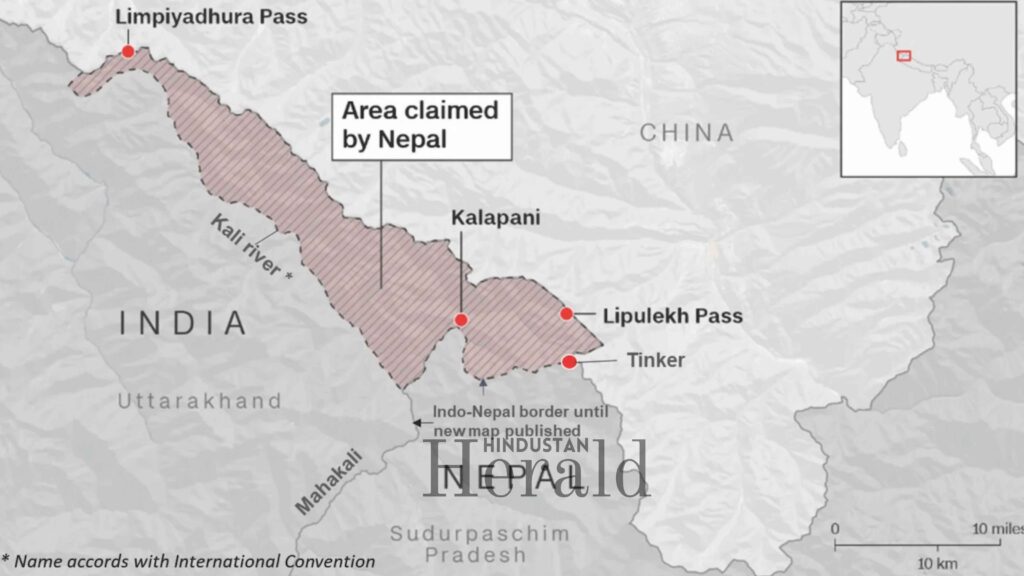
- The Kalapani, Lipulekh, and Limpiyadhura triangle spans roughly 372 square kilometres and has been disputed since the 1816 Treaty of Sugauli, as reported by PolSci Institute.
- Nepal’s Foreign Ministry scrambled out a clarification within hours, framing Shah’s remarks as a technical survey finding rather than a shift in official policy, according to WION.
- MEA spokesperson Randhir Jaiswal responded from New Delhi, calling territorial enlargement claims “untenable” but keeping dialogue open, as reported by India TV News.
- Nepali Congress, CPN-UML, and others are demanding Shah’s resignation and students are out on the streets of Kathmandu, according to ANI.
PM Balen Shah’s India Border Remarks Rise a Dispute in Nepal
Every politician in Nepal knows how the Lipulekh-Kalapani conversation is supposed to go. You get asked about the disputed territories. You say India has been encroaching. The room approves. You sit down. Shah did not do that. A lawmaker asked him directly where his government stood on the three disputed areas. And whatever answer that lawmaker was expecting, it was not what came next.
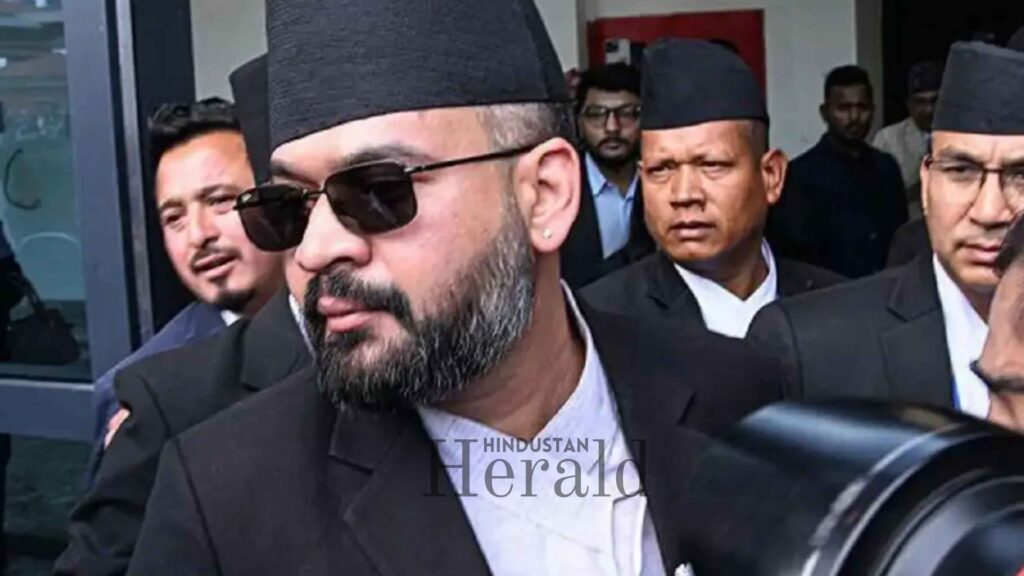
According to India TV News and The Print, Shah told Parliament: “You will be surprised to know about a fact, which I have learnt recently, only after becoming the Prime Minister. It is not only India that has encroached Nepalese territories, but Nepal has also encroached India’s territories in many places.” No buildup. No careful language around it. He just said it.
The words landed in a room full of politicians who had spent their careers saying the exact opposite. The reaction moved through shock first, then disbelief, then the kind of sustained political anger that does not settle quickly.
According to Outlook India, this is the first time in Nepal’s political history that a sitting head of government has publicly acknowledged encroachment from the Nepali side. Across every government that country has had, the official public line has been consistent. Nepal is the wronged party. India is the encroacher. Shah broke that line. Out loud. In his very first session. Without warning a single person apparently.
Whether that makes him honest in a way Nepali politics has badly needed, or whether he simply had not thought carefully enough about what he was about to say, people in Kathmandu are genuinely divided on that question.
What the Nepal India Border Dispute Looks Like Beyond the Admission
The admission itself absorbed almost all the attention that followed. But Shah said other things that day which have been buried under the noise of the reaction.
He told Parliament that Nepal had formally written to India about the encroachment issue, specifically naming Lipulekh, and that India had written back. According to The Print, Shah said India’s response indicated both governments were open to forming joint working teams, historians, surveyors, people who actually know this terrain up close, to work through the Nepal India Border Dispute together at the table.
That is genuinely new territory. Years of formal letters, published maps, public protests, and parliamentary resolutions have not produced anything resembling a functioning joint mechanism. If what Shah said about India’s response is accurate, something real has been quietly moving in the background that the official public statements from both governments have not reflected.
He also told Parliament that Nepal had reached out to the British government about the issue. According to India.com, Shah said Nepal had spoken not only with India and China but also with the British government, reasoning that the Nepal India Border Dispute traces back to the colonial era and London should therefore have some role in resolving it.
That did not find much support anywhere. Nobody seriously expected it to. But it reveals something about how the Shah government is thinking about the history and legal architecture of this dispute differently from its predecessors.
Kathmandu’s Foreign Ministry Had a Very Long Afternoon
The speed of the clarification told its own story. Within a few hours of Shah’s Parliament address, the Nepal Ministry of Foreign Affairs had a statement out. According to WION, the ministry said Shah’s remarks needed to be understood in the context of findings from a technical boundary committee that had been conducting field surveys along the frontier.
The committee had found that in certain specific locations, land being used and lived on by Nepali citizens might technically sit on the Indian side of the true boundary, and the reverse was also true in some places.
This technical detail is not invented. According to Nepal News, around 1,240 of roughly 8,000 boundary pillars along the Nepal-India border are either missing or damaged, and there are 31 documented incidents of encroachment along the frontier. A border this long and this old running through difficult mountain terrain does accumulate real complications over time.
But the ministry was also, quite clearly, trying to pull Shah’s broad unqualified parliamentary statement back into a much narrower technical box. It wanted people to read his words as referring to isolated survey findings in specific mapped locations, not as a general admission that Nepal had been crossing into Indian territory.
According to The Print, the ministry stated that the Prime Minister’s remarks “should be understood in the context of this technical reality and the issue of cross-border occupation” and that Nepal remains “firmly committed to resolving border-related issues through diplomatic dialogue based on historical treaties.” Opposition leaders were not interested in that reframing.
Their argument was simple and honestly quite difficult to argue against. If the narrow technical context was what Shah intended to convey, he had every opportunity to say so clearly. He did not. He made a broad statement without apparently coordinating with the Foreign Ministry beforehand, and the Foreign Ministry spent the rest of that day doing repair work that should not have been necessary.
India Said the Minimum and Meant Every Word of It
New Delhi’s response was exactly what anyone familiar with how India handles sensitive Nepal moments would have predicted. Careful. Controlled. Revealing almost nothing.
According to India TV News, MEA spokesperson Randhir Jaiswal said India has consistently maintained that territorial claims against it are “neither justified nor based on historical facts and evidence” and that “such unilateral artificial enlargement of territorial claims is untenable.” He added that India remains open to constructive interaction with Nepal on all bilateral issues, including the resolution of agreed outstanding boundary matters through dialogue and diplomacy.
Read that response carefully and you see it is not actually responding to what Shah said in Parliament. According to PolSci Institute, India rejected Nepal’s 2020 constitutional amendment, the one where Nepal updated its national emblem to incorporate the three disputed territories within its borders, from the day it happened and continues to reject it today. Jaiswal’s language about unilateral artificial enlargement is directed at that longstanding dispute, not at Shah’s specific parliamentary admission.
What New Delhi chose not to do is at least as significant as what it said. It did not claim vindication. It did not make noise. It held its line, pointed toward dialogue, and allowed the situation in Kathmandu to unfold on its own terms.
One Unfinished Sentence in 1816 Is Still Causing Problems Today
The Kalapani-Lipulekh-Limpiyadhura dispute comes down to one river and one gap in an old treaty. According to PolSci Institute and Nepal News, the Treaty of Sugauli in 1816 ended the Anglo-Nepalese War and drew Nepal’s western boundary along the Kali River. The problem is the treaty never said where the Kali River actually begins. That single missing piece of information has been producing arguments ever since.
According to PolSci Institute, Nepal’s reading is that the river starts at Limpiyadhura, the westernmost Himalayan source. If that is the origin point, then all land east of it including Kalapani and Lipulekh falls within Nepal’s territory. Nepal anchors this claim in maps produced by the British East India Company between 1827 and 1856, which reportedly mark Limpiyadhura as the source of the river, as reported by India.com and Nepal News.
According to PolSci Institute, India’s reading is that the river originates from a different stream much further east, near a location called Lipu Gad, which places the entire contested 372 square kilometres inside India’s Pithoragarh district of Uttarakhand.
Neither country is simply inventing its position. Both have historical documentation. That is precisely what has made this so resistant to resolution.
The land is not trivial in any sense. According to PolSci Institute, this stretch of high-altitude terrain sits at the exact convergence point of three countries, India, Nepal, and China. It controls the pilgrimage route to Kailash Mansarovar in Tibet and carries genuine strategic and military value.
According to Kathmandu Post, Indian troops moved into positions at Kalapani during the 1962 war with China. Nepal’s King Mahendra did not challenge the move at the time, reportedly because pushing back against India right at that moment would have looked like Kathmandu was taking Beijing’s side in the conflict. That restraint allowed India’s presence at Kalapani to become entrenched over the following decades in ways that proved genuinely difficult to unwind.
According to PolSci Institute, the current phase of the dispute began in November 2019 when India published a new political map placing Kalapani, Lipulekh, and Limpiyadhura within Indian territory. Nepal submitted a formal diplomatic protest. Tensions escalated further in May 2020 when India inaugurated a road through Lipulekh Pass to the Chinese border. Nepal’s Parliament responded by endorsing its own map, and the constitution was formally amended in June 2020 to include the revised map in the national emblem. India rejected it entirely.
According to Nepal News, in August 2025, India and China agreed during high-level talks between NSA Ajit Doval and Chinese Foreign Minister Wang Yi to reopen Lipulekh as a trade corridor, again without informing or consulting Nepal. In Kathmandu, that felt less like a diplomatic decision and more like being discussed in your own home without being invited into the conversation. That is the atmosphere Shah walked into when he stood up to speak.
The Rapper Who Became Prime Minister and Still Has Not Learned to Filter Himself
You cannot make sense of what happened in Parliament without spending time on who Balen Shah actually is. According to Wikipedia via India.com, he was born in Kathmandu on April 27, 1990. He served as Mayor of Kathmandu from May 2022 to January 2026. During his tenure as mayor, he introduced initiatives in waste management and traffic management, and his administration carried out enforcement actions including demolitions of illegally constructed structures, which drew both praise and criticism.
He resigned as mayor in January 2026, joined the Rastriya Swatantra Party, won the Jhapa 5 parliamentary seat in the 2026 general election, and became Prime Minister on March 27, 2026, as reported by India.com and Wikipedia. At 36, he became Nepal’s youngest ever Prime Minister.
His entire political identity rests on saying the actual thing rather than the diplomatically appropriate version of the thing. That quality has produced genuine results at moments. It also produced what happened in Parliament last week.
Whether what he said was factually accurate is one question. Whether he should have said it the way he did, without preparation, without coordination, in his very first parliamentary session, is a completely separate question. Kathmandu is loudly arguing about both simultaneously.
His Own Government Was Already Struggling
According to ANI and Times of Oman, opposition parties including Nepali Congress, CPN-UML, and the Shram Sanskriti Party had been disrupting parliamentary proceedings before the encroachment remarks. Lawmakers were occupying the well of the lower house, demanding Shah attend the question sessions the constitution requires him to participate in.
According to ANI, Nepali Congress chief whip Basana Thapa said: “We did not call the Prime Minister to Parliament merely to see his face. We asked him to respond in accordance with constitutional provisions during the first week of the month.”
According to ANI, Harka Sampang of the Shram Sanskriti Party had been the most persistent critic. His party had been raising unresolved issues including a vacant Home Ministry portfolio, squatter management problems, and specifically the question of Indian encroachment on Nepali territory. It was his questioning that drew the statement out of Shah in the first place.
According to Khabarhub, when Speaker Dol Prasad Aryal reportedly went personally to meet the Prime Minister and requested he come to Parliament, Shah reportedly said he was unable to attend immediately and would come at “an appropriate time.” That answer satisfied nobody.
What This All Means Going Forward
India and Nepal are too entangled, economically, culturally, and geographically, to allow one turbulent parliamentary session to permanently damage the relationship. Both governments understand that even when they are not saying it publicly.
For New Delhi, what Shah said is not entirely unwelcome. A Nepali Prime Minister acknowledging mutual border violations, as reported by Outlook India, makes the long-running argument that India is the sole actor in this dispute considerably harder to sustain in any serious diplomatic conversation.
For Shah and his government, the political cost is real and immediate. He handed his opponents exactly what they were looking for at a moment when his government had no reserves of goodwill to draw on.
The Britain suggestion will not go anywhere. The diplomatic noise will eventually subside. But the detail Shah revealed, that India has apparently already indicated willingness to form joint expert teams for a negotiated resolution, as reported by The Print, deserves continued attention. If those teams actually form and do real work, it would mean more genuine progress on this dispute than anything in recent years.
According to Nepal News, there are currently 31 documented encroachment incidents along the Nepal-India frontier and nearly 1,240 boundary pillars are missing or broken. The actual border between these two countries is not the clean line that official maps suggest. It never really has been.
Sorting it properly requires patient sustained work, political will that outlasts election cycles, and the kind of blunt acknowledgment about what is actually happening on both sides of that frontier that most politicians on both sides have successfully avoided for a very long time.
Balen Shah stumbled into that acknowledgment last week. Without a plan. Without clearing it with anyone. In the middle of a parliamentary session that was already on fire. But the words are on the record now. And occasionally that is genuinely how things begin to change.
Stay ahead with Hindustan Herald — bringing you trusted news, sharp analysis, and stories that matter across Politics, Business, Technology, Sports, Entertainment, Lifestyle, and more.
Connect with us on Facebook, Instagram, X (Twitter), LinkedIn, YouTube, and join our Telegram community @hindustanherald for real-time updates.

Tracking world politics, global markets, trade movements, policy decisions, and the changing balance of economic power.
- Shelesh Joshi

- Shelesh Joshi
- Shelesh Joshi
- Shelesh Joshi



Specializes in South Asian geopolitics and global diplomacy, bringing in-depth analysis on international relations.
- Rajiv Menon
- Rajiv Menon
- Rajiv Menon
- Rajiv Menon