
 By Sandeep Verma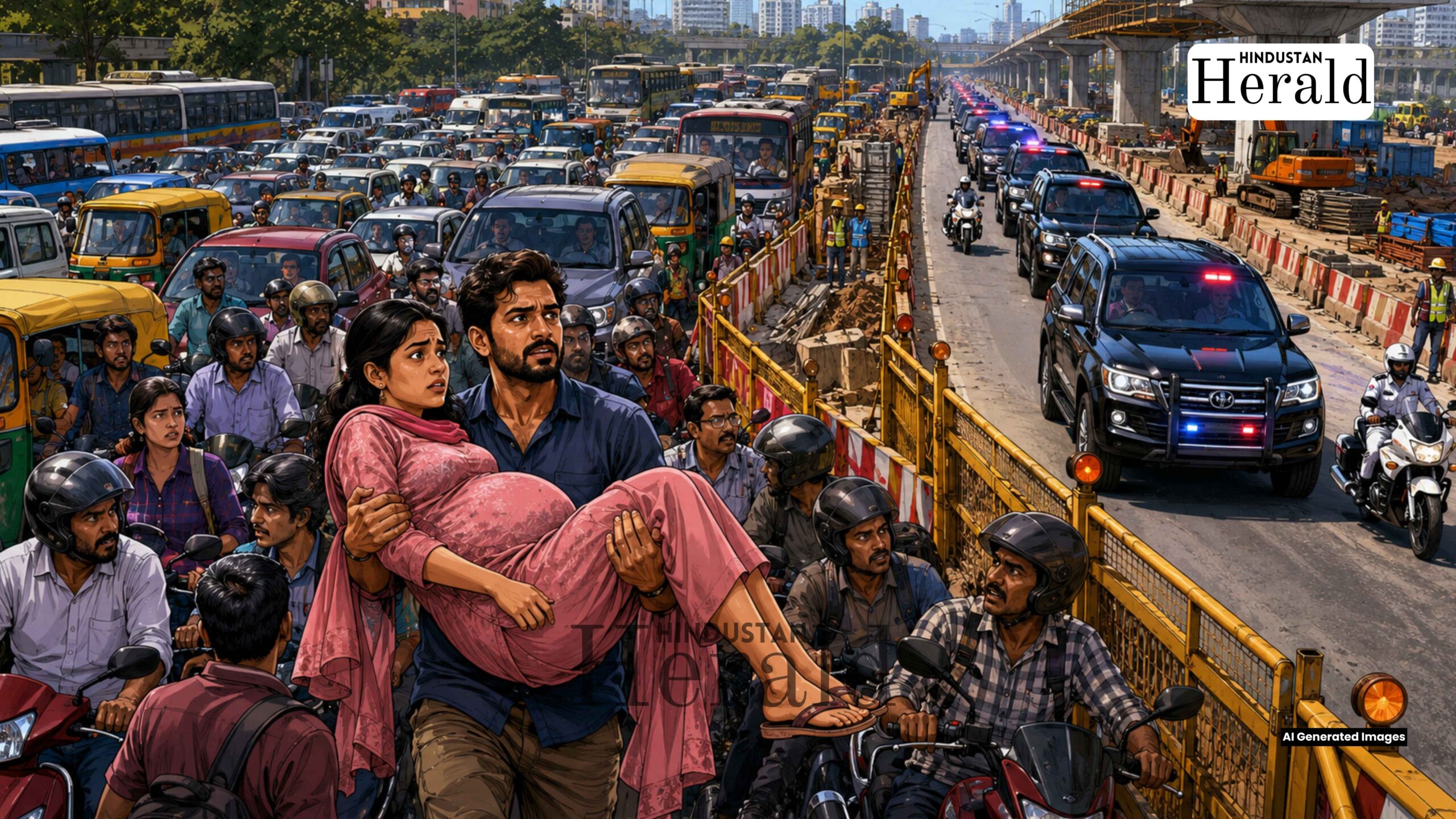
Bengaluru, June 1: On the morning of Sunday, May 31, somewhere in the middle of Old Airport Road’s single open lane, a man got out of his car and tried to carry his pregnant wife through a wall of stalled vehicles. He did not know when the road would open. Nobody did. A Governor convoy had brought everything to a halt, and there they were, stuck in it, with no ambulance, no bypass, no information, and no end in sight.
That image, which spread rapidly through social media by evening, has done something that years of traffic data and civic petitions have failed to do. It has made people genuinely angry in a way that is not going away quickly.
A Road That Was Already Breaking
To understand what Sunday produced, you first need to understand the shape Old Airport Road was already in before any convoy ever entered the picture.
The 13-kilometre stretch running from Domlur to Marathahalli is, on a good day, one of the most stressed corridors in the city. It carries commuters between the central business district and Bengaluru’s sprawling eastern tech belt, running through thick residential and commercial zones that generate their own friction at every junction. There is no quiet hour on this road. There is only varying degrees of bad.
Right now, it is worse than bad. An ongoing Wind Tunnel Road underpass project near Murugeshpalya Junction has been eating into the road for months. One full carriageway has been closed for excavation. What was once a dual-flow corridor is now, for most of its affected length, a single lane carrying traffic in both directions. Vehicles approaching HAL, heading towards Marathahalli, or trying to get into central Bengaluru are all being funnelled through the same narrow channel.
According to local reports, the official construction window sits at around 180 days, and the situation is expected to get worse, not better, once schools reopen and the monsoon properly sets in over the coming weeks. Authorities have acknowledged as much, even as they describe current conditions as manageable.
That was the road onto which Sunday’s VIP movement was imposed.
Thirty Minutes. No Diversion. Nothing.
Traffic chaos erupted on Bengaluru’s Old Airport Road on Sunday, May 31, after vehicular movement was reportedly halted for nearly 30 minutes to facilitate the movement of Karnataka Governor Thaawarchand Gehlot’s convoy, leaving thousands of commuters stranded, according to Siasat Daily. Long queues formed on both sides of the road, with no effective diversion in place and no communication to waiting motorists about what was happening or how long it would last.
Thirty minutes sounds manageable until you think about what it means on a single-lane road. You cannot reverse. You cannot turn. There is no alternative route you can access from inside the queue. You just sit there, or, if you are desperate enough, you get out and walk.
Witnesses describe people stepping out of vehicles in confusion, scanning down the road for some sign of movement. Nobody had answers. There were no traffic personnel on alternative routes managing diversions. There was no advisory that had gone out beforehand. It was simply: convoy passing, road closed, wait.
The pregnant woman’s situation became the defining image of the day. A family trying to reach a hospital, stuck in a standstill on a road already running at reduced capacity, with no way through and no one to help. As reported by Siasat Daily, the family was left helpless as traffic remained frozen for an extended period, raising serious questions about emergency access during VIP movements.
The Governor’s Weekend
Governor Gehlot had a busy schedule over that weekend. According to Prokerala, he was set to leave Bengaluru for Dharmasthala after 1 p.m. on Saturday, May 30, ahead of Vice President C.P. Radhakrishnan’s visit to Karnataka. By Sunday, the Governor was at the Sri Kshetra Dharmasthala Manjunatha Swamy Temple, where the Vice President inaugurated the SIRI Mathrushree Industrial Park. The convoy movement on Old Airport Road on Sunday appears connected to his transit logistics around that visit, according to The News Minute.
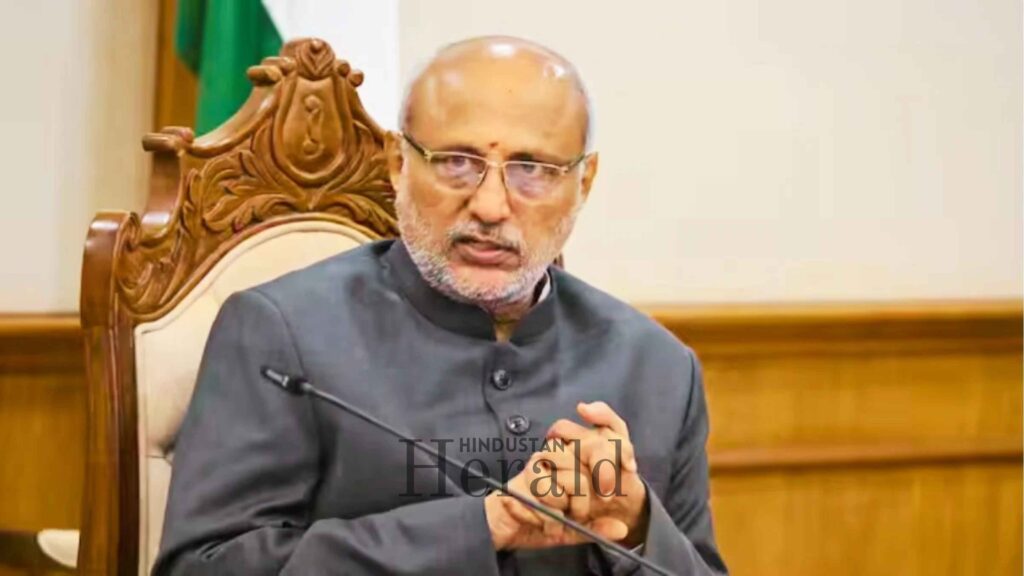
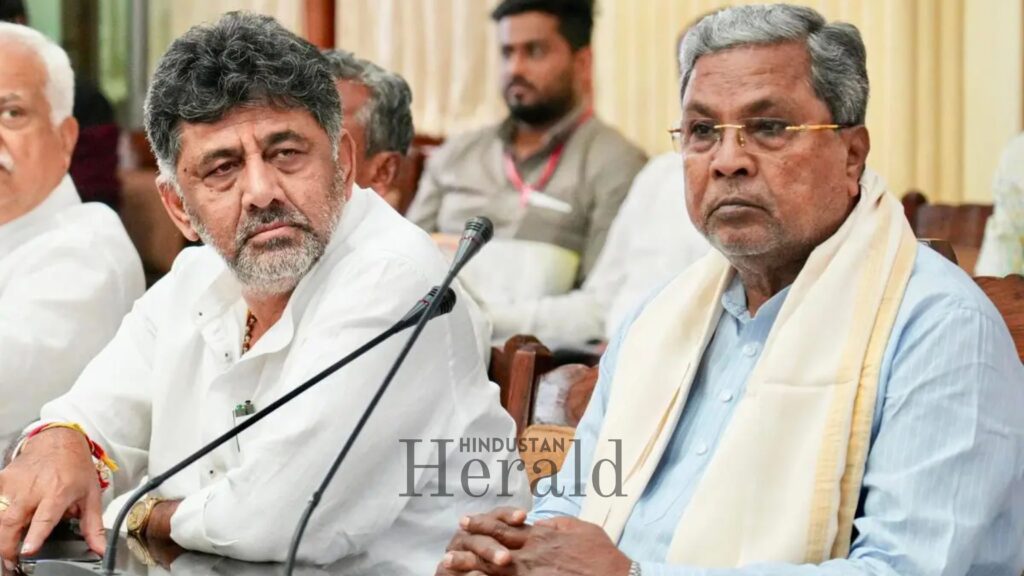
The broader political backdrop is worth noting. Outgoing Chief Minister Siddaramaiah had formally resigned on May 28. The Governor accepted the resignation on May 29, simultaneously dissolving the outgoing ministry while directing Siddaramaiah to continue in a caretaker capacity. With D.K. Shivakumar widely tipped as the next Chief Minister, the Congress Legislature Party assembled on May 30 to elect their new leader, as reported by Outlook India. Governor Gehlot was, by any measure, in the middle of one of Karnataka’s most consequential political transitions in years.
None of that explains why a convoy needed to seal off a construction-narrowed arterial road for half an hour with no traffic management plan to show for it.
There is one more detail worth knowing. Weeks before this incident, Governor Gehlot had publicly announced a reduction in his official convoy size, following Prime Minister Narendra Modi’s call for fuel austerity. The Raj Bhavan posted about it on X. The convoy that shut down Old Airport Road on Sunday was, reportedly, already a trimmed-down version, according to ThePrint. Which raises its own uncomfortable question about what the full formation would have looked like.
An Old Argument That Will Not Stay Buried
The anger that erupted after Sunday’s images circulated is real, but this particular argument is not new. Bengaluru has seen its roads shut down for VIP movements many times before. Vice Presidential visits, Prime Ministerial visits, state-level functionaries, all of them have generated their share of gridlock complaints and social media outrage. According to Deccan Herald, the city has witnessed road closures across the length of Old Airport Road itself for high-level convoys in the past.
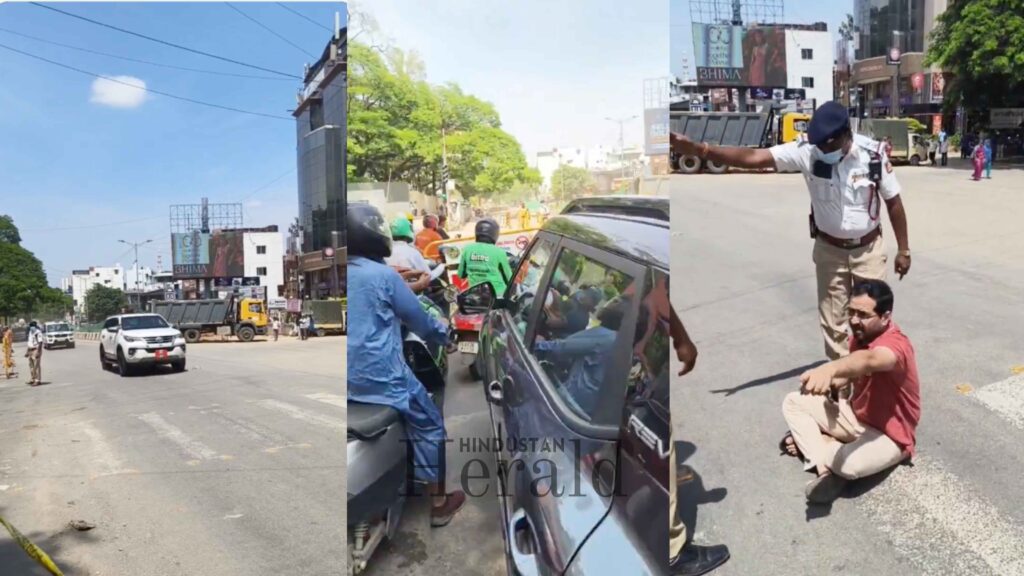
What makes this incident sit differently is the specificity of the harm. This was not a road running at 70 percent capacity having a bad day. This was a road already at near-minimum capacity, serving an area that includes Manipal Hospital, a facility that local residents have repeatedly flagged in civic forums as a reason emergency access on this stretch must be protected. The half-hour closure did not just inconvenience commuters. It shut an emergency corridor that was already compromised.
Videos and photographs of the jam spread quickly on social media, with many users questioning the practice of halting traffic for long periods on one of the city’s busiest corridors, according to Siasat Daily. Several people specifically pointed out that emergency vehicles and patients would have had no way through. That is not a hypothetical. That is what the road looked like.
What the Gap Actually Costs
It is worth being specific about what “no emergency corridor” means on this stretch right now. With one carriageway already closed for the underpass project, there is no parallel lane to pull an ambulance into. There is no quick U-turn option. If a vehicle breaks down inside the queue during a convoy-induced halt, everything behind it compounds further.
Officials have described current conditions as manageable. But they have also noted, in the same breath, that things will worsen when schools reopen and rainfall picks up. Those weeks are almost here. The road that locked up for 30 minutes on a quiet Sunday morning could be significantly more fractured by July.
As per available information, no advance advisory was issued by the Bruhat Bengaluru Mahanagara Palike (BBMP), the Greater Bengaluru Authority (GBA), or the Bengaluru Traffic Police ahead of the Governor’s convoy movement. Motorists alleged that the closure worsened an already difficult situation and exposed the complete absence of traffic management planning during VIP movements, according to Siasat Daily.
That allegation is hard to dispute given what Sunday produced.
The Thing Nobody Is Saying Directly
There is something sitting at the centre of this episode that the official responses have not touched. India’s constitutional framework is clear about what a Governor is: a ceremonial head, representing the Union within a state, operating above party lines. The office carries real protocol entitlements, including security and convoy rights. Nobody is disputing that.
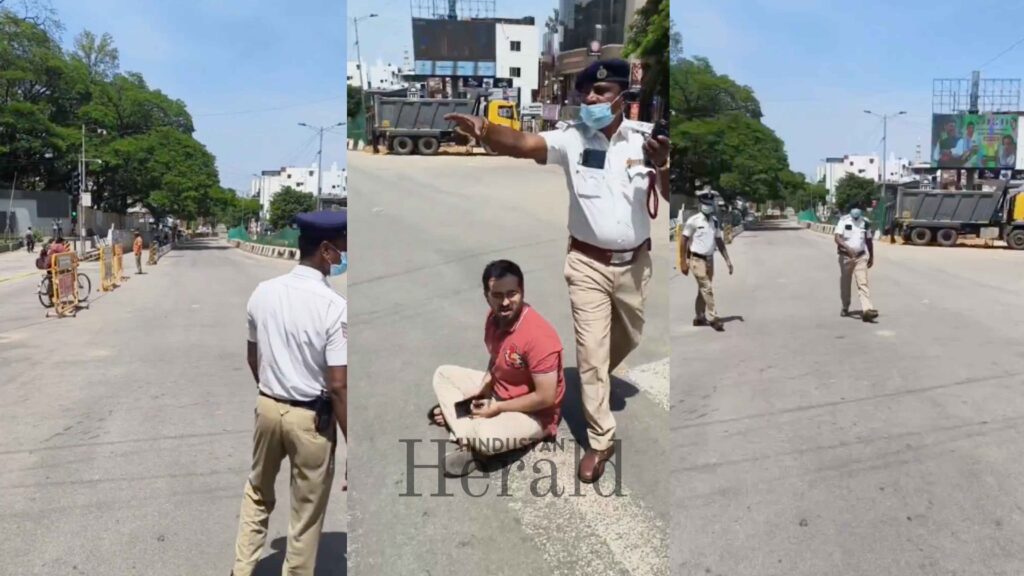
But the social contract around VIP privilege is fraying in urban India in a way that is genuinely different from ten years ago. Citizens who grew up accepting that VIP convoys simply cleared roads are increasingly refusing to treat that as inevitable. The image of a man trying to carry his pregnant wife through gridlock while a Governor’s convoy passes is not an abstract policy failure. It is a specific moment with a specific face.
The Bengaluru Traffic Police restored movement after the convoy passed. But, as Siasat Daily reported, the incident left commuters fuming and renewed calls for better planning during VIP visits.
“Better planning” is a phrase that gets used after every such episode and then quietly shelved. What this city arguably needs now is something more than a phrase. A written, enforceable protocol. One that mandates advance public advisories whenever a VVIP movement is planned through a corridor already under construction stress. One that requires pre-positioned personnel on alternative routes before the closure, not after. One that sets a maximum halt duration and maintains a dedicated lane for emergency vehicles at all times, regardless of who is passing through.
None of that currently exists in any binding form.
What Comes Next
The immediate ask from commuters and civil society groups is not complicated. Issue advisories. Deploy traffic police on alternate routes before the convoy moves. Reroute VIP movements away from construction-stressed corridors where possible. These are not radical demands. They are basic administrative competence.
The slightly bigger ask is for the Karnataka government and Raj Bhavan to revisit standard operating procedures for Governor-level convoy movements in metro cities. The assumption that roads can be sealed at will, without consequence, was built for an India where traffic volumes were a fraction of what they are today. That assumption needs updating.
The biggest ask is also the simplest: acknowledge that Sunday was not acceptable. Say it plainly. Commit to ensuring it does not happen again.
That acknowledgement has not come from Raj Bhavan. It has not come from the Karnataka government. It has not come from Bengaluru Traffic Police.
For now, the man carrying his pregnant wife through a broken road, waiting for a convoy to pass, remains its own statement on where ordinary people sit in the priority order of Indian governance.
Stay ahead with Hindustan Herald — bringing you trusted news, sharp analysis, and stories that matter across Politics, Business, Technology, Sports, Entertainment, Lifestyle, and more.
Connect with us on Facebook, Instagram, X (Twitter), LinkedIn, YouTube, and join our Telegram community @hindustanherald for real-time updates.

Regional journalist bringing grassroots perspectives and stories from towns and cities across India.
- Sandeep Verma

- Sandeep Verma
- Sandeep Verma
- Sandeep Verma




 Herald Desk
  Ananya Sharma
  Ayesha Khan