 By Shelesh Joshi and Rajiv Menon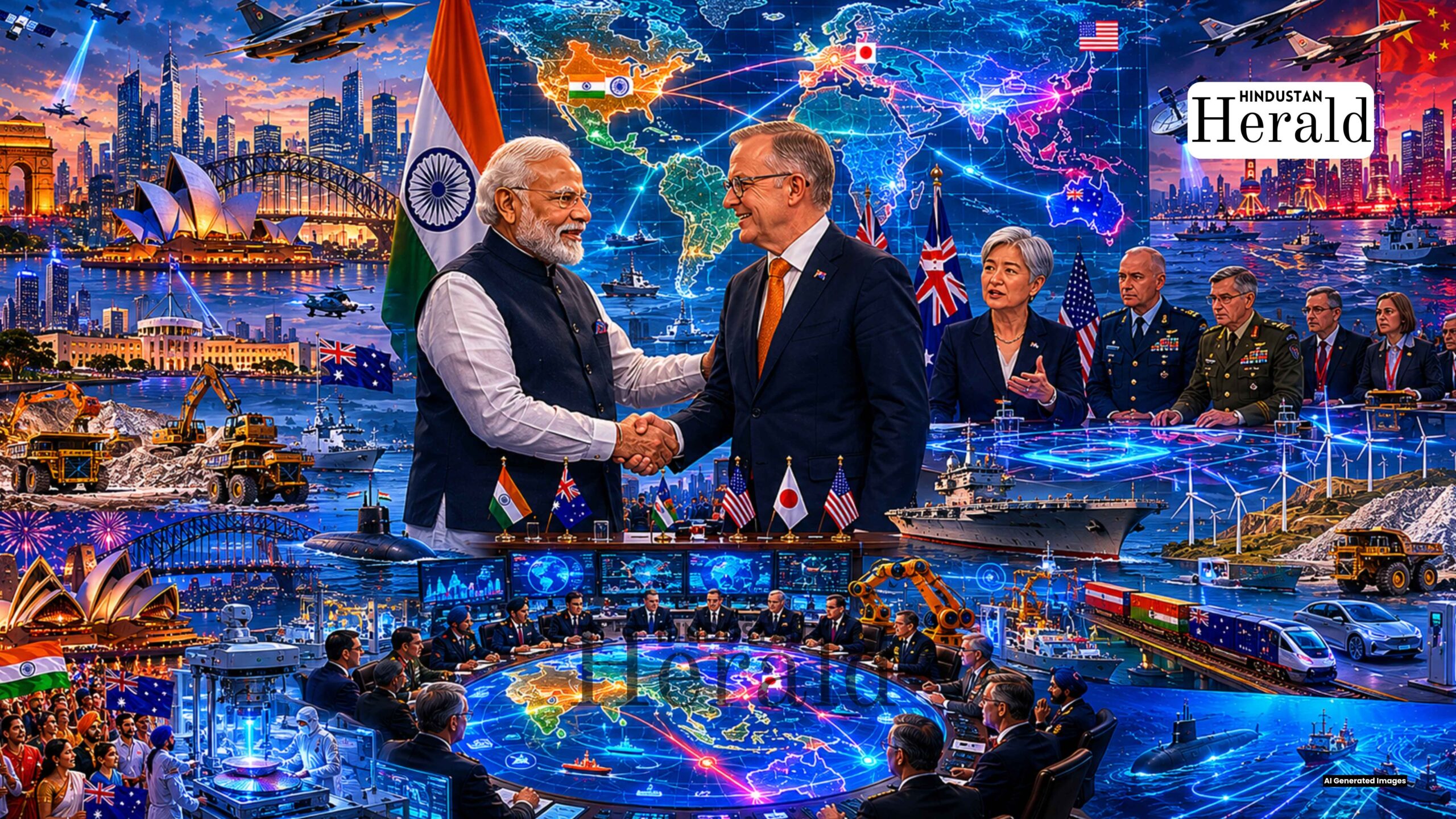
New Delhi, May 26: The Modi Australia Visit, now confirmed by Australian Foreign Minister Penny Wong, has done something that years of careful diplomacy could not quite manage it has pushed India and Australia to the front page of each other’s foreign policy priorities. For too long the relationship existed in a kind of diplomatic middle distance. Present. Acknowledged. Occasionally warm. But never urgent enough to dominate the conversation in either capital. That changed last week. Wong stood before reporters and confirmed that Prime Minister Narendra Modi would be visiting Australia in the “near future.” It was a short statement. It was not a small one.
Wong did not hedge. She did not say “we hope” or “discussions are ongoing.” She said they look forward to the visit. She called the relationship one of the most important Australia has. That kind of language, from a foreign minister of her calibre, does not come out casually at a press conference. Someone chose those words. Someone signed off on them.
This would only be the second time a sitting Indian Prime Minister has visited Australian soil. The first was Modi himself, back in November 2014, when he addressed thousands of screaming Indian Australians at an arena in Sydney and set off what became a decade long upgrade of the relationship. Twelve years later, he is being invited back. And the world those two countries are operating in now looks nothing like 2014. Here are the five reasons this Modi Australia Visit is being watched so closely and why at least one capital is not happy about it.
Reason 1: The Modi Australia Visit Seals A Quad That Beijing Cannot Ignore
The Quad the four nation grouping connecting India, Australia, the United States and Japan has always made Beijing uncomfortable. China has spent years dismissing it as an “Asian NATO,” a containment architecture dressed up in the language of rules based order. New Delhi has consistently pushed back on that framing. India does not do alliances, the argument goes. The Quad is a cooperative framework, not a military pact.
That is technically accurate. But a Modi visit to Canberra in 2026 in the same strategic calendar as ongoing Quad consultations, Indo Pacific supply chain realignments, and deepening India US defence ties will not be read by Beijing as a routine diplomatic courtesy call. It will be read as a demonstration of solidarity. A signal that the four democracies at the corners of the Indo Pacific are moving closer, not drifting apart.
The Quad has evolved far beyond its early identity as a vague maritime arrangement. Recent summits have produced concrete commitments on semiconductor supply chains, undersea cable security, vaccine distribution, clean energy financing, and infrastructure investment across the Global South. A Modi Albanese bilateral on the sidelines of that architecture carries weight that neither side is pretending otherwise.
For Beijing, which monitors Indo Pacific alignment with considerable precision, a warm and well publicised Modi visit to Australia is one more data point in a trend line that it does not like. That alone makes this trip geopolitically significant.
Reason 2: Both Countries Got Burned By China And That Changes Everything
Here is what most coverage of this relationship misses. The reason India and Australia are genuinely close today not just rhetorically close, but structurally close is not because of shared values or cricket or the Commonwealth. It is because both countries got hurt by the same source of pressure, within a couple of years of each other, and drew similar conclusions.
Australia’s falling out with China was ugly and protracted. Between 2018 and 2023, Beijing slapped trade sanctions on Australian coal, barley, wine, beef, lobster, and timber. The trigger was Canberra’s call for an independent inquiry into the origins of Covid 19 a reasonable ask that Beijing treated as a provocation. Australian farmers and exporters paid the price. The lesson was not subtle: economic dependence on a single large partner is a vulnerability, not a relationship.
India had its own version of that lesson, more violent and more immediate. In June 2020, twenty Indian soldiers were killed in hand to hand combat with Chinese troops in the Galwan Valley. That is not a border skirmish. That is men dying with rocks and iron rods in their hands at fifteen thousand feet. Whatever remained of the diplomatic warmth between New Delhi and Beijing after that night did not survive it.
Two democracies. Same pressure point. Similar conclusions. That is not a coincidence. That is the real foundation of what is being built here. And it is the kind of foundation that does not crack easily, because it was not built on optimism. It was built on experience.
Reason 3: A USD 27 Billion Trade Relationship That Has Barely Started
When India and Australia signed the Economic Cooperation and Trade Agreement the ECTA in 2022, it was the first trade deal India had signed in over a decade. Think about that. One of the largest economies in the world had gone more than ten years without completing a bilateral trade agreement with anyone. The ECTA broke that streak.
As Business Standard reported at the time, the deal delivered real tariff cuts on Indian goods textiles, leather, jewellery, engineering products and gave Australian agriculture and resources better access to Indian consumers. Two way trade is now pushing toward USD 27 billion. That sounds significant until you realise how much larger it should be, given the size of both economies and the complementarity of what each produces and needs.
The fuller deal the one covering services, investment, and professional qualifications is still being negotiated. That is where the real money is for India. Getting mutual recognition of Indian engineering degrees, medical qualifications, and IT certifications in Australia would matter directly to hundreds of thousands of people. These negotiations have moved slowly. A Modi visit creates exactly the kind of political pressure that sometimes unsticks them.
Beijing has its own read on this. Every rupee of trade that flows between India and Australia outside of Chinese supply chains is a rupee that does not flow through them. The ECTA was a statement. A deepened investment agreement would be a louder one.
Reason 4: The Critical Minerals Deal That Could Redraw Global Supply Chains
Somewhere in every briefing document prepared for this visit, there will be a section on critical minerals. And unlike a lot of diplomatic language, this one deserves every bit of attention it gets.
Australia has lithium. It has cobalt. It has nickel and rare earth elements in quantities that most countries can only envy. These are the raw materials that go into every electric vehicle battery, every solar panel inverter, every piece of advanced defence equipment that runs on modern electronics. The problem for India, for Europe, for the United States, for anyone trying to build a clean energy industrial base is that almost all of the world’s processing capacity for these materials currently sits inside China. Mine it in Australia, ship it to China, get it processed, buy it back. That is how the supply chain works today. It is not a chain anyone is comfortable with anymore.
India is trying to change its position in that chain. The government’s push on domestic EV manufacturing and battery storage is real and accelerating. But you cannot build batteries without lithium. You cannot secure that supply reliably without a partner who has it and is willing to build processing infrastructure outside of Beijing’s reach.
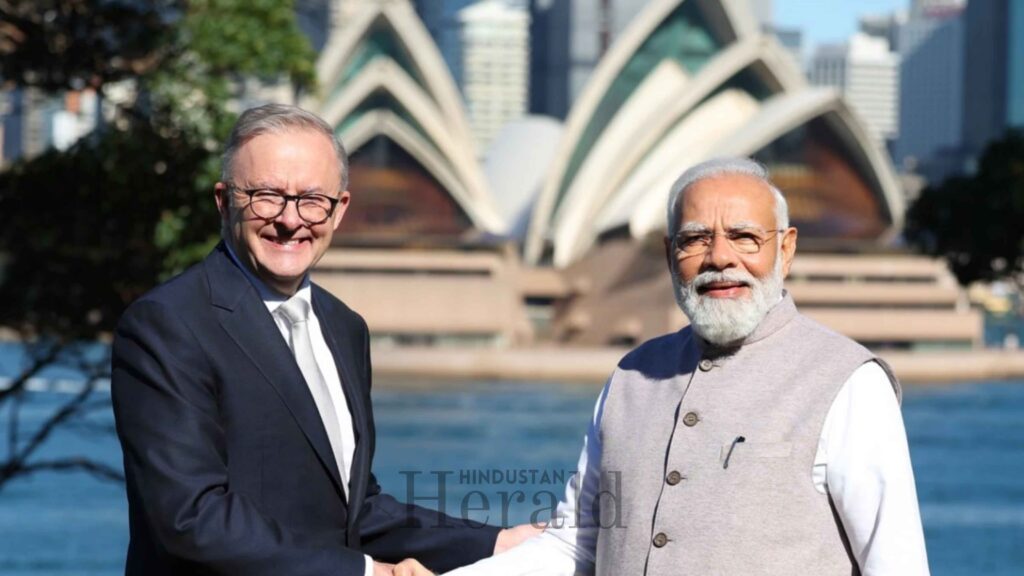
India and Australia signed a Critical Minerals Investment Partnership in 2023, according to The Economic Times. It was a start. A Modi Australia Visit could turn that start into something concrete actual projects, actual investments, actual facilities linking Australian mining to Indian manufacturing. These are not glamorous headlines. But they are the kind of structural deals that shape the next thirty years. And they are precisely the kind of deals that cut China out of a supply chain it currently dominates.
Reason 5: Eight Lakh People And A Diaspora Beijing Cannot Match
More than eight lakh people of Indian origin live in Australia right now. They are Punjabis and Tamils, Gujaratis and Keralites, first generation migrants and people whose grandparents came before them. They are nurses, software engineers, restaurant owners, university professors, and increasingly, local councillors and state politicians. They also still watch Indian news, still send money home, still fly back for weddings and funerals, and still feel in a way that is hard to articulate but very easy to feel that what happens in India happens to them too.
When Modi spoke in Sydney in 2014, the arena was packed. People had driven for hours. Some had flown in from other cities. The energy was not the polite enthusiasm of a diplomatic event. It was something far more personal.
That will happen again. And whatever you think about the politics of diaspora mobilisation, those moments build bridges that outlast any government, any trade agreement, any strategic framework. They create goodwill at a human level that no amount of official diplomacy can manufacture. Beijing has no equivalent of this in Australia. It does not have a community of eight lakh Chinese Australians who feel the same emotional pull toward the Chinese government that Indian Australians feel toward Modi. That asymmetry is soft power. Real soft power. And it matters more than it is usually given credit for in serious foreign policy discussions.
So When Is This Visit Actually Happening?
For now, no date has been confirmed. “Near future” is doing real diplomatic work in Wong’s formulation it signals intent without creating a commitment that scheduling complications could embarrass. The Ministry of External Affairs in New Delhi has not publicly added to what Wong said, which is itself informative. When both sides are being careful, it usually means the preparation is real.
Watch the coming weeks for senior official consultations between the two foreign ministries. Watch for any movement on the stalled full Free Trade Agreement. Watch for whether the 2+2 Foreign and Defence Ministers’ Dialogue gets scheduled, since that format typically sets the substantive agenda that leaders then endorse at the summit level.
And watch Beijing’s reaction. Because a Modi Australia Visit occurring in the same calendar year as Quad consultations, critical minerals negotiations, and a broader regional realignment around technology and supply chains will land in Chinese diplomatic calculations in ways that are not always visible but are always present.
The India Australia relationship took decades to become serious. It was neglected, underestimated, and described as full of potential for so long that the phrase lost all meaning. What is happening now is different. It is structural. It is deliberate. And when Modi finally lands in Canberra, it will not just be a visit. It will be a statement. Beijing will know exactly what kind.
Stay ahead with Hindustan Herald — bringing you trusted news, sharp analysis, and stories that matter across Politics, Business, Technology, Sports, Entertainment, Lifestyle, and more.
Connect with us on Facebook, Instagram, X (Twitter), LinkedIn, YouTube, and join our Telegram community @hindustanherald for real-time updates.

Tracking world politics, global markets, trade movements, policy decisions, and the changing balance of economic power.
- Shelesh Joshi

- Shelesh Joshi
- Shelesh Joshi
- Shelesh Joshi



Specializes in South Asian geopolitics and global diplomacy, bringing in-depth analysis on international relations.
- Rajiv Menon
- Rajiv Menon
- Rajiv Menon
- Rajiv Menon