 By Shelesh Joshi and Rajiv Menon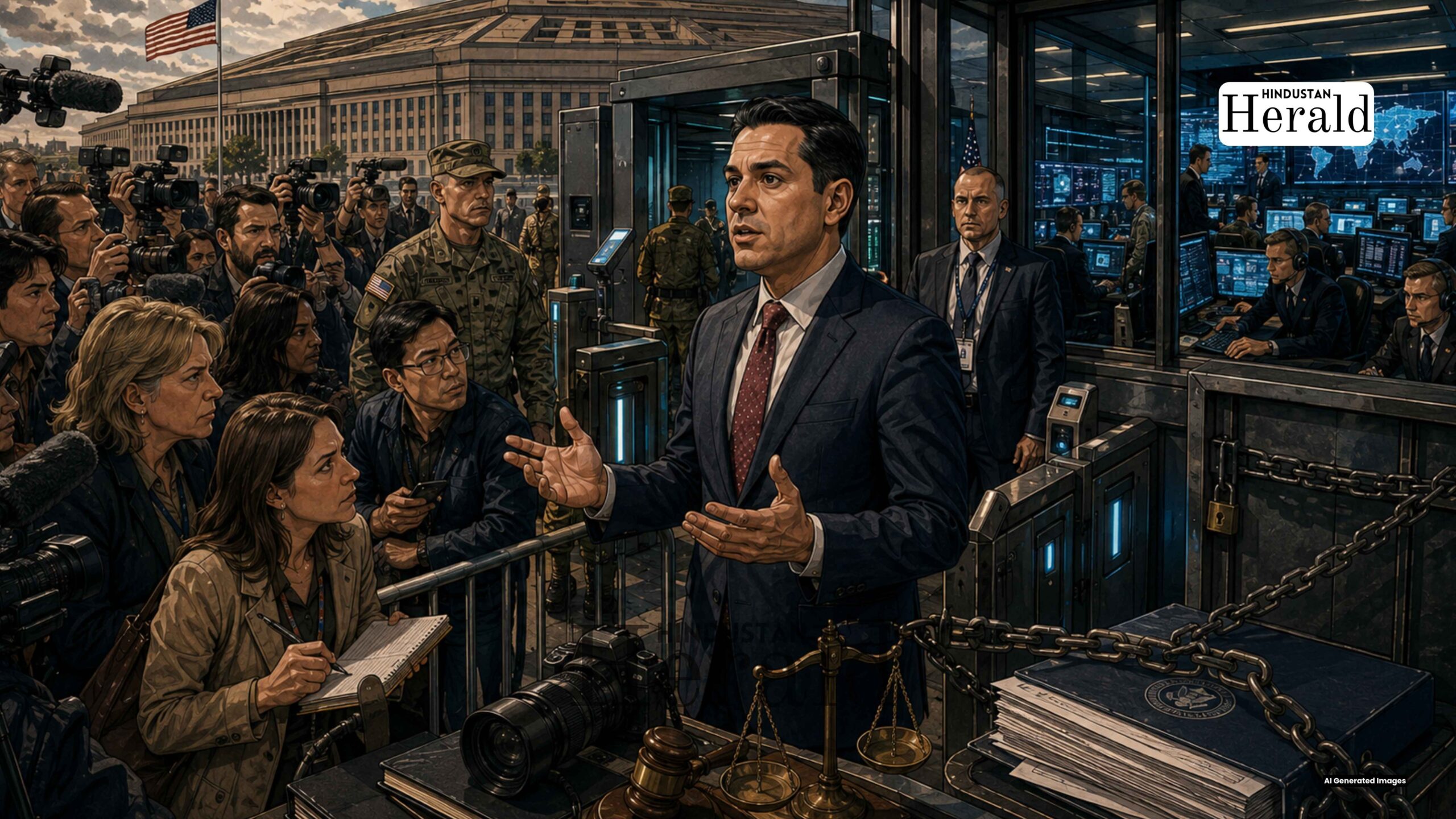
New Delhi, June 2: There is something almost theatrical about what the United States Defense Department did on the first day of June 2026. Pentagon press freedom took what may be its most damaging blow yet when the department took its own press office the room where journalists have spent decades chasing answers about the world’s most powerful military and declared it a classified space. Off limits. A secret. Then it said there was nothing controversial about that.
That last part, perhaps, is what sticks. Not just the act itself, but the complete absence of embarrassment with which it was announced. Acting Pentagon press secretary Joel Valdez posted the news on X, formerly Twitter, as though he were updating a cafeteria menu. The press office, he explained, had been redesignated as a Sensitive Compartmented Information Facility, because speechwriters from the Office of the Secretary of War now share the space and routinely handle classified material requiring access to SIPRNet the Pentagon’s highly secure classified internet network. Therefore, journalists are no longer permitted inside.
“There’s nothing controversial about that,” Valdez wrote. Press freedom organisations, legal scholars, and veteran defence correspondents across the United States responded with something between fury and disbelief. For readers in India a country whose defence relationship with America has grown into one of the most strategically significant partnerships in the Indo Pacific this is worth understanding carefully. Because what is happening inside that five sided building in Arlington, Virginia, carries consequences well beyond the press corps it is squeezing out.
Quick Summary
- The Pentagon formally redesignated its press office as a Sensitive Compartmented Information Facility (SCIF) on June 1, 2026, making it physically and legally off limits to all journalists.
- Acting press secretary Joel Valdez cited the presence of speechwriters from the Office of the Secretary of War who require access to SIPRNet, the Defense Department’s classified communications network, as justification for the ban.
- The New York Times has now filed 2 separate federal lawsuits against the Defense Department since December 2025, challenging restrictions that courts have found unlawful on at least 2 occasions.
- US District Court Judge Paul L. Friedman struck down the Pentagon’s original press restrictions in March 2026, but the department responded by replacing them with new barriers rather than restoring genuine access.
- National Press Club president Mark Schoeff Jr. called the SCIF designation a “remarkable and troubling escalation,” warning it places classified labels on a space whose entire purpose was public communication.
- India-US annual defence trade now exceeds 20 billion dollars, making the transparency of Pentagon communications a matter of direct strategic relevance to New Delhi.
What That Room Meant for Pentagon Press Freedom
Before any of this, the Pentagon press office was just a room. A busy, imperfect, often chaotic room where reporters with valid credentials could walk in without asking permission, pull up a chair, and talk to someone. That room was, for decades, the beating heart of Pentagon press freedom the physical space where accountability journalism about the world’s most powerful military actually happened.
That access sounds ordinary until you understand what it actually produced. The informal conversation that catches an official slightly off guard. The follow up question that a scheduled briefing would never allow. The reporter who notices something in a public affairs officer’s tone and pushes a little harder. This is not glamorous journalism. It is the daily, unglamorous work that Pentagon press freedom depends on and without it, the public gets only what the government chooses to hand over.
Previous Pentagon press secretaries under both Republican and Democratic administrations held off camera question sessions in that space. Reporters gathered on couches. Officials took questions they had not been prepped for. None of that was perfect, and none of it was the whole picture. But it was real access, and it produced real information that the public had a genuine interest in knowing. It was, in the most practical sense of the phrase, Pentagon press freedom functioning as it was designed to.
That is gone now. The Pentagon Press Office is now a Classified Space and the word “now” deserves to sit heavily in that sentence. Pete Hegseth, the former Fox News host who became Defense Secretary in early 2025, ended that dynamic almost from day one. The informal access vanished first. Then the physical presence of journalists was systematically rolled back across eighteen months of deliberate restriction. And now the room itself is dead reclassified into a legal category that journalists cannot enter under any circumstances, regardless of what any court might order about their right to be in the building.

The Pentagon Press Office being declared a Classified Space is not a bureaucratic footnote. It is the final confirmation that Pentagon press freedom, as it was known and practised for generations, has been deliberately and structurally dismantled. The Pentagon Press Office Now ‘Classified Space’ is not just a security designation it is a declaration, made without apology, that the room built to connect the world’s most powerful military to the public it serves will no longer serve that purpose. What was once a space for questions is now a space for secrets. And the difference between those two things is the difference between a democracy that accounts for itself and one that has quietly decided it no longer needs to.
What a SCIF Is, and Why This Particular Reclassification Is Clever
A Sensitive Compartmented Information Facility is, in plain terms, a room built and certified to handle America’s most sensitive intelligence. The walls, floors, and ceilings meet specific anti surveillance standards. The communications systems are isolated. Entry requires a government security clearance of a particular level. None of this is informal or negotiable.
Journalists, by the nature of their work, hold no such clearances. They are not supposed to. The independence of the press from government credentialing is a core principle of what makes press freedom meaningful.
When the Defense Department redesignates a room as a SCIF, it does not just make a policy decision about who can enter. It creates a structural and legal barrier that operates beyond the reach of the kind of judicial review that has been curbing the Pentagon’s media restrictions over the past year.
A judge can order the department to restore journalist access to a corridor or an office. A judge cannot order a journalist into a classified facility. The SCIF designation sidesteps the courts in a way that a credential policy or an escort requirement simply does not.
This is what makes the move significant beyond its immediate, practical effect. It is not just another rule. It is a reclassification that insulates the decision from the legal challenges that have been the only meaningful check on Hegseth’s approach to the press.
Eighteen Months of Escalation
None of this came without warning. What has happened to the Pentagon press corps since early 2025 is a story of incremental restriction, each step individually defensible, each step making the next one easier.
In February 2025, the department restructured which news organisations could maintain dedicated workspace inside the building, introducing a rotation system that pushed out outlets including NBC News from booths they had occupied for decades. NBC said it was “disappointed” and vowed to continue reporting. The statement was dignified. The loss was real.
By May 2025, Hegseth had issued a formal memorandum banning credentialed reporters from most of the Department of Defense headquarters without prior approval and a government escort. He framed this in the language of national security, describing the protection of classified and sensitive information as “an unwavering imperative.”
The Pentagon Press Association was less diplomatic. It described the memo as a direct attack on press freedom, and linked each restriction explicitly to a pattern of deliberate impediment rather than genuine security concern.
September 2025 brought the most extraordinary demand of all. The Pentagon told journalists they could not cover the department unless they signed an agreement pledging not to publish any information including unclassified information without authorisation from a department spokesperson. Sign it, or lose your press pass.
Most major news organisations refused. In October 2025, reporters from across the ideological spectrum organisations as different from each other as The New York Times and Fox News surrendered their access badges and walked out of the building rather than surrender their editorial independence. It was, by any measure, an extraordinary moment in the history of American defence journalism.
The lawsuits followed. The New York Times filed its first case against the Defense Department in December 2025, arguing the policies violated the First Amendment. In March 2026, US District Court Judge Paul L. Friedman agreed, ruling that the Pentagon’s restrictions were unlawful and ordering the department to restore access.
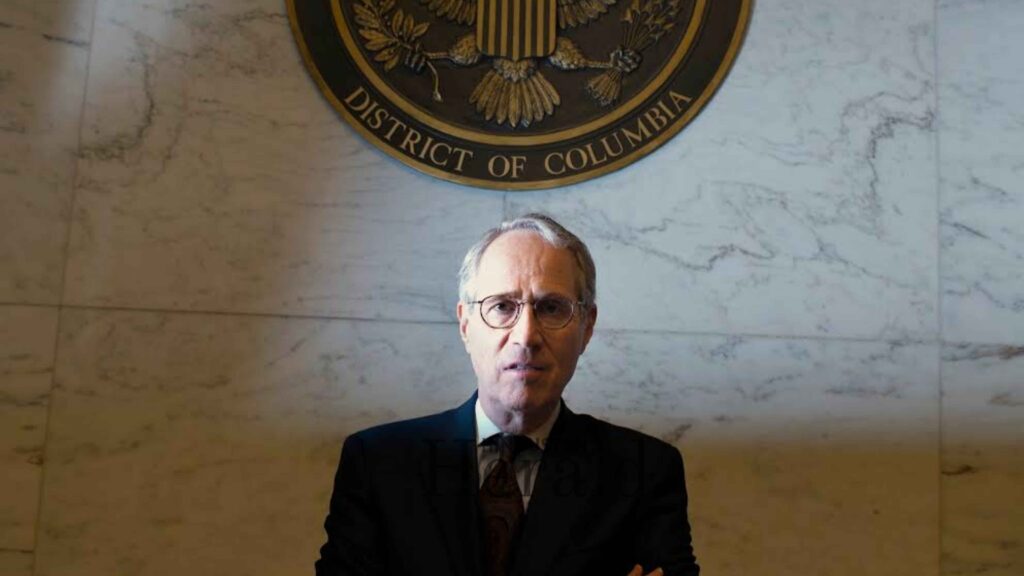
The department did not restore the previous system. It introduced mandatory escort requirements for all journalists inside the building and called this a compromise. Judge Friedman ruled in April 2026 that the escort policy violated his earlier order. The government appealed. An appeals court granted a stay on part of Friedman’s ruling, leaving the escort requirement in effect while the appeal proceeds.
In May 2026, the Times filed a second lawsuit, arguing that the escort requirement was “an unconstitutional attempt by the Pentagon to prevent independent reporting on military affairs.” And then, while that lawsuit was still pending, came the SCIF designation.
Photographers, Couches, and a Particular Kind of Pettiness
There is one detail from earlier this year that deserves to be mentioned, because it illuminates the character of what is happening at the Pentagon.
In March 2026, press photographers were banned from Pentagon press conferences. The reason, as reported by The Washington Post citing two people familiar with the matter, was that photos from a recent briefing were considered “unflattering” to Secretary Hegseth. The cameras went away.
It would be easy to file this under minor grievance, except that it fits perfectly into the larger picture. The restrictions being imposed on the press at the Pentagon are not all driven by genuine operational security concerns. Some of them are driven by the kind of image management that belongs in a public relations department, not a defence ministry. The gap between the stated justification national security, classified material, SIPRNet access and the observed behaviour is wide enough to drive a tank through.
Seth Stern of the Freedom of the Press Foundation has been among those pointing this out directly. He has questioned whether the SCIF designation is genuinely about speechwriters and classified networks, or whether it is the latest in a series of administrative manoeuvres designed to achieve through classification law what the courts have repeatedly said cannot be achieved through press policy. It is a fair question. And the administration has not answered it.
What the Press Freedom World Is Saying
Mark Schoeff Jr., president of the National Press Club, did not mince his words when the SCIF designation was announced. “Calling a press workspace classified does not make the government more transparent,” he said in a formal statement. “It creates yet another obstacle between journalists and the information Americans have a right to know, especially at a moment when the public needs clear, unfiltered information about the US military.”
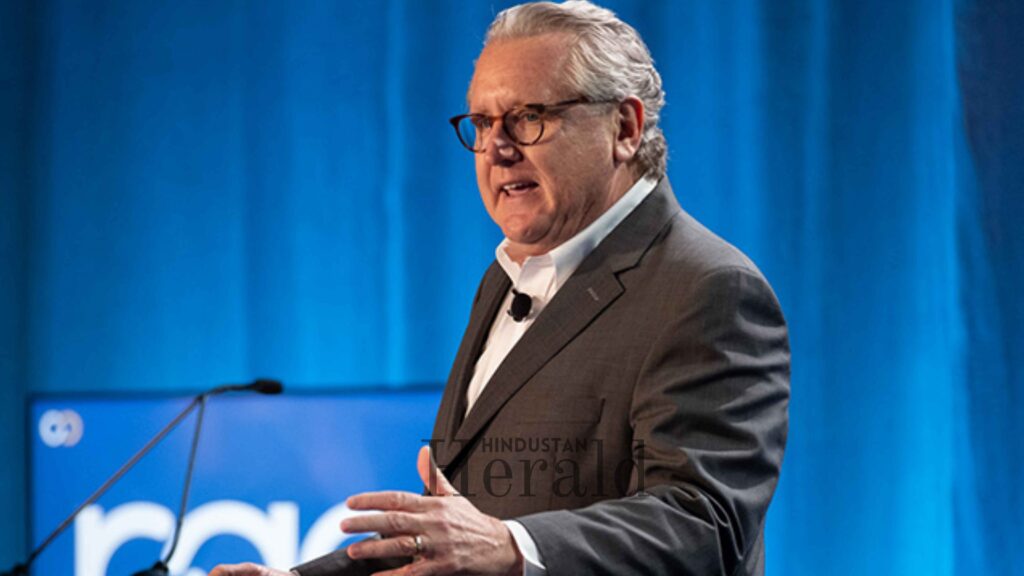
He went further, describing the move as a “remarkable and troubling escalation in the Defense Department’s ongoing effort to restrict independent reporting.” The word “escalation” is doing important work in that sentence. It acknowledges that this is not an isolated decision it is the latest step in a direction that has been clear for eighteen months.
The Freedom of the Press Foundation echoed those concerns, with Stern noting that the administration’s suggestion that journalists use Freedom of Information Act requests as a substitute for direct access is not a genuine offer of transparency. FOIA requests to the Defense Department are subject to significant delays and heavy redactions. Pointing reporters toward FOIA while simultaneously blocking their physical access to officials is, as Stern described it, a bad faith gesture dressed up as accommodation.
Valdez, for his part, pushed back on all of it. “This is the most transparent war department in history,” he wrote on X. “No amount of spin from the fake news media will change that.” He posted this on the same day the department barred journalists from the room where transparency is supposed to happen.
Why India Cannot Afford to Treat This as Someone Else’s Problem
For readers in New Delhi and across India, there may be a temptation to view this as an internal American dispute a quarrel between an aggressive administration and an aggrieved press corps that does not intersect with Indian interests. That reading would be a mistake.
The India-US defence relationship has been one of the defining strategic developments of the past two decades. Annual bilateral defence trade now exceeds 20 billion dollars, compared to almost nothing in the late 1990s. The two countries conduct joint military exercises across all three services. India is a Major Defence Partner of the United States a designation held by no other country outside formal treaty alliances. Cooperation spans naval access, joint technology development under INDUS-X, intelligence sharing frameworks, and the broader vision of a free and open Indo-Pacific that both governments have publicly committed to.
In this context, what happens inside the Pentagon matters to India in a direct and practical sense. The strategic assessments made by Indian defence analysts, the reporting done by Indian defence journalists, the positions taken by New Delhi in diplomatic settings all of these are informed by the quality of information available in the public domain about American military posture, priorities, and decision making.
When that information is filtered through official statements rather than independent reporting, it changes in character. Official statements are designed to communicate what the government wants communicated. Independent journalism is designed to find what the government would rather leave unsaid. The difference between the two is not aesthetic. It is the difference between propaganda and accountability.
India sits in a region where China’s military expansion, Pakistan’s strategic calculations, and the broader contest for influence in the Indian Ocean make accurate information about American military intentions genuinely consequential. If the primary source of that information becomes Pentagon press releases and approved statements, the reliability of what reaches New Delhi degrades accordingly.
A Playbook That Others Are Watching
Beyond the immediate India angle, there is a wider observation worth making. The United States has, for decades, positioned itself as a global advocate for press freedom. Its State Department publishes annual reports on press freedom conditions in other countries. Its diplomats raise journalist access issues with governments in Asia, Europe, Africa, and Latin America. The contrast between that posture and what is currently happening inside the Pentagon has not gone unnoticed by the countries on the receiving end of those diplomatic messages.
Governments that restrict their defence ministries to journalists and are told by Washington that this reflects poorly on their democratic credentials are paying attention. The precedent being set is not just about the United States. It is about what becomes acceptable when a powerful democracy decides that the press is an obstacle rather than a partner.
The tools being used are worth noting specifically, because they are the tools of a system that still calls itself open. There are no arrests. There are no newsroom closures. Editors are not being jailed and reporters are not disappearing. Instead, there are badge requirements and escort mandates and SCIF designations and appellate stays. Each step is narrow enough to be argued, and broad enough, in aggregate, to achieve the same functional result: a press corps that cannot get close to the people and the places it is supposed to cover. This is a playbook that others will study. Some will replicate it.
Where This Goes Next
The legal battles are not over. The New York Times’ second lawsuit, challenging the escort requirement, is still working its way through the courts. The Defense Department’s appeal of Judge Friedman’s ruling is ongoing. The SCIF designation will almost certainly face its own legal scrutiny, though the classification framework makes that a significantly more complicated challenge than access policy litigation.
For now, the people who cover the American military must request appointments to talk to the officials they used to approach in a hallway. They must be escorted through a building they once navigated on their own credentials. And the office that served for decades as the institutional bridge between the world’s most powerful military and the public it serves is, as of this week, a classified space. Valdez said there is nothing controversial about that.
He is wrong. There is something deeply, essentially controversial about a defence ministry that treats its own press office as a state secret. And in a world where India, America, and a dozen other democracies are trying to hold a shared vision of openness together against real and growing pressures, the erosion of that standard inside Washington carries weight that no official statement, however confident in tone, can explain away
Stay ahead with Hindustan Herald — bringing you trusted news, sharp analysis, and stories that matter across Politics, Business, Technology, Sports, Entertainment, Lifestyle, and more.
Connect with us on Facebook, Instagram, X (Twitter), LinkedIn, YouTube, and join our Telegram community @hindustanherald for real-time updates.

Tracking world politics, global markets, trade movements, policy decisions, and the changing balance of economic power.
- Shelesh Joshi

- Shelesh Joshi
- Shelesh Joshi
- Shelesh Joshi





Specializes in South Asian geopolitics and global diplomacy, bringing in-depth analysis on international relations.
- Rajiv Menon
- Rajiv Menon
- Rajiv Menon
- Rajiv Menon