
 By Shelesh Joshi and Rajiv Menon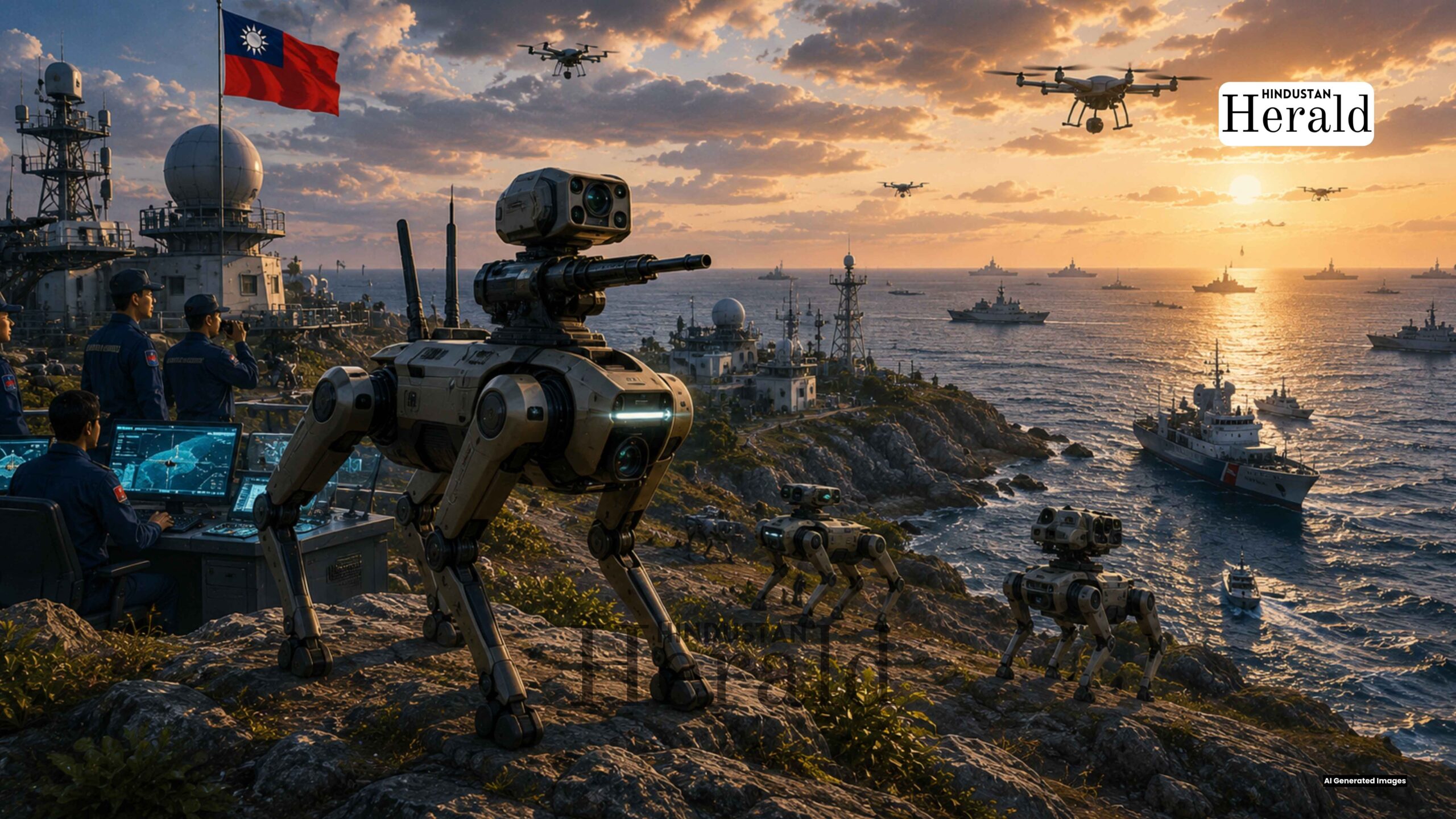
New Delhi, June 2:So Taiwan Robot Dogs made the news this week. Three of them, walking around a ministry courtyard in Taipei on Tuesday morning like something out of a sci-fi film that nobody asked for. One had a gun on its back. Officials called it a “demonstration.” They used phrases like “the military has expressed a need” in that careful, bureaucratic way that defence establishments everywhere use when they are actually very serious about something and do not want to sound alarmed.
The story got picked up mostly as a curiosity. Taiwan Robot Dogs, South China Sea, Beijing. Fun headline, easy to scroll past. But the thing is, if you spend a little time looking at where these machines are supposed to go and why, it stops being a curiosity pretty quickly. It starts looking like a small island trying to figure out how to hold on to some very distant, very exposed pieces of land before it is too late to hold them at all.
Quick Summary
- Taiwan’s National Chung-Shan Institute of Science and Technology unveiled 3 robot dog variants on June 2, 2026 one for scouting, one for surveillance, and one carrying a mounted gun on its back.
- The platforms are based on hardware from Ghost Robotics, a Philadelphia firm that already supplies four legged robots to the US Department of Defense.
- Taiwan administers Itu Aba in the Spratlys and the entire Pratas Islands chain both over 400 kilometres from the Taiwan coast, inhabited only by coast guard personnel.
- China’s PLA 72nd Group Army debuted armed robot wolves in a live Taiwan Strait assault drill in October 2025 each machine weighing 70 kilograms, with a 20-kilogram payload capacity and a firing range of 100 metres.
- Taiwan ordered nearly 50,000 military drones in July 2025 for NTD 50 billion (USD 1.68 billion), then watched the legislature slash the wider defence budget by 38 percent in May 2026.
- India has sold BrahMos missiles to the Philippines, transferred INS Kirpan to Vietnam, and is building INS Varsha in Andhra Pradesh a nuclear submarine base that partly answers China’s growing naval presence near the South China Sea.
Start With the Geography, Because It Explains Everything
Itu Aba. Spend a minute trying to find it on a map if you can. It is a narrow strip of land in the Spratly Islands technically the biggest natural island in the entire group, which sounds impressive until you realise how small the Spratlys are. There is a short runway. There are coast guard officers living there. And it sits roughly 1,600 kilometres from Kaohsiung, the nearest major Taiwanese port city.
For context, that is further than the distance from Delhi to Mumbai. Except instead of a highway or a flight, you are crossing open South China Sea, with no friendly port on the other end and with Chinese ships increasingly in the water around you.
Then there are the Pratas Islands, which Taiwan calls Dongsha. They sit at the northern end of the South China Sea, somewhere between southern Taiwan and Hong Kong, about 400 kilometres offshore. No residents. A coast guard outpost. Nothing else. Taiwan has been administering them for decades, but administering them does not mean much in practice when you are 400 kilometres from your nearest support base and the other side has been gradually making itself more present in those waters.
Taiwan deliberately kept its military off both sets of islands. Coast guard instead of marines softer, less provocative, a way of saying we are here but we are not looking for a fight. For years that policy held up reasonably well. Beijing mostly left Itu Aba alone. The Pratas barely registered in the news. That has been changing. Not dramatically. Not in ways that make the front page every week. But steadily.
Chinese coast guard vessels have been turning up more frequently near the Pratas. Surveillance drones have started appearing overhead. In early 2026, one flew directly over the islands. Taiwan’s defence ministry put out a statement calling it “provocative and irresponsible,” which is true, but a statement is not a deterrent. By April, Taiwan’s own coast guard minister was standing up in public and acknowledging that China had expanded what she called gray zone operations around the islands that slow, grinding, technically not a war pressure that is designed to exhaust whoever is on the receiving end.
You keep sending people to a remote atoll with inadequate support, under constant surveillance, with the other side circling closer every few months, and eventually you have a morale problem, a logistics problem, and a political problem all at once. Or you send a robot dog that doesn’t care about any of that.
The Obvious Question: Why Send Taiwan Robot Dogs to a Remote Island?
Here is what life on the Pratas actually requires if you are doing it with humans. Regular resupply runs. Food, medicine, equipment, fuel. Each one costs money and personnel and time, and each one happens while Chinese coast guard vessels are somewhere nearby and while the political pressure to not make a big deal of it remains constant. The people stationed there need to be rotated before isolation gets to them.
If someone gets seriously hurt, you need to get them out fast 400 kilometres of open sea fast. And you need coverage at all hours, which means shifts, which means gaps between shifts, which means windows.
Taiwan’s Robot Dogs have none of those constraints. They do not need food or a rest rotation. They do not develop the kind of psychological wear that comes from months of isolated posting in a tense environment. They do not need an emergency helicopter at 3 in the morning if one gets damaged on a beach patrol. You send a technician with spare parts.

They can run a coastline scan continuously. Tag anything anomalous. Relay real time data back to the mainland. An armed version can hold a perimeter overnight in a way that asks nothing of the humans who would otherwise have to stand there. That is the practical case. The strategic case is slightly different but runs in the same direction.
Analysts who have been watching Taiwan tests robot dogs that could guard South China Sea islands have pointed to something Taipei has been building toward for years a doctrine that academics and security writers call the “porcupine strategy.” The idea is not to match China plane for plane or ship for ship, which Taiwan cannot do. It is to distribute enough small, stubborn, hard to remove capabilities across its territory that attacking it becomes more trouble than it is worth. The calculation is not that Taiwan wins a war. It is that Beijing keeps deciding not to start one.
A robot dog on a remote beach is one more quill. It does not stop a fleet. But it raises the cost of a quiet encroachment. It means any approach to those islands is logged, flagged, and recorded. Silence becomes harder. That is worth something.
The supply chain picture adds another layer. News that Taiwan tests robot dogs that could soon guard South China Sea islands has drawn attention to a less discussed part of the programme the deliberate effort to build a robotics production line that excludes Chinese made components at every stage.
According to The Defense Post, the Chung-Shan Institute has made this a hard requirement across its robotics procurement, because a supply chain with Chinese components is a supply chain that could be disrupted at precisely the moment it is needed most. China Steel Corporation is making specialised motor materials. HIWIN is handling precision parts. Allied Power, a local firm, has its own robot platform in development and is working with US based AI company Ainos on sensing and detection systems. Ghost Robotics confirmed earlier this year that it is in active joint development with Taiwanese manufacturers to localise production fully an arrangement designed to keep the programme running even if the geopolitical environment around it deteriorates sharply.
China Ran This Playbook Eight Months Ago
One detail that got less attention than it deserved: China already did this. In October 2025, Chinese state television aired footage from a full amphibious landing exercise conducted by the PLA’s 72nd Group Army the unit stationed in the Eastern Theater Command, the one that would lead any real operation across the Taiwan Strait in which four legged robot wolves served as the assault’s first wave. The footage ran on CCTV-7. It was the first time cameras had ever shown a PLA infantry unit sending autonomous ground machines in ahead of its soldiers, and Beijing clearly wanted the footage seen.
The machines come from China South Industries Group. Each one weighs 70 kilograms, carries a 20-kilogram payload enough for rifles, breaching charges, ammunition and can engage targets at up to 100 metres. In the exercise, they crossed beach obstacles, broke barricades, moved supplies to dispersed troops, and laid down covering fire while marines came in behind them.
Brigade Commander Wang Rui described the logic for the cameras in plain terms: the robots “absorb the first wave of enemy fire to open a safe corridor for infantry troops during beach landings.” That is the whole doctrine in one sentence. Send the machines first. Let them take the bullets. Keep the people behind them alive.
Not everything about the exercise looked convincing. The South China Morning Post, reviewing the same CCTV documentary, noticed a clip where a defending soldier shot down one of the wolf robots as it crossed open beach terrain. Moving fast but unarmoured across open ground turns out to have predictable vulnerabilities. Both sides would have noted that.
Still: China put autonomous armed robots into a Taiwan Strait scenario operationally in October 2025. Taiwan watched, spent several months building a response, and showed it to the press this Tuesday. That is the actual sequence of events here.
A Budget Crisis Nobody Advertises
Taiwan’s defence modernisation story has a part that press event coverage does not naturally include. In July 2025, the defence ministry placed a landmark autonomous systems order nearly 50,000 military drones from domestic manufacturers, valued at roughly NTD 50 billion or around USD 1.68 billion. The philosophy came straight from Ukraine’s playbook: treat small unmanned systems the way armies treat ammunition, order in volume, field at scale, replace continuously, and make attrition economics work in your favour rather than your adversary’s. It was, genuinely, one of the more strategically coherent procurement decisions any government had made in the region in years.
Ten months later, in May 2026, Taiwan’s opposition led legislature cut the broader special defence budget by 38 percent. Domestic drone procurement for 2026 was eliminated entirely. Joint research programmes with the United States that had been building for years were defunded mid stream. The Chung-Shan Institute’s robot dog project survives this because it sits within the military’s standing budget rather than the contested special appropriation. But the legislative fight makes visible something that polished defence ministry demonstrations are not designed to show: Taiwan’s attempt to rearm is happening on two fronts simultaneously against escalating external pressure from Beijing, and against genuine domestic political resistance at home.
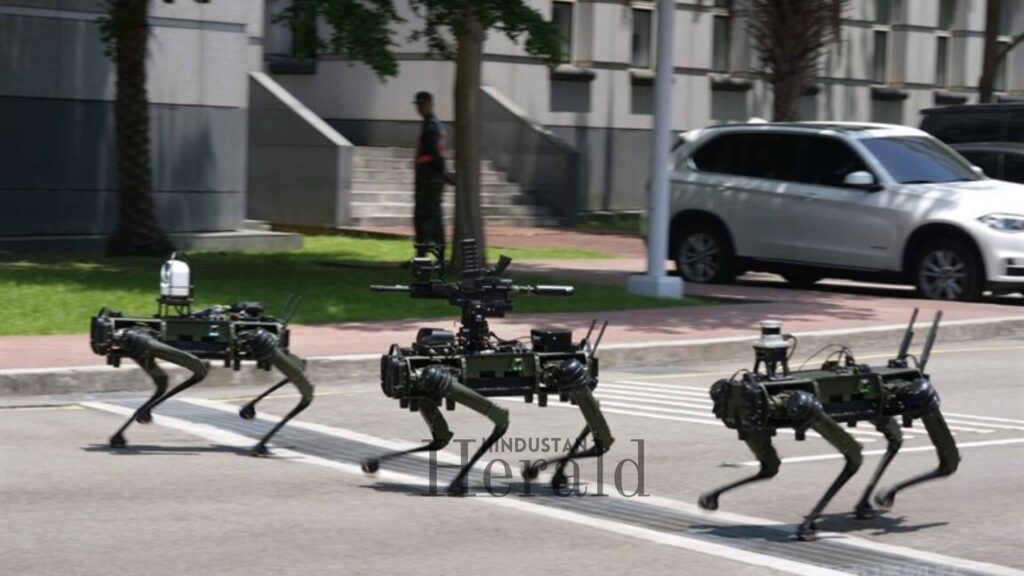
Tuesday’s demonstration was a message to the legislature as much as it was a message to China. This is what we are building. This is why it matters. This is what you are voting to defund when you cut the budget.
Why This Is Also India’s Problem
The honest case for why Indian readers should care about robot dogs on a distant atoll takes about thirty seconds to make, and it has nothing to do with sentiment or alliance politics.
The South China Sea moves roughly USD 3 trillion worth of global trade every year. Indian exports to East Asia pass through these waters. The oil and gas that fuels Indian industry comes from the Gulf through routes that skirt or cross the South China Sea’s approaches. The shipping lanes that connect India to every significant Indo-Pacific trading partner run through or near the same contested space. India is not a claimant in the South China Sea disputes. But it has a large and direct economic interest in who controls those lanes and on what terms, and that interest grows every year as India’s trade footprint expands eastward.
China has spent a decade converting sandbars and underwater reefs into military installations runways, radar systems, anti ship missile batteries on features that were uninhabitable rocks ten years ago. A 2016 international tribunal ruled that China’s sweeping territorial claims in the South China Sea had no basis in international law. Beijing dismissed the ruling and has not slowed construction since. The pattern is patient and it is cumulative: build facts in the water, slowly, until the water looks different enough that the old maps no longer describe reality.
India has been responding to this, not loudly but consistently. Three BrahMos missile batteries sold to the Philippines, which has been in an increasingly tense confrontation with Chinese coast guard vessels near Scarborough Shoal and the Second Thomas Shoal. The warship INS Kirpan transferred to Vietnam, which has its own territorial disputes with China in the sea and has been quietly building up its maritime defence. These are deliberate choices that reflect a reading of regional dynamics that a Southeast Asia better able to push back against Chinese maritime coercion is better for India than one that cannot.
At the Quad foreign ministers’ meeting in May 2026, India joined the United States, Australia, and Japan in reaffirming commitment to freedom of navigation in the Indo-Pacific. The language is carefully constructed to avoid naming anyone. The intent is not carefully constructed to avoid anything.
Defence Minister Rajnath Singh, at an ASEAN defence ministers’ gathering in Kuala Lumpur, invoked UNCLOS and said India’s advocacy for freedom of navigation “are not directed against any country but are meant to safeguard the collective interests of all regional stakeholders.” In South Asian and Southeast Asian diplomatic usage, “not directed against any country” is a phrase with a very specific country in mind. Everyone in that room knew it.

And then there is INS Varsha. A naval base being commissioned in Rambilli, Andhra Pradesh, built to berth up to 12 nuclear submarines. Part of the strategic logic is a direct answer to China’s Longpo Naval Base on Hainan Island, which gives the PLA Navy deep water submarine access to the northern South China Sea. Building a comparable installation on India’s eastern seaboard is a decision that will take years to fully appear on any map and decades to reverse. It is not a news cycle kind of commitment. It is a generational one.
Nobody Knows How This Ends
The robot dogs from Tuesday do not yet have deployment orders. Getting from a ministry courtyard demonstration to armed autonomous platforms stationed on Itu Aba or the Pratas involves a long list of things that take time procurement sign offs, logistics infrastructure, maintenance chains, legal frameworks for autonomous engagement in contested territory, and some fairly significant political decisions about how visibly Taiwan wants to escalate its posture on islands it has spent decades deliberately keeping low profile.
Officials were careful Tuesday to note that no order has been placed. Analysts who track Taiwan’s defence procurement say that is expected no military laboratory stages a public demonstration of an operational prototype and then abandons the programme. The order comes later.
What is not unclear is the direction. China put robot wolves into an amphibious Taiwan scenario in October 2025. Taiwan responded by building its own platforms, developing a domestic supply chain for them, and showing them to the press eight months later. That is not a coincidence. That is a sequence.
The South China Sea has been slowly getting more dangerous for a long time. Not in ways that make big news every week, but in the accumulated way that remote islands get circled a little more, drones fly a little closer, coast guard vessels spend a little more time in waters they weren’t in the year before, and reefs that were underwater become airstrips that are definitely not. The analysts who have been tracking this for years keep saying the same thing: the slow accumulation of small pressures doesn’t stay small. At some point the pieces are arranged badly enough that something goes wrong faster than anyone planned.
Three robot dogs in a Taipei courtyard are a small thing. They are also part of something larger that has been building for longer than this week’s news cycle will remember, and that will matter to far more countries than the ones directly involved in the dispute.
India is one of those countries. It has been acting like it for a while now, quietly and deliberately, even when the connection to events like Tuesday’s demonstration is not immediately obvious. It should probably keep doing that.
Stay ahead with Hindustan Herald — bringing you trusted news, sharp analysis, and stories that matter across Politics, Business, Technology, Sports, Entertainment, Lifestyle, and more.
Connect with us on Facebook, Instagram, X (Twitter), LinkedIn, YouTube, and join our Telegram community @hindustanherald for real-time updates.

Tracking world politics, global markets, trade movements, policy decisions, and the changing balance of economic power.
- Shelesh Joshi

- Shelesh Joshi
- Shelesh Joshi
- Shelesh Joshi





Specializes in South Asian geopolitics and global diplomacy, bringing in-depth analysis on international relations.
- Rajiv Menon
- Rajiv Menon
- Rajiv Menon
- Rajiv Menon