 By Shelesh Joshi and Rajiv Menon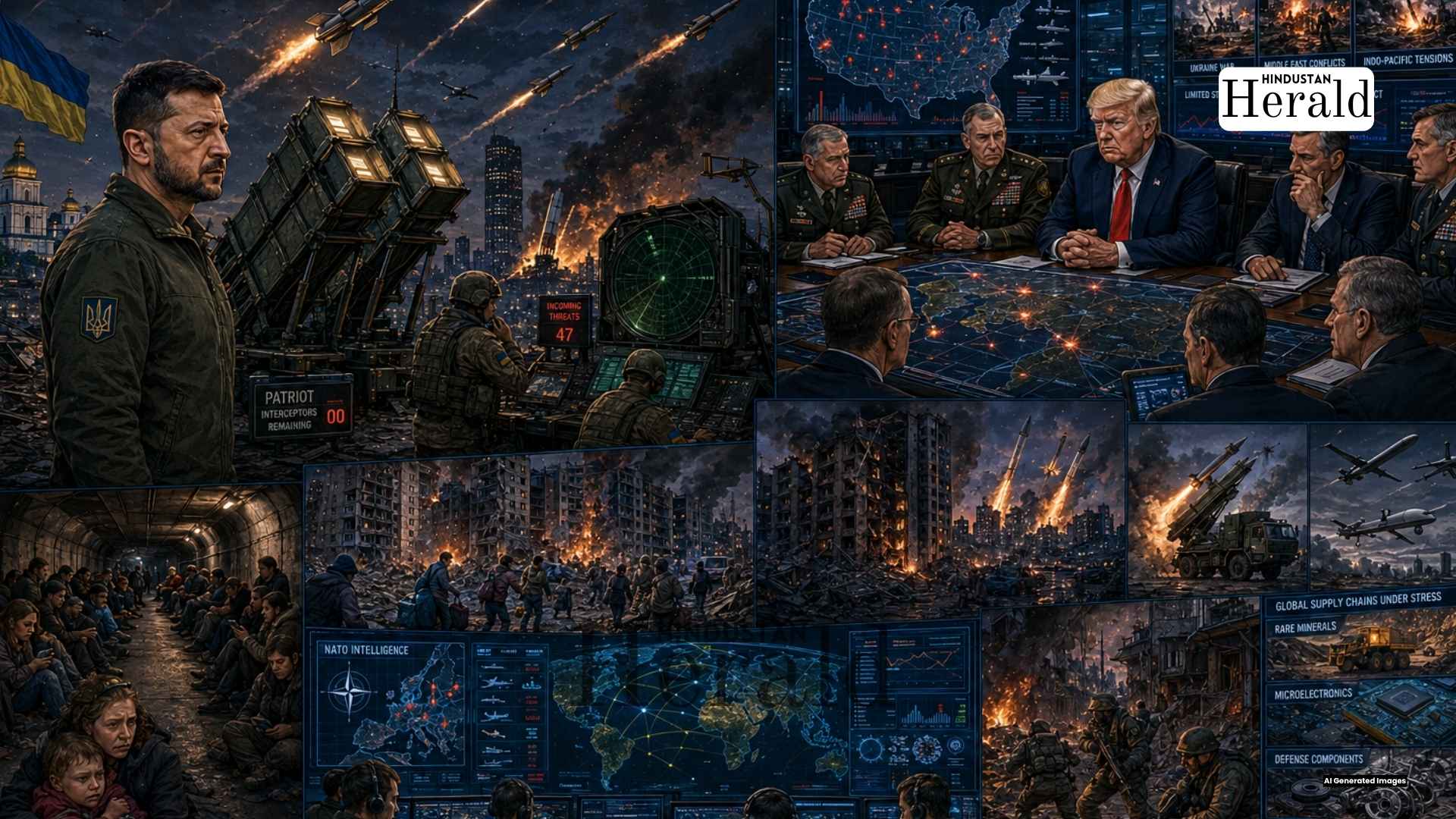
New Delhi, May 28: Start with the simplest fact. A Ukrainian president wrote a letter to an American president asking for missiles. Not a summit. Not a joint communique drafted by a committee of diplomats. A letter. When Zelenskyy asks Trump for more air defence, he is really saying something that should stop anyone mid scroll: Patriot air defence batteries sitting fully assembled on Ukrainian soil, pointing skyward, with nothing loaded inside them.
“For us, for a nation fighting for its survival, there is hardly anything more painful to see than Patriot batteries with no missiles loaded,” he wrote to Donald Trump and the United States Congress this Wednesday.
Read that again slowly. The hardware is there. The launcher is there. The targeting systems are live. The Russian missiles are already airborne. And there is nothing to fire back with.
That is not a dramatic flourish from a wartime leader playing to the cameras. That is the operational reality on the ground in Ukraine in May 2026, more than four years after Russian tanks first crossed the border and the world held its breath wondering how long Kyiv would last. It lasted. It is still lasting. But the cost of lasting is becoming harder to sustain, and the letter Zelenskyy sent to Washington this week is the clearest signal yet that Ukraine is running up against the limits of what its allies have been willing to provide.
Quick Summary
- Zelenskyy wrote directly to President Trump and the U.S. Congress on May 27, 2026, requesting urgent resupply of Patriot PAC 3 interceptor missiles as Russian ballistic attacks intensify across Ukrainian cities.
- Ukraine has achieved a drone interception rate of over 90 percent, and its specialists have actively assisted American military bases and Gulf Arab allies in strengthening their own air defence networks.
- Russia’s State Duma backed a bill this week allowing bank employees to jam and intercept Ukrainian drones, a move analysts say signals that Moscow’s military grade drone defences are failing to cope.
- Despite three declared ceasefires since March 2026, including a Victory Day truce in May, Ukrainian forces recorded 117 combat clashes on the very first day of the latest declared pause.
- GCHQ director Anne Keast Butler publicly stated this week that President Putin is “going backwards on the battlefield,” one of the most direct public assessments from a Western intelligence chief since the war began.
- Russia controls just under 20 percent of Ukrainian territory and has advanced only roughly 500 square kilometres since January 2026, a significantly slower pace than the previous year.
Zelenskyy Asks Trump for More Air Defence and the Letter Says Far More Than That
The letter, obtained by the Associated Press, was not Zelenskyy pleading from a position of imminent collapse. That matters. Ukraine’s military has spent the last two years adapting in ways that have surprised even its supporters. Its drone warfare capability has become one of the most sophisticated in the world, developed not in peacetime research labs but under active bombardment, refined through battlefield failure and iteration. The country’s drone interception rate has crossed 90 percent, a figure that would have seemed implausible in 2022.
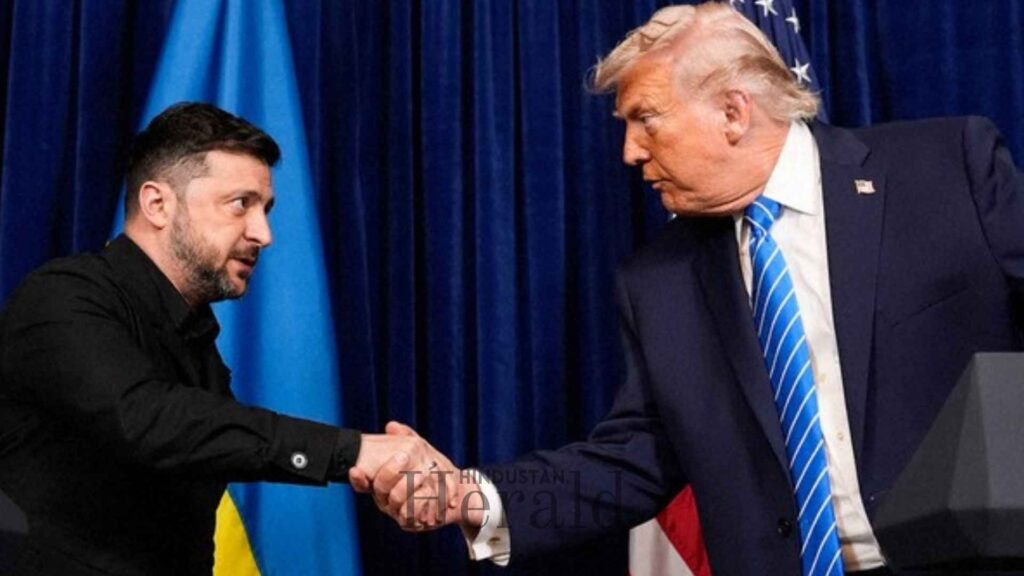
When Zelenskyy asks Trump for more air defence, he is not asking as a supplicant. He is asking as a partner who has been quietly doing Washington’s work in theatres Washington cares about deeply. Beyond its own skies, Ukrainian specialists have been deployed to the Gulf Arab region, helping American allies and U.S. military bases scattered across the Middle East build and reinforce their own air defence networks. This is not widely reported. It does not fit the dominant narrative of Ukraine as a passive recipient of Western charity. But it is happening, and Zelenskyy made sure Trump knew it when he wrote this week.
The letter was not just a request. It was a ledger.
Kyiv has been contributing to American security interests in a theatre that Washington currently considers its primary concern. Now it is asking for something in return, specifically Patriot PAC 3 interceptor missiles and related air defence systems that can take down the Russian ballistic missiles being fired at Ukrainian cities with increasing frequency and increasing confidence.
The supply problem is not a mystery. The same interceptors Ukraine needs are being consumed in the Iran theatre, where American military commitments in the Gulf are stretching defence stockpiles thin. Washington is not withholding weapons out of indifference or hostility. It is stretched across multiple simultaneous emergencies, and a production and logistics system built for a different era is struggling to keep pace. There is no single villain in that supply chain story.
But try explaining competing geopolitical emergencies to the residents of Kharkiv when the air raid sirens go off at two in the morning and the Patriot battery down the road has nothing loaded in it.
What Russia Is Doing Inside Its Own Borders Should Tell You Something
Set the frontline maps aside for a moment. Ignore the daily battlefield updates and the incremental territorial adjustments that require satellite imagery to detect. Look instead at what the Russian State Duma passed this week, because it is genuinely revealing.
Russia’s parliament has backed a draft bill authorising bank employees to shoot down Ukrainian drones.
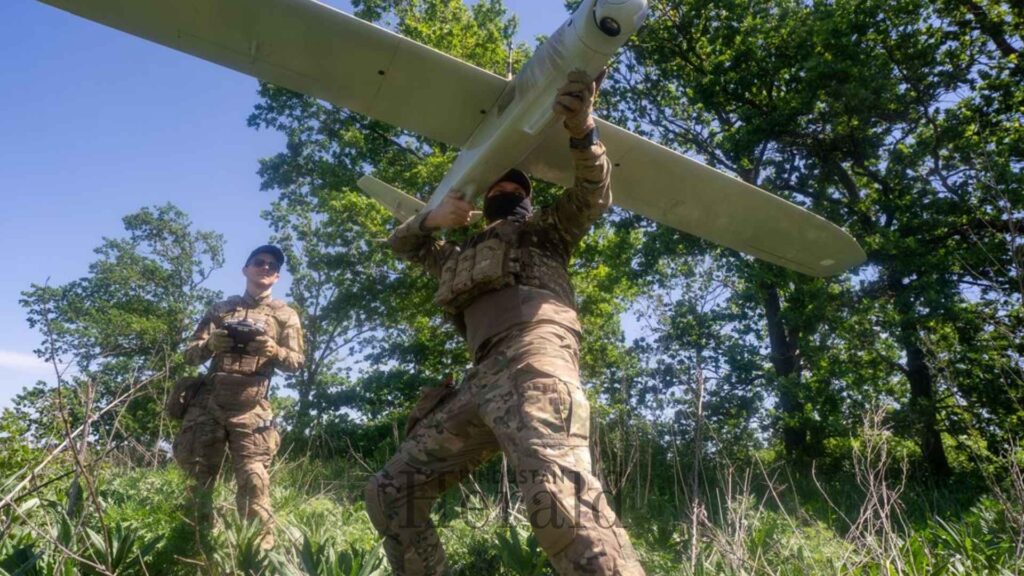
Not soldiers on leave. Not reservists called up for home defence. Bank employees. People who, in any other country in any other moment, would be processing loan applications and reviewing quarterly compliance reports.
The bill gives trained civilian workers in the financial sector the authority to jam drone signals, intercept unmanned aircraft, and destroy uncrewed vehicles, aerial, underwater, and ground based, that are threatening their facilities. Crucially, they can act without waiting for security services to authorise a response. Anatoly Aksakov, the chairman of the Duma’s Financial Markets Committee, explained the rationale to Russian media outlet RBK: jamming will be used to make it harder for drones to locate and engage their targets.
Defence analyst Thomas Withington told the Associated Press what most observers were already thinking. “This situation is not improving for Russia,” he said flatly. He went further: the bill itself is evidence that Moscow’s military grade drone defence systems are failing to cope, because if they were functioning adequately, the state would not need to conscript its banking sector into the air war. “If they were working,” he said, “you wouldn’t need to do that.”
There is a blunt logic to that observation. You do not legislate civilian drone interception as a workaround unless the professional alternative has broken down. Russia is being struck inside its own territory with enough frequency and unpredictability that the government is now trying to distribute the problem outward, into non military, non law enforcement sectors that were never designed to handle it.
That is not what winning looks like.
On Ceasefires, and the Exhausting Business of Pretending They Mean Something
This spring produced another cycle of ceasefires that existed primarily as press releases and international news headlines, with very little connection to what was actually happening along the front.
Russia declared a humanitarian truce for Victory Day in early May. Ukraine’s military command recorded 117 combat clashes within the first twenty four hours of that declared truce. Before that, there was an Easter ceasefire that Zelenskyy said Russia violated nearly 3,000 times across two days. There was also an earlier partial truce on attacks against energy infrastructure, brokered by the United States, that Russian forces reportedly breached repeatedly.
Three thousand violations in forty eight hours. At some point the word ceasefire stops functioning as a meaningful term and becomes instead a piece of theatre that each side performs for different audiences. Moscow announces peace for the cameras. Fires missiles for the generals. Then holds press conferences about its sincere commitment to a negotiated settlement.
Kyiv, for its part, has stopped pretending to be surprised. Ukrainian officials now respond to Russian ceasefire announcements with a kind of weary institutional sarcasm that has become its own diplomatic language.
And yet the ritual continues, because it serves a purpose for Moscow: it allows Russia to present itself as the reasonable party in the conflict, the side willing to pause and talk, while the reality on the ground tells a completely different story.
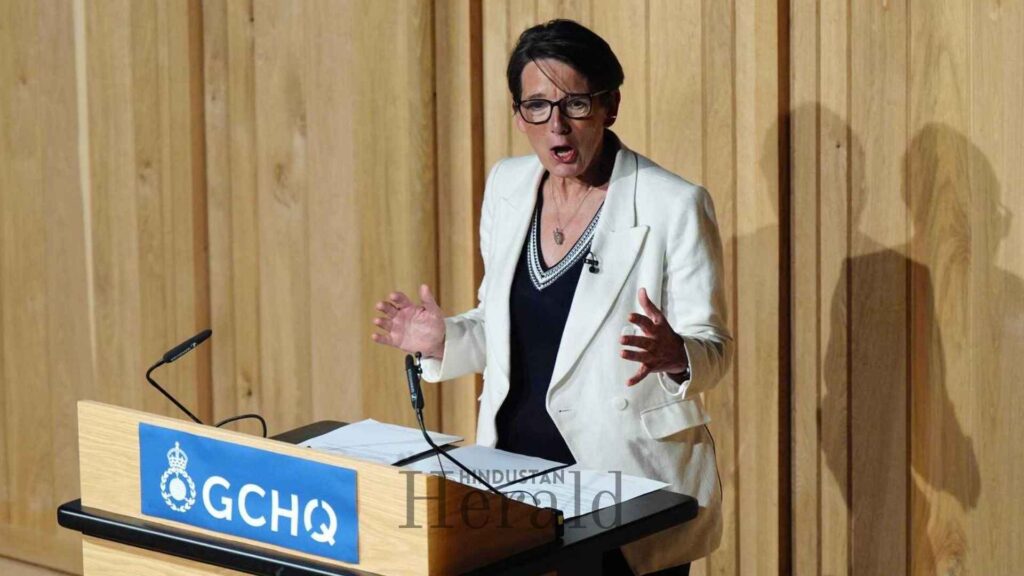
What cut through the noise this week, unexpectedly, was a public statement from Anne Keast Butler, the director of GCHQ, Britain’s signals intelligence agency. She said, plainly, that Putin is “going backwards on the battlefield.” Intelligence chiefs do not typically editorialise. They brief governments in classified settings, they occasionally testify before parliamentary committees, they do not generally step into the public discourse to offer assessments of a sitting foreign leader’s military performance. When someone in that role makes that kind of statement publicly, it is deliberate. It is worth taking seriously.
The Front Itself: One Thousand Two Hundred and Fifty Kilometres of Attritional Exhaustion
The ground war is not moving with any momentum that either side can point to as strategically decisive. Russia controls just under twenty percent of Ukrainian territory. Since January, it has added roughly 500 square kilometres to that total, according to open source intelligence mapping. That sounds significant in isolation until you remember that the front line itself stretches over 1,250 kilometres, a distance roughly equivalent to driving from New Delhi to Mumbai and back with room to spare.
Five hundred square kilometres along a front of that length, over nearly five months, represents a rate of advance that suggests neither side currently has the capacity to break the stalemate through conventional ground operations. The war has settled, for now, into something that military historians will likely describe as a war of attrition, expensive in lives and material on both sides, slow moving at the tactical level, and brutally difficult to end through negotiation because neither party currently has sufficient incentive to make meaningful concessions.
Zelenskyy said in early April that the ground situation was the best it had been in ten months. He credited Ukrainian forces with thwarting a Russian offensive that had been planned for March. “The offensive they were planning for March was thwarted by the actions of our armed forces,” he told reporters at the time. “That is why the Russians will now simply step up their assault operations.”
He predicted it. And it happened. The ground campaign stalled and the aerial campaign intensified, exactly as he said it would. Russian forces, unable to break through Ukrainian defensive lines at scale, have turned to the sky as the primary means of degrading Ukrainian capacity, targeting cities, energy infrastructure, and civilian morale.
That is the strategic logic behind the escalating missile and drone strikes. And it is also, therefore, the strategic logic behind Zelenskyy’s letter to Washington.
India Is Watching All of This. India Always Watches.
New Delhi has not said much publicly about the latest developments in Ukraine, which is entirely consistent with how it has handled every development in Ukraine since February 2022. The public position is well rehearsed, delivered in careful diplomatic language that has remained almost word for word consistent across four years: India supports sovereignty and territorial integrity, India believes in dialogue and diplomacy, India maintains that this is not an era of war.
Prime Minister Narendra Modi has said versions of this to Putin’s face in Moscow and to Zelenskyy’s face in Kyiv. He has said it at the United Nations, at the G20, and at bilateral meetings with leaders who have pressed him, with varying degrees of directness, to take a clearer position. The position has not shifted in any meaningful way. India has abstained on key UN votes. It has not joined sanctions regimes. It has not supplied weapons to either side.
What India has done is buy a great deal of discounted Russian crude oil. Since Western sanctions reshaped the global energy market in early 2022, India emerged as one of Russia’s most significant oil customers, snapping up supplies that European buyers were stepping away from, often at prices well below market rate. Indian refineries processed that oil, and in some cases refined products found their way into global markets, which drew criticism from Western governments and quiet satisfaction from Indian energy planners who were managing the pressures of a large, fuel dependent economy during a period of global price volatility.
The defence relationship is older and more deeply embedded. Russian origin equipment forms a substantial portion of India’s active military inventory. Sukhoi Su 30MKI fighter aircraft. INS Chakra class submarines. The S 400 Triumf air defence system, which India insisted on acquiring despite sustained American pressure and the looming threat of CAATSA sanctions that Washington ultimately chose not to impose, at least not yet. These are not rhetorical dependencies. They are operational ones. Spare parts, technical support, upgrade cycles, all of it connects back to Moscow in ways that cannot be cleanly severed by a policy declaration.
And yet. The longer this war continues, the more pressure accumulates on a position that was always more strategically complex than it appeared.
Western analysts have grown considerably more direct in their assessments of what India’s continued balancing act means in practice. The George W. Bush Presidential Center argued this year that the growing Beijing Moscow axis is not simply a European problem but a challenge that directly implicates Indian interests, given China’s own territorial ambitions in the region. The argument being made, with increasing frequency and increasing specificity, is that India and the United States share a deeper convergence of interest on these questions than New Delhi’s public posture suggests.
India has heard it. India has not changed its position. But the diplomatic environment is less forgiving of studied ambiguity than it was even two years ago.
There is also an argument that India cannot dismiss on purely principled grounds. The norms that the Ukraine war is testing, the inviolability of internationally recognised borders, the illegality of acquiring territory by force, the right of smaller states to exist without being absorbed by more powerful neighbours, are norms that India has invoked repeatedly in its own context. Pakistan occupied Kashmir is an Indian grievance rooted in exactly these principles. The Line of Actual Control with China, where Indian and Chinese soldiers have faced off in confrontations that have turned deadly in recent years, is a dispute in which India’s position depends fundamentally on the international community taking border integrity seriously.
A world that decides powerful neighbours can simply take what they want from weaker ones is not, in the long run, a world that serves Indian interests. That is a difficult argument to dismiss, even for a government that has invested heavily in the language of strategic autonomy.
The Weapons Gap and What It Is Really About
The Patriot PAC 3 has become something larger than a missile system in this war. It has become a symbol, a visible, countable, reportable symbol, of how much the West is genuinely willing to sacrifice to keep Ukraine functional as a fighting state. Every delayed shipment, every shortfall in interceptor stocks, every week that Patriot batteries stand empty while Russian missiles come in, is read not just in Kyiv but in Warsaw, in Vilnius, in Taipei, in Seoul, in every capital that has a security relationship with Washington and is watching to see what that relationship is actually worth under pressure.
For India, the S 400 acquisition looks somewhat different through this particular lens. Whatever diplomatic friction it created with Washington, India made a decision to own a significant air defence capability rather than depend indefinitely on a single supplier’s political will for resupply and maintenance. Ukraine’s current situation is a live case study in what total dependency on one supplier looks like when that supplier has competing priorities. India chose a different path, at some cost, and that choice does not look obviously wrong right now.
The Letter, the President, and What Comes Next
Zelenskyy sent his letter. It is a strong document. The strategic argument is coherent. The numbers support it. The reminder of Ukrainian contributions to American security interests in the Gulf is pointed without being hostile. The emotional register, those empty Patriot batteries, a nation fighting for survival, is calibrated carefully for an audience that responds to concrete imagery.
Whether it moves Trump is genuinely unclear. The U.S. president came into office wanting to end this war quickly, and his frustration with Moscow’s refusal to engage meaningfully with ceasefire proposals has been visible in his public statements. But frustration with Russia is not the same as commitment to Ukraine. And the domestic political environment around continued support for Kyiv remains complicated, with a portion of Trump’s political base deeply resistant to what they characterise as an open ended European entanglement.
Russia, as reported by NPR and PBS NewsHour, continues to show no genuine interest in a settlement that Ukraine could accept. The strikes continue. The front holds, barely, expensively, at a cost measured in lives and equipment that neither side can fully afford.
The summer ahead looks difficult. Russian aerial campaigns historically intensify when ground offensives stall, and the pattern of this war suggests that trajectory will continue. Ukrainian cities will absorb more strikes. The pressure on air defence systems will grow. And the gap between what Kyiv has and what it needs will either close, if Washington responds to the letter, or widen, if the Gulf theatre continues to consume American attention and American hardware.
For now, the Patriot batteries are waiting.
The missiles may come. They may arrive too late for some of the people they were meant to protect. And somewhere over Kyiv tonight, the radar systems are running in the dark, watching for the next Russian launch signature, hoping the interceptors hold out just a little longer while the most powerful country in the world makes up its mind.
The woman in the photograph, the one peering through the shattered window after the May 24 strike, is still there. Not in the photograph anymore. In Kyiv. In her apartment, or what is left of it. The war is not close to over.
Stay ahead with Hindustan Herald — bringing you trusted news, sharp analysis, and stories that matter across Politics, Business, Technology, Sports, Entertainment, Lifestyle, and more.
Connect with us on Facebook, Instagram, X (Twitter), LinkedIn, YouTube, and join our Telegram community @hindustanherald for real-time updates.

Tracking world politics, global markets, trade movements, policy decisions, and the changing balance of economic power.
- Shelesh Joshi

- Shelesh Joshi
- Shelesh Joshi
- Shelesh Joshi




Specializes in South Asian geopolitics and global diplomacy, bringing in-depth analysis on international relations.
- Rajiv Menon
- Rajiv Menon
- Rajiv Menon
- Rajiv Menon