By Ananya Sharma
Thiruvananthapuram, May 27: Tuesday morning started early for the Enforcement Directorate. By the time most of Kerala had finished its first cup of tea, federal investigators were already at the gates at ten different locations across the state, simultaneously. Among them: the homes of former Chief Minister Pinarayi Vijayan and his son-in-law, former minister P. A. Mohammed Riyas.
It is the kind of operation that stops a state in its tracks. And it did.
Not Just Another Raid
To understand why this felt different, you have to understand who Pinarayi Vijayan is in Kerala’s political imagination. This is not some mid-level functionary being pulled in for questioning. This is the man who ran the state for nearly ten years two full terms with a combination of administrative ruthlessness and ideological discipline that even his sharpest critics reluctantly acknowledged. He survived the gold smuggling case. He survived the Life Mission controversy. He survived everything that came at him, and he left office not in disgrace but on his own terms.
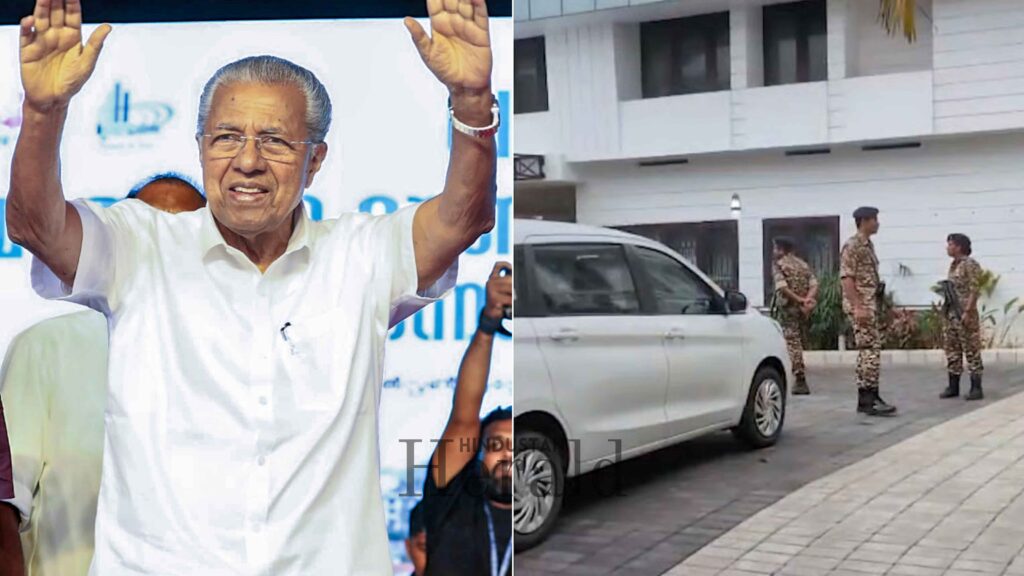
So when ED vehicles showed up outside his Thiruvananthapuram rental home and his ancestral house in Pinarayi village, Kannur, it landed differently. This was not routine. Nobody in Kerala treated it that way.
What the Investigation Is Actually About
At the heart of this is a financial arrangement that investigators have been circling for a while. The Kochi Metro Rail Limited, better known as CMRL, reportedly entered into a monthly payment contract with a technology company called Exalogic. The ED’s interest, according to sources tracking the case, stems from concerns about the nature and flow of money through that contract and, more specifically, alleged connections to Vijayan’s daughter.
The agency had faced a legal attempt to shut the inquiry down. It did not work. Just before Tuesday’s raids, the Kerala High Court dismissed a petition challenging the ED’s investigation, clearing whatever remained of the legal roadblocks. The searches followed shortly after a sequence that suggests the agency had been ready and waiting.
Teams also visited the offices of CMRL and the home of its managing director, Sasidharan Kartha. Riyas’s residence in Kozhikode was covered as well. Ten locations in total, spread from the southern tip of the state to Kannur in the north.
The Response Came Fast
P. A. Mohammed Riyas did not call a press conference. He went to Facebook.
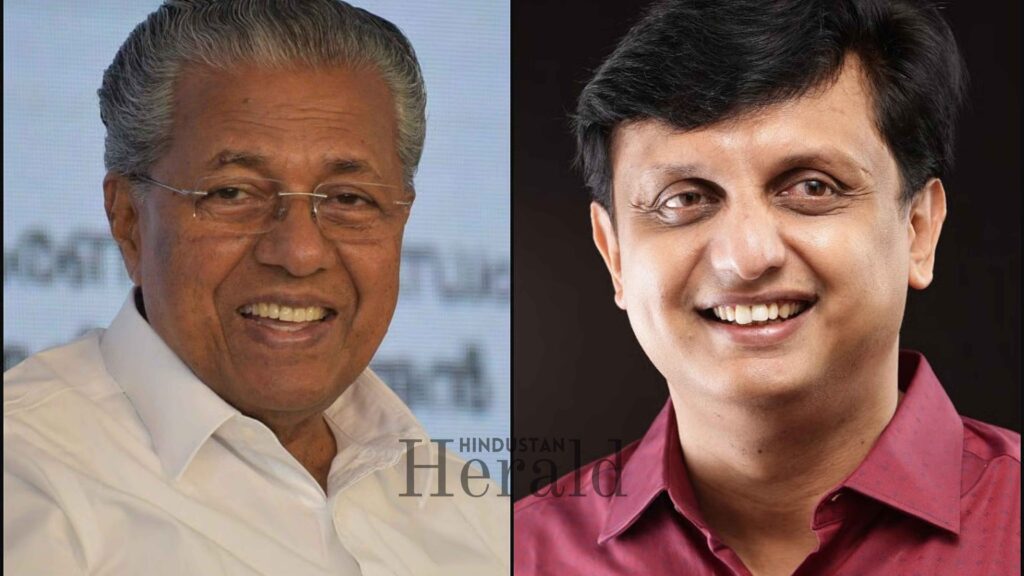
“Encircle and attack us if you want, but we will not kneel before the Sangh Parivar. We will fight till our last breath,” he posted, as reported by Munsif Daily.
That single statement tells you more about the CPI(M)’s chosen strategy than any official party communication could. There is no defensive legal posture here, no measured call for due process. Riyas a minister in Vijayan’s second cabinet, a significant figure in the party’s next generation went straight for the political jugular. He named the RSS ecosystem directly. He framed the raids not as a legal inquiry but as an act of political war.
The party followed his lead almost immediately. M. A. Baby, CPI(M)’s general secretary, told reporters that the action was politically motivated and that the party would “prove in front of the people” that this was a manufactured assault. According to Business Standard, the statement was unequivocal: this was a “heinous attack” driven by the BJP-led Centre.
Outside Vijayan’s Kannur home, party workers had already gathered. Slogans against the ED, against the BJP, filled the street as investigators worked inside. The scenes, reported by The Week, were loud and deliberate. The party wanted them to be.
The Congress Twist
Here is where it gets interesting. The CPI(M) did not limit its accusations to the BJP. The party also pointed fingers at the Congress alleging, as per Business Standard, that the raids were orchestrated with Congress backing or at least Congress complicity.
It is a somewhat unusual charge on the surface. But Kerala politics has its own logic. CPI(M) and Congress have been rivals in the state for decades, trading power back and forth, and the Left clearly wants to ensure Congress cannot extract any political benefit from this moment. By dragging them into the accusation early, the party closes off a lane.
Whether Congress accepts that framing or pushes back will be worth watching.
The Bigger Picture Nobody Should Ignore
This is not the first time a state governed by an opposition party has found itself on the receiving end of a major ED operation. The pattern federal agencies moving against political opponents, opposition parties crying witch-hunt, legal proceedings stretching out over months or years without resolution has played out in Delhi, in West Bengal, in Jharkhand. Each time, the BJP insists the agencies act on evidence alone. Each time, the targeted party insists it is persecution dressed up as procedure.
Neither side is ever fully wrong. Neither is ever fully right. That ambiguity is precisely what makes these situations so combustible.
What is different here is the stature of the man at the centre. Pinarayi Vijayan carries a weight in Kerala’s political culture that very few figures in any Indian state can match. Raids at his home are not just legally significant they are symbolically enormous. For the BJP, which has tried and failed to make meaningful electoral inroads into Kerala for years, there may well be a political calculation woven into all of this. Whether that calculation pays off is another question entirely.
Where Things Stand Now
The ED has not publicly confirmed what, if anything, was recovered during Tuesday’s searches. That information will emerge gradually, as it usually does through official statements, court filings, and the occasional well-placed leak to a national wire service.
Legally, searches of this scale typically represent an escalation, not a conclusion. Documents, phones, hard drives whatever was collected on Tuesday will now be analysed, cross-referenced, and used to determine whether the agency moves toward arrests, summons, or a formal charge sheet under the Prevention of Money Laundering Act.
Politically, the fallout is already underway. Kerala’s new chief minister inherits a situation that has no clean resolution. Vijayan, technically a private citizen now but still the dominant force within CPI(M), will need to balance his personal legal exposure against his ongoing influence within the party. That is not a simple position to be in.
Still, if Tuesday proved anything, it is that neither Vijayan’s camp nor the party around him intends to go quietly. The Facebook post was not a slip. It was a signal. And signals like that, in Kerala politics, tend to set the tempo for everything that follows.
Stay ahead with Hindustan Herald — bringing you trusted news, sharp analysis, and stories that matter across Politics, Business, Technology, Sports, Entertainment, Lifestyle, and more.
Connect with us on Facebook, Instagram, X (Twitter), LinkedIn, YouTube, and join our Telegram community @hindustanherald for real-time updates.

Covers Indian politics, governance, and policy developments with over a decade of experience in political reporting.
- Ananya Sharma

- Ananya Sharma
- Ananya Sharma
- Ananya Sharma