
 By Shelesh Joshi and Rajiv Menon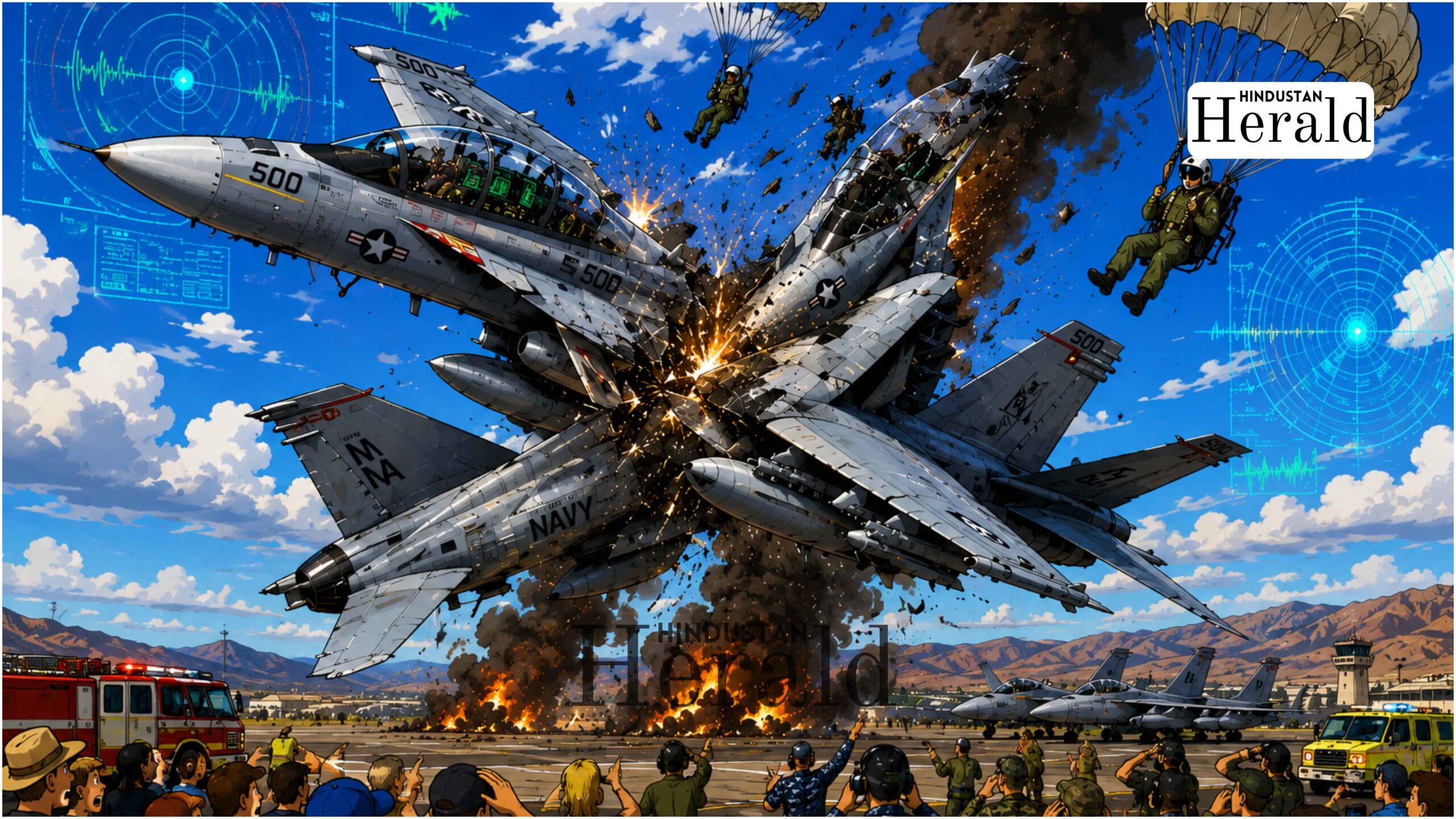
New Delhi, May 18: On May 17, 2026, two US Navy EA-18G aircraft assigned to Electronic Attack Squadron (VAQ) 129 from Whidbey Island, Washington collided mid air while performing an aerial demonstration for the Mountain Home Air Force Base Gunfighter Skies Air Show at about 12:10 p.m. MDT. All four aircrew successfully ejected and were being evaluated by medical personnel, confirmed Cmdr. Amelia Umayam, spokesperson for Naval Air Forces, US Pacific Fleet.
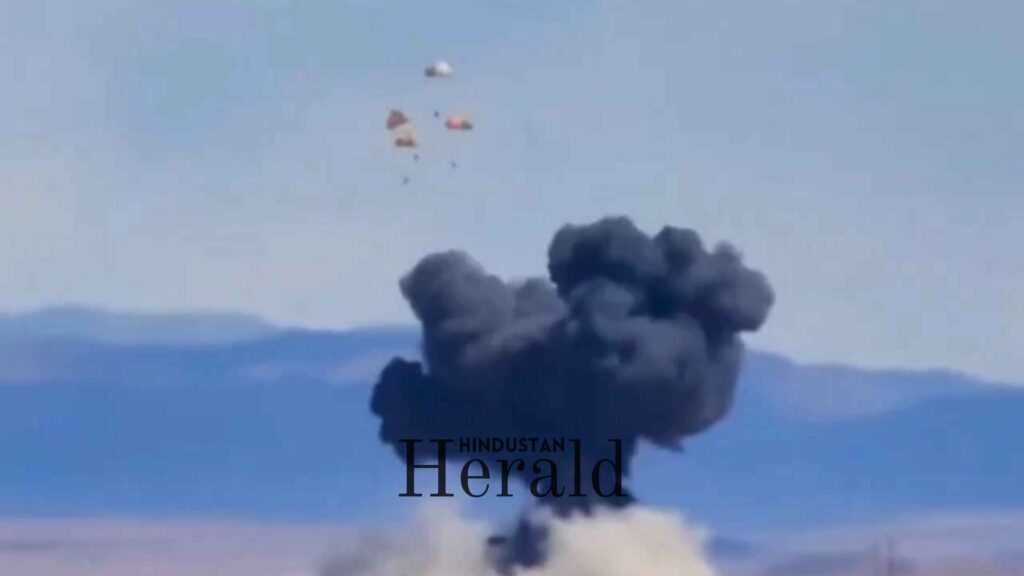
Video posted to social media shows the two Growlers flying close together before appearing to become locked together midair, one on top of the other. When the two planes immediately pitched upwards and appeared to stall, both crews ejected less than five seconds after the initial collision. Still stuck together, the planes cartwheeled to the ground, crashed, and exploded. Four parachutes were seen inflated and drifting downward near the crash site. The crew members were taken to hospital and reported in stable condition according to base officials. No injuries were reported on the ground. The remainder of the air show was cancelled immediately and the base placed on lockdown.
This was the Gunfighter Skies airshow’s comeback event after a long hiatus following a fatal civilian glider incident in 2018. It will be remembered for all the wrong reasons. For defence-sector investors and procurement analysts watching from New Delhi to Singapore, the story does not end with the ejection seats firing successfully.
The EA-18G Is Irreplaceable. That Is Not a Figure of Speech.
This is the detail most coverage has moved past too quickly, and it is the one that matters most from a strategic standpoint. Boeing has already stopped building EA-18G Growlers. Production of the EA-18G ended after the completion of orders for the US Navy and Australia in the late 2010s. The company continues to develop upgrades and support Growlers in service but no new airframes are coming off any production line anywhere in the world.
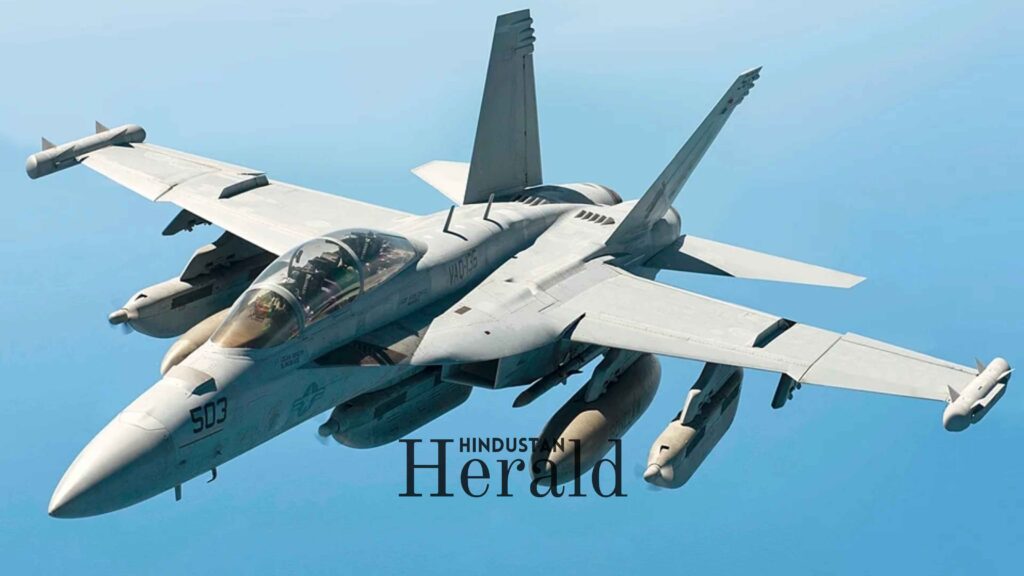
The 160 EA-18G aircraft confirmed in US Navy inventory represent a finite, irreplaceable asset. The Growler is the only dedicated carrier-based electronic warfare aircraft in the entire Western world. Every airframe lost to accident or combat is permanently subtracted from a pool that can never be refilled.
Let that sit for a moment. The US Navy cannot call Boeing and order two replacements. The line is closed. The tooling is gone. What existed on Saturday morning was 160 aircraft. What exists this Monday morning is 158. In a world where the EA-18G is the West’s only carrier-based dedicated electronic warfare platform, that number going down is not a small thing.
What the Videos Show
The kinematics of the midair collision are almost incredible. Video of the incident appears to show the two EA-18G Growlers coming into very close proximity during the display. As they converge, the lead aircraft appears to turn, resulting in apparent contact. Both aircraft then seem to pitch up or abruptly increase their angle of attack before departing controlled flight and beginning to lose altitude, looking almost entangled for a moment.
While the exact cause of the mishap is not yet confirmed, the leading Growler may have been in the under-nose blind spot of the trailing one right before impact. As the jets rolled vertical, they appeared stacked on top of each other, making ejection extremely dangerous.
The fact that all four crew made it out alive in those circumstances is not luck alone. The Martin-Baker NACES ejection seats aboard both jets performed exactly as designed, giving pilots less than five seconds to act. Both aircraft were assigned to the “Vikings” of VAQ-129, the navy’s dedicated EA-18G demonstration squadron based at Naval Air Station Whidbey Island.
Kim Sykes, marketing director with Silver Wings of Idaho which helped plan the show, said simply: “Everyone is safe and I think that’s the most important thing.” Professionally speaking, that is true. Strategically speaking, it is only part of the story.
Boeing Was Already Running Out of Road on This Programme
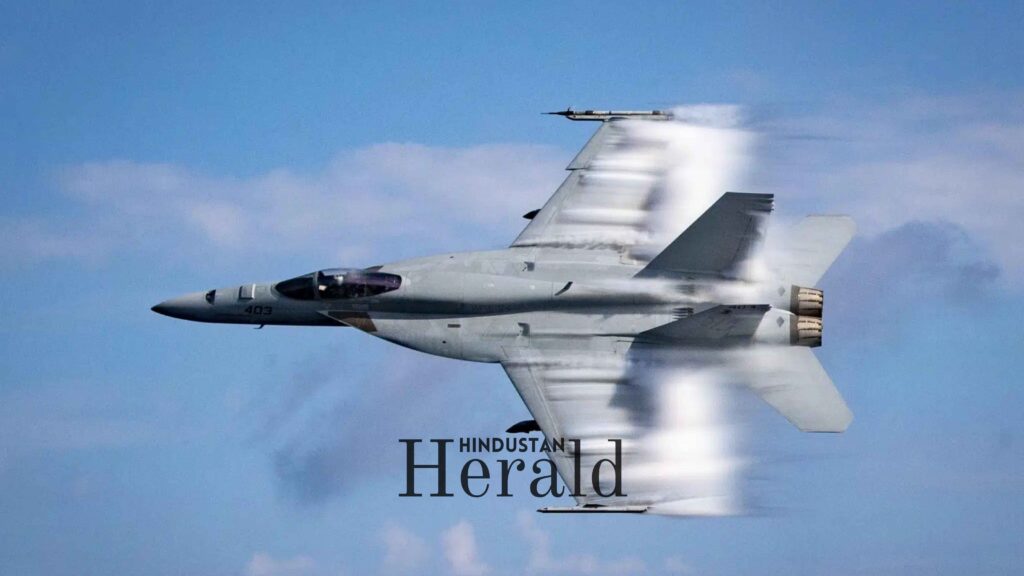
Unless a new export order is placed, Boeing will cease production of the F/A-18 Super Hornet and EA-18G Growler entirely. The last Super Hornets will be delivered to the US Navy at a rate of two aircraft per month before the St. Louis line goes dark in 2027.
The defence division that built the EA-18G has not had a clean run of it in recent years. Fixed-price contract losses on the KC-46 tanker, the T-7A Red Hawk, and the MQ-25 Stingray generated severe operating losses over consecutive years. The company has been working to stabilise its defence business while simultaneously managing the commercial aviation recovery.
None of that is the EA-18G’s fault directly. The Growler production line ran well. The aircraft’s operational record across fifteen years and hundreds of combat deployments including extensive missions in the Red Sea is genuinely strong.
But procurement agencies do not evaluate platforms in isolation from the companies that sustain them. Spare parts, upgrades, long-term support all of that runs through Boeing. When the Idaho collision adds another complicated news cycle to a defence division already under scrutiny, evaluation committees in New Delhi and elsewhere take note.
India Was Already Watching. Now It Is Watching More Carefully.
Here is where this story gets specifically relevant for Indian readers tracking defence sector and Business News India developments.
Boeing’s final ongoing Super Hornet sales campaign before closing the line is the Indian Navy’s multirole carrier-borne fighter requirement for 57 fighter-bombers to equip its two aircraft carriers, competing directly against the Dassault Rafale. That competition has been running for years. The Indian Navy evaluated both the Rafale-M and the F/A-18E/F Super Hornet. No final decision has been announced publicly.
Boeing went so far as to demonstrate the Super Hornet’s ability to fly from ski-jump-equipped carriers as well as catapult-equipped ones as part of those efforts. India has meanwhile been steadily acquiring more French-made Rafales in recent years to meet its needs for new land and carrier-based fighters.
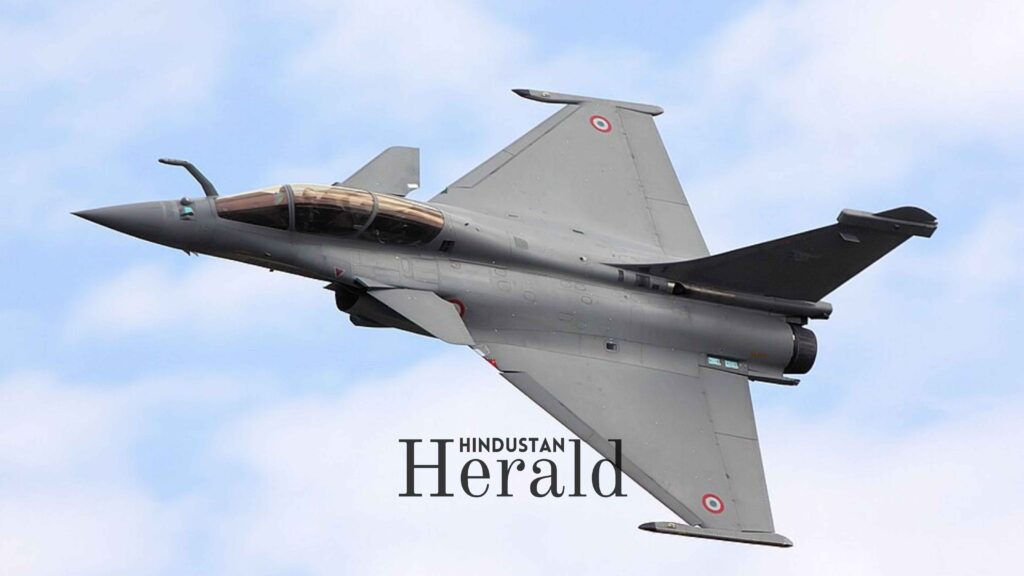
The EA-18G sits directly adjacent to that competition. If India ever went the Super Hornet route, an EA-18G follow-on for INS Vikrant and a potential second carrier was always the logical next chapter. The US Navy pairs them together on every carrier air wing because the two platforms are designed as a team. The Idaho collision now adds a new layer to that already complicated picture.
Any realistic initial Indian EA-18G acquisition would need to come from existing US Navy stock through a Foreign Military Sale arrangement because there are no new ones being built. That is a harder conversation than it was last week. And under India’s Defence Acquisition Procedure (DAP) 2020, operational safety record is an explicit scoring criterion in any platform evaluation. The crash of two EA-18G jets on May 17, 2026 just became a documented entry in that evaluation.
The Irreplaceable Fleet Is Being Upgraded Precisely Because It Cannot Be Replaced
To understand the full weight of what happened in Idaho, consider what the US Navy is currently spending to protect the fleet it has. The Service Life Extension Programme (SLEP) targeting EA-18G service through 2046 is not merely a budget choice. It is an operational necessity. If the Navy is to field this capability beyond the early 2030s, it must preserve every existing airframe.
The AN/ALQ-249(V)1 Next Generation Jammer Mid-Band (NGJ-MB) represents a genuine generational leap in the EA-18G’s jamming capability. A USD 580 million production contract was awarded to Raytheon in 2025, confirming that the upgrade programme is in full swing across the existing fleet.
In other words, the US Navy is spending hundreds of millions upgrading every single EA-18G it owns precisely because it cannot build replacements. The programme’s entire future rests on keeping the existing 160 airframes flying as long as possible. Saturday’s collision took that number to 158. That is not catastrophic in a fleet sense. But it is the wrong direction, and there is no mechanism to reverse it.
What Indian Defence Companies Should Be Watching
For observers tracking Hindustan Aeronautics Limited, Bharat Electronics Limited, and domestic vendors positioned for offset obligations in any large foreign platform deal, the Idaho story carries an interesting secondary implication.
BEL has been building out its electronic warfare portfolio under DRDO collaboration for several years. Airborne jamming systems, electronic intelligence platforms, self-protection suites the domestic capability is more substantial than it was a decade ago and growing steadily.
Any scenario where India delays or reconsiders a foreign EA-18G-type acquisition whether because of the Idaho collision, the closed production line, the ongoing Rafale preference, or simple timeline drift creates room for domestic EW programmes to develop further. For BEL and the indigenous defence manufacturing ecosystem that the government has been building under Aatmanirbhar Bharat, a delayed foreign platform buy is sometimes the best news it gets.
For Boeing (BA: NYSE) investors, the honest read remains that two lost aircraft at USD 67 million each is not a portfolio-moving event against a total defence revenue base in the tens of billions. The larger watch item stays the same: whether the defence division can return to sustainable operating margins before the end of 2026.
The Number That Should Stay With You
160 That is how many EA-18G jets existed in the world going into last weekend. Not 160 in the US Navy and more coming off the line somewhere. Just 160, total, forever. The Growler is the only dedicated carrier-based electronic warfare aircraft in the entire Western world and Boeing has already walked away from the production line.
That number is now 158. Air show safety has genuinely improved over the decades. There were no air show deaths in 2024 or 2025. The last time a spectator was killed at a US air show was 1952. That safety record is real and it matters. But the safety record does not change the arithmetic of an irreplaceable fleet getting two aircraft smaller on a Sunday afternoon in Idaho. The four pilots got their seats to fire in time. Their aircraft were not so fortunate.
The US Navy is now running its investigation. Boeing is managing its response carefully. The remaining EA-18G fleet will keep flying, keep getting upgraded, and keep doing what it does better than any other carrier-based aircraft in the Western world.
Still, in a procurement environment where every data point gets documented and scored, the events of May 17, 2026 will follow the EA-18G into every evaluation room it enters from here on. The platform will fly again. The questions it left behind over Idaho are going to take considerably longer to land.
Stay ahead with Hindustan Herald — bringing you trusted news, sharp analysis, and stories that matter across Politics, Business, Technology, Sports, Entertainment, Lifestyle, and more.
Connect with us on Facebook, Instagram, X (Twitter), LinkedIn, YouTube, and join our Telegram community @hindustanherald for real-time updates.

Tracking world politics, global markets, trade movements, policy decisions, and the changing balance of economic power.

Specializes in South Asian geopolitics and global diplomacy, bringing in-depth analysis on international relations.
- Rajiv Menon

- Rajiv Menon
- Rajiv Menon
- Rajiv Menon