
 By Shelesh Joshi and Kavita Iyer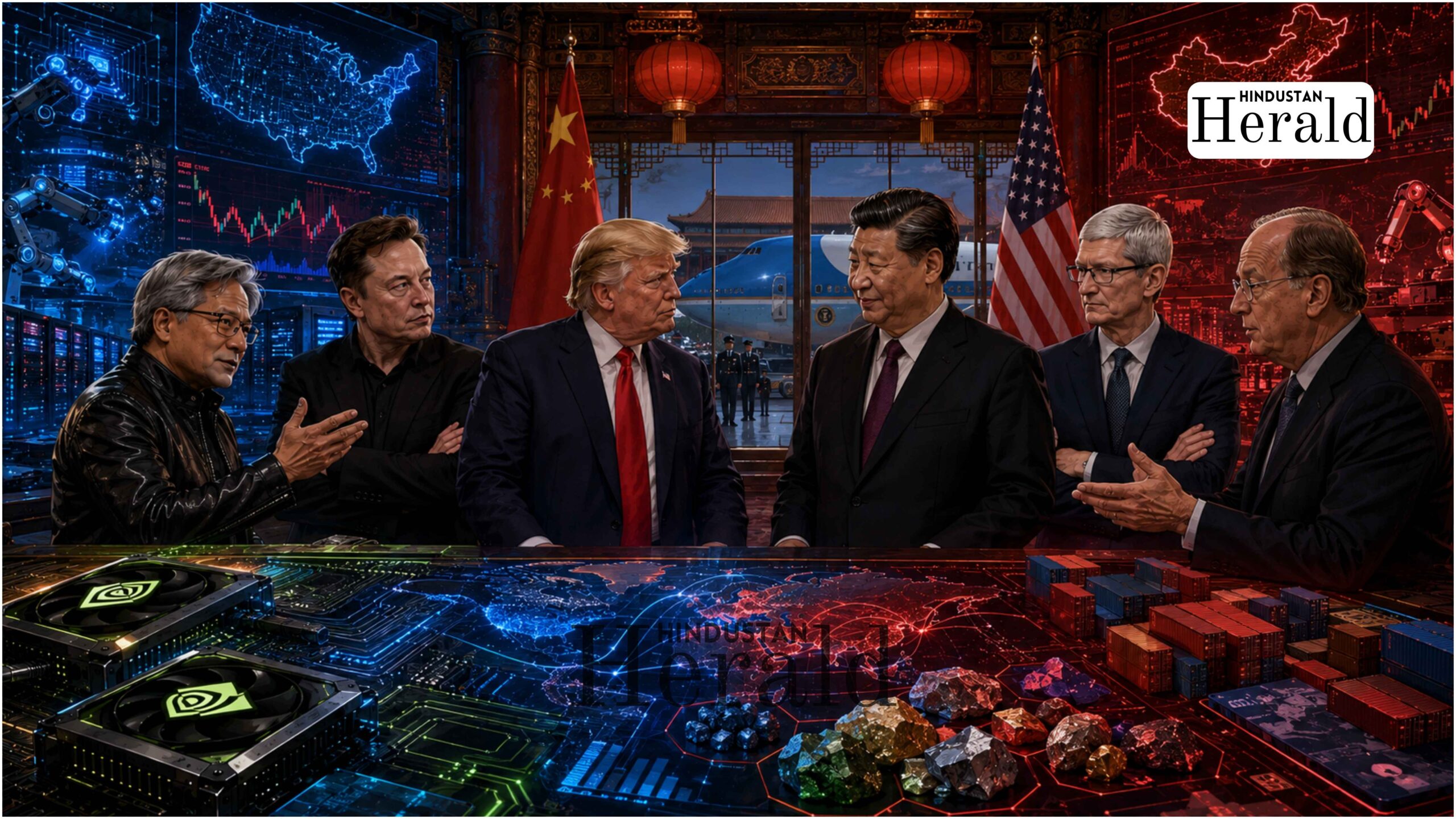
New Delhi, May 18: Imagine boarding a flight with Elon Musk sitting three rows ahead, Tim Cook scrolling through his phone beside you, Jensen Huang quietly reviewing notes across the aisle, and Larry Fink staring out the window somewhere in the back. Now imagine that flight is Air Force One, and it is headed to Beijing. That was the reality of the Trump Xi Summit 2026, and the moment that passenger manifest became public knowledge, every trading desk from Mumbai to Manhattan sat up a little straighter.
This was not a diplomatic courtesy call. This was not a routine review meeting dressed up in summit language. When the most powerful technology, finance, and manufacturing executives in the world clear their calendars, silence their earnings calls, and board a presidential aircraft for a twelve hour flight to China, something consequential is either about to happen or about to be prevented from getting dramatically worse. As it turned out, it was a bit of both.
Trump Xi Summit 2026: Nobody Flies to Beijing Just to Shake Hands
There is a version of this story where the Trump Xi Summit 2026 CEO gathering is pure theatre. A reassuring row of familiar faces arranged behind the President, designed to project unity without delivering substance. That version does not survive contact with the facts.
Each executive who boarded that plane runs a company carrying enormous, specific, and genuinely urgent exposure to how the US China relationship resolves itself over the next two years. Their presence was not ceremonial. It was a message, delivered in the most visible way American business knows how to send one.
Apple manufactures the overwhelming majority of its products in China and has been under relentless pressure from both investors and the administration to diversify. Tim Cook has been quietly accelerating production shifts to India and Vietnam, but anyone who understands manufacturing at Apple’s scale knows that transition cannot happen fast enough to escape tariff pain entirely. Every additional percentage point of duty on Chinese assembled goods lands directly on Apple’s cost structure, and Cook has been managing that exposure with the kind of diplomatic patience his predecessor never needed.
Nvidia had been effectively locked out of the Chinese AI chip market through American export controls, watching with visible discomfort as Chinese technology firms raced to build domestic semiconductor alternatives. The longer that lockout persisted, the more deeply those alternatives would embed themselves into China’s AI infrastructure, and the harder any future re entry would become even if the restrictions were eventually lifted.
Boeing is a story all on its own. After years of self inflicted manufacturing crises, regulatory battles, and reputational damage that had nothing to do with geopolitics, the company desperately needs Beijing to resume buying commercial aircraft. China represents one of the largest aviation growth markets on the planet over the next two decades. Walking away from it is not a strategic option. It is just a slow bleed.
Put all of that together and the picture becomes clear. The CEO contingent at the Trump Xi Summit 2026 was not window dressing. It was American industry telling Washington, in the loudest possible voice: the cost of this trade war is being paid by us, every quarter, and we need you to fix it.
The Year That Made the Trump Xi Summit 2026 Inevitable
To understand why Beijing this week carried the weight it did, you need to go back to April 2025. A month that was, by almost any serious measure, genuinely brutal.
American tariffs on Chinese goods crossed 145 percent. Beijing retaliated in kind. US soybean exports to China collapsed by 75 percent over the course of the year. Rare earth and critical mineral shipments to American manufacturers were quietly throttled, and companies building everything from consumer smartphones to military grade components started running into materials shortages they had no domestic alternative for and no quick fix to. The damage was not the kind that only shows up in spreadsheets months later. It was immediate and visible.
Factory owners in Guangdong and Zhejiang were sitting on warehouses full of inventory with nowhere to ship it. American farmers in Iowa, Illinois, and Kansas, many of them among the most loyal supporters of the administration, had lost their single largest export market almost overnight. Executives at multinationals were quietly commissioning scenario analyses for a world in which US China trade simply did not recover to anything resembling its previous scale. The Federal Reserve found itself stuck, caught between an economy that was still growing on paper and a business confidence that had cratered in real time.
The CEO Confidence Index, tracked by J.P. Morgan, fell to 5.0 by March 2025 from a relatively healthy 7.01 just twelve months earlier. Capital expenditure decisions were being deferred. Hiring cycles were being paused. The uncertainty itself was doing economic damage even before the tariffs fully fed through into consumer prices.
Former US Commerce Secretary Wilbur Ross put the fundamental contradiction plainly, in remarks carried by the Associated Press: “The idea of somehow China being totally independent of us and us being totally independent of China, I think, is a fiction.”
The October 2025 Busan summit on the sidelines of APEC in South Korea was where both sides finally, and somewhat grudgingly, stepped back from the edge. Tariffs came down from their peak levels. China agreed to resume soybean purchases, committing to 12 million metric tons before end 2025 and at least 25 million metric tons annually through 2028. Rare earth export restrictions were partially, though critically not fully, eased.
It was a ceasefire, not a settlement. And every serious analyst covering the relationship knew the reckoning had only been pushed down the calendar. The Trump Xi Summit 2026 was always going to be where the bill came due.
What the Trump Xi Summit 2026 Was Really Negotiating
According to sources familiar with the preparatory discussions, both delegations arrived in Beijing knowing that tariffs, while still politically charged on both sides, were no longer the central issue on the table. Something more structural had shifted in the months since Busan.
China had spent that intervening period quietly and methodically demonstrating that it possessed a weapon considerably more potent than counter tariffs. Rare earths and critical minerals had become Beijing’s primary instrument of economic leverage, and much of the world had been embarrassingly slow to appreciate just how sharp that instrument was.
When Beijing restricted exports of critical minerals and rare earth magnets during the escalation phases of 2025, the effect moved through global supply chains with a speed and severity that genuinely caught Washington off guard.
The Council on Foreign Relations described the impact without softening it: when China activated that export control regime, it effectively shut off the critical minerals taps for companies and their supply chain partners located anywhere in the world, not merely in the United States. The extraterritorial reach of the measure was far more invasive and far more effective than American planners had modelled.
Inputs that go into electric vehicles, advanced semiconductors, defence systems, wind turbines, and consumer electronics were all caught in the restriction. These are not niche industrial materials. They are the foundational components of the modern economy, and China controls a dominant share of their global processing and export.
Xi Jinping walked into the Trump Xi Summit 2026 having already called Trump’s bluff once and won. When China threatened rare earth restrictions in April and October 2025, the US administration chose de escalation over retaliation on both occasions. That history does not leave the room when the negotiators sit down.
The US was not without cards of its own. American technology export controls on advanced semiconductors remain a genuine constraint on China’s AI ambitions. Access to American consumers, American capital markets, and American technology standards still matters enormously to Chinese businesses operating globally. Still, the honest read heading into this summit was that Beijing held the stronger hand. The question was how aggressively it would play it, and how much Washington would concede in the name of stability.
The Nvidia Chip Deal: The Biggest Surprise From Trump Xi Summit 2026
The headline that traders from Dalal Street to Wall Street had been quietly waiting for all week finally landed on Thursday. Reuters, citing three people familiar with the matter, reported that Washington had cleared sales of Nvidia’s H200 AI chips to several major Chinese technology companies.
If that holds, it is a commercially significant development. Nvidia had watched its addressable market in China get carved away methodically by export restrictions, while Chinese chipmakers, backed by state capital and genuine urgency, raced to develop domestic alternatives. The longer the lockout ran, the more deeply those alternatives would embed themselves. The harder any future American re entry would become.
Morningstar senior equity analyst Brian Colello had framed the company’s position clearly before the summit, telling CNBC that Nvidia wanted to be part of the Chinese AI technology stack, and that a selective licensing arrangement had been the preferred commercial outcome it had been pressing government toward for months. Jensen Huang being physically on Air Force One for the Trump Xi Summit 2026 was, in retrospect, the clearest possible advance signal that the administration was willing to take that conversation seriously. The politics of any chip deal, though, remain genuinely treacherous.
A meaningful licensing arrangement for advanced AI chips sold into China would immediately hand ammunition to every China hawk in Congress, and there are quite a few of those. The administration would need to present any concession as a calculated exchange, extracting something concrete on rare earths, agricultural access, or currency practices in return. Whether that framing survives sustained political scrutiny over the months ahead is genuinely uncertain.
How Trump Xi Summit 2026 Is Already Disrupting India’s Export Momentum
From a purely Indian commercial standpoint, the instinct to celebrate a US China thaw needs to be accompanied by an honest reckoning with the second order effects. The past year of tariff warfare between Washington and Beijing was, quietly, quite good for Indian export ambitions.
American buyers who had spent decades building deeply integrated relationships with Chinese suppliers were suddenly making calls to manufacturers in Bengaluru, Surat, Pune, Chennai, and Noida, asking questions they had never asked seriously before. What is your capacity? How quickly can you scale? Can you match what we get from Shenzhen on lead times?
The supply chain diversification conversation that Indian policymakers had been trying to start for years was suddenly happening on its own, driven by straightforward American corporate anxiety rather than any government incentive scheme or bilateral agreement. The Trump Xi Summit 2026 softens that urgency considerably.
Companies that had been seriously modelling a sourcing shift toward India may now pause. Wait to see whether the familiar, deeply integrated, highly efficient Chinese supply chain becomes reliably viable again. Defer the capital commitment that a genuine India pivot requires. That is not catastrophic for Indian industry. But it is a real headwind, and it arrived faster than most domestic exporters had anticipated or planned for.
The more immediate concern for trade economists is what a revitalised Chinese export machine does to global markets for steel, petrochemicals, textiles, and intermediate manufactured goods, all sectors where Indian producers compete directly with Chinese counterparts.
Chinese manufacturers who spent much of 2025 sitting on stockpiles they could not move into American or European markets may now aggressively re enter those markets with discounted pricing. The dumping pressure that follows will be felt acutely across Indian industry, in ways that no amount of positive summit optics will offset.
The Nifty 50 tracked the global risk on mood through the week and closed with modest gains, reflecting the improved broader sentiment. But the more sophisticated institutional money in Mumbai and Delhi is watching the next several weeks of actual trade flow data very carefully before drawing firm conclusions about what the summit truly means for Indian exposure.
India’s own bilateral trade negotiations with the United States had been gaining quiet but meaningful momentum, partly because Washington was actively looking for credible alternatives to Chinese supply chains. That backdrop is now more complicated than it was a fortnight ago.
Trump Xi Summit 2026: When Being in the Same Room Was Enough
The most quietly cutting assessment of the entire Beijing exercise came from a Council on Foreign Relations media briefing held shortly after Trump and Xi wrapped up their first full day of talks. Analyst Rush Doshi delivered the verdict in a single line, and then repeated it for emphasis: “The meeting was the deliverable. The meeting was the deliverable.”
That is it. No binding structural agreement on rare earth access. No durable resolution of the semiconductor dispute. No framework for the deeper, slower moving fault lines around Taiwan, AI governance, and industrial subsidy regimes that sit underneath the tariff argument like tectonic plates, quietly building pressure regardless of what any communiqué says.
Just two leaders in a room together, treating the act of remaining civil toward each other as an accomplishment worth a twelve hour flight. And the genuinely frustrating truth, for anyone hoping for something more substantive, is that in the current state of this relationship, it kind of is.
Goldman Sachs had framed the Trump Xi Summit 2026 for clients in precisely these terms before the planes even took off. The bank expected the meeting to function as a tactical catalyst rather than a strategic turning point, with China committing to expanded purchases of American agricultural products, energy, and commercial aircraft, giving Trump a domestic political win he could take back to farmers and manufacturers, while the underlying tariff architecture remained broadly where it had settled after Busan. That is more or less what appears to have materialised.
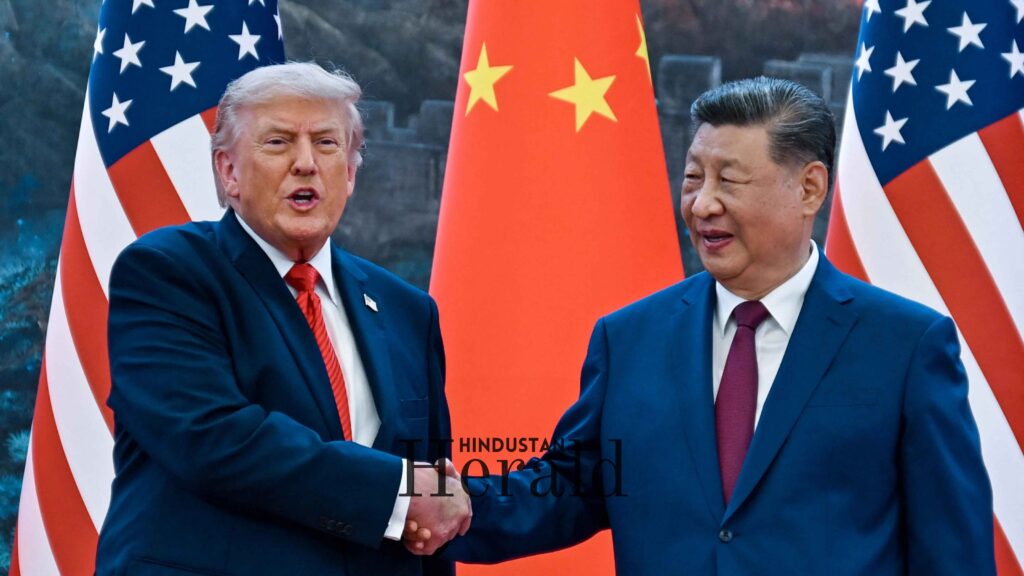
A truce extension. Soybean and Boeing purchase commitments. A possible Nvidia chip licensing carve out. A vague but symbolically meaningful Board of Trade mechanism that American officials have been floating for months as a new framework for managing the bilateral economic relationship. Warm statements about constructive ties and strategic stability. A handshake at the airport.
What Comes After the Trump Xi Summit 2026: The 90 Day Habit
One pattern that observers of this relationship have noted with quiet weariness is how the US China dynamic has locked itself into a rhythm. Short term truces. Review summits. Further short term truces.
The Busan deal bought time through approximately November 2025. The Trump Xi Summit 2026, according to sources cited by the Council on Foreign Relations, may extend that runway but without yet resolving the fundamental question of what a permanent, durable framework actually looks like. The clock that actually matters here is not the diplomatic one. It is the industrial one.
Every month that American companies remain uncertain about their China supply chain exposure is another month in which they are making hedging decisions, splitting orders between Chinese and non Chinese suppliers, paying the premium that redundancy costs, and building relationships with alternative manufacturers in India, Vietnam, and Mexico that will not simply dissolve the moment Washington and Beijing exchange another round of warm words.
Decoupling, as Wilbur Ross said, may be a fiction. But managed distance is already a business reality for dozens of major American companies, and that shift does not fully reverse on the back of a summit communiqué, however warmly worded or however many CEOs were in the room when it was drafted.
For investors watching this from Mumbai, Singapore, or London, the key signals to track over the coming weeks are not the political language flowing out of Beijing. They are the hard commercial numbers.
Whether trade volumes between the two countries actually recover in the June and July data. Whether Chinese rare earth exports resume at meaningful scale. Whether the reported Nvidia chip clearances translate into actual shipments. What American multinationals say about their China business outlook when second quarter earnings season begins in July.
That is the moment when the market will finally find out whether the Trump Xi Summit 2026 was genuinely the beginning of something real, or simply the latest pause in a conflict that neither side has yet figured out how to permanently resolve.
For now, the temperature is lower than it was six months ago. Both men flew home with something they could credibly call a win. The CEO entourage that boarded Air Force One in Washington got at least some of what they flew twelve hours to find. Whether the momentum holds is the one question that nobody in that room, for all their combined wealth and influence, could honestly answer.
Stay ahead with Hindustan Herald — bringing you trusted news, sharp analysis, and stories that matter across Politics, Business, Technology, Sports, Entertainment, Lifestyle, and more.
Connect with us on Facebook, Instagram, X (Twitter), LinkedIn, YouTube, and join our Telegram community @hindustanherald for real-time updates.

Tracking world politics, global markets, trade movements, policy decisions, and the changing balance of economic power.

Former financial consultant turned journalist, reporting on markets, industry trends, and economic policy.
- Kavita Iyer

- Kavita Iyer
- Kavita Iyer
- Kavita Iyer




 Ananya Sharma and Kavita Iyer
  Kavita Iyer and Neeraj Kapoor