
 By Kavita Iyer and Neeraj Kapoor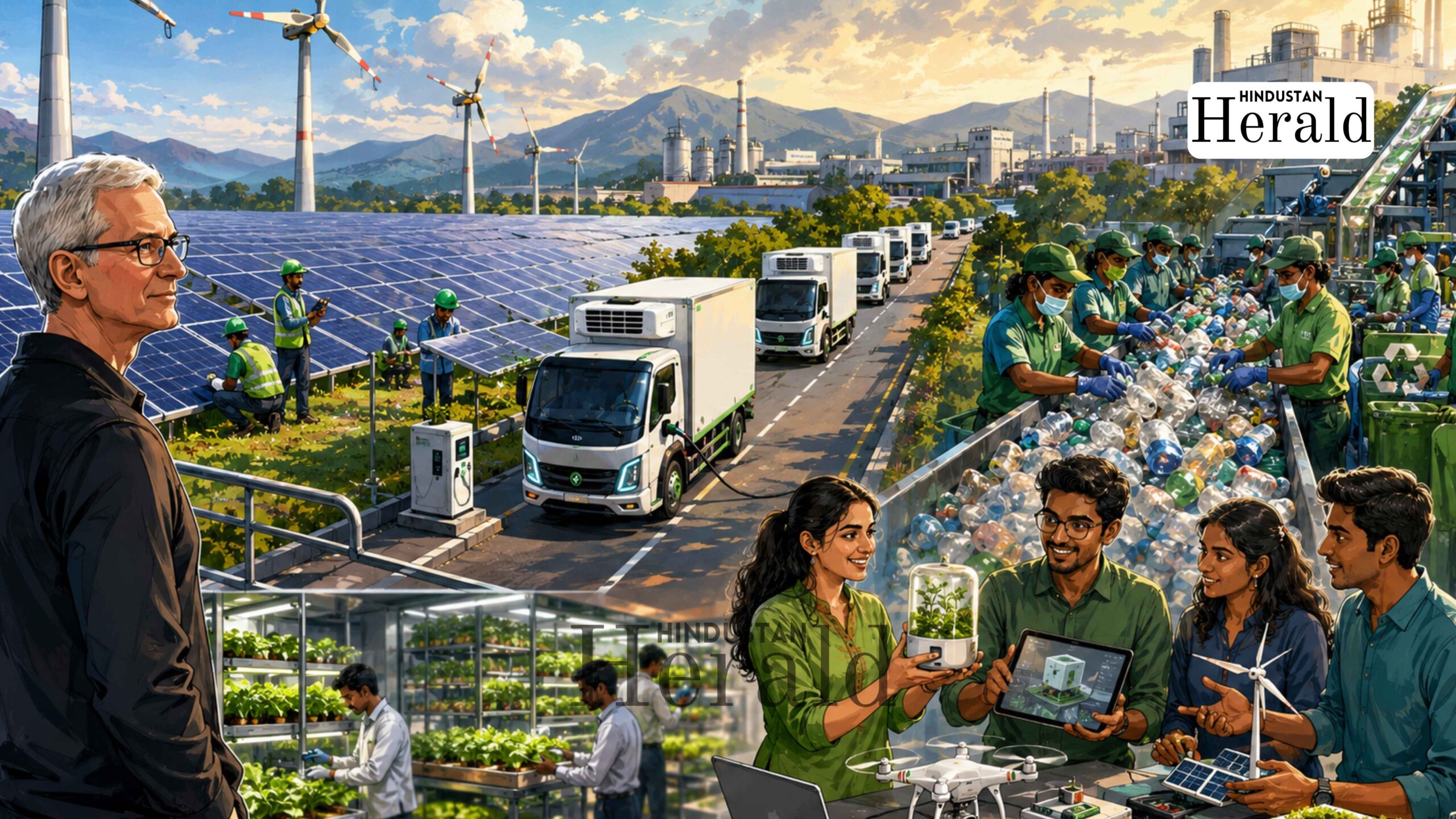
New Delhi, May 7: There are announcements, and then there are announcements that make you sit up a little straighter. Apple’s decision to pump Rs 100 crore into India’s clean energy ecosystem falls closer to the latter not because the number is staggering by global standards, but because of what it represents when you read between the lines.
The company on Wednesday unveiled a three-part sustainability push in India: a major renewable energy partnership with CleanMax, a waste management collaboration with WWF-India, and a grant programme for six green startups through the impact investor Acumen. Taken individually, each initiative is worthwhile. Taken together, they suggest Apple is doing something more strategic than writing a corporate social responsibility cheque.
The CleanMax Deal Is the One to Watch
Start with the energy investment, because that is where the real weight sits. Apple and CleanMax one of the more credible names in India’s renewables space have struck what Business Standard described as a “strategic co-investment transaction” targeting the Commercial and Industrial segment, or C&I as the industry calls it. The Rs 100 crore initial outlay is earmarked for building more than 150 megawatts of fresh renewable energy capacity spread across the country.

To put that figure in terms that actually land: Apple says that volume of clean power is enough to run roughly 1.5 lakh Indian households for a year. And the statement makes clear this is an opening bet, not the final number with the possibility of expansion built into the deal’s language.
The two companies have history here. An earlier CleanMax partnership helped run Apple’s Indian retail stores and offices entirely on solar power, using rooftop installations. That was a relatively contained exercise. This new arrangement has a different ambition. It is primarily about Apple’s supply chain the factories and vendors assembling iPhones in Tamil Nadu, the logistics networks, the tier-two suppliers not just Apple’s own offices. That distinction matters. Supply chains are where most of a technology company’s carbon footprint actually lives, and greening them is considerably harder than slapping solar panels on a flagship store in Mumbai.

Sarah Chandler, Apple’s Vice President of Environment and Supply Chain Innovation, said the company was “proud to expand our efforts to invest in India’s clean energy economy.” That is polished corporate language, naturally. But the structure of the deal co-investment rather than charity, with a commercial partner rather than an NGO suggests this is less about optics and more about Apple locking in a credible path to its 2030 carbon neutrality target.
Goa, Coimbatore, and the Harder Problem of Plastic
The second piece of the announcement is the one that will likely get less attention, which is unfortunate because it is arguably the most grounded in immediate, visible need. Apple is supporting WWF-India to scale up a plastic waste recovery programme that started in Goa, in partnership with Saahas Zero Waste.
The Goa model is not complicated to understand. It builds collection, sorting, and recovery facilities with an emphasis on what the programme calls full material traceability meaning you can actually track where a piece of plastic ends up rather than hoping it doesn’t find its way into a river or a coastline. The communities and informal waste workers are part of the infrastructure, not an afterthought. That is the part that tends to determine whether these programmes last beyond a pilot phase.

With Apple’s support, WWF-India is now carrying this model into Coimbatore. That choice is deliberate. Coimbatore is a serious industrial city textiles, auto components, engineering goods and it sits at the heart of Tamil Nadu’s manufacturing belt, which is also where a significant chunk of Apple’s Indian supply chain is concentrated. You do not need to squint too hard to see the logic. Cleaner waste infrastructure in the region where your products are made is both a reputational and an operational interest.
That said, scaling waste management systems in Indian cities is genuinely difficult work. Local politics, contractor relationships, informal worker livelihoods, municipal capacity all of it complicates even the best-designed programmes. Whether the Goa template translates cleanly to Coimbatore will depend on factors that no press release can guarantee.
Six Startups, and the Ones Worth Knowing
The third strand of Wednesday’s announcement is the most quietly interesting. Through Acumen, the American impact investment organisation with a long track record in India, Apple is extending catalytic grants essentially early-stage funding with training and mentorship attached to six green startups working across waste management, the circular economy, and regenerative agriculture.
Apple did not name all six in the announcement. But three were highlighted, and they are worth describing properly rather than reducing to bullet points.
Saptkrishi is working on a product called Sabjikothi a low-cost storage solution for small and marginal farmers designed to reduce post-harvest losses. This is a real and persistent crisis in Indian agriculture. A farmer who loses 30 percent of her vegetable crop because she cannot afford cold storage is not an abstract policy problem; she is one of hundreds of millions of people whose income leaks away between harvest and market. A cheap, functional fix for that problem has genuine scale potential.
Yotuh Energy is building electric refrigerated trucks for transporting food and medicine. The cold chain in India is inadequate in ways that cost lives vaccines that degrade in transit, produce that rots before it reaches consumers. Electric refrigerated transport addresses both the logistics gap and the emissions problem simultaneously. It is a harder product to build than it sounds, but the market need is not in question.
Mowo Fleet is creating what it describes as livelihood pathways for women to become EV drivers and entrepreneurs. That sits at the intersection of electric mobility and women’s economic inclusion two policy priorities the Indian government talks about constantly and funds inconsistently. A programme that provides women with vehicle access, training, and an income model within the EV ecosystem has obvious social relevance, provided it can achieve financial sustainability.
The grants come bundled with mentorship, technical assistance, and access to Acumen’s networks. Apple had previously worked with Acumen on a clean energy accelerator. Expanding into circular economy and regenerative agriculture is a meaningful step further.
Putting It All in Proportion
It would be easy to be cynical about all of this, and cynicism is not entirely unwarranted. Rs 100 crore sounds like a big number until you remember that India’s clean energy financing gap runs into hundreds of thousands of crore rupees. Apple’s India revenue is enormous and growing. The company’s environmental announcements are also, without question, good for its brand at a moment when regulatory scrutiny of tech giants’ climate claims is rising in Europe and the United States.

Still, there is a difference between a company that gestures at sustainability and one that builds co-investment structures with commercial partners, expands working waste management models into new industrial cities, and backs startups solving problems that actually exist. Apple’s announcement on Wednesday lands closer to the second category than the first.
Apple’s own Environmental Progress Report, released last month, put some numbers on the table. The company says it has cut its global greenhouse gas emissions by more than 60 percent against 2015 levels, even as its revenues grew by around 78 percent over the same period. That combination growth and decarbonisation running in parallel is the argument the company has been making to the world. India, it seems, is now part of that argument in a more substantive way.
For now, the proof will come from what actually gets built. How much of the 150 MW capacity is constructed and when. Which communities in Coimbatore benefit from the waste infrastructure and which get left out. How many of those six startups are still operating and growing in three years.
That is the story to watch. Wednesday’s announcement is the beginning of it, not the end.
Stay ahead with Hindustan Herald — bringing you trusted news, sharp analysis, and stories that matter across Politics, Business, Technology, Sports, Entertainment, Lifestyle, and more.
Connect with us on Facebook, Instagram, X (Twitter), LinkedIn, YouTube, and join our Telegram community @hindustanherald for real-time updates.

Former financial consultant turned journalist, reporting on markets, industry trends, and economic policy.
- Kavita Iyer

- Kavita Iyer
- Kavita Iyer
- Kavita Iyer





Tech writer passionate about AI, startups, and the digital economy, blending industry insights with storytelling.
- Neeraj Kapoor
- Neeraj Kapoor
- Neeraj Kapoor
- Neeraj Kapoor



 Arun Upadhayay
  Neeraj Kapoor and Kavita Iyer