
 By Shelesh Joshi and Kavita Iyer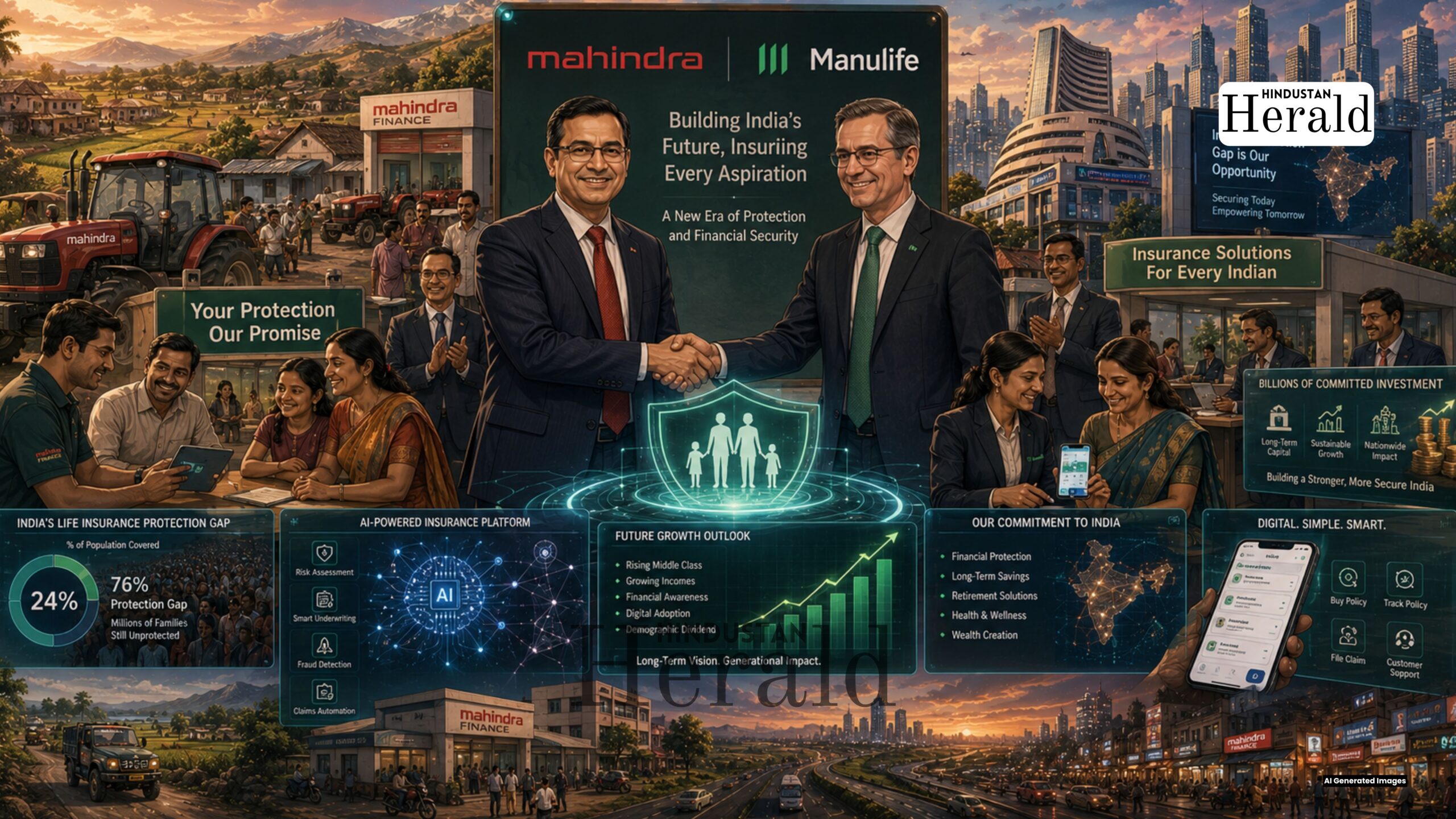
Mumbai, June 1: Seven months after the handshake was announced, the paperwork has finally caught up. Mahindra Manulife Insurance Limited, the life insurance joint venture between Mahindra and Mahindra and the Canadian financial giant Manulife, is now a legally registered company. The Ministry of Corporate Affairs handed over the Certificate of Incorporation on May 29, 2026, and with that, one of the more closely watched financial services partnerships in recent Indian corporate history moved from ambition to reality.
It bears saying upfront: this is not yet a company selling insurance policies. IRDAI’s no objection certificate has been secured, and the incorporation landed just three days ago, but the actual operating license, the one that lets MMIL walk up to a farmer in Vidarbha or a small trader in Meerut and sell them a term plan, has not arrived yet. What exists today is the legal shell. What comes next is the hard part. Still, the shell matters. And the money, the vision, and the people behind it matter quite a bit too.
Quick Summary
- Mahindra Manulife Insurance Limited (MMIL) received its Certificate of Incorporation from the Ministry of Corporate Affairs on May 29, 2026, just three days before this report was filed
- The JV is structured as a strict 50:50 partnership, with both M&M and Manulife Holdings each subscribing to 5,00,000 equity shares at Rs 10 each, contributing Rs 50 lakh apiece
- Each shareholder has individually committed up to Rs 3,600 crore over 10 years, with Rs 1,250 crore expected from each side in the first five years, as per Manulife’s official press release
- Suresh Agarwal, a nearly 30 year veteran of Indian insurance with stints at Kotak Life and Zurich Insurance, stepped into his role as MD and CEO designate of MMIL on May 1, 2026
- India’s life insurance protection gap stands at 87%, with the 26 to 35 age group facing a gap exceeding 90%, representing a potential premium opportunity of USD 106.8 billion by 2030
- The India Life Insurance Market, valued at USD 140.47 billion in 2025, is projected to reach USD 261.53 billion by 2031 at a CAGR of nearly 11%
How This Actually Began
The formal announcement came on November 12, 2025. Mahindra and Mahindra and Manulife said they were going into life insurance together, splitting the venture down the middle at 50:50, and targeting something that no private insurer in India has genuinely managed to crack at scale: the rural and semi urban market.
The Mahindra and Manulife Insurance Joint Venture was not positioned as a tentative market exploration. The vision statement that accompanied the announcement was punchy. The partnership wanted to be the number one life insurance company for rural and semi urban India. Not top five. Not a meaningful player. Number one.
That kind of declaration tends to attract a fair amount of scepticism in a sector dominated by LIC’s six decade head start and private giants like HDFC Life and SBI Life that have spent twenty years building their own distribution muscle. But Mahindra had a specific argument to make about why this time, with this partner, the ambition was not just posturing.
As reported by Business Standard at the time of the November announcement, M&M’s own analyst presentations pointed to a striking data point: rural India represents 65% of the country’s population and 45% of its GDP, yet holds only 2% of India’s life insurance branches. The gap between where people live and where insurance actually reaches them is not a small oversight. It is a structural failure of the sector that has persisted for decades, and Mahindra was betting that its own distribution depth in exactly those geographies could be turned into a lasting competitive advantage.
What made the Mahindra and Manulife Insurance Joint Venture stand out from similar cross border announcements was the pace at which it moved after the ink dried. In the roughly six and a half months between that announcement and today, the two partners have moved with a sense of purpose that is not always common in large cross border corporate ventures. A CEO was named. Regulatory approvals were pursued in sequence. The incorporation was completed within seven months of the original announcement, which, by the standards of Indian financial services licensing, is a respectable pace.
What Has Been Built So Far
As per regulatory filings reported by Business Standard, MMIL has been incorporated with an authorised and paid up capital of Rs 1 crore, divided into 10,00,000 equity shares of Rs 10 each. Both Mahindra and Manulife Holdings have subscribed to 5,00,000 equity shares each, contributing Rs 50 lakh per entity and establishing equal shareholding and control.
The initial paid up capital is deliberately modest for the purposes of incorporation. This is standard practice in India for a newly registered entity that has yet to receive its operating license from IRDAI. The real capital deployment begins once insurance underwriting approvals are in place.
MMIL has been incorporated in Mumbai and will operate as a life insurance company focused on protection and long term savings solutions for Indian consumers.
The Capital Committed: What The Sources Actually Say
For investors tracking Mahindra and Mahindra as a diversified conglomerate, the scale of financial commitment behind MMIL is significant and worth stating precisely as the sources reported it.
According to Manulife’s official press release dated November 12, 2025, and as reported by Business Standard and The Tribune India, the total capital commitment from each shareholder individually is up to US$400 million, approximately Rs 3,600 crore, over the life of the venture. Each partner is separately expected to invest US$140 million, roughly Rs 1,250 crore, in the first five years.
According to M&M’s analyst call presentation cited in The Tribune India, the company expects to invest roughly Rs 250 crore per year for the first five years. That figure represents approximately one third of the annual dividend M&M receives from Mahindra Finance, making it a meaningful but manageable annual outflow for the conglomerate.
The same analyst presentation, as reported by The Tribune India, projected a long term valuation potential of Rs 18,000 to 30,000 crore for MMIL over a decade. M&M has stated publicly that the business will be accretive to Mahindra Finance’s return on assets, which signals the conglomerate’s expectation that MMIL will eventually graduate from a capital consuming startup into a meaningful value generating entity within its broader financial services portfolio.
A Partnership With Prior History
The Mahindra Manulife relationship is not new. The two groups launched Mahindra Manulife Investment Management together back in 2020, building a mutual fund business that has given both sides working experience of each other’s operational cultures, governance standards, and regulatory comfort levels in India.
That prior collaboration matters. It means the transition from planning to execution for MMIL is not happening between strangers navigating each other’s corporate languages for the first time. The leadership at both organisations knows how the other side works, what its priorities are, and how decisions get made under pressure.
That said, life insurance is a fundamentally different business from asset management. The regulatory architecture is more demanding. The capital requirements are deeper. The product development cycles are longer. The agency distribution model is far more labour intensive. The two businesses share a brand name and a partnership structure, but they are built on quite different operational foundations. The learning from the mutual fund JV is valuable context, but MMIL will need to build a great deal from scratch.
The Man They Picked to Run It
Picking the right CEO for a startup insurer backed by two very large organisations with very specific ideas about strategy is not a straightforward task. Mahindra and Manulife made their choice in February 2026, well before the incorporation paperwork was even filed.
Suresh Agarwal was named MD and CEO designate of MMIL, subject to regulatory approvals. He stepped into his new role on May 1, 2026, just weeks before this report was filed, giving the venture a full time leader at precisely the moment the incorporation cleared.

Agarwal brings close to three decades of experience in insurance and financial services to the role. As reported by the Mahindra Group’s official communications, a significant chunk of his career was spent building out Kotak’s life insurance business, which is precisely the kind of ground up franchise building experience that MMIL will need in its formative years. He then led the transformation of Kotak General Insurance into a joint venture with Zurich Insurance, a process that required him to manage the complex interplay of international partnership dynamics and Indian regulatory requirements simultaneously.
Before stepping into the MMIL role, Agarwal served as MD and CEO of Mahindra Insurance Brokers Limited from September 2025. That stint, while brief, gave him working familiarity with Mahindra’s internal structures and distribution ecosystem before he crossed over to lead the new venture.
Anish Shah, MD and Group CEO of Mahindra, said in a statement carried across multiple financial publications that the business would scale with ambition, discipline, and long term value creation at its core. He also described life insurance as a logical extension of Mahindra’s financial services portfolio, pointing to the group’s brand strength and deep rural distribution as the foundation.
Harshal Shah of Manulife, who is also serving as Manulife’s Principal Officer for the JV, stated that India represents one of the most compelling long term opportunities in global life insurance and that the company had been intentional about choosing the right moment and the right partner for its Indian entry.
Why India’s Insurance Gap Is The Real Story Here
It is easy to get lost in the corporate mechanics of MMIL and miss what the venture is actually responding to. India’s life insurance sector carries a problem that no amount of advertising or agent recruitment has yet managed to solve at scale. According to research from the National Insurance Academy, the country has an 87% life insurance protection gap. That means the overwhelming majority of Indian households are either completely uninsured or so underinsured that the coverage they hold would be largely inadequate if the family’s primary earner died tomorrow.
In the 26 to 35 age group, which is where a large portion of India’s new urban and peri urban workforce sits today, the protection gap actually exceeds 90%. These are people with dependants, mortgages, and financial obligations, and with essentially no meaningful insurance net beneath them.
The same study identified a potential premium volume opportunity of USD 106.8 billion by 2030 if this protection gap begins to meaningfully close. That is not a rounding error. That is the size of a substantial insurance market sitting largely uncaptured.
As reported by Mordor Intelligence and the India Brand Equity Foundation, India’s life insurance market was valued at USD 140.47 billion in 2025 and is expected to reach USD 261.53 billion by 2031, rising at a compound annual growth rate of close to 11%. The sector is growing. But growing strongly from a base this low, against a structural protection gap of 87%, means the opportunity ahead is still far larger than what has been captured so far.
India’s life insurance penetration stood at just 3.7% of GDP heading into 2026, well below the global average. That gap in penetration is not merely a statistic. It represents tens of millions of families without adequate financial protection, and tens of millions of potential policyholders for any insurer willing to reach them with the right product at the right price.
The Rural Imperative
For MMIL, the most distinctive aspect of its stated strategy is the explicit prioritisation of rural and semi urban India, a market that large incumbent insurers have historically found difficult and expensive to serve profitably.
As per M&M’s analyst presentations reported by The Tribune India, rural India accounts for 65% of the country’s population and 45% of its GDP. Despite representing such a substantial share of economic life, rural areas hold only 2% of India’s life insurance branches. The access gap is not gradual. It is structural and stark.
Mahindra’s competitive advantage in this context is genuine and difficult to replicate quickly. The Mahindra Group has one of the deepest distribution networks in rural and semi urban India, built across its automotive, farm equipment, and financial services businesses over many decades. The brand carries significant trust in markets where LIC and large private insurers have limited physical presence.
Manulife brings agency led distribution expertise developed across its Asian markets, where semi urban and rural penetration strategies have been refined through operations in countries like Indonesia, Vietnam, and the Philippines.
The combination is designed to be more than the sum of its parts. Mahindra provides the reach and the brand equity. Manulife provides the product architecture, underwriting discipline, and agency training models. Together, MMIL is positioning itself to serve the markets where India’s insurance gap is deepest and most persistent.
The AI Native Architecture Bet
Every public statement from MMIL’s founding partners since November 2025 has included the phrase AI native. That phrase has become slightly worn from overuse across Indian financial services marketing, so it is worth being precise about what it should mean in this specific context.
Building an AI native insurer from scratch means the underwriting models, customer acquisition funnels, claims processing systems, and renewal management infrastructure are all designed with machine learning embedded from the beginning, rather than layered over legacy technology after the fact.
For rural insurance specifically, that architectural choice carries real commercial consequences. Pricing risk accurately for a first generation insurance buyer in a Tier 3 town, someone without a formal credit history, without employment documentation, and with variable seasonal income, is genuinely difficult using conventional actuarial methods. AI driven underwriting models trained on alternative data signals can potentially price that risk more accurately and offer those customers competitive premiums rather than either declining them or charging rates that make the product unaffordable.
As per data from Mordor Intelligence reported earlier this year, mobile apps account for 56.1% of India’s online insurance market today, with the mobile channel projected to grow at a CAGR of 17.1% through to 2031. IRDAI’s push for Bima ASBA, the consent first premium blocking mechanism introduced recently, has further aligned the regulatory environment with digital first product journeys.
The infrastructure for a mobile first, AI driven insurer exists in India in a way it simply did not ten years ago. Whether MMIL builds credibly on that infrastructure, or whether the AI native label turns out to be more marketing than architecture, will only become clear once the company begins actual operations.
The Policy Tailwind Behind The Launch
The regulatory and policy environment in India has shifted in ways that make this a considerably more hospitable moment for a new life insurance entrant than it would have been even two years ago.
In December 2025, Parliament passed the Sabka Bima Sabki Raksha Amendment of Insurance Laws Act, which raised the permissible foreign direct investment limit in insurance companies from 74% to 100%. The Ministry of Finance subsequently notified the Indian Insurance Companies Foreign Investment Amendment Rules, relaxing governance norms for foreign majority insurers.
For a 50:50 JV like MMIL, the immediate practical impact of that FDI change is limited. But it matters for the future. It means that if Manulife and Mahindra ever decide to restructure their ownership, or if MMIL goes through a fundraising round that adjusts one partner’s stake, the regulatory ceiling is no longer a binding constraint the way it once was.
The government’s Insurance for All by 2047 target has also injected real urgency into IRDAI’s licensing posture. The regulator has been issuing new licenses and signalling openness to fresh entrants, clearly intending to expand the competitive field and push insurance coverage deeper into under served markets. MMIL’s IRDAI no objection certificate, secured before the incorporation, reflects that posture directly.
As per the India Brand Equity Foundation, life insurance in India is projected to grow at 10.5% annually between 2025 and 2035, positioning India to become the second largest life insurance market in Asia. Government reform, digital distribution initiatives, and new product approval mechanisms have collectively reinforced that trajectory heading into the second half of this decade.
Manulife’s Broader Asian Ambition
For Manulife, MMIL is one piece of a deliberate long term repositioning in Asia. The Toronto headquartered insurer has been deepening its regional exposure across markets where demographic fundamentals and protection gaps offer the kind of patient, long duration growth opportunity that suits its business model.
As per Manulife’s official disclosures at the end of 2025, the company operated with more than 37,000 employees, over 106,000 agents, and thousands of distribution partners serving over 37 million customers across 25 markets globally. The company’s stock trades as MFC on the Toronto, New York, and Philippine exchanges, and as 945 on the Hong Kong Stock Exchange.
India is among the last major Asian insurance markets where Manulife did not yet have a life insurance presence of scale. The JV with Mahindra changes that, and does so in a way that immediately solves the hardest problem any foreign insurer faces entering India: distribution. Manulife does not need to build a rural network from nothing. It is plugging into one that Mahindra has spent decades constructing.
The partnership also gives Manulife a degree of optionality that a standalone entry would not. With the 100% FDI ceiling now lifted, the ownership structure can be revisited if both parties choose to evolve their arrangement over time.
The Competitive Field MMIL Will Enter
It would be incomplete to discuss MMIL’s opportunity without acknowledging the competitive environment it will face once it begins underwriting policies.
Life Insurance Corporation of India remains the dominant force in the sector by premium volume and branch network, with a brand that carries institutional weight particularly in the rural markets MMIL is targeting. Among private insurers, HDFC Life, SBI Life, ICICI Prudential Life, and Max Life have established significant market positions and distribution depth built over two decades of operations.
MMIL is not walking into an empty room. It is entering one of the more competitive insurance sectors in the world, against incumbents who understand the terrain and are themselves actively investing in digital capabilities and rural reach.
The argument for MMIL is not that competition is weak. It is that the market is large enough, and the under served population deep enough, that a well capitalised and genuinely differentiated entrant can build a meaningful position without needing to take market share from incumbents head on. The 87% protection gap, as documented by the National Insurance Academy, represents hundreds of millions of people whom no insurer is currently reaching effectively. That is the territory MMIL is entering.
For Now, Watch What Comes Next
As of today, June 1, 2026, the incorporation is three days old. The capital commitment is on record. The CEO stepped into his role just weeks ago. The initial regulatory approvals are secured.
What follows is the unglamorous part. Product filing with IRDAI. Agency recruitment and training across Tier 2 and Tier 3 markets. Technology platform construction. Distribution channel agreements. The slow, expensive, often frustrating work of standing up a new institution from scratch inside one of the world’s most demanding regulatory and distribution environments.
The IRDAI operating license will be the next milestone that actually moves markets. When that clearance comes, MMIL transitions from being a corporate entity on paper to being a live insurer in a very crowded field.
Whether the ambition holds up under that pressure, whether the AI native architecture is real or rhetorical, whether the rural distribution bet pays off at meaningful scale none of that is knowable today.
What is knowable is this: two serious organisations have put serious money and serious people behind a serious structural problem. India’s 87% life insurance protection gap has been waiting a long time for someone to go after it with genuine conviction and genuine capital. Mahindra Manulife Insurance Limited has now, formally and legally, raised its hand.
Stay ahead with Hindustan Herald — bringing you trusted news, sharp analysis, and stories that matter across Politics, Business, Technology, Sports, Entertainment, Lifestyle, and more.
Connect with us on Facebook, Instagram, X (Twitter), LinkedIn, YouTube, and join our Telegram community @hindustanherald for real-time updates.

Tracking world politics, global markets, trade movements, policy decisions, and the changing balance of economic power.
- Shelesh Joshi

- Shelesh Joshi
- Shelesh Joshi
- Shelesh Joshi





Former financial consultant turned journalist, reporting on markets, industry trends, and economic policy.
- Kavita Iyer
- Kavita Iyer
- Kavita Iyer
- Kavita Iyer



 Herald Desk