
 By Shelesh Joshi and Kavita Iyer
New Delhi, June 8: Seven countries joined a video call Sunday morning. Agreed on a number. Put out a statement. Hung up. That was the OPEC+ output increase meeting for June. OPEC+ nations’ announcement came on June 7. 188,000 barrels per day more from July. Saudi Arabia, Russia, Iraq, Kuwait, Kazakhstan, Algeria, Oman same faces, same process, same language about stability and cooperation they have been recycling for months now. The communique used the phrase “collective commitment to support oil market stability.” It always does.
What the communique did not mention: the oil these seven nations just voted to produce cannot actually reach anyone right now. The shipping lane it needs to travel through has been a conflict zone since the first week of March. Brent crude has not gone below $108 a barrel in weeks. India’s government oil companies are bleeding Rs 750 crore every day. And the head of the International Energy Agency a body whose entire purpose is calm, measured analysis has described what is happening in global energy markets right now as the greatest threat to energy security in the history of the world. But yes. Seven countries. Video call. Statement issued.
Quick Summary
OPEC+ increases production quotas for July. Seven OPEC+ nations made the announcement on June 7 here is what it means and why it changes very little on the ground.
- Seven OPEC+ nations approved a 188,000 barrels per day output hike for July 2026 second consecutive month at the same figure even as actual production fell from 42.77 million barrels per day in February to just 33.19 million by April.
- Iran declared the Strait of Hormuz closed on March 4, 2026, after U.S.-Israeli airstrikes began. Before the war, around 3,000 vessels used the Strait monthly. That figure is now roughly 5% of what it was.
- The IEA confirmed a cumulative global oil supply loss of 12.8 million barrels per day since February the largest supply disruption in the history of the global oil market.
- India’s oil firms IOCL, HPCL, and BPCL are losing around Rs 750 crore daily even after a Rs 3-per-litre fuel hike in May. Cumulative sector losses may cross Rs 1 trillion by end of May.
- Before the crisis, 45% of India’s crude came through Hormuz. The government has since pushed non-Hormuz sourcing to 70% across 40 supplier countries, up from 27 in 2006-07.
- India’s GDP growth is forecast at 6.7% for 2026-27, down from 7.7% the previous year, as the oil shock works its way through foreign investment, the rupee, and the cost of daily living.
The OPEC+ Output Increase Crisis Began on February 28
That is the date everything changed and nothing in global energy markets has been the same since. U.S. and Israeli forces struck Iran. The supreme leader was killed. Military sites, government buildings, nuclear infrastructure hit in the opening wave. Iran had always said it would respond to something like this in a particular way, and it did exactly that. Missiles toward American bases in the region. Drones over Gulf allied territory.
Then, six days later, the move that made energy traders stop what they were doing and stare at their screens: on March 4, Iranian forces declared the Strait of Hormuz closed. Not “restricted.” Not “under monitoring.” Closed.
The U.K. Maritime Trade Operations Centre reported 10 attacks on commercial ships in the first four days. Five sailors killed across two vessels. War-risk insurance for Persian Gulf shipping was pulled by underwriters almost overnight and once that happens, the ships stop moving whether anyone has officially banned them or not. Insurance is the invisible architecture that holds global shipping together. Remove it and the system stops, fast.
Before any of this, around 3,000 vessels moved through that strait every single month. Not just crude tankers Qatari LNG carriers, Kuwaiti oil exports, LPG ships bound for Indian households and Japanese power stations, container traffic, chemical tankers. The whole catalogue of Gulf commerce, squeezing through a channel that is 21 miles wide at its narrowest point.
By mid-March that traffic was down to roughly 5% of normal. Ships that had already loaded were sitting at anchor in the Gulf of Oman, full of oil, waiting. Saudi Arabia’s refinery at Ras Tanura the biggest in the country took a drone hit and shut down. Qatar declared force majeure on its LNG terminals. The Gulf’s energy export system, assembled over fifty years of infrastructure building, essentially stopped.
What this meant for the OPEC+ output increase picture was immediate and brutal. The IEA’s March Oil Market Report called it what it was: the largest supply disruption in the history of the global oil market. Gulf producers had cut output by at least 10 million barrels per day. Global supply dropped 8 million barrels per day in March alone. Russia pumps about that much in an entire month. It vanished in thirty days.
April brought no relief. Total supply losses since February reached 12.8 million barrels per day. Inventories globally drew down 129 million barrels in March, then another 117 million in April. North Sea Dated crude hit $130 a barrel at the March peak the largest monthly price gain the IEA had ever recorded. Gulf producer output was running 14.4 million barrels per day below pre-war levels.
Analysts who had been in this business since the 1990s were saying quietly that they did not have a comparison for this. Not 1973. Not the Gulf War. Not 2008. Nothing quite fit.
There Was a Ceasefire. It Did Not Do Much.
Pakistan pulled together a pause on April 7-8, five weeks into the fighting. JD Vance flew to Islamabad on April 11-12 and met with Iranian parliamentary leadership. First direct senior engagement between Washington and Tehran since the 1979 revolution. Forty-six years of no real contact, and then a hotel meeting in Pakistan to try to stop a war neither side had quite planned to this scale.

Trump came out of the subsequent days and said most things had been agreed “but the only point that mattered, NUCLEAR, was not” and announced a naval blockade on Iranian ports.
May brought something called “Project Freedom” a White House effort to escort commercial ships through the Strait. Iran struck targets in the UAE the following day. Project Freedom was paused within a week. Pakistan asked for more time. Progress was said to be happening.
Then June arrived and Iran’s state media reported that Tehran had stopped indirect communication with Washington entirely. The reason given was Israeli operations in Lebanon against Hezbollah. The message was simple: no talks until Israel fully withdraws from Lebanese territory and stops all attacks. No talks. No timeline. No Strait.
The House of Commons Library which has been tracking this with unusual care in its public briefings noted that almost no commercial shipping was using the route. Iran had started charging tolls on vessels willing to try the crossing and had publicly said something it had never said before: that its control over the Strait must continue even after any peace agreement.
That is not a negotiating position you walk back easily. That is a country telling the world that one of the oldest international shipping lanes now operates on Tehran’s terms, permanently.
Three months in, the Strait is “open” the way a road is “open” when there is active shooting on it. In a narrow technical sense. Not in any sense that actually moves crude oil to refineries.
Why This Output Hike Will Not Move Oil Prices
This is the part OPEC+ would rather not discuss in its communiques.
The quota increase looks like action. It is designed to look like action. But three specific things make it almost irrelevant to where oil prices go from here, and all three are sitting right there in the data.
First — the barrels cannot leave.
The Strait of Hormuz handles the exit route for most of what the Gulf produces. Iraq’s southern terminals, Kuwait’s export infrastructure, a significant portion of Saudi Arabia’s own output all of it depends on ships being able to move through that 21-mile channel safely. Right now they cannot. Announcing a quota increase when the exit door is jammed does not add a single barrel to global supply. It adds a number to a press release.
Second — actual production has already collapsed, quota or no quota.
OPEC’s own figures show group output was 42.77 million barrels per day in February. By April it had fallen to 33.19 million. That is a drop of nearly 10 million barrels per day in two months. Four consecutive monthly quota increases have added roughly 788,000 barrels per day in announced commitments. None of those barrels have reached the market in the volumes announced. The gap between what the communique says and what the tanker tracking data shows has become almost embarrassing.
Jorge Leon, who spent years as a senior official at OPEC before moving to Rystad Energy, said it plainly: “An OPEC+ production increase means very little while the Strait of Hormuz remains closed.” Former insiders rarely say things that directly about the institution they came from. The fact that he did tells you something about how wide that gap has become.
Third — even the optimistic scenario still shows a supply deficit.
The IEA ran the numbers in its May report under the relatively charitable assumption that Strait traffic would gradually recover from June. Even in that scenario, global oil supply still averages 3.9 million barrels per day below 2025 levels for the full year. Second-quarter refinery throughput is expected to fall 4.5 million barrels per day. Total supply losses from the Middle East since February have crossed 1 billion barrels.
The IEA’s conclusion was unambiguous: “Resuming flows through the Strait of Hormuz remains the single most important variable in easing the pressure on energy supplies, prices, and the global economy.” Not OPEC+ decisions. Not quota numbers. The Strait. Until that changes, Sunday’s announcement is a number on paper. Nothing more.
What Sunday’s Meeting Did Actually Decide
There was one genuine decision in the communique worth paying attention to, tucked well past the headline quota figure. The deadline for countries that have been overproducing their quotas since January 2024 was extended to December 31, 2026, with the Joint Ministerial Monitoring Committee given tighter oversight responsibility. Kazakhstan and Iraq have both been pumping above their agreed ceilings for months Kazakhstan especially, and not for the first time. The extended deadline is the group saying that wartime disruption does not excuse what was happening before the war started.
Fine. Whether real accountability follows is a different matter, and anyone who has watched OPEC over the past decade knows not to bet heavily on that outcome.
India Has Been Unusually Honest About All of This
Which makes sense. When nearly half your crude supply corridor shuts down in a week, pretending everything is under control is not really an option. People notice when their LPG cylinder takes six weeks to arrive instead of two days.
Union Minister Hardeep Singh Puri stood up in the Lok Sabha on March 12 and told Parliament what the situation was. The Press Information Bureau put out the full text. The Strait had been “effectively closed to commercial shipping for the first time in recorded history.” Before the crisis, around 45% of India’s crude transited the Hormuz route. Those were ministry-level numbers, not estimates from a press release.

The response on LPG was fast. The LPG Control Order issued March 8 told every Indian refinery to maximise LPG output and route the entire yield of their C3 and C4 hydrocarbon streams propane, butane, the lot exclusively to IOCL, HPCL, and BPCL for domestic cooking gas. Nothing to commercial users. Nothing to industry. Everything to the household network.
Within five days, LPG production at refineries had gone up 28%. A coordination committee of executive directors from all three OMCs was put together on March 9 to work directly with state civil supply departments and restaurant associations across the country. Because restaurants matter. Street vendors matter. The hospitality sector in India employs millions of people and it runs on LPG.
Puri told Parliament the priority was the 33 crore families depending on domestic LPG connections, specifically the poor. Cylinder booking-to-delivery stayed at 2.5 days, same as before the crisis. Hospitals and schools on uninterrupted priority supply.
On crude, Joint Secretary Sujata Sharma told an inter-ministerial briefing on March 11 on record through News on air that India had secured roughly 70% of its crude from outside the Strait. More than what the Hormuz route would normally have delivered. India was importing from 40 countries. That number was 27 in 2006-07. Twenty years of building supply diversity, one sourcing agreement at a time, and in March 2026 it made a real difference.
On March 14, Special Secretary Rajesh Kumar Sinha from the Ministry of Ports, Shipping and Waterways told a briefing in New Delhi that two Indian ships the Shivalik and the Nanda Devi had crossed the Strait safely, carrying 92,700 metric tonnes of LPG, due at Mundra and Kandla on March 16 and 17. Two ships making it through was news. That tells you something about what March felt like on the ground.
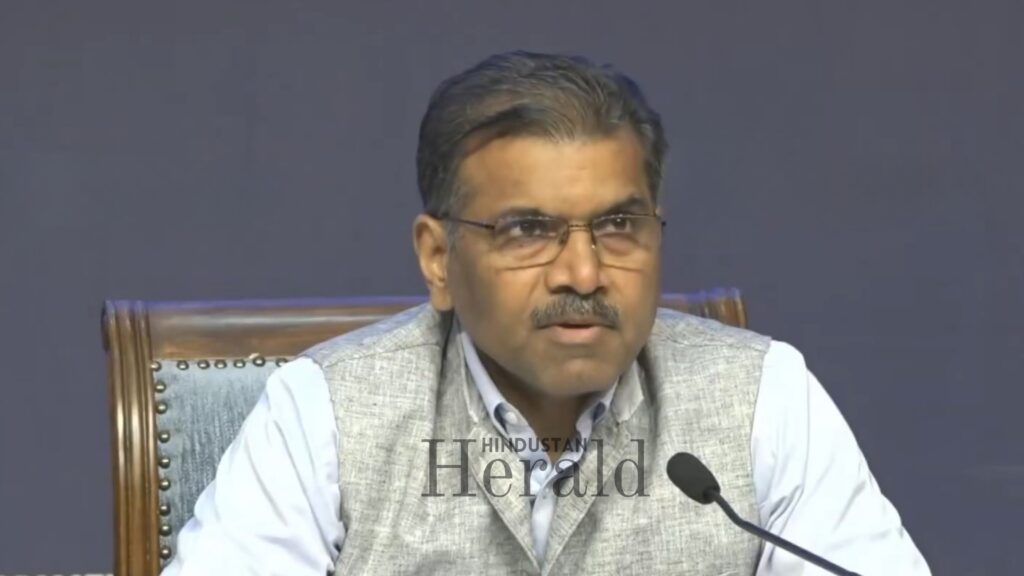
By March 26, the Ministry confirmed all refineries were running at capacity, inventories were adequate, no dry-outs anywhere in the distribution network. The system was holding together. Holding. Not unharmed. Holding.
The Daily Rs 750 Crore Problem That Is Not Going Away
IOCL, HPCL, and BPCL have been absorbing losses since March that would alarm any private company into immediate action. State-run oil companies have more capacity to absorb pain, but not unlimited capacity, and the losses have been extraordinary.
Business Standard reported the Rs 3-per-litre May hike brought daily losses down by about 25% from around Rs 1,000 crore to roughly Rs 750 crore per day. Under-recoveries after that revision still sit at Rs 10 per litre on petrol and Rs 13 per litre on diesel, per Crisil. Cumulative losses since the conflict began could cross Rs 1 trillion by end of May.
Sujata Sharma said at a press briefing, as The Hans India reported, that a direct government subsidy to cover OMC losses is “still not on the table.” So the companies carry it themselves.
In March, Puri had told Parliament losses were Rs 24 per litre on petrol and Rs 30 per litre on diesel. By April, petrol losses had narrowed slightly to Rs 18 after the hike, but diesel had worsened to Rs 35. The overall picture has not improved meaningfully.
On alternative sourcing, India has been resourceful. S&P Global Commodity Insights reported 12.4 million barrels of Venezuelan crude in transit to Sikka in April, with 5.7 million more scheduled for May. The constraint is that Venezuelan heavy grades Merey-16 primarily only work in India’s most complex refineries. You cannot send them to just any plant. Benjamin Tang at Commodities at Sea put it plainly: “For complex refining systems like India, Venezuelan heavy crude is not an incremental supply. It is optionality.” Helpful. Not transformative.
The U.S. gave India a temporary window to access Russian oil stranded near the Gulf. Treasury Secretary Scott Bessent called it a “deliberate short-term measure,” as BBC reported. Breathing room, not a solution.
The Ministry of Petroleum directed GAIL, Indian Oil Corporation, and Engineers India Limited to begin formal feasibility work on an Oman-India undersea gas pipeline a project that had been discussed in theory for years without anyone pushing hard on it. The fact that it is now being treated as an urgent policy directive rather than a future aspiration says something. New Delhi is clearly thinking past this crisis, toward an energy architecture that does not rely on a single chokepoint that a single country can close.
The Numbers That Put All of This Together
GDP growth projected at 6.7% for 2026-27, against 7.7% the year before. More than $20 billion pulled from Indian equities in the first four months of 2026. The Reserve Bank sitting with an inflation problem on one side and a slowing economy on the other, trying to find a policy path that handles both.
The IEA’s April gas report confirmed Qatar’s LNG infrastructure damage delays the global LNG supply expansion by at least two years, with a cumulative supply shortfall of around 120 billion cubic metres through 2030. India gets nearly half its LNG from Qatar. Years of adjustment ahead, not months.
OPEC+ will meet again July 5. They will probably agree to another 188,000 barrels per day increase. Issue a communique about collective commitment to market stability. Set the next meeting for August.
And somewhere in the Gulf of Oman, a tanker captain will still be checking the same weather app he has been checking since March, watching the same anchorage, waiting for clearance that depends on negotiations happening in cities nowhere near his ship. He is not waiting on OPEC. He is waiting on Washington and Tehran. The rest of the world is too.
Stay ahead with Hindustan Herald — bringing you trusted news, sharp analysis, and stories that matter across Politics, Business, Technology, Sports, Entertainment, Lifestyle, and more.
Connect with us on Facebook, Instagram, X (Twitter), LinkedIn, YouTube, and join our Telegram community @hindustanherald for real-time updates.

Tracking world politics, global markets, trade movements, policy decisions, and the changing balance of economic power.
- Shelesh Joshi

- Shelesh Joshi
- Shelesh Joshi
- Shelesh Joshi





Former financial consultant turned journalist, reporting on markets, industry trends, and economic policy.
- Kavita Iyer
- Kavita Iyer
- Kavita Iyer
- Kavita Iyer